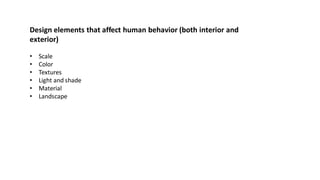
Behavioral architecture considers how the design of built environments can influence human behavior and psychology. It draws from behavioral psychology to understand how elements like scale, color, textures, light, materials, and landscaping affect human moods, attitudes, and perceptions. Studying patterns of human activity within spaces allows designers to identify problems and improve designs. Behavioral architecture aims to create empathetic experiences by deeply understanding users' perspectives, personalities, motivations, and life contexts.