BPEWS
Bedside Pediatric Early Warning
System
1. Age specific record
 Select the correct
age specific
documentation
record
 Five age groups –
five colours
newborn to less
than 3 months
3 months and older
but younger than
fir
s
t b irthday
1 year and younger
than 5th birthday
5th birthday and
younger 12th
birthday
12th birthday and
older
< 3m
3-12m
1-<5yr
5-<12yr
>12yr
2. Time
Ensure to start a
new documentation
record
 24 hour format
 Start time 0700 or
admission time
 Date record
 Patient label
3. Display
Orientate
documentation
record
 Display to show
16 hours (2 pages
are displayed)
 Enhances visual
trending
 Clipboard
designed to
facilitate practice
4. Document
Document all 7
critical indicators
 Graph on the
upper section,
HR, RR, SBP
•
•
•
Document
Record on the
lower section
Oxygen Saturation
Oxygen Therapy
(Oxygen Unit Oxygen
Mode of Delivery)
Capillary Refill
95%
FM
00:30
Heart rate
 Graph on the lines
 Mark with a dot, X or
actual number
 VALUE section if
writing in the value
area top, bottom of
scale, advised to
seek immediate
assistance
172
•
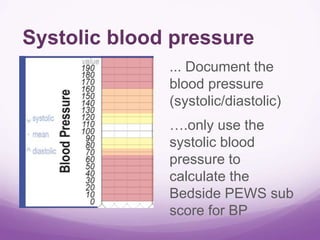
Systolic blood pressure
... Document the
blood pressure
(systolic/diastolic)
….only use the
systolic blood
pressure to
calculate the
Bedside PEWS sub
score for BP
Diastolic blood pressure
 Graphed
 Important to the clinical picture
 Not used to calculate the Bedside PEWS
sub score
Respiratory rate
 One minute
observation
 Visualize the
chest
 Note any apnea
 Graph on the
lines
Saturation
 Chart the actual number
 Chart in the square
88%
Amount of Oxygen
 Chart amount of oxygen (L or %)
 Chart method of delivery (FM, NP, BB, etc)
 Chart even if patient in room air (RA)
60%
FM
Respiratory effort
 Subjective observation by a trained
health care provider
Respiratory effort
 Normal
Normal effort, no apnea, no retraction,
passive expiration
 Mild
Mildly increased respiratory effort,
retractions, nasal flaring
Respiratory effort
 Moderate
Moderately increase work of breathing,
retraction, nasal flaring, tracheal tug
 Severe
Severe respiratory effort, retraction, readily
apparent grunting, nasal flaring, head
bobbing, tracheal tug, accessory muscle use
Capillary Refill Time
 Chart the number in seconds
Elevate the limb to just above the level of
the heart
Depress the digit / chest for five seconds
and release.
Count in seconds for the colour to return
to baseline.
4 sec
5. Sub-Score
Determine the sub
score for each of
the 7 critical
indicators
6. Calculate BPEWS score
Calculate the Bedside PEWS score , add
all the 7 critical indicators sub scores
together
min score 0
max score 26
Document the Bedside PEWS score in the
box corresponding to the time.
Scoring questions
Scoring between two colours
 If you document a critical indicator which
lands between two colours, you would
score on the darker colour
 …To allot the patient the higher
surveillance to ensure reassessment in a
shorter period of time.
Missing Indicator
 If one indicator is not done: If a frontline health
care provider determines not to assess any
single indicator, the previous sub score for the
indicator can be used to calculate the Bedside
PEWS score at that time.
 The previous sub score may only be carried
over once and not greater than 4 hour period.
If any previous sub score are outside of normal
range, it is recommended that the provider
assess the patient to achieve a new sub score
at the current time.
Other assessments
 Lower half of
BPEWS form and
back customized
by each hospital
 Temperature
Pain Score
Bromage
Sedation Score
 Blank space for
additional nursing
care
 Vent Settings
 Doctor Review
 Initials
Pain Score
 Indicate pain score used in dash box beside
pain score
 Use age appropriate pain score for age
group
 Review pain scores used by hospital
 FLACC
 Numbers
 Faces
Bromage Sedation Score
 Modified sedation score for children
 Bromage Score
 0 = awake
 1 = occasionally drowsy, easy to arouse
 2 = frequently drowsy, easy to arouse
 3 = somnolent, difficult to arouse
 S = asleep, easy to arouse, normal
sleep
Doctor review
 Completed by the bedside health care
provider
 Tick box
 Check if any member of the primary team
or medical team has reviewed the patient
at the bedside
 Please document in nursing note
7. Score matched care
recommendations (SMCR)
BPEWS
score
0 - 2
Response Initial Subsequent
0 - 2 Vital Sign
Documentation
4 hours 4 hourly
Charge Nurse
Review
Routine Routine
Review by
Primary Team
Routine Routine
Senior Medical
Review
Routine Routine
Additional
Similar Patients
2 or more 2 or more
Vital sign documentation
 Recommended next vital sign
documentation on the Bedside PEWS
record
 Nurse can do more frequent observation
of patient
Charge nurse review
 Charge nurse is a senior nurse on the
inpatient ward who reviews the patient at
the bedside
 It does not require the charge nurse to do
a physical assessment, but rather to have
a second set of eyes on the patient
Physician review
Review by primary team = any member of
the admitting service
Senior Medical Review = includes
attending physician, fellow and senior
resident. Fellow and senior must review
with the attending by phone if not in house
Monitoring
 Recommended additional monitoring at
the bedside if the patient has an
increasing Bedside PEWS score
 Oxygen saturation
 ECG monitoring
 Close observation
 ICU Consult / RAP Team
Patient Ratio
 Recommended nurse to patient ratio
 Nurse : patient ratio
 Additional similar patients to the current
patient BPEWS score.
 2 or more similar patients with a similar
score of 0–2 .
 2 or less similar patients with a similar score
of 6. Can have other patients with lower
scores.
Initial vs. Subsequent
Initial recommendation
…applied to times when the child has their
first score and/or the next score has
progressed or recovered into a new risk
range
Subsequent recommendation
…applied when a child has remained static
at a certain risk range on repeated
assessment
Care recommendation
These recommendations are to be applied
in addition to clinical judgment of the
frontline health care professional providing
patient care. They are not intended to
replace clinical judgment, but rather
augment it.
“matching care with need”
Let’s Review
Bedside PEWS
 1. Assess: Patient & 7 critical indicators
 2. Document: Bedside PEWS record
 3. Use colour to determine sub-scores
 4. Calculate the Bedside PEWS score
 5. Plan: identification, management plan,
timely referral
Resources for Nursing Staff
 Education desktop slides
 Frequently asked questions
 Technical manual
 Clipboard
 Documentation Record Poster
 Age Specific Poster
 Information Sheet
Bedside PEWS Team
Contacts
 Stollery
Dr. Jon Duff
Dr. Dawn Hartfied
Denise Capito ex 1673
Jackie Ruszkowski ex 3838
 SickKids
Dr. Chris Parshuram- chris@sickkids.ca
Kristen - kristen.middaugh@sickkids.ca
Karen – karen.dyrden-palmer@sickkids.ca
Thank you

Bedside Pediatric Early Warning System

  • 1.
  • 2.
    1. Age specificrecord  Select the correct age specific documentation record  Five age groups – five colours newborn to less than 3 months 3 months and older but younger than fir s t b irthday 1 year and younger than 5th birthday 5th birthday and younger 12th birthday 12th birthday and older < 3m 3-12m 1-<5yr 5-<12yr >12yr
  • 3.
    2. Time Ensure tostart a new documentation record  24 hour format  Start time 0700 or admission time  Date record  Patient label
  • 4.
    3. Display Orientate documentation record  Displayto show 16 hours (2 pages are displayed)  Enhances visual trending  Clipboard designed to facilitate practice
  • 5.
    4. Document Document all7 critical indicators  Graph on the upper section, HR, RR, SBP • • •
  • 6.
    Document Record on the lowersection Oxygen Saturation Oxygen Therapy (Oxygen Unit Oxygen Mode of Delivery) Capillary Refill 95% FM 00:30
  • 7.
    Heart rate  Graphon the lines  Mark with a dot, X or actual number  VALUE section if writing in the value area top, bottom of scale, advised to seek immediate assistance 172 •
  • 8.
    Systolic blood pressure ...Document the blood pressure (systolic/diastolic) ….only use the systolic blood pressure to calculate the Bedside PEWS sub score for BP
  • 9.
    Diastolic blood pressure Graphed  Important to the clinical picture  Not used to calculate the Bedside PEWS sub score
  • 10.
    Respiratory rate  Oneminute observation  Visualize the chest  Note any apnea  Graph on the lines
  • 11.
    Saturation  Chart theactual number  Chart in the square 88%
  • 12.
    Amount of Oxygen Chart amount of oxygen (L or %)  Chart method of delivery (FM, NP, BB, etc)  Chart even if patient in room air (RA) 60% FM
  • 13.
    Respiratory effort  Subjectiveobservation by a trained health care provider
  • 14.
    Respiratory effort  Normal Normaleffort, no apnea, no retraction, passive expiration  Mild Mildly increased respiratory effort, retractions, nasal flaring
  • 15.
    Respiratory effort  Moderate Moderatelyincrease work of breathing, retraction, nasal flaring, tracheal tug  Severe Severe respiratory effort, retraction, readily apparent grunting, nasal flaring, head bobbing, tracheal tug, accessory muscle use
  • 16.
    Capillary Refill Time Chart the number in seconds Elevate the limb to just above the level of the heart Depress the digit / chest for five seconds and release. Count in seconds for the colour to return to baseline. 4 sec
  • 17.
    5. Sub-Score Determine thesub score for each of the 7 critical indicators
  • 18.
    6. Calculate BPEWSscore Calculate the Bedside PEWS score , add all the 7 critical indicators sub scores together min score 0 max score 26 Document the Bedside PEWS score in the box corresponding to the time.
  • 19.
    Scoring questions Scoring betweentwo colours  If you document a critical indicator which lands between two colours, you would score on the darker colour  …To allot the patient the higher surveillance to ensure reassessment in a shorter period of time.
  • 20.
    Missing Indicator  Ifone indicator is not done: If a frontline health care provider determines not to assess any single indicator, the previous sub score for the indicator can be used to calculate the Bedside PEWS score at that time.  The previous sub score may only be carried over once and not greater than 4 hour period. If any previous sub score are outside of normal range, it is recommended that the provider assess the patient to achieve a new sub score at the current time.
  • 21.
    Other assessments  Lowerhalf of BPEWS form and back customized by each hospital  Temperature Pain Score Bromage Sedation Score  Blank space for additional nursing care  Vent Settings  Doctor Review  Initials
  • 22.
    Pain Score  Indicatepain score used in dash box beside pain score  Use age appropriate pain score for age group  Review pain scores used by hospital  FLACC  Numbers  Faces
  • 23.
    Bromage Sedation Score Modified sedation score for children  Bromage Score  0 = awake  1 = occasionally drowsy, easy to arouse  2 = frequently drowsy, easy to arouse  3 = somnolent, difficult to arouse  S = asleep, easy to arouse, normal sleep
  • 24.
    Doctor review  Completedby the bedside health care provider  Tick box  Check if any member of the primary team or medical team has reviewed the patient at the bedside  Please document in nursing note
  • 25.
    7. Score matchedcare recommendations (SMCR) BPEWS score 0 - 2 Response Initial Subsequent 0 - 2 Vital Sign Documentation 4 hours 4 hourly Charge Nurse Review Routine Routine Review by Primary Team Routine Routine Senior Medical Review Routine Routine Additional Similar Patients 2 or more 2 or more
  • 26.
    Vital sign documentation Recommended next vital sign documentation on the Bedside PEWS record  Nurse can do more frequent observation of patient
  • 27.
    Charge nurse review Charge nurse is a senior nurse on the inpatient ward who reviews the patient at the bedside  It does not require the charge nurse to do a physical assessment, but rather to have a second set of eyes on the patient
  • 28.
    Physician review Review byprimary team = any member of the admitting service Senior Medical Review = includes attending physician, fellow and senior resident. Fellow and senior must review with the attending by phone if not in house
  • 29.
    Monitoring  Recommended additionalmonitoring at the bedside if the patient has an increasing Bedside PEWS score  Oxygen saturation  ECG monitoring  Close observation  ICU Consult / RAP Team
  • 30.
    Patient Ratio  Recommendednurse to patient ratio  Nurse : patient ratio  Additional similar patients to the current patient BPEWS score.  2 or more similar patients with a similar score of 0–2 .  2 or less similar patients with a similar score of 6. Can have other patients with lower scores.
  • 31.
    Initial vs. Subsequent Initialrecommendation …applied to times when the child has their first score and/or the next score has progressed or recovered into a new risk range Subsequent recommendation …applied when a child has remained static at a certain risk range on repeated assessment
  • 32.
    Care recommendation These recommendationsare to be applied in addition to clinical judgment of the frontline health care professional providing patient care. They are not intended to replace clinical judgment, but rather augment it. “matching care with need”
  • 33.
  • 34.
    Bedside PEWS  1.Assess: Patient & 7 critical indicators  2. Document: Bedside PEWS record  3. Use colour to determine sub-scores  4. Calculate the Bedside PEWS score  5. Plan: identification, management plan, timely referral
  • 35.
    Resources for NursingStaff  Education desktop slides  Frequently asked questions  Technical manual  Clipboard  Documentation Record Poster  Age Specific Poster  Information Sheet
  • 36.
    Bedside PEWS Team Contacts Stollery Dr. Jon Duff Dr. Dawn Hartfied Denise Capito ex 1673 Jackie Ruszkowski ex 3838  SickKids Dr. Chris Parshuram- chris@sickkids.ca Kristen - kristen.middaugh@sickkids.ca Karen – karen.dyrden-palmer@sickkids.ca
  • 37.

Editor's Notes

  • #3 Review each age group < 3 months = newborn to less than 3 months 3 – 12 months = 3 months and older, but younger than first birthday 1 - < 5 y = 1 year and younger than 5th birthday 5 - < 12 y = 5th birthday and younger than 12th birthday > = 12 y = 12th birthday and older
  • #5 Clipboard designed to enable or encourage this practice for the frontline clinician to open the record to look at the patient over 16 hours, 2 page time period. Visual trending enhances also able to review the slope of change, especially when values are connected with lines.
  • #6 Graph the number on the line, in the box, or vertical, or with a dot or X. Connect the values between time periods.
  • #7 Record (write out) actual numbers on the lower section.
  • #8 Note if any number in value section for HR, RR or BP please seek immediate assistance. On the score matched recommendations it states: Assess the need for CPR/Code Blue or Consult RAP team
  • #9 Reminder right size bp cuff = accurate blood pressure Systolic blood pressure only used when determining the sub score for blood pressure.
  • #10 Diastolic blood pressure is clinically important but did not change or improve the BPEWS score sensitivity to predict evolving critical illness. Therefore it was not included in the BPEWS score.
  • #12 Chart the actual number for saturation.
  • #13 Space may appear to be small. If required to use more space, write vertically to include most of the information in the corresponding box. Remind staff that even if pt is on RA,it is not sufficent to tick off the box. It needs to be written as RA in the appropriate (white) box.
  • #15 Best clinical practice; to expose the chest wall to view work of breathing.
  • #16 Note that with moderate respiratory effort there is the addition of tracheal tug With severe respiratory effort there is the addition of grunting, head bobbing and accessory muscle use.
  • #18 Example: if your HR is charted in a white zone, the sub score would be zero. But if it landed in a purple zone the sub score would be a four. The same goes for the rest of the indicators.
  • #19 Children with higher baseline scores, i.e. cardiac population These children may demonstrate a higher baseline score, but realistically they still have earned these points and do have a higher vulnerability and less reserve to compensate with evolving critical illness. Introducing the slightest infection, decrease in cardiac function will note changes and subtle changes in these children. Changes to their baseline score will indicate closer surveillance and review.
  • #21 E.g.. At 1600 the patient is sleeping, therefore you decide not to take a blood pressure. You can use the recorded SBP from 1200 to calculate your BPEWS score. But at 2000 you can not use the blood pressure value from 1200 to calculate the BPEWS score, and in fact will have to do a blood pressure. Exception made for pts who are pallative, who may not have vitals taken or may be missing vital signs. It is acceptable that their BPEWS score would not necessarily be correct. Exception would also be made for patients on a VAD (eg. Heartmate) for whom, if no SBP are recorded you would give a score of 4 for that critical indicator given their health status and vulnerability. See next page for solutions re. Berlin Heart, Heart Mate, Palliative Care etc.
  • #22 Clipboard has many of the tools: Bromage Sedation Score, Pain scores
  • #23 Please indicate on the record which pain score used on left and right column. Clipboard has pain tool incorporated on it.
  • #25 Doctor review is placed to help monitor and keep track of physician presence at the bedside.
  • #26 Premise behind SMCR are that there should be increasing surveillance for children with higher scores. We will go into more detail about the different categories of recommendations…
  • #31 Similar = patients around the same score range and not higher. The nurse can have 2 patients with a BPEWS score 4 and 1 patients with a BPEWS score 0 Recommendations for ratio. If there are any questions at this slide regarding the feasibility of changing assignments based on the SMCR can bring up the point that these are recommendations and are not orders. Discussion would need to happen with the charge nurse etc in regards to staffing and help. It may initiate a plan being made to ensure the nurse and child gets the support they need based on clinical judgment.
  • #32 INITIAL SMCR: please indicate to staff where this is located on the documentation record. The 2 times that staff would refer to the initial recommendations would be 1. Pt has just been admitted. 2. If their score has moved into a new category, either up or down. SUBSEQUENT SMCR: Please indicate to staff where this is located on the documentation record. Used if a child stays within the same category
  • #33 Recommendation are to be applied in addition to judgment. If the recommendations are not followed, because of feasibility, clinical judgment etc. Remember to document in your nursing narrative notes. For example, charge nurse aware. Senior resident notified. Patient stable, on continuous ECG monitoring. This also demonstrates that the SMCR were considered, even if they were not implemented. If it isn’t charted, it didn't happen!
  • #37 Please use Kristen if you have any questions about BPEWS at any time, day, night, weekend.