Success of Wal-Mart:
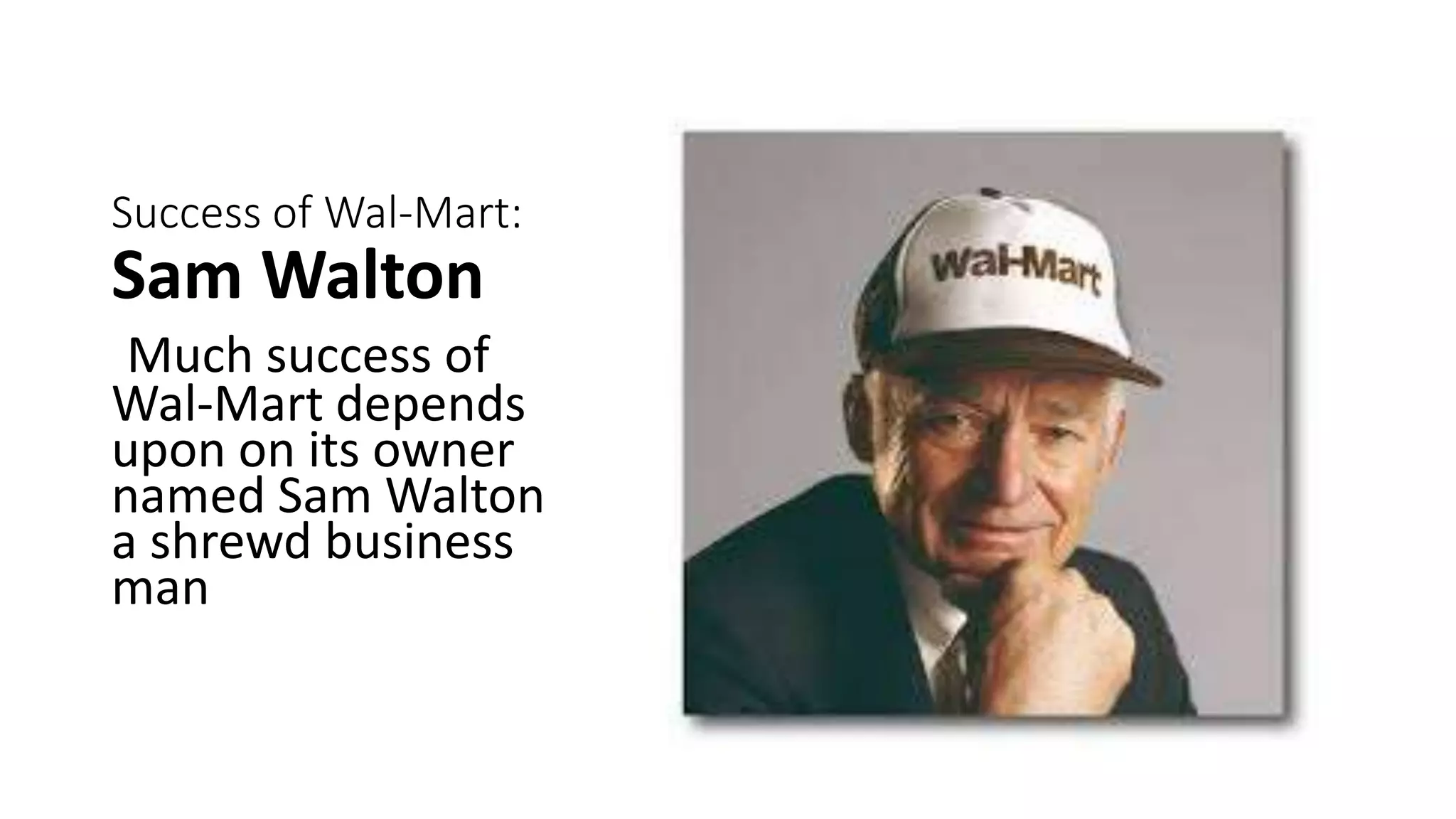
Sam Walton
Much success of
Wal-Mart depends
upon on its owner
named Sam Walton
a shrewd business
man
Success of Wal-Mart:
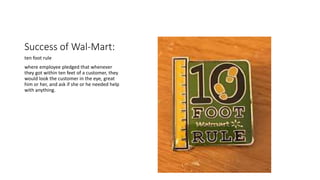
ten foot rule
where employee pledged that whenever
they got within ten feet of a customer, they
would look the customer in the eye, great
him or her, and ask if she or he needed help
with anything.
Success of Wal-Mart:
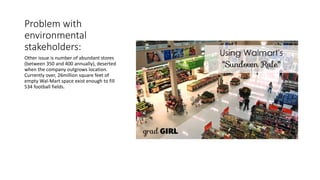
sundown rule
was why put off until tomorrow what you
can do today?
Success of Wal-Mart:
largest glossary chain
In 2002Wal-mart officially became the largest
glossary chain toping the fortune 500, his
position seven between 2008 and 2009.
Lower price:
Wal-Mart world largest retailer. Wal-Mart
lower price create a some positive or some
negative impact on society.
Lower price:
positive impacts
•Wal-Mart reportedly saves
consumer over $287 billion
annually.
•Wal-Mart boosts average
price 14% lower than these
charged by its competitors.
•The retailer boosted $419
billion sales during last
financial year.
Lower price:
negative impacts
•It affects on downtown or main streets
areas, because Wal-Mart store require large
place of land.
•They taking retail dollars from one store to
another, they are not creating new retail
gain, just redirecting profit.
Wal-Mart relation with
its stakeholders:
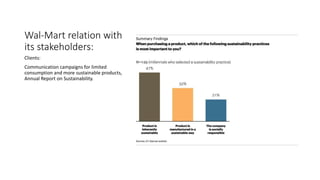
Clients:
Communication campaigns for limited
consumption and more sustainable products,
Annual Report on Sustainability.
Wal-Mart relation with
its stakeholders:
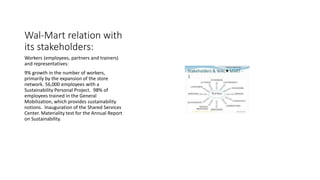
Workers (employees, partners and trainers)
and representatives:
9% growth in the number of workers,
primarily by the expansion of the store
network. 56,000 employees with a
Sustainability Personal Project. 98% of
employees trained in the General
Mobilization, which provides sustainability
notions. Inauguration of the Shared Services
Center. Materiality test for the Annual Report
on Sustainability.
Wal-Mart relation with
its stakeholders:
Government and Association:
Preparation and launch of the Policy of
Responsible Purchase of Fisheries.
Presentation of the results of the survey
Sustainability: Here and Now. Materiality test
for the Annual Report on Sustainability.
Wal-Mart relation with
its stakeholders:
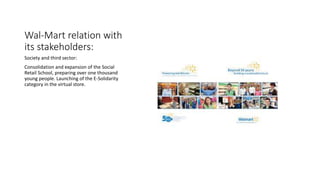
Society and third sector:
Consolidation and expansion of the Social
Retail School, preparing over one thousand
young people. Launching of the E-Solidarity
category in the virtual store.
Wal-Mart relation with
its stakeholders:
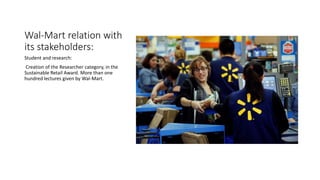
Student and research:
Creation of the Researcher category, in the
Sustainable Retail Award. More than one
hundred lectures given by Wal-Mart.
Relationship between
supplier stakeholders:
Global responsible sourcing initiative
• “Manufacture” facilities much
certify complex with laws and regulation
where they operate as well as rigorous social
and environmental standards, set by
government agencies, beginning with
suppliers in China in January 2009 and for all
other Wal-Mart suppliers in 2011.
• “By 2012 suppliers much work
with Wal-Mart to make a 20% improvement
into the energy efficiency inside the top 200
factories in China that Wal-Mart directly
sources from”
Global responsible
sourcing initiative
• “Suppliers much create a plane to
eliminate, by 2012, defective merchandise
researching the Wal-Mart supply China”
• “And by 2012, all suppliers Wal-
Mart buys from much sources by 25%
production from factories that receive the
highest rating on environmental and social
practices”
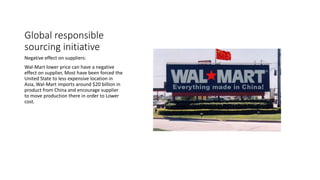
Global responsible
sourcing initiative
Negative effect on suppliers:
Wal-Mart lower price can have a negative
effect on supplier, Most have been forced the
United State to less expensive location in
Asia, Wal-Mart imports around $20 billion in
product from China and encourage supplier
to move production there in order to Lower
cost.
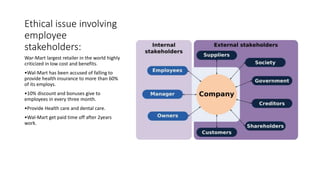
Ethical issue involving
employee
stakeholders:
War-Mart largest retailer in the world highly
criticized in low cost and benefits.
•Wal-Mart has been accused of falling to
provide health insurance to more than 60%
of its employs.
•10% discount and bonuses give to
employees in every three month.
•Provide Health care and dental care.
•Wal-Mart get paid time off after 2years
work.
Wal-Mart stance on
union:
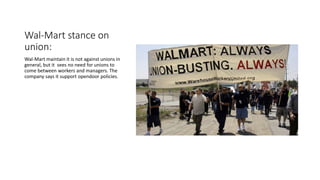
Wal-Mart maintain it is not against unions in
general, but it sees no need for unions to
come between workers and managers. The
company says it support opendoor policies.
Wal-Mart stance on
union:
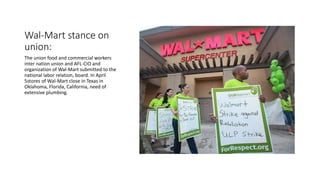
The union food and commercial workers
inter nation union and AFL-CIO and
organization of Wal-Mart submitted to the
national labor relation, board. In April
5stores of Wal-Mart close in Texas in
Oklahoma, Florida, California, need of
extensive plumbing.
Workplace
discrimination:
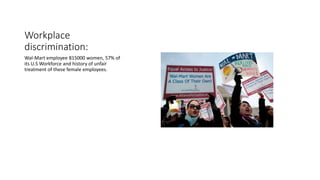
Wal-Mart employee 815000 women, 57% of
its U.S Workforce and history of unfair
treatment of these female employees.
Illegal Immigrants:
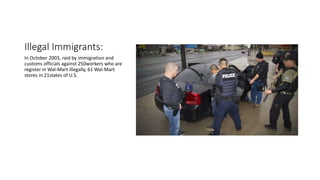
In October 2003, raid by immigration and
customs officials against 250workers who are
register in Wal-Mart illegally, 61 Wal-Mart
stores in 21states of U.S.
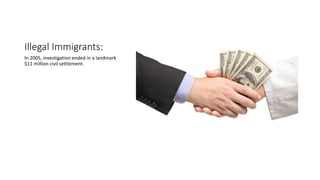
Illegal Immigrants:
In 2005, investigation ended in a landmark
$11 million civil settlement.
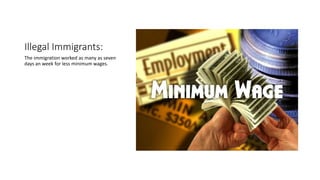
Illegal Immigrants:
The immigration worked as many as seven
days an week for less minimum wages.
Sweat shop workers:
In 2003, it hired an anti sweatshop expert to
expand its global inspection program.
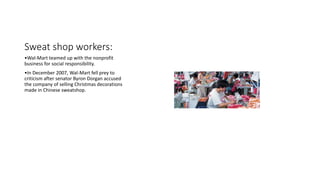
Sweat shop workers:
•Wal-Mart teamed up with the nonprofit
business for social responsibility.
•In December 2007, Wal-Mart fell prey to
criticism after senator Byron Dorgan accused
the company of selling Christmas decorations
made in Chinese sweatshop.
Sweat shop workers
• All these information provided by
National Labor Committee that workers as
young as 12were working 15hours days for as
little as 26 cents an hour.
Ethical leadership
issues:
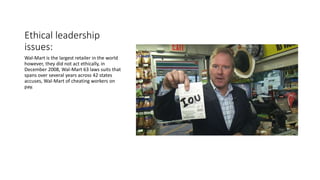
Wal-Mart is the largest retailer in the world
however, they did not act ethically, in
December 2008, Wal-Mart 63 laws suits that
spans over several years across 42 states
accuses, Wal-Mart of cheating workers on
pay.
Ethical leadership
issues:
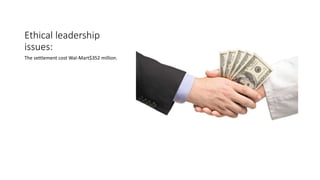
The settlement cost Wal-Mart$352 million.
Ethical leadership
issues:
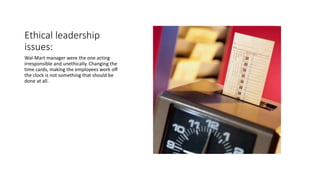
Wal-Mart manager were the one acting
irresponsible and unethically. Changing the
time cards, making the employees work off
the clock is not something that should be
done at all.
Ethical leadership
issues:
The managers were not thinking about the
now and may be not what the company
wanted them to do but they did a selfish act
and it hurt the company.
Problem with
environmental
stakeholders:
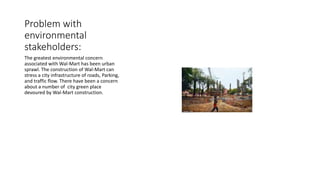
The greatest environmental concern
associated with Wal-Mart has been urban
sprawl. The construction of Wal-Mart can
stress a city infrastructure of roads, Parking,
and traffic flow. There have been a concern
about a number of city green place
devoured by Wal-Mart construction.
Problem with
environmental
stakeholders:
Other issue is number of abundant stores
(between 350 and 400 annually), deserted
when the company outgrows location.
Currently over, 26million square feet of
empty Wal-Mart space exist enough to fill
534 football fields.
Sustainability 360:
Wal-Mart has attempted to address its
environmental stakeholder by becoming a
“greener” company.
Sustainability 360:
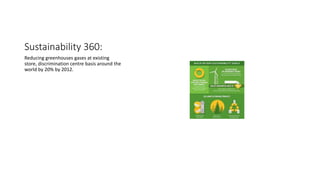
Reducing greenhouses gases at existing
store, discrimination centre basis around the
world by 20% by 2012.
Sustainability 360:
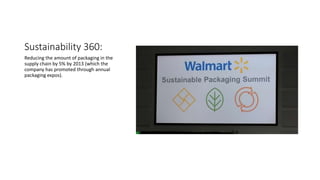
Reducing the amount of packaging in the
supply chain by 5% by 2013 (which the
company has promoted through annual
packaging expos).
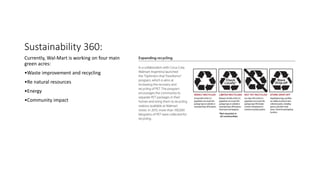
Sustainability 360:
Currently, Wal-Mart is working on four main
green acres:
•Waste improvement and recycling
•Re natural resources
•Energy
•Community impact
Sustainability
leadership:
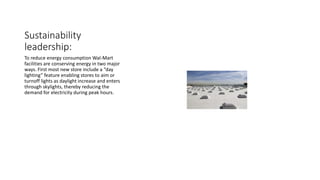
To reduce energy consumption Wal-Mart
facilities are conserving energy in two major
ways. First most new store include a “day
lighting” feature enabling stores to aim or
turnoff lights as daylight increase and enters
through skylights, thereby reducing the
demand for electricity during peak hours.
Sustainability
leadership:
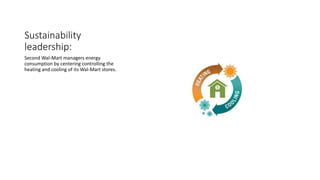
Second Wal-Mart managers energy
consumption by centering controlling the
heating and cooling of its Wal-Mart stores.
Sustainability
leadership:
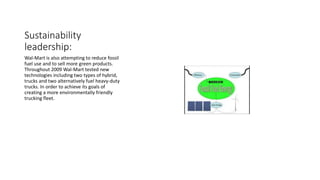
Wal-Mart is also attempting to reduce fossil
fuel use and to sell more green products.
Throughout 2009 Wal-Mart tested new
technologies including two types of hybrid,
trucks and two alternatively fuel heavy-duty
trucks. In order to achieve its goals of
creating a more environmentally friendly
trucking fleet.
Saving: Is Going green
cost Effective:
Wal-Mart green initiative have secured in the
Goodwill of many environmentally conscious
consumer, but does doing green save the
company costs in other ways? Wal-Mart
initiative has racked up the following savings:
•$25million per year in saving from auxiliary
power systems on trucks to run the air
conditioning when trucks are stopped.
Saving: Is Going green
cost Effective:
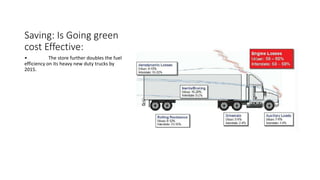
• The store further doubles the fuel
efficiency on its heavy new duty trucks by
2015.
Saving: Is Going green
cost Effective:
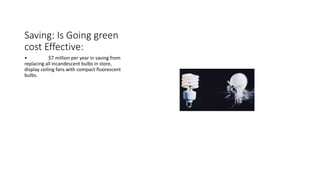
• $7 million per year in saving from
replacing all incandescent bulbs in store,
display ceiling fans with compact fluorescent
bulbs.

Success of wal mart

  • 1.
    Success of Wal-Mart: SamWalton Much success of Wal-Mart depends upon on its owner named Sam Walton a shrewd business man
  • 2.
    Success of Wal-Mart: tenfoot rule where employee pledged that whenever they got within ten feet of a customer, they would look the customer in the eye, great him or her, and ask if she or he needed help with anything.
  • 3.
    Success of Wal-Mart: sundownrule was why put off until tomorrow what you can do today?
  • 4.
    Success of Wal-Mart: largestglossary chain In 2002Wal-mart officially became the largest glossary chain toping the fortune 500, his position seven between 2008 and 2009.
  • 5.
    Lower price: Wal-Mart worldlargest retailer. Wal-Mart lower price create a some positive or some negative impact on society.
  • 6.
    Lower price: positive impacts •Wal-Martreportedly saves consumer over $287 billion annually. •Wal-Mart boosts average price 14% lower than these charged by its competitors. •The retailer boosted $419 billion sales during last financial year.
  • 7.
    Lower price: negative impacts •Itaffects on downtown or main streets areas, because Wal-Mart store require large place of land. •They taking retail dollars from one store to another, they are not creating new retail gain, just redirecting profit.
  • 8.
    Wal-Mart relation with itsstakeholders: Clients: Communication campaigns for limited consumption and more sustainable products, Annual Report on Sustainability.
  • 9.
    Wal-Mart relation with itsstakeholders: Workers (employees, partners and trainers) and representatives: 9% growth in the number of workers, primarily by the expansion of the store network. 56,000 employees with a Sustainability Personal Project. 98% of employees trained in the General Mobilization, which provides sustainability notions. Inauguration of the Shared Services Center. Materiality test for the Annual Report on Sustainability.
  • 10.
    Wal-Mart relation with itsstakeholders: Government and Association: Preparation and launch of the Policy of Responsible Purchase of Fisheries. Presentation of the results of the survey Sustainability: Here and Now. Materiality test for the Annual Report on Sustainability.
  • 11.
    Wal-Mart relation with itsstakeholders: Society and third sector: Consolidation and expansion of the Social Retail School, preparing over one thousand young people. Launching of the E-Solidarity category in the virtual store.
  • 12.
    Wal-Mart relation with itsstakeholders: Student and research: Creation of the Researcher category, in the Sustainable Retail Award. More than one hundred lectures given by Wal-Mart.
  • 13.
    Relationship between supplier stakeholders: Globalresponsible sourcing initiative • “Manufacture” facilities much certify complex with laws and regulation where they operate as well as rigorous social and environmental standards, set by government agencies, beginning with suppliers in China in January 2009 and for all other Wal-Mart suppliers in 2011. • “By 2012 suppliers much work with Wal-Mart to make a 20% improvement into the energy efficiency inside the top 200 factories in China that Wal-Mart directly sources from”
  • 14.
    Global responsible sourcing initiative •“Suppliers much create a plane to eliminate, by 2012, defective merchandise researching the Wal-Mart supply China” • “And by 2012, all suppliers Wal- Mart buys from much sources by 25% production from factories that receive the highest rating on environmental and social practices”
  • 15.
    Global responsible sourcing initiative Negativeeffect on suppliers: Wal-Mart lower price can have a negative effect on supplier, Most have been forced the United State to less expensive location in Asia, Wal-Mart imports around $20 billion in product from China and encourage supplier to move production there in order to Lower cost.
  • 16.
    Ethical issue involving employee stakeholders: War-Martlargest retailer in the world highly criticized in low cost and benefits. •Wal-Mart has been accused of falling to provide health insurance to more than 60% of its employs. •10% discount and bonuses give to employees in every three month. •Provide Health care and dental care. •Wal-Mart get paid time off after 2years work.
  • 17.
    Wal-Mart stance on union: Wal-Martmaintain it is not against unions in general, but it sees no need for unions to come between workers and managers. The company says it support opendoor policies.
  • 18.
    Wal-Mart stance on union: Theunion food and commercial workers inter nation union and AFL-CIO and organization of Wal-Mart submitted to the national labor relation, board. In April 5stores of Wal-Mart close in Texas in Oklahoma, Florida, California, need of extensive plumbing.
  • 19.
    Workplace discrimination: Wal-Mart employee 815000women, 57% of its U.S Workforce and history of unfair treatment of these female employees.
  • 20.
    Illegal Immigrants: In October2003, raid by immigration and customs officials against 250workers who are register in Wal-Mart illegally, 61 Wal-Mart stores in 21states of U.S.
  • 21.
    Illegal Immigrants: In 2005,investigation ended in a landmark $11 million civil settlement.
  • 22.
    Illegal Immigrants: The immigrationworked as many as seven days an week for less minimum wages.
  • 23.
    Sweat shop workers: In2003, it hired an anti sweatshop expert to expand its global inspection program.
  • 24.
    Sweat shop workers: •Wal-Martteamed up with the nonprofit business for social responsibility. •In December 2007, Wal-Mart fell prey to criticism after senator Byron Dorgan accused the company of selling Christmas decorations made in Chinese sweatshop.
  • 25.
    Sweat shop workers •All these information provided by National Labor Committee that workers as young as 12were working 15hours days for as little as 26 cents an hour.
  • 26.
    Ethical leadership issues: Wal-Mart isthe largest retailer in the world however, they did not act ethically, in December 2008, Wal-Mart 63 laws suits that spans over several years across 42 states accuses, Wal-Mart of cheating workers on pay.
  • 27.
  • 28.
    Ethical leadership issues: Wal-Mart managerwere the one acting irresponsible and unethically. Changing the time cards, making the employees work off the clock is not something that should be done at all.
  • 29.
    Ethical leadership issues: The managerswere not thinking about the now and may be not what the company wanted them to do but they did a selfish act and it hurt the company.
  • 30.
    Problem with environmental stakeholders: The greatestenvironmental concern associated with Wal-Mart has been urban sprawl. The construction of Wal-Mart can stress a city infrastructure of roads, Parking, and traffic flow. There have been a concern about a number of city green place devoured by Wal-Mart construction.
  • 31.
    Problem with environmental stakeholders: Other issueis number of abundant stores (between 350 and 400 annually), deserted when the company outgrows location. Currently over, 26million square feet of empty Wal-Mart space exist enough to fill 534 football fields.
  • 32.
    Sustainability 360: Wal-Mart hasattempted to address its environmental stakeholder by becoming a “greener” company.
  • 33.
    Sustainability 360: Reducing greenhousesgases at existing store, discrimination centre basis around the world by 20% by 2012.
  • 34.
    Sustainability 360: Reducing theamount of packaging in the supply chain by 5% by 2013 (which the company has promoted through annual packaging expos).
  • 35.
    Sustainability 360: Currently, Wal-Martis working on four main green acres: •Waste improvement and recycling •Re natural resources •Energy •Community impact
  • 36.
    Sustainability leadership: To reduce energyconsumption Wal-Mart facilities are conserving energy in two major ways. First most new store include a “day lighting” feature enabling stores to aim or turnoff lights as daylight increase and enters through skylights, thereby reducing the demand for electricity during peak hours.
  • 37.
    Sustainability leadership: Second Wal-Mart managersenergy consumption by centering controlling the heating and cooling of its Wal-Mart stores.
  • 38.
    Sustainability leadership: Wal-Mart is alsoattempting to reduce fossil fuel use and to sell more green products. Throughout 2009 Wal-Mart tested new technologies including two types of hybrid, trucks and two alternatively fuel heavy-duty trucks. In order to achieve its goals of creating a more environmentally friendly trucking fleet.
  • 39.
    Saving: Is Goinggreen cost Effective: Wal-Mart green initiative have secured in the Goodwill of many environmentally conscious consumer, but does doing green save the company costs in other ways? Wal-Mart initiative has racked up the following savings: •$25million per year in saving from auxiliary power systems on trucks to run the air conditioning when trucks are stopped.
  • 40.
    Saving: Is Goinggreen cost Effective: • The store further doubles the fuel efficiency on its heavy new duty trucks by 2015.
  • 41.
    Saving: Is Goinggreen cost Effective: • $7 million per year in saving from replacing all incandescent bulbs in store, display ceiling fans with compact fluorescent bulbs.