
Be Digital or Die
By Alpesh Doshi, Fintricity
www.fintricity.com
Leveraging Big Data, disruptive
technologies and new business models
to transform financial services
companies.
The Big Data Innovation Summit
21st April 2016
San Francisco
By Alpesh Doshi, Fintricity
What is Digital Transformation?
Digital Transformation in Financial Services is
the application of disruptive technologies and
business models to transform how the
industry works.
- Alpesh Doshi
“ “
Big data is like teenage sex: everyone talks
about it, nobody really knows how to do it,
everyone thinks everyone else is doing it, so
everyone claims they are doing it.
- Dan Ariely
“ “
What is Big Data?
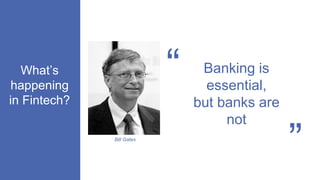
What’s
happening
in Fintech?
“
“
Banking is
essential,
but banks are
not
Bill Gates
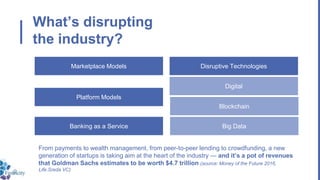
What’s disrupting
the industry?
From payments to wealth management, from peer-to-peer lending to crowdfunding, a new
generation of startups is taking aim at the heart of the industry — and it’s a pot of revenues
that Goldman Sachs estimates to be worth $4.7 trillion (source: Money of the Future 2016,
Life.Sreda VC)
Marketplace Models
Platform Models
Banking as a Service Big Data
Blockchain
Digital
Disruptive Technologies
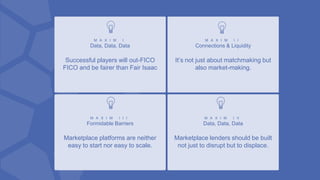
M A X I M I
Data, Data, Data
Successful players will out-FICO
FICO and be fairer than Fair Isaac
M A X I M I I
Connections & Liquidity
It’s not just about matchmaking but
also market-making.
M A X I M I I I
Formidable Barriers
Marketplace platforms are neither
easy to start nor easy to scale.
M A X I M I V
Data, Data, Data
Marketplace lenders should be built
not just to disrupt but to displace.
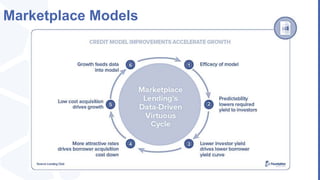
Marketplace Models
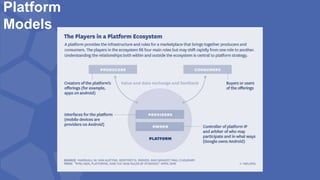
Platform
Models
Platform
Models
Source: Pipelines, Platforms, and the New Rules of Strategy Marshall W. Van Alstyne, Geoffrey G. Parker, Sangeet Paul Choudary,
HBR April 2016
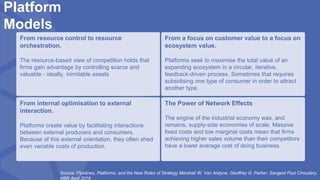
From resource control to resource
orchestration.
The resource-based view of competition holds that
firms gain advantage by controlling scarce and
valuable - ideally, inimitable assets
From a focus on customer value to a focus on
ecosystem value.
Platforms seek to maximise the total value of an
expanding ecosystem in a circular, iterative,
feedback-driven process. Sometimes that requires
subsidising one type of consumer in order to attract
another type.
From internal optimisation to external
interaction.
Platforms create value by facilitating interactions
between external producers and consumers.
Because of this external orientation, they often shed
even variable costs of production.
The Power of Network Effects
The engine of the industrial economy was, and
remains, supply-side economies of scale. Massive
fixed costs and low marginal costs mean that firms
achieving higher sales volume than their competitors
have a lower average cost of doing business.
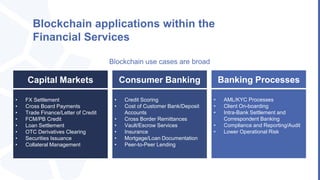
Blockchain applications within the
Financial Services
Blockchain use cases are broad
Capital Markets
• FX Settlement
• Cross Board Payments
• Trade Finance/Letter of Credit
• FCM/PB Credit
• Loan Settlement
• OTC Derivatives Clearing
• Securities Issuance
• Collateral Management
Consumer Banking
• Credit Scoring
• Cost of Customer Bank/Deposit
Accounts
• Cross Border Remittances
• Vault/Escrow Services
• Insurance
• Mortgage/Loan Documentation
• Peer-to-Peer Lending
Banking Processes
• AML/KYC Processes
• Client On-boarding
• Intra-Bank Settlement and
Correspondent Banking
• Compliance and Reporting/Audit
• Lower Operational Risk
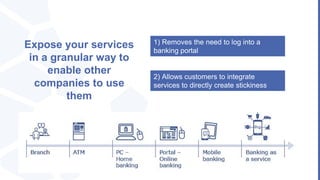
Expose your services
in a granular way to
enable other
companies to use
them
1) Removes the need to log into a
banking portal
2) Allows customers to integrate
services to directly create stickiness
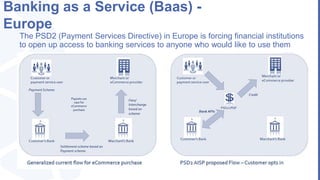
Banking as a Service (Baas) -
Europe
The PSD2 (Payment Services Directive) in Europe is forcing financial institutions
to open up access to banking services to anyone who would like to use them
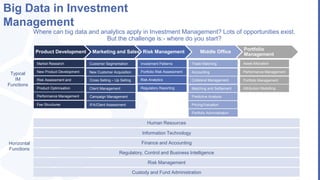
Information Technology
Finance and Accounting
Regulatory, Control and Business Intelligence
Risk Management
Human Resources
Custody and Fund Administration
Product Development Marketing and Sales Risk Management Middle Office
Portfolio
Management
Market Research
New Product Development
Risk Assessment and
Pricing
Product Optimisation
Performance Management
Customer Segmentation
New Customer Acquisition
Cross Selling – Up Selling
Client Management
Campaign Management
IFA/Client Assessment
Investment Patterns
Portfolio Risk Assessment
Risk Analytics
Regulatory Reporting
Trade Matching
Accounting
Collateral Management
Matching and Settlement
Predictive Analysis
Pricing/Valuation
Asset Allocation
Performance Management
Portfolio Management
Horizontal
Functions
Fee Structures
Attribution Modelling
Portfolio Administration
Big Data in Investment
Management
Where can big data and analytics apply in Investment Management? Lots of opportunities exist.
But the challenge is:- where do you start?
Typical
IM
Functions
Product Development Marketing and Sales Risk Management Middle Office
Portfolio
Management
Market Research
New Product Development
Risk Assessment and
Pricing
Product Optimisation
Performance Management
Customer Segmentation
New Customer Acquisition
Client Management
Campaign Management
IFA/Client Assessment
Investment Patterns
Portfolio Risk Assessment
Risk Analytics
Regulatory Reporting
Trade Matching
Accounting
Collateral Management
Matching and Settlement
Predictive Analysis
Pricing/Valuation
Asset Allocation
Performance Management
Portfolio Management
Attribution Modelling
Portfolio Administration
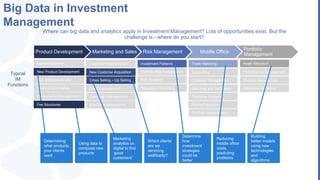
Big Data in Investment
Management
Where can big data and analytics apply in Investment Management? Lots of opportunities exist. But the
challenge is:- where do you start?
Typical
IM
Functions
Determining
what products
your clients
want
Using data to
compose new
products
Marketing
analytics on
digital to find
‘good
customers’
Determine
how
investment
strategies
could be
better
Reducing
middle office
costs,
predicting
problems
Building
better models
using new
technologies
and
algorithms
Fee Structures
Cross Selling – Up Selling
Which clients
are we
servicing
well/badly?
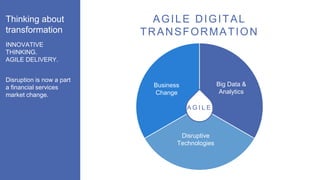
Thinking about
transformation
AGILE DIGITAL
TRANSFORMATION
INNOVATIVE
THINKING.
AGILE DELIVERY.
Disruption is now a part
a financial services
market change.
A G I L E
Business
Change
Big Data &
Analytics
Disruptive
Technologies
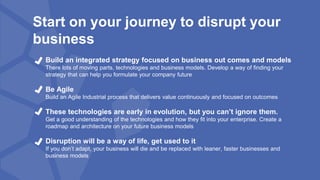
Start on your journey to disrupt your
business
Build an integrated strategy focused on business out comes and models
There lots of moving parts, technologies and business models. Develop a way of finding your
strategy that can help you formulate your company future
Be Agile
Build an Agile Industrial process that delivers value continuously and focused on outcomes
These technologies are early in evolution, but you can’t ignore them.
Get a good understanding of the technologies and how they fit into your enterprise. Create a
roadmap and architecture on your future business models
Disruption will be a way of life, get used to it
If you don’t adapt, your business will die and be replaced with leaner, faster businesses and
business models
Alpesh Doshi
Founder & Managing Director
Alpesh is a thought leader in how
organisations can transform and
future-proof their business using
emerging technologies, particularly
around digital, big data and analytics.
He is focused on innovative thinking
and practical strategies to add value
to his clients fast and often,
introducing the agile approach of
working to digital transformation.
About Fintricity & Alpesh
Doshi
Fintricity
Innovative Thinking, Agile Delivery
Founded in 2001, Fintricity have been at the forefront of
technology and digital transformation for over 15 years.
Entrepreneurs at heart, we take a business-first approach
to match the right blend of solutions and technologies to
solve our clients’ specific business challenges.
Our practical, agile approach combined with the breadth
and depth of expertise across the team, creates
competitive advantages for your business often and fast,
keeping your customer at the heart of everything we do.
Thank you!
Any questions?
You can find me on LinkedIn or email the team at
getintouch@fintricity.com
Fintricity. Innovative Thinking – Agile
Delivery.

Be Digital or Die - Big Data in Financial Services

  • 1.
    Be Digital orDie By Alpesh Doshi, Fintricity www.fintricity.com
  • 2.
    Leveraging Big Data,disruptive technologies and new business models to transform financial services companies. The Big Data Innovation Summit 21st April 2016 San Francisco By Alpesh Doshi, Fintricity
  • 3.
    What is DigitalTransformation? Digital Transformation in Financial Services is the application of disruptive technologies and business models to transform how the industry works. - Alpesh Doshi “ “
  • 4.
    Big data islike teenage sex: everyone talks about it, nobody really knows how to do it, everyone thinks everyone else is doing it, so everyone claims they are doing it. - Dan Ariely “ “ What is Big Data?
  • 5.
  • 6.
    What’s disrupting the industry? Frompayments to wealth management, from peer-to-peer lending to crowdfunding, a new generation of startups is taking aim at the heart of the industry — and it’s a pot of revenues that Goldman Sachs estimates to be worth $4.7 trillion (source: Money of the Future 2016, Life.Sreda VC) Marketplace Models Platform Models Banking as a Service Big Data Blockchain Digital Disruptive Technologies
  • 7.
    M A XI M I Data, Data, Data Successful players will out-FICO FICO and be fairer than Fair Isaac M A X I M I I Connections & Liquidity It’s not just about matchmaking but also market-making. M A X I M I I I Formidable Barriers Marketplace platforms are neither easy to start nor easy to scale. M A X I M I V Data, Data, Data Marketplace lenders should be built not just to disrupt but to displace.
  • 8.
  • 9.
  • 10.
    Platform Models Source: Pipelines, Platforms,and the New Rules of Strategy Marshall W. Van Alstyne, Geoffrey G. Parker, Sangeet Paul Choudary, HBR April 2016 From resource control to resource orchestration. The resource-based view of competition holds that firms gain advantage by controlling scarce and valuable - ideally, inimitable assets From a focus on customer value to a focus on ecosystem value. Platforms seek to maximise the total value of an expanding ecosystem in a circular, iterative, feedback-driven process. Sometimes that requires subsidising one type of consumer in order to attract another type. From internal optimisation to external interaction. Platforms create value by facilitating interactions between external producers and consumers. Because of this external orientation, they often shed even variable costs of production. The Power of Network Effects The engine of the industrial economy was, and remains, supply-side economies of scale. Massive fixed costs and low marginal costs mean that firms achieving higher sales volume than their competitors have a lower average cost of doing business.
  • 11.
    Blockchain applications withinthe Financial Services Blockchain use cases are broad Capital Markets • FX Settlement • Cross Board Payments • Trade Finance/Letter of Credit • FCM/PB Credit • Loan Settlement • OTC Derivatives Clearing • Securities Issuance • Collateral Management Consumer Banking • Credit Scoring • Cost of Customer Bank/Deposit Accounts • Cross Border Remittances • Vault/Escrow Services • Insurance • Mortgage/Loan Documentation • Peer-to-Peer Lending Banking Processes • AML/KYC Processes • Client On-boarding • Intra-Bank Settlement and Correspondent Banking • Compliance and Reporting/Audit • Lower Operational Risk
  • 12.
    Expose your services ina granular way to enable other companies to use them 1) Removes the need to log into a banking portal 2) Allows customers to integrate services to directly create stickiness
  • 13.
    Banking as aService (Baas) - Europe The PSD2 (Payment Services Directive) in Europe is forcing financial institutions to open up access to banking services to anyone who would like to use them
  • 14.
    Information Technology Finance andAccounting Regulatory, Control and Business Intelligence Risk Management Human Resources Custody and Fund Administration Product Development Marketing and Sales Risk Management Middle Office Portfolio Management Market Research New Product Development Risk Assessment and Pricing Product Optimisation Performance Management Customer Segmentation New Customer Acquisition Cross Selling – Up Selling Client Management Campaign Management IFA/Client Assessment Investment Patterns Portfolio Risk Assessment Risk Analytics Regulatory Reporting Trade Matching Accounting Collateral Management Matching and Settlement Predictive Analysis Pricing/Valuation Asset Allocation Performance Management Portfolio Management Horizontal Functions Fee Structures Attribution Modelling Portfolio Administration Big Data in Investment Management Where can big data and analytics apply in Investment Management? Lots of opportunities exist. But the challenge is:- where do you start? Typical IM Functions
  • 15.
    Product Development Marketingand Sales Risk Management Middle Office Portfolio Management Market Research New Product Development Risk Assessment and Pricing Product Optimisation Performance Management Customer Segmentation New Customer Acquisition Client Management Campaign Management IFA/Client Assessment Investment Patterns Portfolio Risk Assessment Risk Analytics Regulatory Reporting Trade Matching Accounting Collateral Management Matching and Settlement Predictive Analysis Pricing/Valuation Asset Allocation Performance Management Portfolio Management Attribution Modelling Portfolio Administration Big Data in Investment Management Where can big data and analytics apply in Investment Management? Lots of opportunities exist. But the challenge is:- where do you start? Typical IM Functions Determining what products your clients want Using data to compose new products Marketing analytics on digital to find ‘good customers’ Determine how investment strategies could be better Reducing middle office costs, predicting problems Building better models using new technologies and algorithms Fee Structures Cross Selling – Up Selling Which clients are we servicing well/badly?
  • 16.
    Thinking about transformation AGILE DIGITAL TRANSFORMATION INNOVATIVE THINKING. AGILEDELIVERY. Disruption is now a part a financial services market change. A G I L E Business Change Big Data & Analytics Disruptive Technologies
  • 17.
    Start on yourjourney to disrupt your business Build an integrated strategy focused on business out comes and models There lots of moving parts, technologies and business models. Develop a way of finding your strategy that can help you formulate your company future Be Agile Build an Agile Industrial process that delivers value continuously and focused on outcomes These technologies are early in evolution, but you can’t ignore them. Get a good understanding of the technologies and how they fit into your enterprise. Create a roadmap and architecture on your future business models Disruption will be a way of life, get used to it If you don’t adapt, your business will die and be replaced with leaner, faster businesses and business models
  • 18.
    Alpesh Doshi Founder &Managing Director Alpesh is a thought leader in how organisations can transform and future-proof their business using emerging technologies, particularly around digital, big data and analytics. He is focused on innovative thinking and practical strategies to add value to his clients fast and often, introducing the agile approach of working to digital transformation. About Fintricity & Alpesh Doshi Fintricity Innovative Thinking, Agile Delivery Founded in 2001, Fintricity have been at the forefront of technology and digital transformation for over 15 years. Entrepreneurs at heart, we take a business-first approach to match the right blend of solutions and technologies to solve our clients’ specific business challenges. Our practical, agile approach combined with the breadth and depth of expertise across the team, creates competitive advantages for your business often and fast, keeping your customer at the heart of everything we do.
  • 19.
    Thank you! Any questions? Youcan find me on LinkedIn or email the team at getintouch@fintricity.com Fintricity. Innovative Thinking – Agile Delivery.

Editor's Notes

  • #6 Video: https://youtu.be/4sm5LNqL5j0