© 2009, Home Care Institute, LLC
Page 1 of 9 
SSaalleess JJoobb AAiidd
TTeerrrriittoorryy MMaannaaggeemmeenntt
 
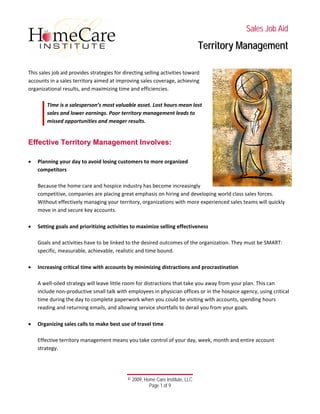
This sales job aid provides strategies for directing selling activities toward 
accounts in a sales territory aimed at improving sales coverage, achieving 
organizational results, and maximizing time and efficiencies. 
 
Time is a salesperson’s most valuable asset. Lost hours mean lost 
sales and lower earnings. Poor territory management leads to 
missed opportunities and meager results. 
 
EEffffeeccttiivvee TTeerrrriittoorryy MMaannaaggeemmeenntt IInnvvoollvveess::
 
• Planning your day to avoid losing customers to more organized 
competitors 
 
Because the home care and hospice industry has become increasingly 
competitive, companies are placing great emphasis on hiring and developing world class sales forces. 
Without effectively managing your territory, organizations with more experienced sales teams will quickly 
move in and secure key accounts. 
 
• Setting goals and prioritizing activities to maximize selling effectiveness 
 
Goals and activities have to be linked to the desired outcomes of the organization. They must be SMART:  
specific, measurable, achievable, realistic and time bound. 
 
• Increasing critical time with accounts by minimizing distractions and procrastination 
 
A well‐oiled strategy will leave little room for distractions that take you away from your plan. This can 
include non‐productive small talk with employees in physician offices or in the hospice agency, using critical 
time during the day to complete paperwork when you could be visiting with accounts, spending hours 
reading and returning emails, and allowing service shortfalls to derail you from your goals. 
 
• Organizing sales calls to make best use of travel time 
 
Effective territory management means you take control of your day, week, month and entire account 
strategy. 


© 2009, Home Care Institute, LLC
Page 2 of 9 
SSaalleess JJoobb AAiidd
TTeerrrriittoorryy MMaannaaggeemmeenntt
• Stretching your selling day and spending more time with your accounts 
 
It is well‐known that persons who readily stretch beyond what is easily achievable, deliver legendary results. 
If you typically visit six accounts each day, think what type of impact you would have in a year just by adding 
one or two additional calls each day. 
 
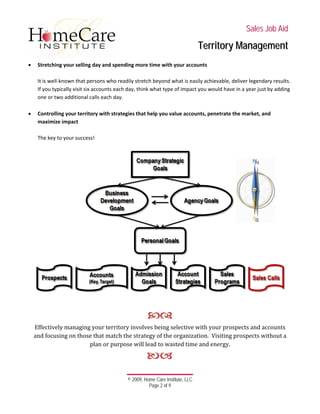
• Controlling your territory with strategies that help you value accounts, penetrate the market, and 
maximize impact 
 
The key to your success! 


Effectively managing your territory involves being selective with your prospects and accounts 
and focusing on those that match the strategy of the organization.  Visiting prospects without a 
plan or purpose will lead to wasted time and energy.   


© 2009, Home Care Institute, LLC
Page 3 of 9 
SSaalleess JJoobb AAiidd
TTeerrrriittoorryy MMaannaaggeemmeenntt
 
AAddvvaanncceedd PPrreeppaarraattiioonn iiss KKeeyy
 
• Involves researching and understanding critical information 
about each account. 
• Knowing which accounts will produce the best results. 
• Reduces wasted time focusing on accounts that fail to 
produce. 
• Allows the business development plan to be implemented 
efficiently and effectively. 
 
 
PPrriioorriittiizzee YYoouurr PPllaann
 
• Agency liaison activities 
• Key accounts 
o Accounts already delivering results 
o Nurture and protect 
o Visit  frequently (weekly)  
o Use as a base for determining your territory plan 
• Target accounts 
o Target accounts with a large desired patient base that do not currently contribute a significant 
number of referrals but identified as aligning with the organization’s strategic growth plan 
o Visit based on your established strategy 
o Qualify to determine priority level 
o Prioritize based on realistic expectations 
• Prospects 
o Unknown sources within your territory that, through qualification efforts, may become target or 
key accounts 
o Qualify to determine account status 
o Prioritize based on revenue, value and realistic expectations 
o May be biggest time‐wasters 
• Community outreach and organizational branding 
 
The goal is to break your call list into bite‐sized, manageable chunks 


© 2009, Home Care Institute, LLC
Page 4 of 9 
SSaalleess JJoobb AAiidd
TTeerrrriittoorryy MMaannaaggeemmeenntt
SScchheedduulliinngg AAccccoouunnttss
 
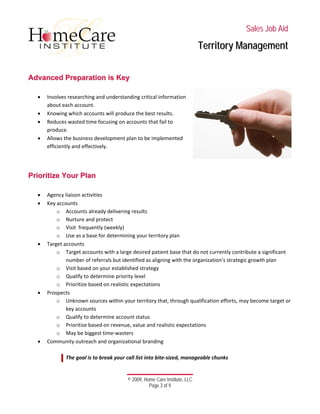
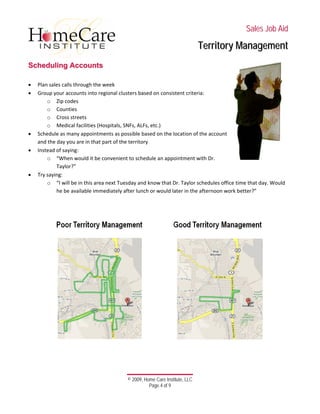
• Plan sales calls through the week 
• Group your accounts into regional clusters based on consistent criteria: 
o Zip codes 
o Counties 
o Cross streets 
o Medical facilities (Hospitals, SNFs, ALFs, etc.) 
• Schedule as many appointments as possible based on the location of the account 
and the day you are in that part of the territory 
• Instead of saying: 
o “When would it be convenient to schedule an appointment with Dr. 
Taylor?” 
• Try saying: 
o “I will be in this area next Tuesday and know that Dr. Taylor schedules office time that day. Would 
he be available immediately after lunch or would later in the afternoon work better?” 


© 2009, Home Care Institute, LLC
Page 5 of 9 
SSaalleess JJoobb AAiidd
TTeerrrriittoorryy MMaannaaggeemmeenntt
 
EEssttaabblliisshh VVaalluuee PPrrooppoossiittiioonnss
 
• Take each market segment and determine why this group would want to refer to your agency 
• What are your key capabilities for the Segment? 
• What issues or problems do your prospects have that your agency capabilities could solve? 
• What benefits does your agency bring to the segment of customers? 
• Determine the value of what you have to offer 
 
QQuuaalliiffyyiinngg PPrroossppeeccttss
 
• The best territory management plan involves a mechanism 
to qualify the worth of targets of your plan  
o Does the account have target‐appropriate patients? 
o Who is the decision maker for referrals? 
o When is the best time to visit? 
o What strategies are most likely to net results with 
the account? 
• Set up a working profile that can be used to gather 
information about the account 
 
 
WWhheenn ttoo MMoovvee OOnn……
 
• Limit your active number of non‐target prospects 
o Should be less than 20% of your total accounts 
o Evaluate every 90 days to determine whether they should continue to be managed 
o When abandoning a prospect, replace it with another 
o Before abandoning a prospect, make sure you have done everything to ask for the business 
• When to abandon a prospect 
o They are non‐referring and refuse to refer (over period of 90 days) 
o They start sending referrals and now are a good account 
o They die or move 


© 2009, Home Care Institute, LLC
Page 6 of 9 
SSaalleess JJoobb AAiidd
TTeerrrriittoorryy MMaannaaggeemmeenntt


Building long‐term relationships takes on average 
of 6 months or more.  The only way to shorten the 
time is to increase the number of impressions. 


MMaannaaggiinngg AAccccoouunnttss
 
• Managing your territory involves having a defined plan for managing accounts 
o Begins with a good understanding of the account 
o Having a goal and plan for each account and sales call 
o Efficiently executing the plan 
o ALWAYS asking for the business 
o Also involves anticipating and preparing for objections 
o Avoid adjusting call volume based on ebb and flow of referrals 
o Look out for personnel changes that might require re‐education 
• Have a plan for responding to every person in the office 
o Gatekeeper / Receptionist 
Main job is to control access to the office 
Engage personally and professionally 
Know the best times to visit to avoid adding extra burden 
Ask for her help 
Let her know the benefit you bring to the practice 
 
“We have a cardiac disease management program that can help Dr. Smith support his patients 
who are struggling with frequent re‐admissions.  I could really use your help to set up a time to 
meet with the person in your office who sets up home care services so I can let him or her know 
about the specific benefits of this program.” 


© 2009, Home Care Institute, LLC
Page 7 of 9 
SSaalleess JJoobb AAiidd
TTeerrrriittoorryy MMaannaaggeemmeenntt
MMaannaaggiinngg SSaalleess CCaallllss
 
• Prepare for objections  
o Objections can undermine a sales call and stop the flow of 
conversation 
o Consider as many possible objections as possible that might arise 
during a sales call and have a ready inventory of solutions 
o To build confidence, steer sales calls toward objections for which 
you have effective solutions 
 
What would you say?
 
“I’m very happy with ABC and send all of my referrals to them.” 
 
Say… 
 
“It would be our goal to be your first second choice in the event ABC is unable to take a patient.  As you can 
see by this service brochure, we cover all of the counties in this area.” 
 
 
What would you say?
 
“The last time I used you, my patient had a bad experience with an after‐hours visit.” 
 
Say… 
 
“I’m sorry that happened, but that’s why I am here. I’m your new service representative and it’s my job to 
make sure there are no problems. Do you have a few minutes for us to sit down so you can tell me what 
happened?” 


© 2009, Home Care Institute, LLC
Page 8 of 9 
SSaalleess JJoobb AAiidd
TTeerrrriittoorryy MMaannaaggeemmeenntt
 
TTiimmee MMaannaaggeemmeenntt SSttrraatteeggiieess 
 
• Avoid excessive non‐business conversation  
• Prepare a concise elevator statement that conveys your message in 
30 seconds or less 
• Complete non‐account activities outside of “normal” account 
business hours, including: 
o Documentation and paperwork 
o Report generation and analysis 
o Collateral preparation 
o Sales meetings 
 
 
TToooollss
 
• Calendar or planner with time allocation resources 
o Daily /weekly views for detailed schedule 
o Monthly view for longer‐term appointments 
o Slot calls and plan time for the full month based on overall goals 
• Schedule key accounts at least weekly; target accounts based on strategy 
o Activity reporting 
o Document activity and results 
• Update immediately after visiting account 
• Marketing campaigns (strategies) to guide goals 
• Sales collateral 
 
Avoid Time Wasters
 
• Unclear objectives 
• Lack of focus 
• Low motivation 
• Not finishing something 
• Too many emails and memos 


© 2009, Home Care Institute, LLC
Page 9 of 9 
SSaalleess JJoobb AAiidd
TTeerrrriittoorryy MMaannaaggeemmeenntt
• Unnecessary meetings or conference calls 
• Unplanned call sequencing  
• Finding things that were misplaced 
• No pre‐call planning 
• Gossiping 
• Not saying NO 
• No teamwork 
• Paperwork overload 
 
Utilize Time Savers
 
• Have clear objectives 
• Be organized 
• Cluster activities 
• Take the time to put data where you can find it 
• Plan your week; not your day 
• Route your sales calls logically 
• Excuse yourself from calls and meetings that don’t advance your plan 
• Pre‐call plan EVERY sales call 
• Be ready for every possible scenario 
• When in the car between calls  
o Check in with the office 
o Give status reports to customers 
o Gather information about your next meeting 
o Follow up on information from the last call 
 
 
Just as a rubber band shoots farther when it is stretched, so 
will sales results increase when activity is stretched beyond 
what can be achieved with minimal effort 
 
How many sales calls do you make each day? 
How many sales calls could you make each day if you managed 
your territory efficiently and effectively? 
 
Caution:  stretching too far can snap the rubber band! 

Bd territory management

  • 1.
                  © 2009, HomeCare Institute, LLC Page 1 of 9  SSaalleess JJoobb AAiidd TTeerrrriittoorryy MMaannaaggeemmeenntt   This sales job aid provides strategies for directing selling activities toward  accounts in a sales territory aimed at improving sales coverage, achieving  organizational results, and maximizing time and efficiencies.    Time is a salesperson’s most valuable asset. Lost hours mean lost  sales and lower earnings. Poor territory management leads to  missed opportunities and meager results.    EEffffeeccttiivvee TTeerrrriittoorryy MMaannaaggeemmeenntt IInnvvoollvveess::   • Planning your day to avoid losing customers to more organized  competitors    Because the home care and hospice industry has become increasingly  competitive, companies are placing great emphasis on hiring and developing world class sales forces.  Without effectively managing your territory, organizations with more experienced sales teams will quickly  move in and secure key accounts.    • Setting goals and prioritizing activities to maximize selling effectiveness    Goals and activities have to be linked to the desired outcomes of the organization. They must be SMART:   specific, measurable, achievable, realistic and time bound.    • Increasing critical time with accounts by minimizing distractions and procrastination    A well‐oiled strategy will leave little room for distractions that take you away from your plan. This can  include non‐productive small talk with employees in physician offices or in the hospice agency, using critical  time during the day to complete paperwork when you could be visiting with accounts, spending hours  reading and returning emails, and allowing service shortfalls to derail you from your goals.    • Organizing sales calls to make best use of travel time    Effective territory management means you take control of your day, week, month and entire account  strategy.     
  • 2.
                  © 2009, HomeCare Institute, LLC Page 2 of 9  SSaalleess JJoobb AAiidd TTeerrrriittoorryy MMaannaaggeemmeenntt • Stretching your selling day and spending more time with your accounts    It is well‐known that persons who readily stretch beyond what is easily achievable, deliver legendary results.  If you typically visit six accounts each day, think what type of impact you would have in a year just by adding  one or two additional calls each day.    • Controlling your territory with strategies that help you value accounts, penetrate the market, and  maximize impact    The key to your success!            Effectively managing your territory involves being selective with your prospects and accounts  and focusing on those that match the strategy of the organization.  Visiting prospects without a  plan or purpose will lead to wasted time and energy.      
  • 3.
                  © 2009, HomeCare Institute, LLC Page 3 of 9  SSaalleess JJoobb AAiidd TTeerrrriittoorryy MMaannaaggeemmeenntt   AAddvvaanncceedd PPrreeppaarraattiioonn iiss KKeeyy   • Involves researching and understanding critical information  about each account.  • Knowing which accounts will produce the best results.  • Reduces wasted time focusing on accounts that fail to  produce.  • Allows the business development plan to be implemented  efficiently and effectively.      PPrriioorriittiizzee YYoouurr PPllaann   • Agency liaison activities  • Key accounts  o Accounts already delivering results  o Nurture and protect  o Visit  frequently (weekly)   o Use as a base for determining your territory plan  • Target accounts  o Target accounts with a large desired patient base that do not currently contribute a significant  number of referrals but identified as aligning with the organization’s strategic growth plan  o Visit based on your established strategy  o Qualify to determine priority level  o Prioritize based on realistic expectations  • Prospects  o Unknown sources within your territory that, through qualification efforts, may become target or  key accounts  o Qualify to determine account status  o Prioritize based on revenue, value and realistic expectations  o May be biggest time‐wasters  • Community outreach and organizational branding    The goal is to break your call list into bite‐sized, manageable chunks   
  • 4.
                  © 2009, HomeCare Institute, LLC Page 4 of 9  SSaalleess JJoobb AAiidd TTeerrrriittoorryy MMaannaaggeemmeenntt SScchheedduulliinngg AAccccoouunnttss   • Plan sales calls through the week  • Group your accounts into regional clusters based on consistent criteria:  o Zip codes  o Counties  o Cross streets  o Medical facilities (Hospitals, SNFs, ALFs, etc.)  • Schedule as many appointments as possible based on the location of the account  and the day you are in that part of the territory  • Instead of saying:  o “When would it be convenient to schedule an appointment with Dr.  Taylor?”  • Try saying:  o “I will be in this area next Tuesday and know that Dr. Taylor schedules office time that day. Would  he be available immediately after lunch or would later in the afternoon work better?”                                           
  • 5.
                  © 2009, HomeCare Institute, LLC Page 5 of 9  SSaalleess JJoobb AAiidd TTeerrrriittoorryy MMaannaaggeemmeenntt   EEssttaabblliisshh VVaalluuee PPrrooppoossiittiioonnss   • Take each market segment and determine why this group would want to refer to your agency  • What are your key capabilities for the Segment?  • What issues or problems do your prospects have that your agency capabilities could solve?  • What benefits does your agency bring to the segment of customers?  • Determine the value of what you have to offer    QQuuaalliiffyyiinngg PPrroossppeeccttss   • The best territory management plan involves a mechanism  to qualify the worth of targets of your plan   o Does the account have target‐appropriate patients?  o Who is the decision maker for referrals?  o When is the best time to visit?  o What strategies are most likely to net results with  the account?  • Set up a working profile that can be used to gather  information about the account      WWhheenn ttoo MMoovvee OOnn……   • Limit your active number of non‐target prospects  o Should be less than 20% of your total accounts  o Evaluate every 90 days to determine whether they should continue to be managed  o When abandoning a prospect, replace it with another  o Before abandoning a prospect, make sure you have done everything to ask for the business  • When to abandon a prospect  o They are non‐referring and refuse to refer (over period of 90 days)  o They start sending referrals and now are a good account  o They die or move     
  • 6.
                  © 2009, HomeCare Institute, LLC Page 6 of 9  SSaalleess JJoobb AAiidd TTeerrrriittoorryy MMaannaaggeemmeenntt       Building long‐term relationships takes on average  of 6 months or more.  The only way to shorten the  time is to increase the number of impressions.              MMaannaaggiinngg AAccccoouunnttss   • Managing your territory involves having a defined plan for managing accounts  o Begins with a good understanding of the account  o Having a goal and plan for each account and sales call  o Efficiently executing the plan  o ALWAYS asking for the business  o Also involves anticipating and preparing for objections  o Avoid adjusting call volume based on ebb and flow of referrals  o Look out for personnel changes that might require re‐education  • Have a plan for responding to every person in the office  o Gatekeeper / Receptionist  Main job is to control access to the office  Engage personally and professionally  Know the best times to visit to avoid adding extra burden  Ask for her help  Let her know the benefit you bring to the practice    “We have a cardiac disease management program that can help Dr. Smith support his patients  who are struggling with frequent re‐admissions.  I could really use your help to set up a time to  meet with the person in your office who sets up home care services so I can let him or her know  about the specific benefits of this program.”     
  • 7.
                  © 2009, HomeCare Institute, LLC Page 7 of 9  SSaalleess JJoobb AAiidd TTeerrrriittoorryy MMaannaaggeemmeenntt MMaannaaggiinngg SSaalleess CCaallllss   • Prepare for objections   o Objections can undermine a sales call and stop the flow of  conversation  o Consider as many possible objections as possible that might arise  during a sales call and have a ready inventory of solutions  o To build confidence, steer sales calls toward objections for which  you have effective solutions    What would you say?   “I’m very happy with ABC and send all of my referrals to them.”    Say…    “It would be our goal to be your first second choice in the event ABC is unable to take a patient.  As you can  see by this service brochure, we cover all of the counties in this area.”      What would you say?   “The last time I used you, my patient had a bad experience with an after‐hours visit.”    Say…    “I’m sorry that happened, but that’s why I am here. I’m your new service representative and it’s my job to  make sure there are no problems. Do you have a few minutes for us to sit down so you can tell me what  happened?”       
  • 8.
                  © 2009, HomeCare Institute, LLC Page 8 of 9  SSaalleess JJoobb AAiidd TTeerrrriittoorryy MMaannaaggeemmeenntt   TTiimmee MMaannaaggeemmeenntt SSttrraatteeggiieess    • Avoid excessive non‐business conversation   • Prepare a concise elevator statement that conveys your message in  30 seconds or less  • Complete non‐account activities outside of “normal” account  business hours, including:  o Documentation and paperwork  o Report generation and analysis  o Collateral preparation  o Sales meetings      TToooollss   • Calendar or planner with time allocation resources  o Daily /weekly views for detailed schedule  o Monthly view for longer‐term appointments  o Slot calls and plan time for the full month based on overall goals  • Schedule key accounts at least weekly; target accounts based on strategy  o Activity reporting  o Document activity and results  • Update immediately after visiting account  • Marketing campaigns (strategies) to guide goals  • Sales collateral    Avoid Time Wasters   • Unclear objectives  • Lack of focus  • Low motivation  • Not finishing something  • Too many emails and memos 
  • 9.
                  © 2009, HomeCare Institute, LLC Page 9 of 9  SSaalleess JJoobb AAiidd TTeerrrriittoorryy MMaannaaggeemmeenntt • Unnecessary meetings or conference calls  • Unplanned call sequencing   • Finding things that were misplaced  • No pre‐call planning  • Gossiping  • Not saying NO  • No teamwork  • Paperwork overload    Utilize Time Savers   • Have clear objectives  • Be organized  • Cluster activities  • Take the time to put data where you can find it  • Plan your week; not your day  • Route your sales calls logically  • Excuse yourself from calls and meetings that don’t advance your plan  • Pre‐call plan EVERY sales call  • Be ready for every possible scenario  • When in the car between calls   o Check in with the office  o Give status reports to customers  o Gather information about your next meeting  o Follow up on information from the last call      Just as a rubber band shoots farther when it is stretched, so  will sales results increase when activity is stretched beyond  what can be achieved with minimal effort    How many sales calls do you make each day?  How many sales calls could you make each day if you managed  your territory efficiently and effectively?    Caution:  stretching too far can snap the rubber band!