Report


   Global Retail Banking 2010/2011

The Road to Excellence
The Boston Consulting Group (BCG) is a global manage-
ment consulting firm and the world’s leading advisor on
business strategy. We partner with clients in all sectors
and regions to identify their highest-value opportunities,
address their most critical challenges, and transform their
businesses. Our customized approach combines deep
insight into the dynamics of companies and markets with
close collaboration at all levels of the client organization.
This ensures that our clients achieve sustainable compet-
itive advantage, build more capable organizations, and
secure lasting results. Founded in 1963, BCG is a private
company with 71 offices in 41 countries. For more infor-
mation, please visit www.bcg.com.
The Road to Excellence

   Global Retail Banking 2010/2011


             Andy Maguire
             Vincent Chin
          Laurent Desmangles
            Huib Kurstjens
          Reinhold Leichtfuss
         Reinhard Messenböck
             Tim Monger
            Nicole Mönter
          Steven Thogmartin
             André Xavier


              December 2010


                bcg.com
© The Boston Consulting Group, Inc. 2010. All rights reserved.

For information or permission to reprint, please contact BCG at:
E-mail: bcg-info@bcg.com
Fax:     +1 617 850 3901, attention BCG/Permissions
Mail: BCG/Permissions
         The Boston Consulting Group, Inc.
         One Beacon Street
         Boston, MA 02108
         USA
Contents
Executive Summary                                                          4

The State of the Nation in Global Retail Banking                           6
Financial Stress                                                           6
Stricter Government Regulation                                             7
Changes in the Competitive Landscape                                       9
Changes in Customer Behavior and Expectations                              10
The Shifting Roles of Products                                             10

Operational Excellence: Becoming a Process and Productivity Leader         12
The Profile of a Process and Productivity Leader                           12
Different Ways of Differentiating                                          14

Customer Excellence: Reaching the Highest Level                            17
The First Step: Remaining a Near-Perfect Retail Bank                       17
Completing the Journey: Achieving Truly Perfect Customer Excellence        18

Appendix: From Global to Local—Trends in Specific Retail-Banking Markets   22

For Further Reading                                                        29

Note to the Reader                                                         30


The Road to Excellence                                                      3
Executive Summary


T
             he retail banking industry has been bat-          ◊ In the best banks, a large majority of employees are
             tered by the global financial crisis. But           dedicated to customer-facing sales and service activi-
             in many markets its resilience has                  ties. Processing is centralized in a small number of
             helped enable a turning of the tide that            centers across regions. Leading banks embrace a high
             began in 2009 and continued into 2010.              level of industrialization, characterized by simplified,
Overall, retail banking is on track to resume its sta-           standardized processes that maximize the number of
tus as a reliable and profitable backbone for univer-            new accounts and loan decisions per operations full-
sal banks.                                                       time equivalent. They focus on end-to-end sales and
                                                                 service effectiveness, applying a holistic approach to
◊ Although the nature and impact of current industry             streamlining processes and interfaces across the front-
  dynamics vary by market, banks have generally under-           line and operations.
  gone significant financial stress, owing to margin pres-
  sure, sharp rises in loan loss provisions, and declines in   ◊ Although no retail banks have been able to achieve
  asset volumes, revenues, and profits. Banks have also          operational excellence in all areas, the scope of the op-
  had to cope with stricter government regulation aimed          portunity is vast and has led many banks to embark
  at mitigating risk and beefing up consumer protection.         on multiyear efforts to raise their game. Banks that ac-
  Such regulation has been implemented in many coun-             celerate these initiatives and invest wisely to reach a
  tries and is on the horizon in others.                         high level of operational excellence will reap signifi-
                                                                 cant benefits.
◊ The overall retail-banking landscape has undergone
  measurable change, altering the competitive position         In the wake of the financial crisis, retail banks must
  of many institutions. Customer behavior and expecta-         commit themselves to achieving a far higher degree
  tions have also changed, with a greater premium being        of customer excellence in order to win a greater share
  placed on trust and reliability. The roles of traditional    of their customers’ business. They must combine
  products are shifting.                                       sales and service excellence with low costs, take mul-
                                                               tichannel excellence to the next level, and create a
◊ In order to respond to the new environment in retail         truly differentiated customer experience. These ini-
  banking, institutions will need to push their perfor-        tiatives are critical to showing customers that they
  mance to the next level along two broad dimensions:          need only one bank to meet their financial-services
  operational excellence and customer excellence.              needs. Many banks are aware of the need for a re-
                                                               newed focus on such goals, but their execution and
Banks must utilize three key levers in order to achieve        attention to detail are frequently insufficient.
operational excellence and become process and pro-
ductivity leaders. They must streamline the organiza-          ◊ Banks often hurt themselves by providing poor overall
tion, develop efficient and effective processes, and             customer service and setting expectations that they
improve end-to-end performance.                                  cannot consistently meet. To address these shortcom-


4                                                                                          The Boston Consulting Group
ings, they must be more actively supportive of their       About the Authors
  customers—for example, by warning them of poten-           Andy Maguire is a senior partner and managing director
  tial overdraft scenarios and helping them figure out       in the London office of The Boston Consulting Group and
  whether they can afford the car or house that they cov-    the leader of the global retail-banking practice. You may
  et without overextending themselves. Such support          contact him by e-mail at maguire.andy@bcg.com. Vin-
  can be offered only if the bank captures comprehen-        cent Chin is a partner and managing director in the
  sive customer information, updates it continually, and     firm’s Kuala Lumpur office. You may contact him by e-
  understands it in a holistic way that builds in under-     mail at chin.vincent@bcg.com. Laurent Desmangles is a
  writing risk and appropriate pricing. By developing        partner and managing director in BCG’s New York office.
  such integrated insights, banks can make every service     You may contact him by e-mail at desmangles.laurent@
  opportunity a sales opportunity and vice versa.            bcg.com. Huib Kurstjens is a senior partner and manag-
                                                             ing director in the firm’s Amsterdam office. You may con-
◊ The primary checking or current account is clearly the     tact him by e-mail at kurstjens.huib@bcg.com. Reinhold
  anchor of the customer relationship. Because of the        Leichtfuss is a senior partner and managing director in
  cross-selling opportunities these accounts present, cus-   BCG’s Dubai office. You many contact him by e-mail at
  tomers who hold them are up to 10 times more profit-       leichtfuss.reinhold@bcg.com. Reinhard Messenböck is
  able than those who do not—and are up to 25 percent        a partner and managing director in the firm’s Berlin of-
  less likely to have overdraft or default difficulties.     fice. You may contact him by e-mail at messenboeck.rein-
                                                             hard@bcg.com. Tim Monger is a partner and managing
◊ Multichannel excellence goes beyond making sure that       director in BCG’s London office. You may contact him by
  channels are not competing with each other and that        e-mail at monger.tim@bcg.com. Nicole Mönter is a proj-
  access to customer information is open and unified. It     ect leader in the firm’s Brussels office and the manager
  also means monitoring channel usage and using that         of the global retail-banking segment. You may contact her
  information to drive more high-quality interactions        by e-mail at monter.nicole@bcg.com. Steven Thogmar-
  with the customer. It means shifting from a passive ap-    tin is a partner and managing director in BCG’s New York
  proach—merely displaying products “on the shelf”—          office. You may contact him by e-mail at thogmartin.ste-
  to proactive, sales- and service-oriented, multichannel    ven@bcg.com. André Xavier is a partner and managing
  lead management.                                           director in the firm’s São Paulo office. You may contact
                                                             him by e-mail at xavier.andre@bcg.com.
◊ Many, if not all, retail banks are genuinely afraid of
  regulatory intervention. Yet customer excellence may
  be the ultimate defense. Banks that take the time to
  capture and maintain their customers’ profiles—such
  as their demographic characteristics, attitude toward
  risk, product history and preferences, channel behav-
  ior, and financial boundaries and limitations—may
  find themselves less troubled by regulation because
  they really do know their customers and act in their
  interests, which is what regulators care about most.


The Road to Excellence                                                                                              5
The State of the Nation
           in Global Retail Banking


T
              here is no doubt that the retail banking in-    maries of the trends specific to individual markets.) In-
              dustry has been battered by the global fi-      deed, the crisis generally hit mature markets harder than
              nancial crisis. Yet even in the darkest days    developing ones, and it hit the United States—which con-
              of the recession, there was a silver lining:    tinues to face serious difficulties—perhaps the hardest of
              the fundamental strength and resilience of      all. These forces form the backdrop to the overall state of
the industry. This resilience has helped enable a turning     the global retail-banking industry today.
of the tide in many markets that began in 2009 and con-
tinued into 2010. Overall, retail banking is on track to
resume its status as a reliable and profitable backbone       Financial Stress
for universal banks.
                                                              The margin pressure that has long plagued retail banks is
But a full recovery will be neither easy nor without pit-     gradually becoming less severe. Asset margins have wid-
falls. Over the past few years, the retail banking industry   ened from unsustainable lows, and pressure on liability
has witnessed upheaval in five principal areas:               margins, while still intense, has on average eased up from
                                                              the depths of the crisis. New mortgages are being sold at
◊ The industry has endured significant financial stress,      higher spreads than were possible for many years, as a
  owing to margin pressure, sharp rises in loan loss pro-     significant percentage of existing mortgages come up for
  visions, and declines in asset volumes, revenues, and       repricing—and are rolled over at better margins. Retail
  profits.                                                    banking customers in most markets are less able to refi-
                                                              nance regularly, extending the lives of loans. Many back-
◊ Stricter government regulation aimed at mitigating risk     book mortgages that were not repriced are now earning
  and beefing up consumer protection has been imple-          better margins owing to slightly better, blended funding
  mented in many countries and is on the horizon in           costs than were possible in 2008 and 2009.
  others.
                                                              On the liability side, the expensive fixed deposits and
◊ The overall retail-banking landscape has undergone          high-interest-rate savings accounts—combined with the
  measurable change, altering the competitive position        flat interest-rate curve—that weighed banks down during
  of many institutions.                                       the crisis have begun to run their course and represent
                                                              less of an undue burden. However, the vicious fight for
◊ Customer behavior and expectations have changed, with       savings is continuing in most markets. The still relatively
  a higher premium being placed on trust and reliability.     high interest rates offered on deposits are resulting in
                                                              continued downward pressure on liability margins and
◊ The roles of products are shifting.                         upward pressure on asset margins.

The exact nature and impact of these dynamics vary            When it comes to asset volumes, the crisis obviously had
from market to market. (See the Appendix for brief sum-       a marked effect. Overall sales declined, with the extent


6                                                                                         The Boston Consulting Group
varying across specific markets. Initially, the pressure on       terms better than highly diversified banks—with the no-
credit supply was driven by banks trying to reduce risk in        table exception of the U.S. market, where retail earnings
their portfolios and shore up their balance sheets. Later,        have turned positive only relatively recently. The retail
restricted funding possibilities became a factor. Today, de-      share of all global banking revenues rose to 52 percent by
spite the fact that funding constraints are less severe, a        the end of 2009, compared with 49 percent in 2006, with
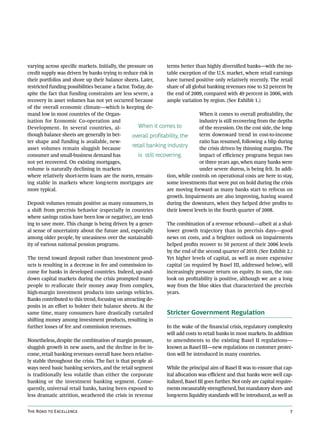
recovery in asset volumes has not yet occurred because            ample variation by region. (See Exhibit 1.)
of the overall economic climate—which is keeping de-
mand low in most countries of the Organ-                                           When it comes to overall profitability, the
isation for Economic Co-operation and                                              industry is still recovering from the depths
Development. In several countries, al-               When it comes to              of the recession. On the cost side, the long-
though balance sheets are generally in bet-       overall profitability, the       term downward trend in cost-to-income
ter shape and funding is available, new-                                           ratio has resumed, following a blip during
asset volumes remain sluggish because
                                                  retail banking industry          the crisis driven by thinning margins. The
consumer and small-business demand has               is still recovering.          impact of efficiency programs begun two
not yet recovered. On existing mortgages,                                          or three years ago, when many banks were
volume is naturally declining in markets                                           under severe duress, is being felt. In addi-
where relatively short-term loans are the norm, remain-           tion, while controls on operational costs are here to stay,
ing stable in markets where long-term mortgages are               some investments that were put on hold during the crisis
more typical.                                                     are moving forward as many banks start to refocus on
                                                                  growth. Impairments are also improving, having soared
Deposit volumes remain positive as many consumers, in             during the downturn, when they helped drive profits to
a shift from precrisis behavior (especially in countries          their lowest levels in the fourth quarter of 2008.
where savings ratios have been low or negative), are tend-
ing to save more. This change is being driven by a gener-         The combination of a revenue rebound—albeit at a shal-
al sense of uncertainty about the future and, especially          lower growth trajectory than in precrisis days—good
among older people, by uneasiness over the sustainabil-           news on costs, and a brighter outlook on impairments
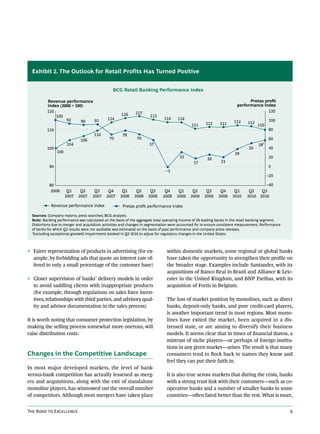
ity of various national pension programs.                         helped profits recover to 50 percent of their 2006 levels
                                                                  by the end of the second quarter of 2010. (See Exhibit 2.)
The trend toward deposit rather than investment prod-             Yet higher levels of capital, as well as more expensive
ucts is resulting in a decrease in fee and commission in-         capital (as required by Basel III, addressed below), will
come for banks in developed countries. Indeed, up-and-            increasingly pressure return on equity. In sum, the out-
down capital markets during the crisis prompted many              look on profitability is positive, although we are a long
people to reallocate their money away from complex,               way from the blue skies that characterized the precrisis
high-margin investment products into savings vehicles.            years.
Banks contributed to this trend, focusing on attracting de-
posits in an effort to bolster their balance sheets. At the
same time, many consumers have drastically curtailed              Stricter Government Regulation
shifting money among investment products, resulting in
further losses of fee and commission revenues.                    In the wake of the financial crisis, regulatory complexity
                                                                  will add costs to retail banks in most markets. In addition
Nonetheless, despite the combination of margin pressure,          to amendments to the existing Basel II regulations—
sluggish growth in new assets, and the decline in fee in-         known as Basel III—new regulations on customer protec-
come, retail banking revenues overall have been relative-         tion will be introduced in many countries.
ly stable throughout the crisis. The fact is that people al-
ways need basic banking services, and the retail segment          While the principal aim of Basel II was to ensure that cap-
is traditionally less volatile than either the corporate          ital allocation was efficient and that banks were well cap-
banking or the investment banking segment. Conse-                 italized, Basel III goes further. Not only are capital require-
quently, universal retail banks, having been exposed to           ments measurably strengthened, but mandatory short- and
less dramatic attrition, weathered the crisis in revenue          long-term liquidity standards will be introduced, as well as


The Road to Excellence                                                                                                         7
Exhibit 1. Retail’s Share of Global Banking Revenues Grew to 52 Percent in 2009


                                                   Retail share of global revenues, 2009 [2006] (%)


                                                                                  52
                                                                                 [49]
                                                                       48
                                                                      [51]


                Americas,                    Europe,                     Australia,                Middle East,                     Asia,
              2009 [2006] (%)             2009 [2006] (%)              2009 [2006] (%)            2009 [2006] (%)              2009 [2006] (%)


                                                                                 46
                41                                    52                        [70]                                                       28
               [42]      59                  48                          54                          47
                                                     [45]                                                                                 [38]
                        [58]                [55]                        [30]                        [39]      53                 72
                                                                                                             [61]               [62]


                Retail revenues
                                                                   Other banking businesses
                Retail revenues covered by database
    Source: BCG Retail Banking Database.
    Note: Retail shares based on segment reporting of banks in BCG’s Retail Banking Database of roughly 140 banks worldwide with retail banking
    involvement.


a leverage-ratio requirement. Basel III will be adopted
worldwide, creating a level playing field internationally.                             In the United States, a Raft of Regulation
However, national regulators will have discretion to
strengthen Basel III’s minimum requirements as they see
fit in their local jurisdictions. For example, this is expected                        In the United States, the Credit Card Accountability,
                                                                                       Responsibility, and Disclosure Act of 2009 aims to curb
to happen in Switzerland, where the relative size of the
                                                                                       excessive interest-rate hikes and hidden fees. It is ex-
major Swiss banks is seen to pose substantial risk to the                              pected to reduce card profits by $3 billion to $5 billion
country’s economy.                                                                     per year. The Durbin amendment aims to limit the in-
                                                                                       terchange fees that banks earn from their customers’
When it comes to new consumer-protection legislation,                                  debit-card transactions. Its impact on profitability will
although emerging regulatory patterns are similar across                               amount to about $10 billion per year. Regulation E
some countries, there is considerable variation in the top-                            was recently modified to require customers to “opt in”
ics covered and in the strictness of the proposed controls.                            for debit point-of-sale and ATM overdraft protection
                                                                                       on their demand-deposit accounts (also known as
(See the sidebar, “In the United States, a Raft of Regula-
                                                                                       DDAs or checking accounts). This measure will likely
tion.”) It is safe to say, however, that the main themes are                           reduce profits by between $12 billion and $15 billion
the following:                                                                         per year. Finally, with the establishment of the new
                                                                                       Consumer Financial Protection Board, the industry is
◊ Increased transparency on product design in terms of                                 facing the prospect of additional compliance costs
  the description of product details and pricing (for ex-                              and potential further curtailment of overdraft and oth-
  ample, to avoid fine-print surprises such as up-front                                er fee sources. Overall, the combined effect of the new
                                                                                       legislation will be a sharp reduction in banks’ return
  commissions, hidden fees, and penalties for actions
                                                                                       on equity.
  like early redemptions)


8                                                                                                                      The Boston Consulting Group
Exhibit 2. The Outlook for Retail Profits Has Turned Positive


                                                 BCG Retail Banking Performance Index

          Revenue performance                                                                                                  Pretax profit
          index (2006 = 100)                                                                                             performance index
          120                                                 117                                                                       120
              100                                     116             115
                   92         91              114                              114     114                                                  100
                           90                                                                                          112     112
                                                                                               111     112     111                   110
          110                                                                                                                               80
                                      110             78
                              106              70              70                                                                           60
                       104                                            57                                                              581
          100                                                                                                                   50          40
                 100                                                                                                    39
                                                                                        32              26                                  20
                                                                                                17              21
            90                                                                                                                              0
                                                                                –1
                                                                                                                                            –20

            80                                                                                                                         –40
             2006       Q1     Q2     Q3      Q4      Q1      Q2      Q3       Q4      Q1      Q2      Q3      Q4      Q1       Q2   Q3
                       2007   2007   2007    2007    2008    2008    2008     2008    2009    2009    2009    2009    2010     2010 2010

             Revenue performance index                Pretax profit performance index

  Sources: Company reports; press searches; BCG analysis.
  Note: Banking performance was calculated on the basis of the aggregate total operating income of 26 leading banks in the retail banking segment.
  Distortions due to merger and acquisition activities and changes in segmentation were accounted for to ensure consistent measurement. Performance
  of banks for which Q3 results were not available was estimated on the basis of past performance and company press releases.
  1
   Excluding exceptional goodwill impairments booked in Q3 2010 to adjust for regulatory changes in the United States.


◊ Fairer representation of products in advertising (for ex-                     within domestic markets, some regional or global banks
  ample, by forbidding ads that quote an interest rate of-                      have taken the opportunity to strengthen their profile on
  fered to only a small percentage of the customer base)                        the broader stage. Examples include Santander, with its
                                                                                acquisitions of Banco Real in Brazil and Alliance & Leic-
◊ Closer supervision of banks’ delivery models in order                         ester in the United Kingdom, and BNP Paribas, with its
  to avoid saddling clients with inappropriate products                         acquisition of Fortis in Belgium.
  (for example, through regulations on sales force incen-
  tives, relationships with third parties, and advisory qual-                   The loss of market position by monolines, such as direct
  ity and advisor documentation in the sales process)                           banks, deposit-only banks, and pure credit-card players,
                                                                                is another important trend in most regions. Most mono-
It is worth noting that consumer protection legislation, by                     lines have exited the market, been acquired in a dis-
making the selling process somewhat more onerous, will                          tressed state, or are aiming to diversify their business
raise distribution costs.                                                       models. It seems clear that in times of financial duress, a
                                                                                mistrust of niche players—or perhaps of foreign institu-
                                                                                tions in any given market—arises. The result is that many
Changes in the Competitive Landscape                                            consumers tend to flock back to names they know and
                                                                                feel they can put their faith in.
In most major developed markets, the level of bank-
versus-bank competition has actually lessened as merg-                          It is also true across markets that during the crisis, banks
ers and acquisitions, along with the exit of standalone                         with a strong trust link with their customers—such as co-
monoline players, has winnowed out the overall number                           operative banks and a number of smaller banks in some
of competitors. Although most mergers have taken place                          countries—often fared better than the rest. What is more,


The Road to Excellence                                                                                                                                9
any limitations on the day-to-day operations of major fi-         the most attractive (least risky) customers whom the
nancial institutions brought about by government guar-            bank knows well. Moreover, and needless to say, there are
antees and shareholdings have not proved very onerous.            market-by-market nuances in the ways in which product
Many governments seem to have adopted a relatively                roles are changing.
hands-off attitude, hoping that banks will work their way
back to better financial health. The future divestiture of        Deposit Accounts. For many years, savings accounts pro-
government shareholdings in some banks, particularly in           vided wide margins from long-standing customers and
Europe, may offer further acquisition op-                                         opportunities to manage margins with
portunities for retail banks with regional        Financial institutions          new customers. Funding was mainly an af-
or international ambitions.                                                       terthought. Now, with profit margins gen-
                                                  realize that they have
                                                                                  erally being squeezed—although they
                                                   to raise their game            have improved since the worst days of the
Changes in Customer                                 in terms of overall           crisis—savings accounts have become pri-
Behavior and Expectations                                                         marily a funding vehicle for the asset side
                                                         reliability.             of the balance sheet. Duration is rewarded
The recent focus on transparency in bank-                                         much more than it was in the past (for cus-
ing, which has benefited institutions that have managed           tomers, but also internally, in the transfer prices paid on
to develop deeper goodwill with their customers, is just          the stickiest balances).
one facet of a more general shift in customer attitudes,
behavior, and expectations. By and large, customers are           Checking Accounts. In the past, checking accounts en-
more guarded, more circumspect, and more in need of               joyed standalone profitability in most countries, provided
clear communication and reassurance. They expect clar-            a source of new customers, and represented an anchor
ity and full disclosure. And although switching retail            product for cross-selling. The key metric was volume and
banks is often a burdensome process for customers—a               price realization. Today, checking accounts have become
fact that in the past has made some dissatisfied clients          an important funding source for assets and a vehicle for
think twice about “voting with their feet” and changing           maintaining long-term relationships with high-value cus-
banks—financial institutions realize that they have to            tomers. The key metric is customer quality and the depth
raise their game in terms of overall reliability.                 of the relationship. These accounts are increasingly criti-
                                                                  cal for data gathering, credit underwriting, and providing
Indeed, in the post-recession era, deepening customer re-         frequent customer touchpoints. The strongest banks are
lationships will principally be about the fundamental is-         investing heavily in good customer on-boarding and up-
sue of trust. The financial crisis was a crisis not just of       selling processes, and they are increasingly pricing for re-
markets but also of confidence in the banking industry as         lationship value. Indeed, the growth of high-quality cur-
a whole. Many consumers felt disappointed, disillusioned,         rent accounts is more critical than ever to building
even exploited by their financial institutions.                   primary, multiproduct banking relationships.

                                                                  Unsecured Credit. Traditionally, cards and loans were
The Shifting Roles of Products                                    cross-sold to checking account, deposit, and mortgage
                                                                  customers—at increasingly thin (and sometimes nega-
Changing business models, largely prompted by the crisis,         tive) margins—to solidify the banking relationship.1 They
have had important implications for retail banking prod-          were vehicles for lucrative fee-income and payment-pro-
ucts. Many institutions have shifted away from a simplis-         tection premiums. Today, they are a source of wider mar-
tic, volume-driven focus on new-customer acquisition, in-         gins in the core product itself, funded by the liability side
stead placing more emphasis on the quality of the                 of the balance sheet. Payment protection income has dis-
customers acquired and the lifetime value they create.            appeared in many markets, seriously challenging the fun-
This shift has been reflected in the roles that individual
products play and how they are positioned and priced.
                                                                  1. This has not generally been the case in the U.S. market, where
On the asset side, in particular, there has been a notable        unsecured credit has traditionally been managed in product silos or
return to “in franchise” lending, with loans reserved for         monolines.


10                                                                                                The Boston Consulting Group
damental business economics. As banks attempt to rec-         of deepening customer relationships and value—both
tify the loose credit standards of the recent past—and the    now and in the medium term. In the United States, how-
havoc those standards wrought—they are placing greater        ever, there are reasons to fear a rapid return of the credit
emphasis on managing underwriting risk. Banks are in-         cycle as banks look for scarce opportunities to gather as-
vesting heavily not only in better front-end scorecards       sets and the most creditworthy businesses remain reluc-
but also in more differentiated treatment of customers        tant to borrow.
going through the bad-debt process.
                                                              Obviously, Basel III will have an impact on the future
Mortgages. In many markets, mortgages used to be a            characteristics and dynamics of certain retail-banking
source of margin from long-standing customers and a           products.
means of acquiring new customers. Losses were minimal
as housing prices escalated. Today, mortgages are a game


                                                              I
of microsegments for new customers—constrained by
funding and compromised by risk, but with wider mar-               n order to respond to the new environment in retail
gins across the book. There are some early signs of in-            banking, the best players will need to push their per-
creasing competitive pressure from the stronger players,           formance to the next level along two broad dimen-
but it will take several years for sufficient balance-sheet   sions: operational excellence and customer excellence. In-
capacity to wear away today’s high spreads. Regulatory        deed, it will become increasingly critical for retail banks
intervention and more-stringent risk processes have re-       to have highly efficient yet flexible operating models
moved many of the market’s excesses. We expect this to        amid continuing margin pressure. At the same time,
remain the case in the medium term but are equally con-       banks will need to achieve a far higher level of customer-
vinced that the cycle will return as memories fade.           centricity, trustworthiness, and overall service excellence
                                                              if they hope to thrive in the post-crisis environment. In
SME Banking. In the recent past, small- and medium-           the next two chapters, we explore these dimensions in
enterprise (SME) banking was a transactional and lend-        detail.
ing-based business with very low loan losses, low funding
costs, and many options for highly profitable growth in
specialized lending. The key metric was book size. Today,
SME banking remains attractive as a relationship-based,
full-service business. Deposit gathering is highly compet-
itive, but specialist lending offers high returns in ex-
change for high risk. In a balance-sheet-constrained
world, skillful SME lending can be a very powerful source


The Road to Excellence                                                                                                 11
Operational Excellence
                  Becoming a Process and Productivity Leader


T
           he Boston Consulting Group recently con-            The Profile of a Process and Productivity
           ducted an operational-performance bench-            Leader
           marking of 12 of the top 30 retail banks
           across North America, Europe, and Asia-Pa-          Our benchmarking indicates that no bank has achieved
           cific. Altogether, these 12 banks account for       excellence across all three levers and underlying capabil-
roughly 450 million customers, 51,000 branches, and            ities. But top retail banks are striving for this goal.
more than $14.5 trillion in assets.
                                                               A Streamlined Organization. In the best banks, a large
Each bank is unique—a product of its own history and           majority of employees are dedicated to customer-facing
the nature of its principal markets. But a number of im-       sales and service activities. (See Exhibit 3.) Processing is
portant insights can be drawn from the ways in which           centralized in a small number of centers across regions.
these institutions approach processes and productivity         Sales, product, and operations management functions
and how these approaches influence their overall retail-       are lean, keeping overhead expenses extremely low.
banking strategies.                                            These banks carefully investigate subscale, repetitive, and
                                                               nondifferentiating activities for sustainable outsourcing
While typical operational-benchmarking exercises focus         possibilities. They explore in-sourcing for activities where
on back-office processes and metrics, our effort took a        scale provides a competitive advantage. And when reli-
comprehensive, end-to-end perspective. This exercise,          able, mature vendors are available, they near- or offshore
along with our client work for financial institutions glob-    some activities to low-cost locations.
ally, has enabled us to identify three key levers that banks
must utilize in order to achieve operational excellence.       Efficient and Effective Processes. Process and produc-
They must streamline the organization, develop efficient       tivity leaders embrace a high level of industrialization,
and effective processes, and improve overall end-to-end        characterized by simplified, standardized processes that
performance. We have also found that these levers must         maximize the number of new accounts and loan deci-
be supported by some core, underlying capabilities that        sions per operations full-time equivalent (FTE). (See Ex-
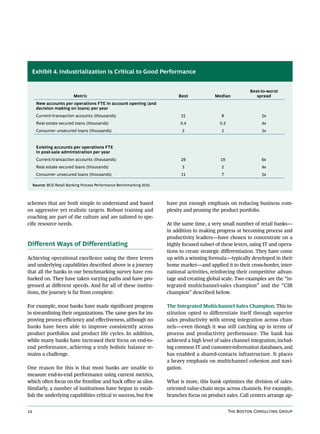
create winning conditions.                                     hibit 4.) Activities are shared across products and chan-
                                                               nels, typically starting within product families. Processes
Overall, our benchmarking revealed a wide range in per-        and data flows are designed for quality assurance of in-
formance among banks, reflecting the vast potential for        puts, as opposed to repetitive quality-control checks. Proc-
improvement. Below, we first examine the profile of a          essing is channel and location agnostic.
process and productivity leader. How would such a bank
look in terms of these three levers and the necessary un-      The best banks also possess a high level of process auto-
derlying capabilities? We then look at two players that        mation that features straight-through processing (STP).
have used a narrow set of sublevers to push the boundar-       Up to 90 percent of new-account openings and 70 percent
ies of excellence, allowing them to create and export stra-    of consumer unsecured-credit originations are processed
tegic differentiation.                                         with STP. Such banks are capable of automated decision


12                                                                                          The Boston Consulting Group
Exhibit 3. At Top Banks, the Majority of FTEs Are Customer Facing

                                             1
                        FTE activites (%)
                        100

                                                        82
                         80
                                        69

                         60


                         40

                                                                                 24
                         20
                                                                                                 10
                                                                                                                   7
                                                                                                                               3
                          0
                                         Sales and service                          Operations                     Management

             Best-to-worst                       1.5x                                    3x                            4.5x
             spread

                  Median           Best2

  Source: BCG Retail Banking Process Performance Benchmarking 2010.
  Note: Totals do not add up to 100 because no one bank had the best performance in all of the three activities.
  1
   Full-time equivalents do not include corporate functions, such as risk, finance, HR, and IT.
  2
   “Best” is defined as the highest level of performance in each standalone activity.


making at the point of interaction with the customer.                              right” interactions across channels. These interactions are
Workflow-enabled processes with prepopulation of re-                               codified in explicit service-level agreements, differentiated
quired documentation, intelligent validation, skill-based                          by client segment where appropriate. (See the next chap-
routing, and minimized data entry are the norm.                                    ter for a discussion of overall customer excellence.)

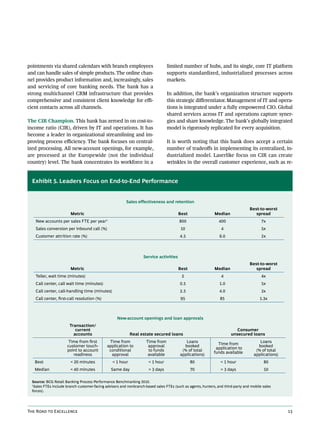
End-to-End Performance Focus. Process and productiv-                               Underlying Capabilities That Create Winning Condi-
ity leaders focus on end-to-end sales and service effec-                           tions. Process and productivity leaders create winning
tiveness, including excellence in new-account openings                             conditions inside their organizations that enable opera-
and loan approvals, applying a holistic approach to                                tional excellence. They manage down business complex-
streamlining processes and interfaces across the frontline                         ity in order to reduce fragmented demands on resources
and operations. (See Exhibit 5.) This approach includes                            and systems, shorten time to market, and facilitate sales
using the tools and processes necessary to enable front-                           force training. They routinely examine and prune their
line staff to focus on customers (instead of on low-value                          product portfolios. They achieve a high degree of opera-
administrative tasks). It also fosters efficient multichan-                        tional harmonization across channels, business units, and
nel lead generation and routing, as well as scripted and                           regions.
systematic approaches to sales—with an emphasis on
products that generate “stickiness.”                                               Another way that these banks foster winning conditions
                                                                                   is through rigorous and systematic performance manage-
Such banks leverage common sales and servicing plat-                               ment across sales and operations. The result is a produc-
forms, including customer relationship management                                  tivity culture within the bank that supports efficient
(CRM) systems, to deliver relevant information succinctly                          growth. This involves setting expectations clearly and
and with minimal complexity. Customer service is effi-                             succinctly, adopting highly transparent and continuous
cient and effective, with consistent, high-quality, “first time                    performance monitoring, and developing incentive


The Road to Excellence                                                                                                                       13
Exhibit 4. Industrialization Is Critical to Good Performance


                                                                                                                Best-to-worst
                           Metric                                             Best             Median              spread
      New accounts per operations FTE in account opening (and
      decision making on loans) per year
      Current/transaction accounts (thousands)                                 31                 8                  5x
      Real estate secured loans (thousands)                                    0.4               0.2                 4x
      Consumer unsecured loans (thousands)                                      3                 2                  3x


      Existing accounts per operations FTE
      in post-sale administration per year
      Current/transaction accounts (thousands)                                 29                 19                 6x
      Real estate secured loans (thousands)                                     3                 2                  4x
      Consumer unsecured loans (thousands)                                     11                 7                  5x

     Source: BCG Retail Banking Process Performance Benchmarking 2010.


schemes that are both simple to understand and based                     have put enough emphasis on reducing business com-
on aggressive yet realistic targets. Robust training and                 plexity and pruning the product portfolio.
coaching are part of the culture and are tailored to spe-
cific resource needs.                                                    At the same time, a very small number of retail banks—
                                                                         in addition to making progress at becoming process and
                                                                         productivity leaders—have chosen to concentrate on a
Different Ways of Differentiating                                        highly focused subset of these levers, using IT and opera-
                                                                         tions to create strategic differentiation. They have come
Achieving operational excellence using the three levers                  up with a winning formula—typically developed in their
and underlying capabilities described above is a journey                 home market—and applied it to their cross-border, inter-
that all the banks in our benchmarking survey have em-                   national activities, reinforcing their competitive advan-
barked on. They have taken varying paths and have pro-                   tage and creating global scale. Two examples are the “in-
gressed at different speeds. And for all of these institu-               tegrated multichannel-sales champion” and the “CIR
tions, the journey is far from complete.                                 champion” described below.

For example, most banks have made significant progress                   The Integrated Multichannel-Sales Champion. This in-
in streamlining their organizations. The same goes for im-               stitution opted to differentiate itself through superior
proving process efficiency and effectiveness, although no                sales productivity with strong integration across chan-
banks have been able to improve consistently across                      nels—even though it was still catching up in terms of
product portfolios and product life cycles. In addition,                 process and productivity performance. The bank has
while many banks have increased their focus on end-to-                   achieved a high level of sales channel integration, includ-
end performance, achieving a truly holistic balance re-                  ing common IT and customer-information databases, and
mains a challenge.                                                       has enabled a shared-contacts infrastructure. It places
                                                                         a heavy emphasis on multichannel cohesion and navi-
One reason for this is that most banks are unable to                     gation.
measure end-to-end performance using current metrics,
which often focus on the frontline and back office as silos.             What is more, this bank optimizes the division of sales-
Similarly, a number of institutions have begun to estab-                 oriented value-chain steps across channels. For example,
lish the underlying capabilities critical to success, but few            branches focus on product sales. Call centers arrange ap-


14                                                                                                     The Boston Consulting Group
pointments via shared calendars with branch employees                             limited number of hubs, and its single, core IT platform
and can handle sales of simple products. The online chan-                         supports standardized, industrialized processes across
nel provides product information and, increasingly, sales                         markets.
and servicing of core banking needs. The bank has a
strong multichannel CRM infrastructure that provides                              In addition, the bank’s organization structure supports
comprehensive and consistent client knowledge for effi-                           this strategic differentiator. Management of IT and opera-
cient contacts across all channels.                                               tions is integrated under a fully empowered CIO. Global
                                                                                  shared services across IT and operations capture syner-
The CIR Champion. This bank has zeroed in on cost-to-                             gies and share knowledge. The bank’s globally integrated
income ratio (CIR), driven by IT and operations. It has                           model is rigorously replicated for every acquisition.
become a leader in organizational streamlining and im-
proving process efficiency. The bank focuses on central-                          It is worth noting that this bank does accept a certain
ized processing. All new-account openings, for example,                           number of tradeoffs in implementing its centralized, in-
are processed at the Europewide (not the individual                               dustrialized model. Laserlike focus on CIR can create
country) level. The bank concentrates its workforce in a                          wrinkles in the overall customer experience, such as re-


  Exhibit 5. Leaders Focus on End-to-End Performance


                                                         Sales effectiveness and retention
                                                                                                                                  Best-to-worst
                        Metric                                                          Best                 Median                  spread
    New accounts per sales FTE per year1                                                 800                    400                      7x
    Sales conversion per inbound call (%)                                                10                      4                       5x
    Customer attrition rate (%)                                                          4.5                    6.0                      2x


                                                                   Service activities
                                                                                                                                  Best-to-worst
                        Metric                                                          Best                 Median                  spread
    Teller, wait time (minutes)                                                           2                      4                       4x
    Call center, call wait time (minutes)                                                0.5                    1.0                      5x
    Call center, call-handling time (minutes)                                            2.5                    4.0                      2x
    Call center, first-call resolution (%)                                               95                      85                     1.3x


                                                    New-account openings and loan approvals
                        Transaction/
                           current                                                                                        Consumer
                          accounts                          Real estate secured loans                                  unsecured loans
                       Time from first         Time from             Time from              Loans                                      Loans
                                                                                                               Time from
                      customer touch-         application to          approval             booked                                     booked
                                                                                                              application to
                      point to account         conditional            to funds            (% of total                                (% of total
                                                                                                             funds available
                         readiness              approval              available          applications)                              applications)
   Best                 < 20 minutes             < 1 hour             < 1 hour                 80                < 1 hour                 80
   Median               < 40 minutes            Same day              > 3 days                 70                > 3 days                 50

  Source: BCG Retail Banking Process Performance Benchmarking 2010.
  1
   Sales FTEs include branch customer-facing advisors and nonbranch-based sales FTEs (such as agents, hunters, and third-party and mobile sales
  forces).


The Road to Excellence                                                                                                                              15
duced online functionality after an acquisition or a thin-     has yet become a full-fledged leader in this area, the
ner product range following standardization of the port-       scope of the opportunity is leading many banks to em-
folio. Also, a centralized, global model combined with         bark on multiyear efforts to raise their operational game.
tight cost controls can delay important strategic invest-      Cutting-edge banks have made such initiatives a high pri-
ments across the enterprise.                                   ority, pushing them to the top of their leadership
                                                               agendas.


T
                                                               We strongly believe that banks should continue this en-
       he banking industry’s recent focus on managing          deavor. Better still, they should accelerate their efforts
       out of the crisis proves that cost reduction alone is   and investments in order to reach a high level of opera-
       not enough. Succeeding in the new environment           tional excellence as quickly as possible. Those that do will
clearly requires excellence in process and productivity.       not only reap vast benefits but also create the ability to
Although our experience with clients and our bench-            sustain them.
marking survey show that none of the top retail banks


16                                                                                          The Boston Consulting Group
Customer Excellence
                                    Reaching the Highest Level


W
                      e have already gone on the record        efits may relate to cost, service, convenience, transparen-
                      regarding a number of steps that re-     cy, high rates on savings accounts, or other features. Top-
                      tail banks need to take in order to      tier banks emphasize simple, targeted relationship
                      win in the postcrisis era. (See The      propositions—the more targeted, the better. They devel-
                      Near-Perfect Retail Bank, BCG White      op creative marketing initiatives that focus on specific
Paper, November 2009.) But as the industry has evolved,        customer segments. For instance, affluent women and
the need for further actions has become clear. In fact, it     ethnic minorities sometimes require a specialized ap-
is not sufficient for leading institutions to be merely        proach to their financial needs. Relatively few institutions
“near perfect” in terms of customer excellence. They           have developed products and services specifically de-
must become “truly perfect”—or as close to that ideal          signed for such segments, but many that have done so—
as possible. Initiatives undertaken to achieve this goal       and marketed their offerings intelligently—have been
are highly relevant not only for top-tier banks seeking to     glad that they did. (See Leveling the Playing Field: Upgrad-
take their game to the next level, but also for second-        ing the Wealth Management Experience for Women, BCG
and third-tier banks, which should analyze their               White Paper, July 2010.)
strengths and weaknesses relative to leading players in
order to identify best practices and key priorities for        Optimize branch networks. There are some basics that
gradually raising their performance level. For leading         too many banks seem to ignore. For instance, banks need
banks, however, the first step is to ensure that they main-    to redesign and develop branch networks in order to
tain their top-tier status.                                    achieve just the right density in both urban and subur-
                                                               ban locales, with carefully chosen formats aimed at max-
                                                               imizing visibility and attracting both established custom-
The First Step: Remaining a Near-Perfect                       ers and passersby. Interiors should be light and bright
Retail Bank                                                    with clear, user-friendly signage. A greeter should always
                                                               be on duty to welcome and direct customers, to help max-
Much of what is required to remain a near-perfect bank         imize utilization of sales and service personnel, and to
will be familiar. What distinguishes such banks from their     drive usage of ATMs, IDMs, telephones, and Internet
less effective peers in achieving customer excellence is at-   points. Flexible formats with extended hours of opera-
tention to detail and quality of execution.                    tion, sometimes staffed but otherwise consisting of digital
                                                               self-service kiosks, can offer 30 to 50 percent more conve-
Make marketing meaningful. Effective marketing cam-            nience to customers.
paigns drive traffic to all channels and do not waste time
boasting about how large, wise, international, or steeped      Drive sales force effectiveness. Sales force diaries
in tradition the bank is. Best-practice banks carry out        should be 80 percent prebooked, with appointments con-
marketing that means something—sending crystal-clear           firmed by phone the previous day. A daily process and
messages about the benefits they can provide that will         rhythm at each branch should motivate employees to fill
make a tangible difference in people’s lives. These ben-       those diaries, to manage the “show rate,” and to develop


The Road to Excellence                                                                                                  17
well-thought-out sales pitches that lead to high conver-         small number of layers—seven, at most—and wide spans
sion rates and multiple product sales at each interaction        of control of eight or more. Such banks have relatively
with potential customers. Highly automated pricing dis-          low overhead. This type of structure can thrive if there
ciplines linked to specific products, with clearly targeted      are energetic and motivational leaders who promote a
returns, should be adopted—as should preapproved,                high degree of single-point accountability and clear deci-
easy-to-acquire offers to existing customers.                    sion rights. Local empowerment, more-direct lines of
                                                                 communication, and faster decision making are all criti-
Enable seamless multichannel naviga-                                            cal and help reduce complaints as well as
tion. This is a must, not a choice. And it is                                   improve customer outcomes.
not exactly a new idea: many retailers             Customer navigation
have been multichannel since the nine-                across channels
teenth century. But the bar is rising, and                                      Completing the Journey:
the gap between the best and the rest is
                                                   should, above all, be        Achieving Truly Perfect
widening. Customer navigation across                  simple and easy.          Customer Excellence
channels—principally, branches, the Inter-
net, and call centers—should, above all, be                                     We have observed that most leading banks
simple and easy. There should be no more than one log-          pursue some of the above goals and that a handful of the
in process for safe and reliable identification and verifica-   very best institutions pursue them all. But in virtually ev-
tion, and one telephone number for customer assistance.         ery case, execution is less sharp than it could be. Indeed,
Digital devices should involve a simple user interface that     the CEO of one top retail bank once commented that he’d
lends itself to intuitive navigation. Extra bells and whis-     rather have decent execution than a brilliant strategy
tles that can add complexity should be avoided. The key         any day.
is for channels to support, not compete with, one another
and for customer pathways to be obvious. Also, not every        So what must top-tier banks do to move from being near
function for every product in every channel must be             perfect to truly perfect? Acknowledging that no bank can
available 24-7.                                                 do everything flawlessly and that some choices invariably
                                                                have to be made, we believe that even the best retail
Set clear expectations and deliver on them. Service             banks can take steps toward significant improvement in
standards that drive true satisfaction, retention, and ad-      customer excellence. Sharper execution, which we see as
vocacy are built on deep insight regarding the touch-           the great differentiator, is the key.
points for each product and process that matter most to
the customer. Banks should strive for high levels of first-     Combine sales and service excellence with low costs.
contact resolution (above 80 percent), while acknowledg-        Many banks that forged their identities by emphasizing
ing that a single handoff can be more effective for certain     just one dimension of the overall operational model have
products. Most customers, for example, expect quick re-         come and gone. For example, there was a time not so
sponses about recent transactions or balances from their        long ago when a lot of banks tried to be “sales machines”
first call-center contact. They also expect to be able to       that embraced an aggressive sales culture. Others concen-
shift funds between accounts in order to pay a credit card      trated on service and convenience. Still others flew the
bill. But they do not necessarily expect to be able to pay      low-cost banner. Indeed, cost has always been something
down their mortgage or open an investment account               of a sine qua non for retail banks. Those that were not
without being passed on to a specialist. A defining fea-        highly efficient could not sustainably compete. The prob-
ture of top retail banks is that they set expectations with     lem was that low-cost players often had high levels of
respect to service levels and turnaround times—and              churn or attrition owing to poor customer service.
meet them 99.999 percent of the time (the Six Sigma
goal).                                                          Today, however, it is no longer an option to concentrate
                                                                on just one piece of the puzzle. Truly perfect retail banks
Streamline the organization. Banks need to be stream-           know that they will have to fit all the pieces together if
lined not only on the operations side but across the over-      they hope to achieve real competitive advantage. They
all organization. The best banks are characterized by a         will need to excel at sales force effectiveness, have smooth


18                                                                                           The Boston Consulting Group
service processes, run efficient operations in engineered          Take another example. If a customer downloads a mort-
process factories, manage wide spans of control, and               gage application to complete offline, the bank should
maintain low overhead, all at the same time—and they               make sure to capture the contact details. Then, if the form
will have to do it all smartly.                                    is not submitted within a certain period, the bank can
                                                                   contact the customer to offer help—which can also serve
Take multichannel excellence to the next level. Tak-               to deepen the relationship.
ing multichannel excellence to the next level goes beyond
making sure that channels are not compet-                                            Prepare for the digital-banking deluge.
ing with each other and that access to cus-                                          Over the next five to ten years, there will
tomer information is open and unified. It            Over the next five to           likely be an explosion in digital banking
also means monitoring channel usage and               ten years, there will          built on the growing popularity and func-
using the data gathered to push leads and                                            tionality of the latest generation of hand-
close the loop on them. It means shifting
                                                    likely be an explosion           sets such as the iPhone. In our view, the
from a passive approach—merely display-                in digital banking.           increasing use of these devices will not
ing products “on the shelf”—to proactive,                                            dramatically reduce traffic in branches. In
sales-oriented, multichannel lead manage-                                            fact, as in other retail industries, digital
ment. Among today’s leading banks, Lloyds Banking                   handsets can be leveraged to attract desirable customers
Group does this particularly well.                                  who need advice—especially about complex products or
                                                                    overall financial planning. At the very least, there could
In the future, banks will need to direct leads and informa-         well be a big prize in terms of “prequalifying” custom-
tion flow regarding sales and service transactions to their         ers—making sure that they are ready to have the conver-
customers’ preferred points of interaction. And that                sations about their financial needs that banks think they
means every channel—branches, call centers, mobile                  should be having—and thereby increasing the effective-
banking, and the Internet. It is also important to send co-         ness and reducing the unit cost of each interaction.
herent and consistent messages via direct mail, mobile
sales forces, and authorized agents, as well as through             That said, the growth of digital banking could significant-
print and TV advertising.                                           ly reduce volume and change the nature of interactions
                                                                    at call centers, and perhaps over the Internet as well. But
Multichannel excellence is also about providing choice,             digital banking is likely to increase the overall number of
convenience, and value for the customer—including eas-              interactions between customers and their banks, so it
ier access, reduced purchase risk, and better price trans-          may not lead to significant cost reduction in other chan-
parency. Banks can gain a higher share of wallet, in terms          nels. Banks must develop a careful and far-reaching strat-
of both frequency of purchase and ticket value, improv-             egy for capturing the long-term opportunity that digital
ing cost efficiency through higher capacity utilization             banking represents. Among current institutions, Bank of
across channels. A sharper brand image and better cus-              America appears to be ahead of the pack in this arena.
tomer acquisition are part of the overall picture.
                                                                    As for social networking, those banks that have been
What is more, boundaries are blurring because consumers             brave enough to embrace this trend are already reaping
don’t typically “belong” to any one channel. They tend ei-          the benefits of rapid, candid feedback from customers.
ther to find what they are looking for online and then buy          Some banks are discovering that their customers trust the
offline—or the reverse. They want to “learn, buy, and use”          recommendations of their friends more than they trust
across several channels. Thus, a sophisticated bank will            the bank—but to good effect. A few leading players are
present a personalized offer of a preapproved credit card           starting to experiment with location-based services, ex-
in the right channel at the right time. If the customer ex-         ploiting the capability to pinpoint the geographic position
presses interest, the bank will then offer a selection of ful-      of mobile devices.
fillment channels on the basis of the customer’s historical
preferences and behavior. But this approach only works if           Create a truly differentiated customer experience.
the navigation pathways are built in such a way that the            The truth is that banks are generally quite similar in
customer can easily complete the process.                           terms of customer service—in most cases, not very good.


The Road to Excellence                                                                                                        19
This state of affairs is often made worse by setting expec-     ness and earn his or her trust. Obviously, the primary
tations that cannot consistently be met. Obviously, as dis-     checking or current account is the anchor of the relation-
cussed above, knowing which touchpoints matter most to          ship. Because of the cross-selling opportunities these ac-
customers, keeping prices as low as practicable, and mak-       counts present, customers who hold them are up to 10
ing identification and verification processes simple and        times more profitable than those who do not—and up to
easy are critically important. So are maintaining one “go       25 percent less likely to have overdraft or default difficul-
to” phone number, resolving problems fast and with min-         ties. By knowing when salaries and bonuses are typically
imal handoffs, and identifying and making                                      paid in and when significant payments for
the most of those all-important “moments                                       mortgages, car loans, and other expenses
of truth” that shape customer opinion.                                         are usually paid out, and by factoring in
                                                  The truly perfect retail
                                                                               the pattern of everyday expenditures,
But the truly perfect retail bank of the fu-      bank of the future will      banks can help customers manage their fi-
ture will be more proactive. It will warn          be more proactive.          nances more effectively.
customers of potential overdraft scenarios.
It will help them figure out whether they                                         Truly perfect banks will develop highly re-
can afford to buy the car or house that                                           fined access to behavioral information via
they covet and suggest an appropriate level of savings            customers’ use of direct-debit standing orders and debit
based on their income. It will recommend moving to bet-           cards. They will be able to observe turnover, average min-
ter tariffs or rates on its products—perhaps turning a            imum and maximum balances, and patterns of channel
very minor pricing issue into greater customer loyalty. It        use, all of which they can leverage to make useful and rel-
will encourage customers to plan all of their financial af-       evant offers in a convenient and nonintrusive manner. In
fairs in a one-stop shop.                                         the past, some banks used behavioral information to
                                                                  their customers’ detriment, but the future will be all
In addition, the truly perfect retail bank will not repeat-       about improving the customer relationship.
edly ask customers for (extra) identification, proof of
earnings or address, or the ages of their children, because       Capture and truly leverage customer data. This initia-
it will have captured, calculated, and validated all the in-      tive may be the most important of all. Without it, differ-
formation it needs to serve the customer—unobtrusively            entiating the customer experience and deepening custom-
and respectfully—at the outset of the relationship. It will       er relationships are much more difficult. Of course, it’s no
make decisions on the basis of the complete relation-             revelation that banks possess copious amounts of data.
ship—not just one product. For example, modifying an              What is less well known is that most banks struggle might-
existing account or opening a new one will be as simple           ily to glean truly valuable intelligence or insight into their
as a click on a handset or a yes or no at a branch or on          customers. Banks need to capture comprehensive custom-
the phone. No paperwork, no signature, no hassle.                 er information, update it continually, and understand it in
                                                                  a holistic way that builds in underwriting risk and appro-
What is more, advice—traditionally provided face-to-face          priate pricing. Over the past decade, a handful of banks—
or on the phone—presents another real opportunity for             among them, BNP Paribas—have painfully (but fruitfully)
differentiation. In the future, we expect to see a lot more       taken the necessary steps to set themselves apart in terms
self-help. Some leading banks have successfully intro-            of capturing and leveraging customer data. They know
duced opportunities for their customers to learn and even         which type of information they need, harvest it carefully,
to be entertained. Such offerings can range from simple           store it safely, keep it current—and, above all, use it pro-
how-to guides to sophisticated comparisons with people            actively to cross-sell, improve the customer experience,
in other demographics or professions—how they tend to             and deepen relationships.
save, invest, or finance their purchases most effectively.
                                                                  By developing such built-in intelligence, top-tier banks
Turn a better customer experience into a deeper re-               will not only know which of the bank’s own products a
lationship. It is only by being fair, transparent, and truly      customer holds, but also, by analyzing payment traffic,
committed to helping customers that retail banks can              have a fair idea of what that customer holds in other in-
earn the right to handle all or most of a customer’s busi-        stitutions. Such banks will understand the customer’s


20                                                                                              The Boston Consulting Group
preferences and patterns of channel use and be able to          Use customer excellence as an antidote to regulation.
propose financial solutions that are reliable and trustwor-     Many, if not all, retail banks are genuinely afraid of regu-
thy in the eyes of both frontline colleagues and custom-        latory intervention. In our view, customer excellence in
ers. One caveat is that in some markets, the extent of per-     retail banking could be the ultimate defense.
missible data collection may be restricted by regulation.
                                                                Due-diligence steps such as “know your customer” just
Break the tradeoff between procedures and people.               scratch the surface. Banks that take the time to thorough-
In the past, some banks developed models based explic-          ly document their customers’ profiles—such as their de-
itly on people and the roles and authority that they            mographic characteristics, attitude toward risk, product
have—basically, a bottom-up approach. Other banks de-           history and preferences, channel behavior, and financial
veloped models that were much more procedural and               boundaries and limitations—and that continually update
top-down. But as customer-centricity comes increasingly         such information may find themselves less troubled by
to the fore, the best banks are trying to combine the best      regulation because they really do know their customers
of both models.                                                 and act in their interests, which is what regulators care
                                                                about most.
On the sales side, this implies highly disciplined proce-
dures that guide the actions of advisors. Such procedures       Such banks aim to educate their customers first. They ad-
do not allow them much freedom to decide, for example,          vertise honestly and don’t gouge. Their products do what
when or how to conduct a client meeting. Yet, at the same       they say “on the label” and have a transparent and fair
time, banks are granting advisors wider latitude in con-        pricing structure, without cross-subsidies—all leading to
ducting client conversations, depending on their own ex-        a high level of “cross buying,” as opposed to cross-selling.
pertise, the client’s profile, and other factors. The same is   They enable simple account opening and servicing that,
true in call centers, where some banks have stopped fo-         ideally, is fully automated.
cusing on call duration and are placing more emphasis on
customer satisfaction. Broadly speaking, the number of          Banks that embrace these initiatives will have fewer
years that banking staff spend in client-facing positions       complaints and regulatory concerns, including hindsight
may be on the rise—which would greatly promote cus-             risk. Their bywords are simplicity, clarity, and efficiency
tomer excellence.                                               for all.


The Road to Excellence                                                                                                   21
Appendix
                              From Global to Local—
                     Trends in Specific Retail-Banking Markets


Although this report is focused on broad-based global         ket, pressure on deposit margins, and continued reliance
trends, we recognize that the dynamics of local and re-       on wholesale funding.
gional retail-banking markets have varied significantly
during the crisis and continue to show a wide range of
specific characteristics. In this Appendix, we briefly ad-    Canada
dress some of these dynamics on a market-by-market
basis.                                                        Canada’s leading retail banks demonstrated a high de-
                                                              gree of performance stability during the financial and
                                                              economic crisis. While growth rates in many product cat-
Australia                                                     egories have been dampened somewhat and loan loss
                                                              provisions have increased, the relative impact of these
Australian banks have come through the financial crisis       changes has been small compared with that in many oth-
in better shape than most of their global peers, supported    er countries. Moreover, thanks to continuing cost-manage-
by a strong domestic economy and housing market, a            ment discipline and focused resource management, Ca-
sound regulatory framework, prudent risk management,          nadian banks are poised to deliver robust results going
and government guarantees of customers’ deposits and          forward.
banks’ wholesale funding.
                                                              The primary domestic focus of Canadian retail banks is
Mortgage specialists, which have relied heavily on securi-    improving the customer experience and continuing to
tization, have largely exited the market, and many for-       create deeper, multiproduct relationships. Better execu-
eign banks have scaled back their activities, particularly    tion and successful, targeted strategies in high-growth seg-
in commercial property. As a result, the major Australian     ments and local markets by some banks have resulted in
banks have consolidated their leading positions. The rela-    market share shifts. Several niche, subprime players have
tive strength of the Big Four banks has enabled them to       withdrawn from the market or reduced their presence,
pursue organic and inorganic growth opportunities in          with some of the volume migrating to the balance sheets
support of increasingly differentiated strategies, specifi-   of established banks.
cally, a focus on Asia (Australia and New Zealand Bank-
ing Group), wealth management (National Australia             Broadly speaking, Canadian banks have gained signifi-
Bank), and consolidating domestic customer franchises         cant confidence and enhanced their international reputa-
(Commonwealth Bank Group and Westpac Bank).                   tions. Relatively solid balance sheets coupled with a
                                                              strong currency is helping these banks position them-
However, some significant headwinds exist for the Aus-        selves for more aggressive strategies in global markets,
tralian banking sector. These include potential household     including the United States. Given their improved global
and business deleveraging, historically high property pric-   status and focus on growth, several Canadian banks are
es—among the world’s highest in real terms—renewing           adding to their capabilities by attracting experienced tal-
interest from some foreign banks in the Australian mar-       ent from other markets.


22                                                                                         The Boston Consulting Group
China                                                        Within this context, top French retail banks have demon-
                                                             strated strong resistance to the financial crisis, managing
The financial health of Chinese banks remained relative-     to increase both revenues and profits. Revenues, on aver-
ly stable throughout the global financial crisis. Retail     age, grew by 3 percent per year between 2006 and 2009
banking revenues have showed moderate growth, but            (although they decreased by 2 percent in 2008). In addi-
their relative share of overall revenues has decreased       tion, cost containment initiatives contributed to an over-
owing to a massive surge in corporate and state-led busi-    all increase in profitability for most banks during the
ness driven by the government’s economic stimulus            crisis.
program.
                                                             Nonetheless, French retail banks will face regulatory chal-
In 2009, retail banking profit in China declined. This was   lenges that could affect overall profitability. For example,
due both to constraints on top-line growth and to an in-     despite good results from stress tests, new requirements
creased cost base. In addition, income growth and profit-    from Basel III could affect returns and increase competi-
ability were affected by a series of regulatory measures     tion for deposits. In addition, the evolution of local regu-
aimed at cooling off an overheating economy. These           lation might influence margin levels and the current busi-
measures included increased deposit-reserve ratios and       ness mix of French banks.
restrictions on loan growth. Impairments dropped back
to precrisis levels, and nonperforming loans remained rel-
atively low in 2009.                                         Germany

As Chinese household wealth and the number of million-       German retail banks enjoyed relatively stable revenues
aires continue to rise, leading local banks have been ac-    throughout the financial crisis. Manageable private-
tively developing their wealth-management and private-       household debt and limited risk in real estate financing
banking offerings. There has also been rapid growth in       contributed to this stability.
credit cards and consumer finance, as well as the launch-
ing of a few bancassurance joint ventures.                   Still, average 2009 operating profit for German retail banks
                                                             was lower than 2002 levels. Moreover, revenues have now
Going forward, the Big Five Chinese banks, along with        dropped to precrisis levels and are sinking slightly. But
China Merchants Bank, should continue to hold domi-          costs are declining, too—a sign that German banks have
nant positions, while some smaller retail-banking players    leveraged the crisis to improve their efficiency.
will try to differentiate themselves through innovation in
products and alternative channels. Large, established for-   Specialized institutions and direct banks with sparse
eign banks will continue to actively expand their branch     branch networks have not only profited from the crisis
footprints, and more foreign entrants will likely arrive     and increased their revenues; they have also become star
and try to ride the wave of growth in the Chinese con-       performers, achieving the highest average return on as-
sumer-banking market.                                        sets with low average cost-to-income ratios (CIRs) for the
                                                             years 2001 through 2009. Some of these players have
                                                             used their efficient processes and lean cost structures to
France                                                       prevail in the market.

Retail business represents roughly two-thirds of global      Many traditional branch-based banks have undergone re-
revenues for French banks, with strong variations among      structuring initiatives, and several mergers aimed at in-
players (from around 50 percent up to 100 percent). With-    creasing back- and head-office efficiencies are in progress.
in retail banking, French domestic customers account for     At the same time, savings banks and mutuals—perceived
more than 60 percent of all activity, again with a wide      as safe havens—enjoyed rising deposit volumes through-
range among banks (from about 30 percent for the most        out the crisis.
international banks to 100 percent for the local post
bank). A small number of institutions dominate the           The key challenge over the next few years will be to con-
market.                                                      tinue generating revenues with deposit products—as


The Road to Excellence                                                                                                23
long as the flat interest-curve persists—and to reignite        Retail banks showed lower margins on average and re-
growth models.                                                  ported negative revenue and pretax-profit growth in 2009.
                                                                Government regulations and a customer shift toward less
                                                                risky investments were contributing factors to the down-
India                                                           ward trend. Operating costs were fairly stable. No re-
                                                                bound in profits is expected in 2010.
Banks in India stayed largely insulated from the global
crisis. However, the mild slowdown in the economy dur-          When it comes to loans, retail banks reported slightly
ing the recession was manifested by rising nonperform-          lower credit volumes in 2009, owing mostly to increased
ing assets in unsecured loans. Today, most banks and            customer defaults (chiefly among small-business owners).
nonbanks have recalibrated their unsecured-lending strat-       The deleveraging trend witnessed in some countries has
egies. Overall, the prospects for sustained high economic       not been seen in Italy, as Italian consumers have long
growth in India look bright, and retail banking is poised       been relatively savings oriented. Credit volumes are ex-
for its second round of spectacular growth.                     pected to be up in 2010, in line with recovering consumer
                                                                confidence.
Looking ahead, the dependency ratio in India will con-
tinually decline over the next two decades, and the sav-        During the height of the crisis, small and local players
ings rate is expected to rise. The mortgage market will         such as cooperative banks gained market share, acceler-
benefit from the demographic dividend and is expected           ating a trend already present in the precrisis years. These
to surpass $900 billion by 2020. Rapid concentration of in-     banks have leveraged such strengths as entrenchment in
come in the top 5 percent of households will drive the          local communities, closeness to customers, long-tenured
wealth management market to ten times its current size.         relationship managers, and rapid response to queries and
                                                                problems—as well as to credit requests. Larger Italian
At the same time, millions of households will rise out of       banks have noticed this success and have started to move
poverty to form the largest customer segment for banks.         accordingly, reorganizing their retail operations to opti-
In order to serve this segment profitably, financial institu-   mize processes while focusing on the “local” factor.
tions will need to adopt low-cost business models and
pursue rapid expansion using smaller, cost-effective
branches as well as innovative technology. There has al-        Latin America
ready been a significant regulatory push to use nonbank
organizations as partners for low-cost banking activities.      Current opportunities for banks in Latin America are
Moreover, there is a threat of a margin squeeze stemming        vast, especially in the retail sector. In most countries, ris-
from the deregulation of savings bank rates. Many banks         ing levels of prosperity will reduce the number of un-
are exploring initiatives to enhance productivity and im-       banked people. Similarly, the rise of an affluent class will
prove branch throughput.                                        increase demand for retail banking products. The mar-
                                                                ket’s strength is illustrated by the fact that Latin Ameri-
Internet banking, which has otherwise not seen much             can banks accounted for 6.9 percent of the global bank-
adoption, will experience a revolution as mobile phones         ing industry’s market capitalization in 2009, up
become the primary channel of Internet access for the           significantly from 5.5 percent in 2008.
majority of Indian households.
                                                                Brazil. Brazil’s banking sector, the largest in Latin Amer-
                                                                ica with more than $2 trillion in total assets, weathered
Italy                                                           the crisis well. Market leaders have consolidated their po-
                                                                sitions in the ranks of leading banks worldwide as mea-
In Italy, the effects of the financial crisis moved progres-    sured by market capitalization, and the retail sector has
sively from the realm of financial markets into the real        been a key element in their success.
economy in 2009, dramatically affecting the cost of risk,
hindering revenues, and hurting the overall performance         Credit products will continue to be the engine of growth—
of the retail banking sector.                                   perhaps not at the precrisis pace, but at double-digit rates


24                                                                                            The Boston Consulting Group
for the foreseeable future. The greatest opportunity is in     ness and in cross-selling into other retail products such as
mortgages, which have boomed in line with declining in-        consumer lending, insurance, car loans, and mortgages.
terest rates. We expect mortgage volumes, starting from        With the Chilean economy entering an expansionary cy-
a very low base, to reach 10 to 12 percent of GDP over the     cle, retail banks should benefit. Given their strong fund-
next ten years.                                                ing and capital, we expect continued growth and increas-
                                                               ing penetration.
Brazilian banks are also growing in a geographic sense.
Banco do Brasil has bought a bank in Argentina and ac-         Argentina. The Argentine banking industry is emerging
quired a license to operate in the United States. It has       from a challenging decade. Banking penetration in 2010
also, along with Bradesco and Banco Espírito Santo,            will end up well below pre-2001 levels—and also below
formed a joint venture to pursue opportunities in Africa.      penetration rates in Brazil, Mexico, and Chile. Yet there
In addition, Itaú Unibanco has grown throughout Latin          has recently been a remarkable turnaround in profitabil-
America, notably in Argentina and Chile. We expect to          ity driven by the recovery of Argentine sovereign bonds.
see more geographic expansion by Brazilian banks.              With strong liquidity and solvency indicators, and taking
                                                               advantage of the resurgence in GDP, Argentine retail
Mexico. The Mexican banking sector, the second-largest         banks are better prepared to ride the next growth wave.
in Latin America, performed well during the crisis and is      An ongoing challenge will be restoring the confidence of
continuing to do so. Consolidation has been robust: the        the affluent segment, much of which continues to book
top five banks in the country now account for roughly 80       savings predominantly offshore.
percent of the market.

The retail sector, representing close to 55 percent of all     The Middle East
banking revenues, is growing strongly. The number of
branches is expanding at 5 percent annually, with an add-      Overall, Middle Eastern banks were less affected by the
ed capillary coming from the corresponsalias, through          financial crisis than their international peers. Retail banks
which all major retailers provide basic banking services       in most countries were able to generate double-digit
for a fee. Deposits are growing at precrisis rates, and con-   growth rates between 2005 and 2008, led by U.A.E. banks,
sumer credit has started to recover. Nonperforming loans       which had average annual growth of 21 percent. In the
seem to be stabilizing and banks are starting to lend          first half of 2010, retail banking revenues in the region
again. Smaller single-purpose financial firms (such as the     stagnated for the first time in five years. Profits decreased
sofoles, or niche mortgage lenders) were harder hit by the     slightly. Still, impairments were more than $4 billion and
slower mortgage market, providing an opportunity for           remain at a high level today. The decelerated revenue
large universal banks. But mortgage markets are getting        growth has been caused largely by more cautious lending
healthier, with a high concentration of loans in the social    policies combined with high rates on deposits in several
sector guaranteed by the government.                           countries (owing to funding needs and heavy competition
                                                               for deposits).
Retailers that have acquired formal banking licenses are
the new entrants in the market, but they have yet to           For many years, amid strong overall growth in the Middle
prove their ability to attract the nearly 45 percent of the    East, virtually all banks were able to steadily increase
Mexican population that remains unbanked.                      their revenues by simply expanding in line with market
                                                               development. But the new market environment will lead
Chile. Measured by market penetration, Chile has the           to a significant increase in competition for the most at-
most developed banking sector in Latin America—a sec-          tractive customer segments, since banks are still in search
tor that maintained strong profitability throughout the        of revenue and profit growth. While a number of banks
crisis. As of June 2010, the overall return on equity (ROE)    have started cost reduction initiatives, simply cutting
of the banking sector was a very healthy 20.75 percent.        costs will not be sufficient. Banks in the region will need
Credit volumes are growing at more than 7 percent per          to increase their productivity, get their risks under con-
year. In addition, retailers continue to play an important     trol, and focus on the right differentiated strategies and
role, having developed leading positions in the cards busi-    business models.


The Road to Excellence                                                                                                   25
The Netherlands                                               better capital protection and tighter risk management,
                                                              and a stronger focus on deepening client relationships (as
Although the Dutch retail-banking revenue pool was rela-      opposed to just pushing products).
tively stable during the crisis, the market has undergone
significant turmoil.                                          Following a slowdown during the crisis, overall banking-
                                                              sector revenues in Poland are expected to grow at a com-
Savings volume increased in 2009 compared with 2008,          pound annual growth rate of 9 percent from 2011
albeit at very low margins. In 2010, margins have recov-      through 2015. Retail revenues will be the largest contrib-
ered somewhat. New-production volumes in mortgages            utor, accounting for 70 percent of the growth—which will
have dropped dramatically since early 2009 owing to eco-      be driven mainly by mortgages and consumer loans on
nomic as well as fiscal uncertainty, but new-production       the product side and by the upper-mass-market and af-
margins have increased significantly in 2010. Also, the       fluent segments on the client side. Small and medium
back-book margin has benefited as the duration of mort-       enterprises (SMEs) will also strongly contribute to
gages has increased—enabling banks to refinance them          growth. In addition, the retail banking sector will remain
at (on average) better rates.                                 highly competitive, and some degree of consolidation
                                                              may occur.
CIRs are currently declining as a result of large-scale
transformation and integration programs, although they        Overall, institutions that understand and act on the
are still above the European average. Profit levels in 2009   following axioms will be best positioned to succeed in
were under pressure, but the level of loan losses on mort-    Poland:
gages was lower than expected during the crisis. With
higher margins in both savings and mortgages, 2010 prof-      ◊ Branches will remain crucial for high-margin product
it levels are expected to be significantly better. However,     sales.
renewed competition, increasing transparency enforced
by regulators and consumers, and high funding costs will      ◊ Multichannel success is about convenience and lower-
lead to meager revenue-growth rates—between –1 per-             ing the bank’s cost to serve, but not necessarily about
cent and 2 percent in the short term—compared with              migrating the customer online.
precrisis rates of roughly 5.5 percent.
                                                              ◊ Good “hook” products supported by powerful market-
The competitive landscape underwent a significant shift         ing will always work.
during the crisis. Several smaller monoline players col-
lapsed (Icesave and DSB Bank) or retreated (GMAC Bank         ◊ Leveraging the customer base through cross-selling,
and Argenta). Many clients retrenched to the major play-        smart pricing, and effective customer-relationship
ers, with Rabobank emerging as a clear winner, attracting       management will drive profitability.
large volumes of savings in the midst of the crisis with a
continuing strong share in mortgages. With ING and ABN        ◊ Operational efficiency will become more and more
AMRO finalizing their integration efforts with Postbank         important.
and Fortis Bank Nederland, respectively, competition is
expected to intensify.
                                                              Portugal

Poland                                                        The global financial crisis triggered a profound downturn
                                                              in Portugal. Ongoing uncertainty about the country’s abil-
The retail banking sector in Poland was not as severely       ity to deploy an effective growth and sustainability plan
hit by the global financial crisis as many other markets.     to ensure fiscal stability has put additional stress on the
Nonetheless, change is in the air. The postcrisis climate     economy. Portugal is expected to continue suffering from
will be characterized by lower but more stable ROE than       low growth (between –0.7 percent and 0.5 percent in
in the past, more diversified revenue streams from both       2011), high unemployment (currently around 11 percent),
lending and deposits, healthier balance sheets owing to       and reduced access to international financing.


26                                                                                        The Boston Consulting Group
Liquidity constraints and a wholesale-funding shortage           competitive dynamics of the Spanish retail-banking
are playing large roles in restricting the overall banking       industry, as the merged players focus on improving
industry’s ability to recover. Thin margins along with an        efficiency and deleveraging. We are likely to witness the
expected decrease in credit concessions, mainly in corpo-        following:
rate lending, will continue to hinder revenue generation
and profitability. Such constraints, combined with the           ◊ Large divestments and branch closings
need to cope with additional asset impairments, will have
an impact on solvency—and thus on retail banks’ capac-           ◊ A fierce deposit war
ity to meet new regulatory requirements.
                                                                 ◊ A potential second wave of consolidation, as some
Despite good stress-test results, the Portuguese banking           players may have difficulty meeting their transforma-
industry is slowly transforming itself. Institutions will fo-      tion plans in a difficult environment with low
cus on deleveraging, as well as on improving liquidity and         margins
profitability. The war for deposits will intensify, and limits
on credit concession (supply driven) and asset repricing         ◊ In the medium term, a shift in market share of 10 to
will be imposed. When it comes to market configuration             15 percent
and banking concentration, both shareholder structures
and the lack of sufficient capital will limit national con-      Large players and strong second-tier competitors will be
solidation. This will likely result in a trend toward higher     well placed to leverage these opportunities and enhance
levels of international shareholdings.                           their positions.


Spain                                                            United Kingdom

In Spain, the crisis in the real estate sector set off a pro-    Retail banking profits in the U.K. market were deeply hit
found and long-lasting downturn. For the foreseeable fu-         by the financial crisis, driven largely by a high level of im-
ture, the country will experience low growth rates and           pairments. There are signs, however, that the market is
high levels of unemployment (around 20 percent).                 turning a corner. In fact, actual asset performance has
                                                                 been much better than expected in 2010, and a strong re-
In this environment, the financial industry faces three          bound in profitability is expected in 2011.
principal dynamics, which are having a greater effect on
savings institutions than on universal retail banks:             Asset prices have slipped slightly from their historical
                                                                 highs as competitive pressure has begun to reassert itself.
◊ Deteriorating efficiency resulting from expansion into         However, the funding constraints that underpin the high
  new areas, demonstrated by numerous branch open-               spreads will take years to dissipate. Therefore, unusually
  ings amid a construction boom                                  high asset profitability and intense competition for front-
                                                                 book deposits are expected to remain in the medium
◊ Decreasing solvency resulting from real estate and             term.
  mortgage exposure
                                                                 Moreover, the U.K. consumer continues to deleverage, al-
◊ Increasing liquidity problems owing to troubled bal-           though it is unclear how much is demand- rather than
  ance sheets, reduced ability to appeal to wholesale            supply-side driven. State aid provisions on some major
  markets amid tumbling ratings, and new requirements            banks are reinforcing the trend. This environment offers
  from Basel III                                                 a unique opportunity for those with stronger balance
                                                                 sheets to gain significant share, often at very attractive
Overall, the industry is consolidating slowly. Fourteen          margins. For the rest, unsurprisingly, the focus is on “fran-
merger agreements have been announced in 2010, with              chise customers”—rationing the scarce balance sheet and
13 involving savings banks. Seven of the mergers have            deepening existing relationships by getting clients with
asked for public aid. These developments will change the         three key products to buy a fourth, for example.


The Road to Excellence                                                                                                      27
While there is much talk of new entrants, we expect their        row or refinance early to take advantage of incentives—
actual impact to be muted. However, if someone were to           in a sense, “borrowing demand” from the future.
bring together the 1,000 branches and roughly £100 bil-
lion in assets from the government’s various stakes, that        As for costs, most retail costs are in the branch network.
would make a material difference.                                Addressing the revenue challenge in any meaningful way
                                                                 must include reducing cost to serve in branches, but the
                                                                 scope for that is limited. Most costs are fixed and expen-
United States                                                    sive to reduce. Branch consolidation is a tricky exercise,
                                                                 and it provides little relief in the short term.
Following an intense battle for liquidity in late 2008 and
early 2009, most U.S. retail banks now find themselves           Many banks are adopting similar responses to this chal-
flush with deposits. But a wave of new regulations re-           lenge. Most are actively engaged in efforts to review mar-
stricting or eliminating lucrative fees has dramatically di-     ginal branches and markets for potential closures. In ad-
minished the attractiveness of new retail deposits in 2010.      dition, some banks, such as Bank of America, have been
These regulations are expected to reduce the deposit             especially successful at migrating transactions to lower-
profit pool by $25 billion by the end of 2011. Given the         cost channels. They have done this through innovative of-
continued impact of low base interest rates, which are ex-       ferings in mobile and online banking, as well as heavy
pected to remain at rock bottom for the foreseeable fu-          investments in advanced ATMs. While back-office savings
ture, it is no surprise that U.S. retail banks are questioning   have been substantial for some U.S. banks, real savings
the value of raising further deposits.                           will occur only once banks have actually removed tellers
                                                                 and vaults from the branches.
But new capital regulations may bring some relief. For
example, lenders will need to cover hundreds of billions         In the current low-growth environment, almost every
of dollars of securitized assets coming back onto their          player is banking on cross-selling to gain share of wallet
balance sheets. And the increase in liquidity ratios             and ultimately achieve above-market rates of growth. In
prompted by Basel III may drive renewed interest in re-          addition, many U.S. banks have identified the mass-afflu-
tail deposits.                                                   ent and SME segments as priorities. The overall result
                                                                 will be a tremendous increase in competitive intensity as
When it comes to lending, the first half of 2010 saw im-         multiple players fight for the same limited opportunity
proving credit quality for consumers and small business-         for growth. As the rising tide will no longer lift all boats,
es (outside of home equity lending). Delinquencies and           differences in execution ability will drive banks’ profits
charge-offs are turning the corner, and the release of loan      and growth rates over the next several years.
loss reserves will bring relief in 2011 and 2012. Nonethe-
less, with businesses and consumers still deleveraging,
loan demand remains low. In part, this reflects govern-
ment stimulus programs, which prompted people to bor-


28                                                                                            The Boston Consulting Group
For Further Reading
The Boston Consulting Group pub-         The Solvency II Challenge:               After the Storm: Creating Value
lishes other reports and articles that   Anticipating the Far-Ranging             in Banking 2010
                                         Impact on Business Strategy              A report by The Boston Consulting
may be of interest to senior financial   A White Paper by The Boston Consulting   Group, February 2010
executives. Recent examples include:     Group, October 2010
                                                                                  Leveraging Consumer Insights
                                         In Search of Stable Growth: Global       in Insurance
                                         Asset Management 2010                    A White Paper by The Boston Consulting
                                         A report by The Boston Consulting        Group, February 2010
                                         Group, July 2010
                                                                                  Retail Banking: Winning
                                         Leveling the Playing Field:              Strategies and Business Models
                                         Upgrading the Wealth                     Revisited
                                         Management Experience                    A White Paper by The Boston Consulting
                                         for Women                                Group, January 2010
                                         A White Paper by The Boston Consulting
                                         Group, July 2010                         The Near-Perfect Retail Bank
                                                                                  A White Paper by The Boston Consulting
                                         Crisis as Opportunity: Global            Group, November 2009
                                         Corporate Banking 2010
                                         A report by The Boston Consulting        Come Out a Winner in Retail
                                         Group, June 2010                         Banking
                                                                                  A White Paper by The Boston Consulting
                                         Regaining Lost Ground: Global            Group, September 2009
                                         Wealth 2010
                                         A report by The Boston Consulting        Value Creation in Insurance:
                                         Group, June 2010                         Laying a Foundation for
                                                                                  Successful M&A
                                         Life Insurance in Asia: New              A White Paper by The Boston Consulting
                                         Realities and Emerging                   Group, September 2009
                                         Opportunities
                                         A White Paper by The Boston Consulting
                                         Group, April 2010

                                         Building a High-Powered Branch
                                         Network in Retail Banking
                                         A White Paper by The Boston Consulting
                                         Group, March 2010

                                         Risk and Reward: What Banks
                                         Should Do About Evolving
                                         Financial Regulations
                                         A White Paper by The Boston Consulting
                                         Group, March 2010


The Road to Excellence                                                                                                29
Note to the Reader
Acknowledgments                          For Further Contact                     Tim Monger
First and foremost, we would like to     If you would like to discuss your re-   Partner and Managing Director
thank the retail banking institutions    tail-banking business with The Bos-     BCG London
that participated in our current and     ton Consulting Group, please contact    +44 207 753 5353
previous research, as well as other      one of the authors.                     monger.time@bcg.com
organizations that contributed to the
insights contained in this report.       Andy Maguire                            Nicole Mönter
                                         Senior Partner and Managing Director    Project Leader
Within The Boston Consulting             BCG London                              BCG Brussels
Group, this report would not have        +44 207 753 5353                        +32 2 289 02 02
been possible without the dedication     maguire.andy@bcg.com                    monter.nicole@bcg.com
of many members of BCG’s Finan-
cial Institutions practice, including    Vincent Chin                            Steven Thogmartin
Lionel Aré, Bruno Bacchetti, Jorge       Partner and Managing Director           Partner and Managing Director
Becerra, Kilian Berz, Nan DasGupta,      BCG Kuala Lumpur                        BCG New York
Christophe Duthoit, Thad Garver,         +60 3 2688 5000                         +1 212 446 2800
Julien Ghesquieres, Michael Grebe,       chin.vincent@bcg.com                    thogmartin.steven@bcg.com
Roland Kastoun, Frankie Leung,
Stefan Mohr, Jens Mündler, Joel Mu-      Laurent Desmangles                      André Xavier
niz, Federico Muxi, Monica Regazzi,      Partner and Managing Director           Partner and Managing Director
Rob Sims, Pablo Tramazaygues, Sau-       BCG New York                            BCG São Paulo
rabh Tripathi, Ute Wellnitz, and Willi   +1 212 446 2800                         + 55 11 3046 3533
Westenberger.                            desmangles.laurent@bcg.com              xavier.andre@bcg.com

Finally, our special thanks go to        Huib Kurstjens
Philip Crawford for his editorial di-    Senior Partner and Managing Director
rection, as well as to other members     BCG Amsterdam
of the editorial and production          +31 20 548 4000
teams, including Gary Callahan, Kim      kurstjens.huib@bcg.com
Friedman, and Gina Goldstein.
                                         Reinhold Leichtfuss
                                         Senior Partner and Managing Director
                                         BCG Dubai
                                         + 971 4 509 6700
                                          leichtfuss.reinhold@bcg.com

                                         Reinhard Messenböck
                                         Partner and Managing Director
                                         BCG Berlin
                                         +49 30 28 87 10
                                         messenboeck.reinhard@bcg.com


30                                                                                       The Boston Consulting Group
For a complete list of BCG publications and information about how to obtain copies, please visit our website at
www.bcg.com/publications.

To receive future publications in electronic form about this topic or others, please visit our subscription website at
www.bcg.com/subscribe.

12/10
Abu Dhabi      Chicago      Kuala Lumpur   New Delhi       Stockholm
Amsterdam      Cologne      Lisbon         New Jersey      Stuttgart
Athens         Copenhagen   London         New York        Sydney
Atlanta        Dallas       Los Angeles    Oslo            Taipei
Auckland       Detroit      Madrid         Paris           Tel Aviv
Bangkok        Dubai        Melbourne      Perth           Tokyo
Barcelona      Düsseldorf   Mexico City    Philadelphia    Toronto
Beijing        Frankfurt    Miami          Prague          Vienna
Berlin         Hamburg      Milan          Rome            Warsaw
Boston         Helsinki     Minneapolis    San Francisco   Washington
Brussels       Hong Kong    Monterrey      Santiago        Zurich
Budapest       Houston      Moscow         São Paulo
Buenos Aires   Istanbul     Mumbai         Seoul
Canberra       Jakarta      Munich         Shanghai
Casablanca     Kiev         Nagoya         Singapore       bcg.com

Bcg Banking Report

  • 1.
    Report Global Retail Banking 2010/2011 The Road to Excellence
  • 2.
    The Boston ConsultingGroup (BCG) is a global manage- ment consulting firm and the world’s leading advisor on business strategy. We partner with clients in all sectors and regions to identify their highest-value opportunities, address their most critical challenges, and transform their businesses. Our customized approach combines deep insight into the dynamics of companies and markets with close collaboration at all levels of the client organization. This ensures that our clients achieve sustainable compet- itive advantage, build more capable organizations, and secure lasting results. Founded in 1963, BCG is a private company with 71 offices in 41 countries. For more infor- mation, please visit www.bcg.com.
  • 3.
    The Road toExcellence Global Retail Banking 2010/2011 Andy Maguire Vincent Chin Laurent Desmangles Huib Kurstjens Reinhold Leichtfuss Reinhard Messenböck Tim Monger Nicole Mönter Steven Thogmartin André Xavier December 2010 bcg.com
  • 4.
    © The BostonConsulting Group, Inc. 2010. All rights reserved. For information or permission to reprint, please contact BCG at: E-mail: bcg-info@bcg.com Fax: +1 617 850 3901, attention BCG/Permissions Mail: BCG/Permissions The Boston Consulting Group, Inc. One Beacon Street Boston, MA 02108 USA
  • 5.
    Contents Executive Summary 4 The State of the Nation in Global Retail Banking 6 Financial Stress 6 Stricter Government Regulation 7 Changes in the Competitive Landscape 9 Changes in Customer Behavior and Expectations 10 The Shifting Roles of Products 10 Operational Excellence: Becoming a Process and Productivity Leader 12 The Profile of a Process and Productivity Leader 12 Different Ways of Differentiating 14 Customer Excellence: Reaching the Highest Level 17 The First Step: Remaining a Near-Perfect Retail Bank 17 Completing the Journey: Achieving Truly Perfect Customer Excellence 18 Appendix: From Global to Local—Trends in Specific Retail-Banking Markets 22 For Further Reading 29 Note to the Reader 30 The Road to Excellence 3
  • 6.
    Executive Summary T he retail banking industry has been bat- ◊ In the best banks, a large majority of employees are tered by the global financial crisis. But dedicated to customer-facing sales and service activi- in many markets its resilience has ties. Processing is centralized in a small number of helped enable a turning of the tide that centers across regions. Leading banks embrace a high began in 2009 and continued into 2010. level of industrialization, characterized by simplified, Overall, retail banking is on track to resume its sta- standardized processes that maximize the number of tus as a reliable and profitable backbone for univer- new accounts and loan decisions per operations full- sal banks. time equivalent. They focus on end-to-end sales and service effectiveness, applying a holistic approach to ◊ Although the nature and impact of current industry streamlining processes and interfaces across the front- dynamics vary by market, banks have generally under- line and operations. gone significant financial stress, owing to margin pres- sure, sharp rises in loan loss provisions, and declines in ◊ Although no retail banks have been able to achieve asset volumes, revenues, and profits. Banks have also operational excellence in all areas, the scope of the op- had to cope with stricter government regulation aimed portunity is vast and has led many banks to embark at mitigating risk and beefing up consumer protection. on multiyear efforts to raise their game. Banks that ac- Such regulation has been implemented in many coun- celerate these initiatives and invest wisely to reach a tries and is on the horizon in others. high level of operational excellence will reap signifi- cant benefits. ◊ The overall retail-banking landscape has undergone measurable change, altering the competitive position In the wake of the financial crisis, retail banks must of many institutions. Customer behavior and expecta- commit themselves to achieving a far higher degree tions have also changed, with a greater premium being of customer excellence in order to win a greater share placed on trust and reliability. The roles of traditional of their customers’ business. They must combine products are shifting. sales and service excellence with low costs, take mul- tichannel excellence to the next level, and create a ◊ In order to respond to the new environment in retail truly differentiated customer experience. These ini- banking, institutions will need to push their perfor- tiatives are critical to showing customers that they mance to the next level along two broad dimensions: need only one bank to meet their financial-services operational excellence and customer excellence. needs. Many banks are aware of the need for a re- newed focus on such goals, but their execution and Banks must utilize three key levers in order to achieve attention to detail are frequently insufficient. operational excellence and become process and pro- ductivity leaders. They must streamline the organiza- ◊ Banks often hurt themselves by providing poor overall tion, develop efficient and effective processes, and customer service and setting expectations that they improve end-to-end performance. cannot consistently meet. To address these shortcom- 4 The Boston Consulting Group
  • 7.
    ings, they mustbe more actively supportive of their About the Authors customers—for example, by warning them of poten- Andy Maguire is a senior partner and managing director tial overdraft scenarios and helping them figure out in the London office of The Boston Consulting Group and whether they can afford the car or house that they cov- the leader of the global retail-banking practice. You may et without overextending themselves. Such support contact him by e-mail at maguire.andy@bcg.com. Vin- can be offered only if the bank captures comprehen- cent Chin is a partner and managing director in the sive customer information, updates it continually, and firm’s Kuala Lumpur office. You may contact him by e- understands it in a holistic way that builds in under- mail at chin.vincent@bcg.com. Laurent Desmangles is a writing risk and appropriate pricing. By developing partner and managing director in BCG’s New York office. such integrated insights, banks can make every service You may contact him by e-mail at desmangles.laurent@ opportunity a sales opportunity and vice versa. bcg.com. Huib Kurstjens is a senior partner and manag- ing director in the firm’s Amsterdam office. You may con- ◊ The primary checking or current account is clearly the tact him by e-mail at kurstjens.huib@bcg.com. Reinhold anchor of the customer relationship. Because of the Leichtfuss is a senior partner and managing director in cross-selling opportunities these accounts present, cus- BCG’s Dubai office. You many contact him by e-mail at tomers who hold them are up to 10 times more profit- leichtfuss.reinhold@bcg.com. Reinhard Messenböck is able than those who do not—and are up to 25 percent a partner and managing director in the firm’s Berlin of- less likely to have overdraft or default difficulties. fice. You may contact him by e-mail at messenboeck.rein- hard@bcg.com. Tim Monger is a partner and managing ◊ Multichannel excellence goes beyond making sure that director in BCG’s London office. You may contact him by channels are not competing with each other and that e-mail at monger.tim@bcg.com. Nicole Mönter is a proj- access to customer information is open and unified. It ect leader in the firm’s Brussels office and the manager also means monitoring channel usage and using that of the global retail-banking segment. You may contact her information to drive more high-quality interactions by e-mail at monter.nicole@bcg.com. Steven Thogmar- with the customer. It means shifting from a passive ap- tin is a partner and managing director in BCG’s New York proach—merely displaying products “on the shelf”— office. You may contact him by e-mail at thogmartin.ste- to proactive, sales- and service-oriented, multichannel ven@bcg.com. André Xavier is a partner and managing lead management. director in the firm’s São Paulo office. You may contact him by e-mail at xavier.andre@bcg.com. ◊ Many, if not all, retail banks are genuinely afraid of regulatory intervention. Yet customer excellence may be the ultimate defense. Banks that take the time to capture and maintain their customers’ profiles—such as their demographic characteristics, attitude toward risk, product history and preferences, channel behav- ior, and financial boundaries and limitations—may find themselves less troubled by regulation because they really do know their customers and act in their interests, which is what regulators care about most. The Road to Excellence 5
  • 8.
    The State ofthe Nation in Global Retail Banking T here is no doubt that the retail banking in- maries of the trends specific to individual markets.) In- dustry has been battered by the global fi- deed, the crisis generally hit mature markets harder than nancial crisis. Yet even in the darkest days developing ones, and it hit the United States—which con- of the recession, there was a silver lining: tinues to face serious difficulties—perhaps the hardest of the fundamental strength and resilience of all. These forces form the backdrop to the overall state of the industry. This resilience has helped enable a turning the global retail-banking industry today. of the tide in many markets that began in 2009 and con- tinued into 2010. Overall, retail banking is on track to resume its status as a reliable and profitable backbone Financial Stress for universal banks. The margin pressure that has long plagued retail banks is But a full recovery will be neither easy nor without pit- gradually becoming less severe. Asset margins have wid- falls. Over the past few years, the retail banking industry ened from unsustainable lows, and pressure on liability has witnessed upheaval in five principal areas: margins, while still intense, has on average eased up from the depths of the crisis. New mortgages are being sold at ◊ The industry has endured significant financial stress, higher spreads than were possible for many years, as a owing to margin pressure, sharp rises in loan loss pro- significant percentage of existing mortgages come up for visions, and declines in asset volumes, revenues, and repricing—and are rolled over at better margins. Retail profits. banking customers in most markets are less able to refi- nance regularly, extending the lives of loans. Many back- ◊ Stricter government regulation aimed at mitigating risk book mortgages that were not repriced are now earning and beefing up consumer protection has been imple- better margins owing to slightly better, blended funding mented in many countries and is on the horizon in costs than were possible in 2008 and 2009. others. On the liability side, the expensive fixed deposits and ◊ The overall retail-banking landscape has undergone high-interest-rate savings accounts—combined with the measurable change, altering the competitive position flat interest-rate curve—that weighed banks down during of many institutions. the crisis have begun to run their course and represent less of an undue burden. However, the vicious fight for ◊ Customer behavior and expectations have changed, with savings is continuing in most markets. The still relatively a higher premium being placed on trust and reliability. high interest rates offered on deposits are resulting in continued downward pressure on liability margins and ◊ The roles of products are shifting. upward pressure on asset margins. The exact nature and impact of these dynamics vary When it comes to asset volumes, the crisis obviously had from market to market. (See the Appendix for brief sum- a marked effect. Overall sales declined, with the extent 6 The Boston Consulting Group
  • 9.
    varying across specificmarkets. Initially, the pressure on terms better than highly diversified banks—with the no- credit supply was driven by banks trying to reduce risk in table exception of the U.S. market, where retail earnings their portfolios and shore up their balance sheets. Later, have turned positive only relatively recently. The retail restricted funding possibilities became a factor. Today, de- share of all global banking revenues rose to 52 percent by spite the fact that funding constraints are less severe, a the end of 2009, compared with 49 percent in 2006, with recovery in asset volumes has not yet occurred because ample variation by region. (See Exhibit 1.) of the overall economic climate—which is keeping de- mand low in most countries of the Organ- When it comes to overall profitability, the isation for Economic Co-operation and industry is still recovering from the depths Development. In several countries, al- When it comes to of the recession. On the cost side, the long- though balance sheets are generally in bet- overall profitability, the term downward trend in cost-to-income ter shape and funding is available, new- ratio has resumed, following a blip during asset volumes remain sluggish because retail banking industry the crisis driven by thinning margins. The consumer and small-business demand has is still recovering. impact of efficiency programs begun two not yet recovered. On existing mortgages, or three years ago, when many banks were volume is naturally declining in markets under severe duress, is being felt. In addi- where relatively short-term loans are the norm, remain- tion, while controls on operational costs are here to stay, ing stable in markets where long-term mortgages are some investments that were put on hold during the crisis more typical. are moving forward as many banks start to refocus on growth. Impairments are also improving, having soared Deposit volumes remain positive as many consumers, in during the downturn, when they helped drive profits to a shift from precrisis behavior (especially in countries their lowest levels in the fourth quarter of 2008. where savings ratios have been low or negative), are tend- ing to save more. This change is being driven by a gener- The combination of a revenue rebound—albeit at a shal- al sense of uncertainty about the future and, especially lower growth trajectory than in precrisis days—good among older people, by uneasiness over the sustainabil- news on costs, and a brighter outlook on impairments ity of various national pension programs. helped profits recover to 50 percent of their 2006 levels by the end of the second quarter of 2010. (See Exhibit 2.) The trend toward deposit rather than investment prod- Yet higher levels of capital, as well as more expensive ucts is resulting in a decrease in fee and commission in- capital (as required by Basel III, addressed below), will come for banks in developed countries. Indeed, up-and- increasingly pressure return on equity. In sum, the out- down capital markets during the crisis prompted many look on profitability is positive, although we are a long people to reallocate their money away from complex, way from the blue skies that characterized the precrisis high-margin investment products into savings vehicles. years. Banks contributed to this trend, focusing on attracting de- posits in an effort to bolster their balance sheets. At the same time, many consumers have drastically curtailed Stricter Government Regulation shifting money among investment products, resulting in further losses of fee and commission revenues. In the wake of the financial crisis, regulatory complexity will add costs to retail banks in most markets. In addition Nonetheless, despite the combination of margin pressure, to amendments to the existing Basel II regulations— sluggish growth in new assets, and the decline in fee in- known as Basel III—new regulations on customer protec- come, retail banking revenues overall have been relative- tion will be introduced in many countries. ly stable throughout the crisis. The fact is that people al- ways need basic banking services, and the retail segment While the principal aim of Basel II was to ensure that cap- is traditionally less volatile than either the corporate ital allocation was efficient and that banks were well cap- banking or the investment banking segment. Conse- italized, Basel III goes further. Not only are capital require- quently, universal retail banks, having been exposed to ments measurably strengthened, but mandatory short- and less dramatic attrition, weathered the crisis in revenue long-term liquidity standards will be introduced, as well as The Road to Excellence 7
  • 10.
    Exhibit 1. Retail’sShare of Global Banking Revenues Grew to 52 Percent in 2009 Retail share of global revenues, 2009 [2006] (%) 52 [49] 48 [51] Americas, Europe, Australia, Middle East, Asia, 2009 [2006] (%) 2009 [2006] (%) 2009 [2006] (%) 2009 [2006] (%) 2009 [2006] (%) 46 41 52 [70] 28 [42] 59 48 54 47 [45] [38] [58] [55] [30] [39] 53 72 [61] [62] Retail revenues Other banking businesses Retail revenues covered by database Source: BCG Retail Banking Database. Note: Retail shares based on segment reporting of banks in BCG’s Retail Banking Database of roughly 140 banks worldwide with retail banking involvement. a leverage-ratio requirement. Basel III will be adopted worldwide, creating a level playing field internationally. In the United States, a Raft of Regulation However, national regulators will have discretion to strengthen Basel III’s minimum requirements as they see fit in their local jurisdictions. For example, this is expected In the United States, the Credit Card Accountability, Responsibility, and Disclosure Act of 2009 aims to curb to happen in Switzerland, where the relative size of the excessive interest-rate hikes and hidden fees. It is ex- major Swiss banks is seen to pose substantial risk to the pected to reduce card profits by $3 billion to $5 billion country’s economy. per year. The Durbin amendment aims to limit the in- terchange fees that banks earn from their customers’ When it comes to new consumer-protection legislation, debit-card transactions. Its impact on profitability will although emerging regulatory patterns are similar across amount to about $10 billion per year. Regulation E some countries, there is considerable variation in the top- was recently modified to require customers to “opt in” ics covered and in the strictness of the proposed controls. for debit point-of-sale and ATM overdraft protection on their demand-deposit accounts (also known as (See the sidebar, “In the United States, a Raft of Regula- DDAs or checking accounts). This measure will likely tion.”) It is safe to say, however, that the main themes are reduce profits by between $12 billion and $15 billion the following: per year. Finally, with the establishment of the new Consumer Financial Protection Board, the industry is ◊ Increased transparency on product design in terms of facing the prospect of additional compliance costs the description of product details and pricing (for ex- and potential further curtailment of overdraft and oth- ample, to avoid fine-print surprises such as up-front er fee sources. Overall, the combined effect of the new legislation will be a sharp reduction in banks’ return commissions, hidden fees, and penalties for actions on equity. like early redemptions) 8 The Boston Consulting Group
  • 11.
    Exhibit 2. TheOutlook for Retail Profits Has Turned Positive BCG Retail Banking Performance Index Revenue performance Pretax profit index (2006 = 100) performance index 120 117 120 100 116 115 92 91 114 114 114 100 90 112 112 111 112 111 110 110 80 110 78 106 70 70 60 104 57 581 100 50 40 100 39 32 26 20 17 21 90 0 –1 –20 80 –40 2006 Q1 Q2 Q3 Q4 Q1 Q2 Q3 Q4 Q1 Q2 Q3 Q4 Q1 Q2 Q3 2007 2007 2007 2007 2008 2008 2008 2008 2009 2009 2009 2009 2010 2010 2010 Revenue performance index Pretax profit performance index Sources: Company reports; press searches; BCG analysis. Note: Banking performance was calculated on the basis of the aggregate total operating income of 26 leading banks in the retail banking segment. Distortions due to merger and acquisition activities and changes in segmentation were accounted for to ensure consistent measurement. Performance of banks for which Q3 results were not available was estimated on the basis of past performance and company press releases. 1 Excluding exceptional goodwill impairments booked in Q3 2010 to adjust for regulatory changes in the United States. ◊ Fairer representation of products in advertising (for ex- within domestic markets, some regional or global banks ample, by forbidding ads that quote an interest rate of- have taken the opportunity to strengthen their profile on fered to only a small percentage of the customer base) the broader stage. Examples include Santander, with its acquisitions of Banco Real in Brazil and Alliance & Leic- ◊ Closer supervision of banks’ delivery models in order ester in the United Kingdom, and BNP Paribas, with its to avoid saddling clients with inappropriate products acquisition of Fortis in Belgium. (for example, through regulations on sales force incen- tives, relationships with third parties, and advisory qual- The loss of market position by monolines, such as direct ity and advisor documentation in the sales process) banks, deposit-only banks, and pure credit-card players, is another important trend in most regions. Most mono- It is worth noting that consumer protection legislation, by lines have exited the market, been acquired in a dis- making the selling process somewhat more onerous, will tressed state, or are aiming to diversify their business raise distribution costs. models. It seems clear that in times of financial duress, a mistrust of niche players—or perhaps of foreign institu- tions in any given market—arises. The result is that many Changes in the Competitive Landscape consumers tend to flock back to names they know and feel they can put their faith in. In most major developed markets, the level of bank- versus-bank competition has actually lessened as merg- It is also true across markets that during the crisis, banks ers and acquisitions, along with the exit of standalone with a strong trust link with their customers—such as co- monoline players, has winnowed out the overall number operative banks and a number of smaller banks in some of competitors. Although most mergers have taken place countries—often fared better than the rest. What is more, The Road to Excellence 9
  • 12.
    any limitations onthe day-to-day operations of major fi- the most attractive (least risky) customers whom the nancial institutions brought about by government guar- bank knows well. Moreover, and needless to say, there are antees and shareholdings have not proved very onerous. market-by-market nuances in the ways in which product Many governments seem to have adopted a relatively roles are changing. hands-off attitude, hoping that banks will work their way back to better financial health. The future divestiture of Deposit Accounts. For many years, savings accounts pro- government shareholdings in some banks, particularly in vided wide margins from long-standing customers and Europe, may offer further acquisition op- opportunities to manage margins with portunities for retail banks with regional Financial institutions new customers. Funding was mainly an af- or international ambitions. terthought. Now, with profit margins gen- realize that they have erally being squeezed—although they to raise their game have improved since the worst days of the Changes in Customer in terms of overall crisis—savings accounts have become pri- Behavior and Expectations marily a funding vehicle for the asset side reliability. of the balance sheet. Duration is rewarded The recent focus on transparency in bank- much more than it was in the past (for cus- ing, which has benefited institutions that have managed tomers, but also internally, in the transfer prices paid on to develop deeper goodwill with their customers, is just the stickiest balances). one facet of a more general shift in customer attitudes, behavior, and expectations. By and large, customers are Checking Accounts. In the past, checking accounts en- more guarded, more circumspect, and more in need of joyed standalone profitability in most countries, provided clear communication and reassurance. They expect clar- a source of new customers, and represented an anchor ity and full disclosure. And although switching retail product for cross-selling. The key metric was volume and banks is often a burdensome process for customers—a price realization. Today, checking accounts have become fact that in the past has made some dissatisfied clients an important funding source for assets and a vehicle for think twice about “voting with their feet” and changing maintaining long-term relationships with high-value cus- banks—financial institutions realize that they have to tomers. The key metric is customer quality and the depth raise their game in terms of overall reliability. of the relationship. These accounts are increasingly criti- cal for data gathering, credit underwriting, and providing Indeed, in the post-recession era, deepening customer re- frequent customer touchpoints. The strongest banks are lationships will principally be about the fundamental is- investing heavily in good customer on-boarding and up- sue of trust. The financial crisis was a crisis not just of selling processes, and they are increasingly pricing for re- markets but also of confidence in the banking industry as lationship value. Indeed, the growth of high-quality cur- a whole. Many consumers felt disappointed, disillusioned, rent accounts is more critical than ever to building even exploited by their financial institutions. primary, multiproduct banking relationships. Unsecured Credit. Traditionally, cards and loans were The Shifting Roles of Products cross-sold to checking account, deposit, and mortgage customers—at increasingly thin (and sometimes nega- Changing business models, largely prompted by the crisis, tive) margins—to solidify the banking relationship.1 They have had important implications for retail banking prod- were vehicles for lucrative fee-income and payment-pro- ucts. Many institutions have shifted away from a simplis- tection premiums. Today, they are a source of wider mar- tic, volume-driven focus on new-customer acquisition, in- gins in the core product itself, funded by the liability side stead placing more emphasis on the quality of the of the balance sheet. Payment protection income has dis- customers acquired and the lifetime value they create. appeared in many markets, seriously challenging the fun- This shift has been reflected in the roles that individual products play and how they are positioned and priced. 1. This has not generally been the case in the U.S. market, where On the asset side, in particular, there has been a notable unsecured credit has traditionally been managed in product silos or return to “in franchise” lending, with loans reserved for monolines. 10 The Boston Consulting Group
  • 13.
    damental business economics.As banks attempt to rec- of deepening customer relationships and value—both tify the loose credit standards of the recent past—and the now and in the medium term. In the United States, how- havoc those standards wrought—they are placing greater ever, there are reasons to fear a rapid return of the credit emphasis on managing underwriting risk. Banks are in- cycle as banks look for scarce opportunities to gather as- vesting heavily not only in better front-end scorecards sets and the most creditworthy businesses remain reluc- but also in more differentiated treatment of customers tant to borrow. going through the bad-debt process. Obviously, Basel III will have an impact on the future Mortgages. In many markets, mortgages used to be a characteristics and dynamics of certain retail-banking source of margin from long-standing customers and a products. means of acquiring new customers. Losses were minimal as housing prices escalated. Today, mortgages are a game I of microsegments for new customers—constrained by funding and compromised by risk, but with wider mar- n order to respond to the new environment in retail gins across the book. There are some early signs of in- banking, the best players will need to push their per- creasing competitive pressure from the stronger players, formance to the next level along two broad dimen- but it will take several years for sufficient balance-sheet sions: operational excellence and customer excellence. In- capacity to wear away today’s high spreads. Regulatory deed, it will become increasingly critical for retail banks intervention and more-stringent risk processes have re- to have highly efficient yet flexible operating models moved many of the market’s excesses. We expect this to amid continuing margin pressure. At the same time, remain the case in the medium term but are equally con- banks will need to achieve a far higher level of customer- vinced that the cycle will return as memories fade. centricity, trustworthiness, and overall service excellence if they hope to thrive in the post-crisis environment. In SME Banking. In the recent past, small- and medium- the next two chapters, we explore these dimensions in enterprise (SME) banking was a transactional and lend- detail. ing-based business with very low loan losses, low funding costs, and many options for highly profitable growth in specialized lending. The key metric was book size. Today, SME banking remains attractive as a relationship-based, full-service business. Deposit gathering is highly compet- itive, but specialist lending offers high returns in ex- change for high risk. In a balance-sheet-constrained world, skillful SME lending can be a very powerful source The Road to Excellence 11
  • 14.
    Operational Excellence Becoming a Process and Productivity Leader T he Boston Consulting Group recently con- The Profile of a Process and Productivity ducted an operational-performance bench- Leader marking of 12 of the top 30 retail banks across North America, Europe, and Asia-Pa- Our benchmarking indicates that no bank has achieved cific. Altogether, these 12 banks account for excellence across all three levers and underlying capabil- roughly 450 million customers, 51,000 branches, and ities. But top retail banks are striving for this goal. more than $14.5 trillion in assets. A Streamlined Organization. In the best banks, a large Each bank is unique—a product of its own history and majority of employees are dedicated to customer-facing the nature of its principal markets. But a number of im- sales and service activities. (See Exhibit 3.) Processing is portant insights can be drawn from the ways in which centralized in a small number of centers across regions. these institutions approach processes and productivity Sales, product, and operations management functions and how these approaches influence their overall retail- are lean, keeping overhead expenses extremely low. banking strategies. These banks carefully investigate subscale, repetitive, and nondifferentiating activities for sustainable outsourcing While typical operational-benchmarking exercises focus possibilities. They explore in-sourcing for activities where on back-office processes and metrics, our effort took a scale provides a competitive advantage. And when reli- comprehensive, end-to-end perspective. This exercise, able, mature vendors are available, they near- or offshore along with our client work for financial institutions glob- some activities to low-cost locations. ally, has enabled us to identify three key levers that banks must utilize in order to achieve operational excellence. Efficient and Effective Processes. Process and produc- They must streamline the organization, develop efficient tivity leaders embrace a high level of industrialization, and effective processes, and improve overall end-to-end characterized by simplified, standardized processes that performance. We have also found that these levers must maximize the number of new accounts and loan deci- be supported by some core, underlying capabilities that sions per operations full-time equivalent (FTE). (See Ex- create winning conditions. hibit 4.) Activities are shared across products and chan- nels, typically starting within product families. Processes Overall, our benchmarking revealed a wide range in per- and data flows are designed for quality assurance of in- formance among banks, reflecting the vast potential for puts, as opposed to repetitive quality-control checks. Proc- improvement. Below, we first examine the profile of a essing is channel and location agnostic. process and productivity leader. How would such a bank look in terms of these three levers and the necessary un- The best banks also possess a high level of process auto- derlying capabilities? We then look at two players that mation that features straight-through processing (STP). have used a narrow set of sublevers to push the boundar- Up to 90 percent of new-account openings and 70 percent ies of excellence, allowing them to create and export stra- of consumer unsecured-credit originations are processed tegic differentiation. with STP. Such banks are capable of automated decision 12 The Boston Consulting Group
  • 15.
    Exhibit 3. AtTop Banks, the Majority of FTEs Are Customer Facing 1 FTE activites (%) 100 82 80 69 60 40 24 20 10 7 3 0 Sales and service Operations Management Best-to-worst 1.5x 3x 4.5x spread Median Best2 Source: BCG Retail Banking Process Performance Benchmarking 2010. Note: Totals do not add up to 100 because no one bank had the best performance in all of the three activities. 1 Full-time equivalents do not include corporate functions, such as risk, finance, HR, and IT. 2 “Best” is defined as the highest level of performance in each standalone activity. making at the point of interaction with the customer. right” interactions across channels. These interactions are Workflow-enabled processes with prepopulation of re- codified in explicit service-level agreements, differentiated quired documentation, intelligent validation, skill-based by client segment where appropriate. (See the next chap- routing, and minimized data entry are the norm. ter for a discussion of overall customer excellence.) End-to-End Performance Focus. Process and productiv- Underlying Capabilities That Create Winning Condi- ity leaders focus on end-to-end sales and service effec- tions. Process and productivity leaders create winning tiveness, including excellence in new-account openings conditions inside their organizations that enable opera- and loan approvals, applying a holistic approach to tional excellence. They manage down business complex- streamlining processes and interfaces across the frontline ity in order to reduce fragmented demands on resources and operations. (See Exhibit 5.) This approach includes and systems, shorten time to market, and facilitate sales using the tools and processes necessary to enable front- force training. They routinely examine and prune their line staff to focus on customers (instead of on low-value product portfolios. They achieve a high degree of opera- administrative tasks). It also fosters efficient multichan- tional harmonization across channels, business units, and nel lead generation and routing, as well as scripted and regions. systematic approaches to sales—with an emphasis on products that generate “stickiness.” Another way that these banks foster winning conditions is through rigorous and systematic performance manage- Such banks leverage common sales and servicing plat- ment across sales and operations. The result is a produc- forms, including customer relationship management tivity culture within the bank that supports efficient (CRM) systems, to deliver relevant information succinctly growth. This involves setting expectations clearly and and with minimal complexity. Customer service is effi- succinctly, adopting highly transparent and continuous cient and effective, with consistent, high-quality, “first time performance monitoring, and developing incentive The Road to Excellence 13
  • 16.
    Exhibit 4. IndustrializationIs Critical to Good Performance Best-to-worst Metric Best Median spread New accounts per operations FTE in account opening (and decision making on loans) per year Current/transaction accounts (thousands) 31 8 5x Real estate secured loans (thousands) 0.4 0.2 4x Consumer unsecured loans (thousands) 3 2 3x Existing accounts per operations FTE in post-sale administration per year Current/transaction accounts (thousands) 29 19 6x Real estate secured loans (thousands) 3 2 4x Consumer unsecured loans (thousands) 11 7 5x Source: BCG Retail Banking Process Performance Benchmarking 2010. schemes that are both simple to understand and based have put enough emphasis on reducing business com- on aggressive yet realistic targets. Robust training and plexity and pruning the product portfolio. coaching are part of the culture and are tailored to spe- cific resource needs. At the same time, a very small number of retail banks— in addition to making progress at becoming process and productivity leaders—have chosen to concentrate on a Different Ways of Differentiating highly focused subset of these levers, using IT and opera- tions to create strategic differentiation. They have come Achieving operational excellence using the three levers up with a winning formula—typically developed in their and underlying capabilities described above is a journey home market—and applied it to their cross-border, inter- that all the banks in our benchmarking survey have em- national activities, reinforcing their competitive advan- barked on. They have taken varying paths and have pro- tage and creating global scale. Two examples are the “in- gressed at different speeds. And for all of these institu- tegrated multichannel-sales champion” and the “CIR tions, the journey is far from complete. champion” described below. For example, most banks have made significant progress The Integrated Multichannel-Sales Champion. This in- in streamlining their organizations. The same goes for im- stitution opted to differentiate itself through superior proving process efficiency and effectiveness, although no sales productivity with strong integration across chan- banks have been able to improve consistently across nels—even though it was still catching up in terms of product portfolios and product life cycles. In addition, process and productivity performance. The bank has while many banks have increased their focus on end-to- achieved a high level of sales channel integration, includ- end performance, achieving a truly holistic balance re- ing common IT and customer-information databases, and mains a challenge. has enabled a shared-contacts infrastructure. It places a heavy emphasis on multichannel cohesion and navi- One reason for this is that most banks are unable to gation. measure end-to-end performance using current metrics, which often focus on the frontline and back office as silos. What is more, this bank optimizes the division of sales- Similarly, a number of institutions have begun to estab- oriented value-chain steps across channels. For example, lish the underlying capabilities critical to success, but few branches focus on product sales. Call centers arrange ap- 14 The Boston Consulting Group
  • 17.
    pointments via sharedcalendars with branch employees limited number of hubs, and its single, core IT platform and can handle sales of simple products. The online chan- supports standardized, industrialized processes across nel provides product information and, increasingly, sales markets. and servicing of core banking needs. The bank has a strong multichannel CRM infrastructure that provides In addition, the bank’s organization structure supports comprehensive and consistent client knowledge for effi- this strategic differentiator. Management of IT and opera- cient contacts across all channels. tions is integrated under a fully empowered CIO. Global shared services across IT and operations capture syner- The CIR Champion. This bank has zeroed in on cost-to- gies and share knowledge. The bank’s globally integrated income ratio (CIR), driven by IT and operations. It has model is rigorously replicated for every acquisition. become a leader in organizational streamlining and im- proving process efficiency. The bank focuses on central- It is worth noting that this bank does accept a certain ized processing. All new-account openings, for example, number of tradeoffs in implementing its centralized, in- are processed at the Europewide (not the individual dustrialized model. Laserlike focus on CIR can create country) level. The bank concentrates its workforce in a wrinkles in the overall customer experience, such as re- Exhibit 5. Leaders Focus on End-to-End Performance Sales effectiveness and retention Best-to-worst Metric Best Median spread New accounts per sales FTE per year1 800 400 7x Sales conversion per inbound call (%) 10 4 5x Customer attrition rate (%) 4.5 6.0 2x Service activities Best-to-worst Metric Best Median spread Teller, wait time (minutes) 2 4 4x Call center, call wait time (minutes) 0.5 1.0 5x Call center, call-handling time (minutes) 2.5 4.0 2x Call center, first-call resolution (%) 95 85 1.3x New-account openings and loan approvals Transaction/ current Consumer accounts Real estate secured loans unsecured loans Time from first Time from Time from Loans Loans Time from customer touch- application to approval booked booked application to point to account conditional to funds (% of total (% of total funds available readiness approval available applications) applications) Best < 20 minutes < 1 hour < 1 hour 80 < 1 hour 80 Median < 40 minutes Same day > 3 days 70 > 3 days 50 Source: BCG Retail Banking Process Performance Benchmarking 2010. 1 Sales FTEs include branch customer-facing advisors and nonbranch-based sales FTEs (such as agents, hunters, and third-party and mobile sales forces). The Road to Excellence 15
  • 18.
    duced online functionalityafter an acquisition or a thin- has yet become a full-fledged leader in this area, the ner product range following standardization of the port- scope of the opportunity is leading many banks to em- folio. Also, a centralized, global model combined with bark on multiyear efforts to raise their operational game. tight cost controls can delay important strategic invest- Cutting-edge banks have made such initiatives a high pri- ments across the enterprise. ority, pushing them to the top of their leadership agendas. T We strongly believe that banks should continue this en- he banking industry’s recent focus on managing deavor. Better still, they should accelerate their efforts out of the crisis proves that cost reduction alone is and investments in order to reach a high level of opera- not enough. Succeeding in the new environment tional excellence as quickly as possible. Those that do will clearly requires excellence in process and productivity. not only reap vast benefits but also create the ability to Although our experience with clients and our bench- sustain them. marking survey show that none of the top retail banks 16 The Boston Consulting Group
  • 19.
    Customer Excellence Reaching the Highest Level W e have already gone on the record efits may relate to cost, service, convenience, transparen- regarding a number of steps that re- cy, high rates on savings accounts, or other features. Top- tail banks need to take in order to tier banks emphasize simple, targeted relationship win in the postcrisis era. (See The propositions—the more targeted, the better. They devel- Near-Perfect Retail Bank, BCG White op creative marketing initiatives that focus on specific Paper, November 2009.) But as the industry has evolved, customer segments. For instance, affluent women and the need for further actions has become clear. In fact, it ethnic minorities sometimes require a specialized ap- is not sufficient for leading institutions to be merely proach to their financial needs. Relatively few institutions “near perfect” in terms of customer excellence. They have developed products and services specifically de- must become “truly perfect”—or as close to that ideal signed for such segments, but many that have done so— as possible. Initiatives undertaken to achieve this goal and marketed their offerings intelligently—have been are highly relevant not only for top-tier banks seeking to glad that they did. (See Leveling the Playing Field: Upgrad- take their game to the next level, but also for second- ing the Wealth Management Experience for Women, BCG and third-tier banks, which should analyze their White Paper, July 2010.) strengths and weaknesses relative to leading players in order to identify best practices and key priorities for Optimize branch networks. There are some basics that gradually raising their performance level. For leading too many banks seem to ignore. For instance, banks need banks, however, the first step is to ensure that they main- to redesign and develop branch networks in order to tain their top-tier status. achieve just the right density in both urban and subur- ban locales, with carefully chosen formats aimed at max- imizing visibility and attracting both established custom- The First Step: Remaining a Near-Perfect ers and passersby. Interiors should be light and bright Retail Bank with clear, user-friendly signage. A greeter should always be on duty to welcome and direct customers, to help max- Much of what is required to remain a near-perfect bank imize utilization of sales and service personnel, and to will be familiar. What distinguishes such banks from their drive usage of ATMs, IDMs, telephones, and Internet less effective peers in achieving customer excellence is at- points. Flexible formats with extended hours of opera- tention to detail and quality of execution. tion, sometimes staffed but otherwise consisting of digital self-service kiosks, can offer 30 to 50 percent more conve- Make marketing meaningful. Effective marketing cam- nience to customers. paigns drive traffic to all channels and do not waste time boasting about how large, wise, international, or steeped Drive sales force effectiveness. Sales force diaries in tradition the bank is. Best-practice banks carry out should be 80 percent prebooked, with appointments con- marketing that means something—sending crystal-clear firmed by phone the previous day. A daily process and messages about the benefits they can provide that will rhythm at each branch should motivate employees to fill make a tangible difference in people’s lives. These ben- those diaries, to manage the “show rate,” and to develop The Road to Excellence 17
  • 20.
    well-thought-out sales pitchesthat lead to high conver- small number of layers—seven, at most—and wide spans sion rates and multiple product sales at each interaction of control of eight or more. Such banks have relatively with potential customers. Highly automated pricing dis- low overhead. This type of structure can thrive if there ciplines linked to specific products, with clearly targeted are energetic and motivational leaders who promote a returns, should be adopted—as should preapproved, high degree of single-point accountability and clear deci- easy-to-acquire offers to existing customers. sion rights. Local empowerment, more-direct lines of communication, and faster decision making are all criti- Enable seamless multichannel naviga- cal and help reduce complaints as well as tion. This is a must, not a choice. And it is improve customer outcomes. not exactly a new idea: many retailers Customer navigation have been multichannel since the nine- across channels teenth century. But the bar is rising, and Completing the Journey: the gap between the best and the rest is should, above all, be Achieving Truly Perfect widening. Customer navigation across simple and easy. Customer Excellence channels—principally, branches, the Inter- net, and call centers—should, above all, be We have observed that most leading banks simple and easy. There should be no more than one log- pursue some of the above goals and that a handful of the in process for safe and reliable identification and verifica- very best institutions pursue them all. But in virtually ev- tion, and one telephone number for customer assistance. ery case, execution is less sharp than it could be. Indeed, Digital devices should involve a simple user interface that the CEO of one top retail bank once commented that he’d lends itself to intuitive navigation. Extra bells and whis- rather have decent execution than a brilliant strategy tles that can add complexity should be avoided. The key any day. is for channels to support, not compete with, one another and for customer pathways to be obvious. Also, not every So what must top-tier banks do to move from being near function for every product in every channel must be perfect to truly perfect? Acknowledging that no bank can available 24-7. do everything flawlessly and that some choices invariably have to be made, we believe that even the best retail Set clear expectations and deliver on them. Service banks can take steps toward significant improvement in standards that drive true satisfaction, retention, and ad- customer excellence. Sharper execution, which we see as vocacy are built on deep insight regarding the touch- the great differentiator, is the key. points for each product and process that matter most to the customer. Banks should strive for high levels of first- Combine sales and service excellence with low costs. contact resolution (above 80 percent), while acknowledg- Many banks that forged their identities by emphasizing ing that a single handoff can be more effective for certain just one dimension of the overall operational model have products. Most customers, for example, expect quick re- come and gone. For example, there was a time not so sponses about recent transactions or balances from their long ago when a lot of banks tried to be “sales machines” first call-center contact. They also expect to be able to that embraced an aggressive sales culture. Others concen- shift funds between accounts in order to pay a credit card trated on service and convenience. Still others flew the bill. But they do not necessarily expect to be able to pay low-cost banner. Indeed, cost has always been something down their mortgage or open an investment account of a sine qua non for retail banks. Those that were not without being passed on to a specialist. A defining fea- highly efficient could not sustainably compete. The prob- ture of top retail banks is that they set expectations with lem was that low-cost players often had high levels of respect to service levels and turnaround times—and churn or attrition owing to poor customer service. meet them 99.999 percent of the time (the Six Sigma goal). Today, however, it is no longer an option to concentrate on just one piece of the puzzle. Truly perfect retail banks Streamline the organization. Banks need to be stream- know that they will have to fit all the pieces together if lined not only on the operations side but across the over- they hope to achieve real competitive advantage. They all organization. The best banks are characterized by a will need to excel at sales force effectiveness, have smooth 18 The Boston Consulting Group
  • 21.
    service processes, runefficient operations in engineered Take another example. If a customer downloads a mort- process factories, manage wide spans of control, and gage application to complete offline, the bank should maintain low overhead, all at the same time—and they make sure to capture the contact details. Then, if the form will have to do it all smartly. is not submitted within a certain period, the bank can contact the customer to offer help—which can also serve Take multichannel excellence to the next level. Tak- to deepen the relationship. ing multichannel excellence to the next level goes beyond making sure that channels are not compet- Prepare for the digital-banking deluge. ing with each other and that access to cus- Over the next five to ten years, there will tomer information is open and unified. It Over the next five to likely be an explosion in digital banking also means monitoring channel usage and ten years, there will built on the growing popularity and func- using the data gathered to push leads and tionality of the latest generation of hand- close the loop on them. It means shifting likely be an explosion sets such as the iPhone. In our view, the from a passive approach—merely display- in digital banking. increasing use of these devices will not ing products “on the shelf”—to proactive, dramatically reduce traffic in branches. In sales-oriented, multichannel lead manage- fact, as in other retail industries, digital ment. Among today’s leading banks, Lloyds Banking handsets can be leveraged to attract desirable customers Group does this particularly well. who need advice—especially about complex products or overall financial planning. At the very least, there could In the future, banks will need to direct leads and informa- well be a big prize in terms of “prequalifying” custom- tion flow regarding sales and service transactions to their ers—making sure that they are ready to have the conver- customers’ preferred points of interaction. And that sations about their financial needs that banks think they means every channel—branches, call centers, mobile should be having—and thereby increasing the effective- banking, and the Internet. It is also important to send co- ness and reducing the unit cost of each interaction. herent and consistent messages via direct mail, mobile sales forces, and authorized agents, as well as through That said, the growth of digital banking could significant- print and TV advertising. ly reduce volume and change the nature of interactions at call centers, and perhaps over the Internet as well. But Multichannel excellence is also about providing choice, digital banking is likely to increase the overall number of convenience, and value for the customer—including eas- interactions between customers and their banks, so it ier access, reduced purchase risk, and better price trans- may not lead to significant cost reduction in other chan- parency. Banks can gain a higher share of wallet, in terms nels. Banks must develop a careful and far-reaching strat- of both frequency of purchase and ticket value, improv- egy for capturing the long-term opportunity that digital ing cost efficiency through higher capacity utilization banking represents. Among current institutions, Bank of across channels. A sharper brand image and better cus- America appears to be ahead of the pack in this arena. tomer acquisition are part of the overall picture. As for social networking, those banks that have been What is more, boundaries are blurring because consumers brave enough to embrace this trend are already reaping don’t typically “belong” to any one channel. They tend ei- the benefits of rapid, candid feedback from customers. ther to find what they are looking for online and then buy Some banks are discovering that their customers trust the offline—or the reverse. They want to “learn, buy, and use” recommendations of their friends more than they trust across several channels. Thus, a sophisticated bank will the bank—but to good effect. A few leading players are present a personalized offer of a preapproved credit card starting to experiment with location-based services, ex- in the right channel at the right time. If the customer ex- ploiting the capability to pinpoint the geographic position presses interest, the bank will then offer a selection of ful- of mobile devices. fillment channels on the basis of the customer’s historical preferences and behavior. But this approach only works if Create a truly differentiated customer experience. the navigation pathways are built in such a way that the The truth is that banks are generally quite similar in customer can easily complete the process. terms of customer service—in most cases, not very good. The Road to Excellence 19
  • 22.
    This state ofaffairs is often made worse by setting expec- ness and earn his or her trust. Obviously, the primary tations that cannot consistently be met. Obviously, as dis- checking or current account is the anchor of the relation- cussed above, knowing which touchpoints matter most to ship. Because of the cross-selling opportunities these ac- customers, keeping prices as low as practicable, and mak- counts present, customers who hold them are up to 10 ing identification and verification processes simple and times more profitable than those who do not—and up to easy are critically important. So are maintaining one “go 25 percent less likely to have overdraft or default difficul- to” phone number, resolving problems fast and with min- ties. By knowing when salaries and bonuses are typically imal handoffs, and identifying and making paid in and when significant payments for the most of those all-important “moments mortgages, car loans, and other expenses of truth” that shape customer opinion. are usually paid out, and by factoring in The truly perfect retail the pattern of everyday expenditures, But the truly perfect retail bank of the fu- bank of the future will banks can help customers manage their fi- ture will be more proactive. It will warn be more proactive. nances more effectively. customers of potential overdraft scenarios. It will help them figure out whether they Truly perfect banks will develop highly re- can afford to buy the car or house that fined access to behavioral information via they covet and suggest an appropriate level of savings customers’ use of direct-debit standing orders and debit based on their income. It will recommend moving to bet- cards. They will be able to observe turnover, average min- ter tariffs or rates on its products—perhaps turning a imum and maximum balances, and patterns of channel very minor pricing issue into greater customer loyalty. It use, all of which they can leverage to make useful and rel- will encourage customers to plan all of their financial af- evant offers in a convenient and nonintrusive manner. In fairs in a one-stop shop. the past, some banks used behavioral information to their customers’ detriment, but the future will be all In addition, the truly perfect retail bank will not repeat- about improving the customer relationship. edly ask customers for (extra) identification, proof of earnings or address, or the ages of their children, because Capture and truly leverage customer data. This initia- it will have captured, calculated, and validated all the in- tive may be the most important of all. Without it, differ- formation it needs to serve the customer—unobtrusively entiating the customer experience and deepening custom- and respectfully—at the outset of the relationship. It will er relationships are much more difficult. Of course, it’s no make decisions on the basis of the complete relation- revelation that banks possess copious amounts of data. ship—not just one product. For example, modifying an What is less well known is that most banks struggle might- existing account or opening a new one will be as simple ily to glean truly valuable intelligence or insight into their as a click on a handset or a yes or no at a branch or on customers. Banks need to capture comprehensive custom- the phone. No paperwork, no signature, no hassle. er information, update it continually, and understand it in a holistic way that builds in underwriting risk and appro- What is more, advice—traditionally provided face-to-face priate pricing. Over the past decade, a handful of banks— or on the phone—presents another real opportunity for among them, BNP Paribas—have painfully (but fruitfully) differentiation. In the future, we expect to see a lot more taken the necessary steps to set themselves apart in terms self-help. Some leading banks have successfully intro- of capturing and leveraging customer data. They know duced opportunities for their customers to learn and even which type of information they need, harvest it carefully, to be entertained. Such offerings can range from simple store it safely, keep it current—and, above all, use it pro- how-to guides to sophisticated comparisons with people actively to cross-sell, improve the customer experience, in other demographics or professions—how they tend to and deepen relationships. save, invest, or finance their purchases most effectively. By developing such built-in intelligence, top-tier banks Turn a better customer experience into a deeper re- will not only know which of the bank’s own products a lationship. It is only by being fair, transparent, and truly customer holds, but also, by analyzing payment traffic, committed to helping customers that retail banks can have a fair idea of what that customer holds in other in- earn the right to handle all or most of a customer’s busi- stitutions. Such banks will understand the customer’s 20 The Boston Consulting Group
  • 23.
    preferences and patternsof channel use and be able to Use customer excellence as an antidote to regulation. propose financial solutions that are reliable and trustwor- Many, if not all, retail banks are genuinely afraid of regu- thy in the eyes of both frontline colleagues and custom- latory intervention. In our view, customer excellence in ers. One caveat is that in some markets, the extent of per- retail banking could be the ultimate defense. missible data collection may be restricted by regulation. Due-diligence steps such as “know your customer” just Break the tradeoff between procedures and people. scratch the surface. Banks that take the time to thorough- In the past, some banks developed models based explic- ly document their customers’ profiles—such as their de- itly on people and the roles and authority that they mographic characteristics, attitude toward risk, product have—basically, a bottom-up approach. Other banks de- history and preferences, channel behavior, and financial veloped models that were much more procedural and boundaries and limitations—and that continually update top-down. But as customer-centricity comes increasingly such information may find themselves less troubled by to the fore, the best banks are trying to combine the best regulation because they really do know their customers of both models. and act in their interests, which is what regulators care about most. On the sales side, this implies highly disciplined proce- dures that guide the actions of advisors. Such procedures Such banks aim to educate their customers first. They ad- do not allow them much freedom to decide, for example, vertise honestly and don’t gouge. Their products do what when or how to conduct a client meeting. Yet, at the same they say “on the label” and have a transparent and fair time, banks are granting advisors wider latitude in con- pricing structure, without cross-subsidies—all leading to ducting client conversations, depending on their own ex- a high level of “cross buying,” as opposed to cross-selling. pertise, the client’s profile, and other factors. The same is They enable simple account opening and servicing that, true in call centers, where some banks have stopped fo- ideally, is fully automated. cusing on call duration and are placing more emphasis on customer satisfaction. Broadly speaking, the number of Banks that embrace these initiatives will have fewer years that banking staff spend in client-facing positions complaints and regulatory concerns, including hindsight may be on the rise—which would greatly promote cus- risk. Their bywords are simplicity, clarity, and efficiency tomer excellence. for all. The Road to Excellence 21
  • 24.
    Appendix From Global to Local— Trends in Specific Retail-Banking Markets Although this report is focused on broad-based global ket, pressure on deposit margins, and continued reliance trends, we recognize that the dynamics of local and re- on wholesale funding. gional retail-banking markets have varied significantly during the crisis and continue to show a wide range of specific characteristics. In this Appendix, we briefly ad- Canada dress some of these dynamics on a market-by-market basis. Canada’s leading retail banks demonstrated a high de- gree of performance stability during the financial and economic crisis. While growth rates in many product cat- Australia egories have been dampened somewhat and loan loss provisions have increased, the relative impact of these Australian banks have come through the financial crisis changes has been small compared with that in many oth- in better shape than most of their global peers, supported er countries. Moreover, thanks to continuing cost-manage- by a strong domestic economy and housing market, a ment discipline and focused resource management, Ca- sound regulatory framework, prudent risk management, nadian banks are poised to deliver robust results going and government guarantees of customers’ deposits and forward. banks’ wholesale funding. The primary domestic focus of Canadian retail banks is Mortgage specialists, which have relied heavily on securi- improving the customer experience and continuing to tization, have largely exited the market, and many for- create deeper, multiproduct relationships. Better execu- eign banks have scaled back their activities, particularly tion and successful, targeted strategies in high-growth seg- in commercial property. As a result, the major Australian ments and local markets by some banks have resulted in banks have consolidated their leading positions. The rela- market share shifts. Several niche, subprime players have tive strength of the Big Four banks has enabled them to withdrawn from the market or reduced their presence, pursue organic and inorganic growth opportunities in with some of the volume migrating to the balance sheets support of increasingly differentiated strategies, specifi- of established banks. cally, a focus on Asia (Australia and New Zealand Bank- ing Group), wealth management (National Australia Broadly speaking, Canadian banks have gained signifi- Bank), and consolidating domestic customer franchises cant confidence and enhanced their international reputa- (Commonwealth Bank Group and Westpac Bank). tions. Relatively solid balance sheets coupled with a strong currency is helping these banks position them- However, some significant headwinds exist for the Aus- selves for more aggressive strategies in global markets, tralian banking sector. These include potential household including the United States. Given their improved global and business deleveraging, historically high property pric- status and focus on growth, several Canadian banks are es—among the world’s highest in real terms—renewing adding to their capabilities by attracting experienced tal- interest from some foreign banks in the Australian mar- ent from other markets. 22 The Boston Consulting Group
  • 25.
    China Within this context, top French retail banks have demon- strated strong resistance to the financial crisis, managing The financial health of Chinese banks remained relative- to increase both revenues and profits. Revenues, on aver- ly stable throughout the global financial crisis. Retail age, grew by 3 percent per year between 2006 and 2009 banking revenues have showed moderate growth, but (although they decreased by 2 percent in 2008). In addi- their relative share of overall revenues has decreased tion, cost containment initiatives contributed to an over- owing to a massive surge in corporate and state-led busi- all increase in profitability for most banks during the ness driven by the government’s economic stimulus crisis. program. Nonetheless, French retail banks will face regulatory chal- In 2009, retail banking profit in China declined. This was lenges that could affect overall profitability. For example, due both to constraints on top-line growth and to an in- despite good results from stress tests, new requirements creased cost base. In addition, income growth and profit- from Basel III could affect returns and increase competi- ability were affected by a series of regulatory measures tion for deposits. In addition, the evolution of local regu- aimed at cooling off an overheating economy. These lation might influence margin levels and the current busi- measures included increased deposit-reserve ratios and ness mix of French banks. restrictions on loan growth. Impairments dropped back to precrisis levels, and nonperforming loans remained rel- atively low in 2009. Germany As Chinese household wealth and the number of million- German retail banks enjoyed relatively stable revenues aires continue to rise, leading local banks have been ac- throughout the financial crisis. Manageable private- tively developing their wealth-management and private- household debt and limited risk in real estate financing banking offerings. There has also been rapid growth in contributed to this stability. credit cards and consumer finance, as well as the launch- ing of a few bancassurance joint ventures. Still, average 2009 operating profit for German retail banks was lower than 2002 levels. Moreover, revenues have now Going forward, the Big Five Chinese banks, along with dropped to precrisis levels and are sinking slightly. But China Merchants Bank, should continue to hold domi- costs are declining, too—a sign that German banks have nant positions, while some smaller retail-banking players leveraged the crisis to improve their efficiency. will try to differentiate themselves through innovation in products and alternative channels. Large, established for- Specialized institutions and direct banks with sparse eign banks will continue to actively expand their branch branch networks have not only profited from the crisis footprints, and more foreign entrants will likely arrive and increased their revenues; they have also become star and try to ride the wave of growth in the Chinese con- performers, achieving the highest average return on as- sumer-banking market. sets with low average cost-to-income ratios (CIRs) for the years 2001 through 2009. Some of these players have used their efficient processes and lean cost structures to France prevail in the market. Retail business represents roughly two-thirds of global Many traditional branch-based banks have undergone re- revenues for French banks, with strong variations among structuring initiatives, and several mergers aimed at in- players (from around 50 percent up to 100 percent). With- creasing back- and head-office efficiencies are in progress. in retail banking, French domestic customers account for At the same time, savings banks and mutuals—perceived more than 60 percent of all activity, again with a wide as safe havens—enjoyed rising deposit volumes through- range among banks (from about 30 percent for the most out the crisis. international banks to 100 percent for the local post bank). A small number of institutions dominate the The key challenge over the next few years will be to con- market. tinue generating revenues with deposit products—as The Road to Excellence 23
  • 26.
    long as theflat interest-curve persists—and to reignite Retail banks showed lower margins on average and re- growth models. ported negative revenue and pretax-profit growth in 2009. Government regulations and a customer shift toward less risky investments were contributing factors to the down- India ward trend. Operating costs were fairly stable. No re- bound in profits is expected in 2010. Banks in India stayed largely insulated from the global crisis. However, the mild slowdown in the economy dur- When it comes to loans, retail banks reported slightly ing the recession was manifested by rising nonperform- lower credit volumes in 2009, owing mostly to increased ing assets in unsecured loans. Today, most banks and customer defaults (chiefly among small-business owners). nonbanks have recalibrated their unsecured-lending strat- The deleveraging trend witnessed in some countries has egies. Overall, the prospects for sustained high economic not been seen in Italy, as Italian consumers have long growth in India look bright, and retail banking is poised been relatively savings oriented. Credit volumes are ex- for its second round of spectacular growth. pected to be up in 2010, in line with recovering consumer confidence. Looking ahead, the dependency ratio in India will con- tinually decline over the next two decades, and the sav- During the height of the crisis, small and local players ings rate is expected to rise. The mortgage market will such as cooperative banks gained market share, acceler- benefit from the demographic dividend and is expected ating a trend already present in the precrisis years. These to surpass $900 billion by 2020. Rapid concentration of in- banks have leveraged such strengths as entrenchment in come in the top 5 percent of households will drive the local communities, closeness to customers, long-tenured wealth management market to ten times its current size. relationship managers, and rapid response to queries and problems—as well as to credit requests. Larger Italian At the same time, millions of households will rise out of banks have noticed this success and have started to move poverty to form the largest customer segment for banks. accordingly, reorganizing their retail operations to opti- In order to serve this segment profitably, financial institu- mize processes while focusing on the “local” factor. tions will need to adopt low-cost business models and pursue rapid expansion using smaller, cost-effective branches as well as innovative technology. There has al- Latin America ready been a significant regulatory push to use nonbank organizations as partners for low-cost banking activities. Current opportunities for banks in Latin America are Moreover, there is a threat of a margin squeeze stemming vast, especially in the retail sector. In most countries, ris- from the deregulation of savings bank rates. Many banks ing levels of prosperity will reduce the number of un- are exploring initiatives to enhance productivity and im- banked people. Similarly, the rise of an affluent class will prove branch throughput. increase demand for retail banking products. The mar- ket’s strength is illustrated by the fact that Latin Ameri- Internet banking, which has otherwise not seen much can banks accounted for 6.9 percent of the global bank- adoption, will experience a revolution as mobile phones ing industry’s market capitalization in 2009, up become the primary channel of Internet access for the significantly from 5.5 percent in 2008. majority of Indian households. Brazil. Brazil’s banking sector, the largest in Latin Amer- ica with more than $2 trillion in total assets, weathered Italy the crisis well. Market leaders have consolidated their po- sitions in the ranks of leading banks worldwide as mea- In Italy, the effects of the financial crisis moved progres- sured by market capitalization, and the retail sector has sively from the realm of financial markets into the real been a key element in their success. economy in 2009, dramatically affecting the cost of risk, hindering revenues, and hurting the overall performance Credit products will continue to be the engine of growth— of the retail banking sector. perhaps not at the precrisis pace, but at double-digit rates 24 The Boston Consulting Group
  • 27.
    for the foreseeablefuture. The greatest opportunity is in ness and in cross-selling into other retail products such as mortgages, which have boomed in line with declining in- consumer lending, insurance, car loans, and mortgages. terest rates. We expect mortgage volumes, starting from With the Chilean economy entering an expansionary cy- a very low base, to reach 10 to 12 percent of GDP over the cle, retail banks should benefit. Given their strong fund- next ten years. ing and capital, we expect continued growth and increas- ing penetration. Brazilian banks are also growing in a geographic sense. Banco do Brasil has bought a bank in Argentina and ac- Argentina. The Argentine banking industry is emerging quired a license to operate in the United States. It has from a challenging decade. Banking penetration in 2010 also, along with Bradesco and Banco Espírito Santo, will end up well below pre-2001 levels—and also below formed a joint venture to pursue opportunities in Africa. penetration rates in Brazil, Mexico, and Chile. Yet there In addition, Itaú Unibanco has grown throughout Latin has recently been a remarkable turnaround in profitabil- America, notably in Argentina and Chile. We expect to ity driven by the recovery of Argentine sovereign bonds. see more geographic expansion by Brazilian banks. With strong liquidity and solvency indicators, and taking advantage of the resurgence in GDP, Argentine retail Mexico. The Mexican banking sector, the second-largest banks are better prepared to ride the next growth wave. in Latin America, performed well during the crisis and is An ongoing challenge will be restoring the confidence of continuing to do so. Consolidation has been robust: the the affluent segment, much of which continues to book top five banks in the country now account for roughly 80 savings predominantly offshore. percent of the market. The retail sector, representing close to 55 percent of all The Middle East banking revenues, is growing strongly. The number of branches is expanding at 5 percent annually, with an add- Overall, Middle Eastern banks were less affected by the ed capillary coming from the corresponsalias, through financial crisis than their international peers. Retail banks which all major retailers provide basic banking services in most countries were able to generate double-digit for a fee. Deposits are growing at precrisis rates, and con- growth rates between 2005 and 2008, led by U.A.E. banks, sumer credit has started to recover. Nonperforming loans which had average annual growth of 21 percent. In the seem to be stabilizing and banks are starting to lend first half of 2010, retail banking revenues in the region again. Smaller single-purpose financial firms (such as the stagnated for the first time in five years. Profits decreased sofoles, or niche mortgage lenders) were harder hit by the slightly. Still, impairments were more than $4 billion and slower mortgage market, providing an opportunity for remain at a high level today. The decelerated revenue large universal banks. But mortgage markets are getting growth has been caused largely by more cautious lending healthier, with a high concentration of loans in the social policies combined with high rates on deposits in several sector guaranteed by the government. countries (owing to funding needs and heavy competition for deposits). Retailers that have acquired formal banking licenses are the new entrants in the market, but they have yet to For many years, amid strong overall growth in the Middle prove their ability to attract the nearly 45 percent of the East, virtually all banks were able to steadily increase Mexican population that remains unbanked. their revenues by simply expanding in line with market development. But the new market environment will lead Chile. Measured by market penetration, Chile has the to a significant increase in competition for the most at- most developed banking sector in Latin America—a sec- tractive customer segments, since banks are still in search tor that maintained strong profitability throughout the of revenue and profit growth. While a number of banks crisis. As of June 2010, the overall return on equity (ROE) have started cost reduction initiatives, simply cutting of the banking sector was a very healthy 20.75 percent. costs will not be sufficient. Banks in the region will need Credit volumes are growing at more than 7 percent per to increase their productivity, get their risks under con- year. In addition, retailers continue to play an important trol, and focus on the right differentiated strategies and role, having developed leading positions in the cards busi- business models. The Road to Excellence 25
  • 28.
    The Netherlands better capital protection and tighter risk management, and a stronger focus on deepening client relationships (as Although the Dutch retail-banking revenue pool was rela- opposed to just pushing products). tively stable during the crisis, the market has undergone significant turmoil. Following a slowdown during the crisis, overall banking- sector revenues in Poland are expected to grow at a com- Savings volume increased in 2009 compared with 2008, pound annual growth rate of 9 percent from 2011 albeit at very low margins. In 2010, margins have recov- through 2015. Retail revenues will be the largest contrib- ered somewhat. New-production volumes in mortgages utor, accounting for 70 percent of the growth—which will have dropped dramatically since early 2009 owing to eco- be driven mainly by mortgages and consumer loans on nomic as well as fiscal uncertainty, but new-production the product side and by the upper-mass-market and af- margins have increased significantly in 2010. Also, the fluent segments on the client side. Small and medium back-book margin has benefited as the duration of mort- enterprises (SMEs) will also strongly contribute to gages has increased—enabling banks to refinance them growth. In addition, the retail banking sector will remain at (on average) better rates. highly competitive, and some degree of consolidation may occur. CIRs are currently declining as a result of large-scale transformation and integration programs, although they Overall, institutions that understand and act on the are still above the European average. Profit levels in 2009 following axioms will be best positioned to succeed in were under pressure, but the level of loan losses on mort- Poland: gages was lower than expected during the crisis. With higher margins in both savings and mortgages, 2010 prof- ◊ Branches will remain crucial for high-margin product it levels are expected to be significantly better. However, sales. renewed competition, increasing transparency enforced by regulators and consumers, and high funding costs will ◊ Multichannel success is about convenience and lower- lead to meager revenue-growth rates—between –1 per- ing the bank’s cost to serve, but not necessarily about cent and 2 percent in the short term—compared with migrating the customer online. precrisis rates of roughly 5.5 percent. ◊ Good “hook” products supported by powerful market- The competitive landscape underwent a significant shift ing will always work. during the crisis. Several smaller monoline players col- lapsed (Icesave and DSB Bank) or retreated (GMAC Bank ◊ Leveraging the customer base through cross-selling, and Argenta). Many clients retrenched to the major play- smart pricing, and effective customer-relationship ers, with Rabobank emerging as a clear winner, attracting management will drive profitability. large volumes of savings in the midst of the crisis with a continuing strong share in mortgages. With ING and ABN ◊ Operational efficiency will become more and more AMRO finalizing their integration efforts with Postbank important. and Fortis Bank Nederland, respectively, competition is expected to intensify. Portugal Poland The global financial crisis triggered a profound downturn in Portugal. Ongoing uncertainty about the country’s abil- The retail banking sector in Poland was not as severely ity to deploy an effective growth and sustainability plan hit by the global financial crisis as many other markets. to ensure fiscal stability has put additional stress on the Nonetheless, change is in the air. The postcrisis climate economy. Portugal is expected to continue suffering from will be characterized by lower but more stable ROE than low growth (between –0.7 percent and 0.5 percent in in the past, more diversified revenue streams from both 2011), high unemployment (currently around 11 percent), lending and deposits, healthier balance sheets owing to and reduced access to international financing. 26 The Boston Consulting Group
  • 29.
    Liquidity constraints anda wholesale-funding shortage competitive dynamics of the Spanish retail-banking are playing large roles in restricting the overall banking industry, as the merged players focus on improving industry’s ability to recover. Thin margins along with an efficiency and deleveraging. We are likely to witness the expected decrease in credit concessions, mainly in corpo- following: rate lending, will continue to hinder revenue generation and profitability. Such constraints, combined with the ◊ Large divestments and branch closings need to cope with additional asset impairments, will have an impact on solvency—and thus on retail banks’ capac- ◊ A fierce deposit war ity to meet new regulatory requirements. ◊ A potential second wave of consolidation, as some Despite good stress-test results, the Portuguese banking players may have difficulty meeting their transforma- industry is slowly transforming itself. Institutions will fo- tion plans in a difficult environment with low cus on deleveraging, as well as on improving liquidity and margins profitability. The war for deposits will intensify, and limits on credit concession (supply driven) and asset repricing ◊ In the medium term, a shift in market share of 10 to will be imposed. When it comes to market configuration 15 percent and banking concentration, both shareholder structures and the lack of sufficient capital will limit national con- Large players and strong second-tier competitors will be solidation. This will likely result in a trend toward higher well placed to leverage these opportunities and enhance levels of international shareholdings. their positions. Spain United Kingdom In Spain, the crisis in the real estate sector set off a pro- Retail banking profits in the U.K. market were deeply hit found and long-lasting downturn. For the foreseeable fu- by the financial crisis, driven largely by a high level of im- ture, the country will experience low growth rates and pairments. There are signs, however, that the market is high levels of unemployment (around 20 percent). turning a corner. In fact, actual asset performance has been much better than expected in 2010, and a strong re- In this environment, the financial industry faces three bound in profitability is expected in 2011. principal dynamics, which are having a greater effect on savings institutions than on universal retail banks: Asset prices have slipped slightly from their historical highs as competitive pressure has begun to reassert itself. ◊ Deteriorating efficiency resulting from expansion into However, the funding constraints that underpin the high new areas, demonstrated by numerous branch open- spreads will take years to dissipate. Therefore, unusually ings amid a construction boom high asset profitability and intense competition for front- book deposits are expected to remain in the medium ◊ Decreasing solvency resulting from real estate and term. mortgage exposure Moreover, the U.K. consumer continues to deleverage, al- ◊ Increasing liquidity problems owing to troubled bal- though it is unclear how much is demand- rather than ance sheets, reduced ability to appeal to wholesale supply-side driven. State aid provisions on some major markets amid tumbling ratings, and new requirements banks are reinforcing the trend. This environment offers from Basel III a unique opportunity for those with stronger balance sheets to gain significant share, often at very attractive Overall, the industry is consolidating slowly. Fourteen margins. For the rest, unsurprisingly, the focus is on “fran- merger agreements have been announced in 2010, with chise customers”—rationing the scarce balance sheet and 13 involving savings banks. Seven of the mergers have deepening existing relationships by getting clients with asked for public aid. These developments will change the three key products to buy a fourth, for example. The Road to Excellence 27
  • 30.
    While there ismuch talk of new entrants, we expect their row or refinance early to take advantage of incentives— actual impact to be muted. However, if someone were to in a sense, “borrowing demand” from the future. bring together the 1,000 branches and roughly £100 bil- lion in assets from the government’s various stakes, that As for costs, most retail costs are in the branch network. would make a material difference. Addressing the revenue challenge in any meaningful way must include reducing cost to serve in branches, but the scope for that is limited. Most costs are fixed and expen- United States sive to reduce. Branch consolidation is a tricky exercise, and it provides little relief in the short term. Following an intense battle for liquidity in late 2008 and early 2009, most U.S. retail banks now find themselves Many banks are adopting similar responses to this chal- flush with deposits. But a wave of new regulations re- lenge. Most are actively engaged in efforts to review mar- stricting or eliminating lucrative fees has dramatically di- ginal branches and markets for potential closures. In ad- minished the attractiveness of new retail deposits in 2010. dition, some banks, such as Bank of America, have been These regulations are expected to reduce the deposit especially successful at migrating transactions to lower- profit pool by $25 billion by the end of 2011. Given the cost channels. They have done this through innovative of- continued impact of low base interest rates, which are ex- ferings in mobile and online banking, as well as heavy pected to remain at rock bottom for the foreseeable fu- investments in advanced ATMs. While back-office savings ture, it is no surprise that U.S. retail banks are questioning have been substantial for some U.S. banks, real savings the value of raising further deposits. will occur only once banks have actually removed tellers and vaults from the branches. But new capital regulations may bring some relief. For example, lenders will need to cover hundreds of billions In the current low-growth environment, almost every of dollars of securitized assets coming back onto their player is banking on cross-selling to gain share of wallet balance sheets. And the increase in liquidity ratios and ultimately achieve above-market rates of growth. In prompted by Basel III may drive renewed interest in re- addition, many U.S. banks have identified the mass-afflu- tail deposits. ent and SME segments as priorities. The overall result will be a tremendous increase in competitive intensity as When it comes to lending, the first half of 2010 saw im- multiple players fight for the same limited opportunity proving credit quality for consumers and small business- for growth. As the rising tide will no longer lift all boats, es (outside of home equity lending). Delinquencies and differences in execution ability will drive banks’ profits charge-offs are turning the corner, and the release of loan and growth rates over the next several years. loss reserves will bring relief in 2011 and 2012. Nonethe- less, with businesses and consumers still deleveraging, loan demand remains low. In part, this reflects govern- ment stimulus programs, which prompted people to bor- 28 The Boston Consulting Group
  • 31.
    For Further Reading TheBoston Consulting Group pub- The Solvency II Challenge: After the Storm: Creating Value lishes other reports and articles that Anticipating the Far-Ranging in Banking 2010 Impact on Business Strategy A report by The Boston Consulting may be of interest to senior financial A White Paper by The Boston Consulting Group, February 2010 executives. Recent examples include: Group, October 2010 Leveraging Consumer Insights In Search of Stable Growth: Global in Insurance Asset Management 2010 A White Paper by The Boston Consulting A report by The Boston Consulting Group, February 2010 Group, July 2010 Retail Banking: Winning Leveling the Playing Field: Strategies and Business Models Upgrading the Wealth Revisited Management Experience A White Paper by The Boston Consulting for Women Group, January 2010 A White Paper by The Boston Consulting Group, July 2010 The Near-Perfect Retail Bank A White Paper by The Boston Consulting Crisis as Opportunity: Global Group, November 2009 Corporate Banking 2010 A report by The Boston Consulting Come Out a Winner in Retail Group, June 2010 Banking A White Paper by The Boston Consulting Regaining Lost Ground: Global Group, September 2009 Wealth 2010 A report by The Boston Consulting Value Creation in Insurance: Group, June 2010 Laying a Foundation for Successful M&A Life Insurance in Asia: New A White Paper by The Boston Consulting Realities and Emerging Group, September 2009 Opportunities A White Paper by The Boston Consulting Group, April 2010 Building a High-Powered Branch Network in Retail Banking A White Paper by The Boston Consulting Group, March 2010 Risk and Reward: What Banks Should Do About Evolving Financial Regulations A White Paper by The Boston Consulting Group, March 2010 The Road to Excellence 29
  • 32.
    Note to theReader Acknowledgments For Further Contact Tim Monger First and foremost, we would like to If you would like to discuss your re- Partner and Managing Director thank the retail banking institutions tail-banking business with The Bos- BCG London that participated in our current and ton Consulting Group, please contact +44 207 753 5353 previous research, as well as other one of the authors. monger.time@bcg.com organizations that contributed to the insights contained in this report. Andy Maguire Nicole Mönter Senior Partner and Managing Director Project Leader Within The Boston Consulting BCG London BCG Brussels Group, this report would not have +44 207 753 5353 +32 2 289 02 02 been possible without the dedication maguire.andy@bcg.com monter.nicole@bcg.com of many members of BCG’s Finan- cial Institutions practice, including Vincent Chin Steven Thogmartin Lionel Aré, Bruno Bacchetti, Jorge Partner and Managing Director Partner and Managing Director Becerra, Kilian Berz, Nan DasGupta, BCG Kuala Lumpur BCG New York Christophe Duthoit, Thad Garver, +60 3 2688 5000 +1 212 446 2800 Julien Ghesquieres, Michael Grebe, chin.vincent@bcg.com thogmartin.steven@bcg.com Roland Kastoun, Frankie Leung, Stefan Mohr, Jens Mündler, Joel Mu- Laurent Desmangles André Xavier niz, Federico Muxi, Monica Regazzi, Partner and Managing Director Partner and Managing Director Rob Sims, Pablo Tramazaygues, Sau- BCG New York BCG São Paulo rabh Tripathi, Ute Wellnitz, and Willi +1 212 446 2800 + 55 11 3046 3533 Westenberger. desmangles.laurent@bcg.com xavier.andre@bcg.com Finally, our special thanks go to Huib Kurstjens Philip Crawford for his editorial di- Senior Partner and Managing Director rection, as well as to other members BCG Amsterdam of the editorial and production +31 20 548 4000 teams, including Gary Callahan, Kim kurstjens.huib@bcg.com Friedman, and Gina Goldstein. Reinhold Leichtfuss Senior Partner and Managing Director BCG Dubai + 971 4 509 6700 leichtfuss.reinhold@bcg.com Reinhard Messenböck Partner and Managing Director BCG Berlin +49 30 28 87 10 messenboeck.reinhard@bcg.com 30 The Boston Consulting Group
  • 33.
    For a completelist of BCG publications and information about how to obtain copies, please visit our website at www.bcg.com/publications. To receive future publications in electronic form about this topic or others, please visit our subscription website at www.bcg.com/subscribe. 12/10
  • 34.
    Abu Dhabi Chicago Kuala Lumpur New Delhi Stockholm Amsterdam Cologne Lisbon New Jersey Stuttgart Athens Copenhagen London New York Sydney Atlanta Dallas Los Angeles Oslo Taipei Auckland Detroit Madrid Paris Tel Aviv Bangkok Dubai Melbourne Perth Tokyo Barcelona Düsseldorf Mexico City Philadelphia Toronto Beijing Frankfurt Miami Prague Vienna Berlin Hamburg Milan Rome Warsaw Boston Helsinki Minneapolis San Francisco Washington Brussels Hong Kong Monterrey Santiago Zurich Budapest Houston Moscow São Paulo Buenos Aires Istanbul Mumbai Seoul Canberra Jakarta Munich Shanghai Casablanca Kiev Nagoya Singapore bcg.com