Method Overloading and
Overriding
Method Overloading in Java
• If a class has multiple methods having same name but different in
parameters, it is known as Method Overloading.
• In Java, Method Overloading is not possible by changing the return
type of the method only.
Different ways to overload the method
• There are two ways to overload the method in java
• By changing number of arguments
• By changing the data type
Example
class Adder
{
void add(int a, int b)
{
int c = a+b;
System.out.println(c);
}
void add(int a, int b, int c)
{
int d = a+b+c;
System.out.println(d);
}
public static void main(String x[])
{
Adder a1 = new Adder();
a1.add(10,20);
a1.add(10,20,30);
}
}
Cont…
Output:
30
60
Advantage of method overloading
• Method overloading increases the readability of the program.
Method Overriding in Java
• If subclass (child class) has the same method as declared in the parent
class, it is known as method overriding in Java.
Rules for Java Method Overriding
• The method must have the same name as in the parent class.
• The method must have the same parameter as in the parent class.
• There must be an IS-A relationship (inheritance).
Example of method overriding
class Vehicle
{
void run()
{
System.out.println("Vehicle is running");
}
}
class Bike extends Vehicle
{
void run()
{
System.out.println("Bike is running safely");
}
public static void main(String x[])
{
Bike obj = new Bike();
obj.run();
}
}
Cont…
Output:
Bike is running safely
Usage of Java Method Overriding
• Method overriding is used for runtime polymorphism.
Dynamic Method Dispatch
• When the object of child class is initialized to the reference variable of
parent class is known as dynamic method dispatch.
• It is also called Upcasting.
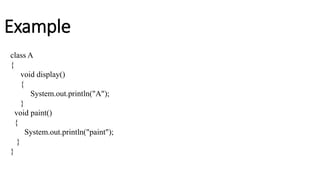
Example
class A
{
void display()
{
System.out.println("A");
}
void paint()
{
System.out.println("paint");
}
}
Cont…
class B extends A
{
void display()
{
System.out.println("B");
}
void print()
{
System.out.println("print");
}
public static void main(String x[])
{
A a1 = new B();
a1.display();
a1.paint();
}
}
Output:
B
paint

BCA Oveloading and Overriding (2).pptx

  • 1.
  • 2.
    Method Overloading inJava • If a class has multiple methods having same name but different in parameters, it is known as Method Overloading. • In Java, Method Overloading is not possible by changing the return type of the method only.
  • 3.
    Different ways tooverload the method • There are two ways to overload the method in java • By changing number of arguments • By changing the data type
  • 4.
    Example class Adder { void add(inta, int b) { int c = a+b; System.out.println(c); } void add(int a, int b, int c) { int d = a+b+c; System.out.println(d); } public static void main(String x[]) { Adder a1 = new Adder(); a1.add(10,20); a1.add(10,20,30); } }
  • 5.
  • 6.
    Advantage of methodoverloading • Method overloading increases the readability of the program.
  • 7.
    Method Overriding inJava • If subclass (child class) has the same method as declared in the parent class, it is known as method overriding in Java.
  • 8.
    Rules for JavaMethod Overriding • The method must have the same name as in the parent class. • The method must have the same parameter as in the parent class. • There must be an IS-A relationship (inheritance).
  • 9.
    Example of methodoverriding class Vehicle { void run() { System.out.println("Vehicle is running"); } } class Bike extends Vehicle { void run() { System.out.println("Bike is running safely"); } public static void main(String x[]) { Bike obj = new Bike(); obj.run(); } }
  • 10.
  • 11.
    Usage of JavaMethod Overriding • Method overriding is used for runtime polymorphism.
  • 12.
    Dynamic Method Dispatch •When the object of child class is initialized to the reference variable of parent class is known as dynamic method dispatch. • It is also called Upcasting.
  • 13.
  • 14.
    Cont… class B extendsA { void display() { System.out.println("B"); } void print() { System.out.println("print"); } public static void main(String x[]) { A a1 = new B(); a1.display(); a1.paint(); } } Output: B paint