2
Notes courtesy:Adil Aslam & Dr Humaira Arshad
Reference: Java A complete reference
3.
Method Overriding
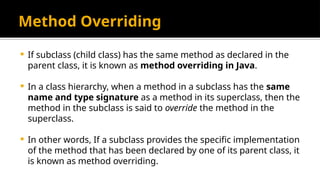
Ifsubclass (child class) has the same method as declared in the
parent class, it is known as method overriding in Java.
In a class hierarchy, when a method in a subclass has the same
name and type signature as a method in its superclass, then the
method in the subclass is said to override the method in the
superclass.
In other words, If a subclass provides the specific implementation
of the method that has been declared by one of its parent class, it
is known as method overriding.
4.
Usage of MethodOverriding
Method overriding is used to provide the specific
implementation of a method which is already
provided by its superclass.
Method overriding is used for runtime polymorphism
5.
Rules for MethodOverriding
The method must have the
same name as in the parent
class
The method must have the
same parameter as in the
parent class.
There must be an IS-A
relationship (inheritance).
6.
Understanding the problemwithout method
overriding
//Java Program to demonstrate why we need method overriding
//Here, we are calling the method of parent class with child
//class object.
//Creating a parent class
class Vehicle{
void run(){
System.out.println("Vehicle is running");
}
}
//Creating a child class
class Bike extends Vehicle{
public static void main(String args[]){
//creating an instance of child class
Bike obj = new Bike();
//calling the method with child class instance
obj.run();
}
}
Output:
Vehicle is running
Problem is that I have to provide a specific
implementation of run() method in subclass
that is why we use method overriding.
7.
Method Overriding –Example 1
//Java Program to illustrate the use of Java Method Overriding
//Creating a parent class.
class Vehicle{
//defining a method
void run(){System.out.println("Vehicle is running");}
}
//Creating a child class
class Bike2 extends Vehicle{
//defining the same method as in the parent class
void run(){System.out.println("Bike is running safely");}
public static void main(String args[]){
Bike2 obj = new Bike2();//creating object
obj.run();//calling method
}
}
Output:
Bike is running safely
8.
Method Overriding -A real example of Java
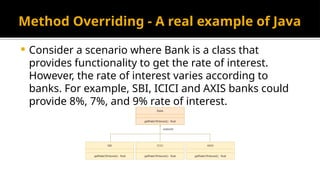
Consider a scenario where Bank is a class that
provides functionality to get the rate of interest.
However, the rate of interest varies according to
banks. For example, SBI, ICICI and AXIS banks could
provide 8%, 7%, and 9% rate of interest.
9.
Method Overriding -A real example
of Java
//Java Program to demonstrate the real scenario of
Java Method Overriding
//where three classes are overriding the method of a
parent class.
//Creating a parent class.
class Bank{
int getRateOfInterest(){return 0;}
}
//Creating child classes.
class SBI extends Bank{
int getRateOfInterest(){return 8;}
}
class ICICI extends Bank{
int getRateOfInterest(){return 7;}
}
class AXIS extends Bank{
int getRateOfInterest(){return 9;}
}
//Test class to create objects and call the methods
class Test2{
public static void main(String args[]){
SBI s=new SBI();
ICICI i=new ICICI();
AXIS a=new AXIS();
System.out.println("SBI Rate of Interest:
"+s.getRateOfInterest());
System.out.println("ICICI Rate of Interest:
"+i.getRateOfInterest());
System.out.println("AXIS Rate of Interest:
"+a.getRateOfInterest());
}
}
Output:
SBI Rate of Interest: 8
ICICI Rate of Interest: 7
AXIS Rate of Interest: 9
10.
Method overriding –Example 3
// Method overriding.
class A {
int i, j;
A(int a, int b) {
i = a;
j = b;
}
// display i and j
void show() {
System.out.println("i and j: " + i + " " + j);
}
}
class B extends A {
int k;
B(int a, int b, int c) {
super(a, b);
k = c;
}
// display k – this overrides show() in A
void show() {
System.out.println("k: " + k);
}
}
class Override {
public static void main(String args[]) {
B subOb = new B(1, 2, 3);
subOb.show(); // this calls show() in B
}
}
Output:
k = 3
11.
Method overriding –Example 3
When show( ) is invoked on an object of type B, the
version of show( ) defined within B is used.
That is, the version of show( ) inside B overrides the
version declared in A.
If you wish to access the superclass version of an
overridden method, you can do so by using super.
12.
Method overriding –Example 3
class B extends A {
int k;
B(int a, int b, int c) {
super(a, b);
k = c;
}
void show() {
super.show(); // this calls A's show()
System.out.println("k: " + k);
}
}
In this version of B, the superclass version of
show( ) is invoked within the subclass’ version.
This allows all instance variables to be
displayed.
Output:
i and j: 1 2
k: 3
13.
Can we overridestatic method?
No, a static method cannot be overridden. It can be
proved by runtime polymorphism, so we will learn it
later.
14.
Why can wenot override static method?
It is because the static method is bound with class
whereas instance method is bound with an object.
Static belongs to the class area, and an instance
belongs to the heap area.
15.
Can we overridejava main method?
No, because the main is a static method.
Overloading Vs. Overriding
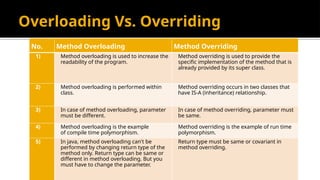
No.Method Overloading Method Overriding
1) Method overloading is used to increase the
readability of the program.
Method overriding is used to provide the
specific implementation of the method that is
already provided by its super class.
2) Method overloading is performed within
class.
Method overriding occurs in two classes that
have IS-A (inheritance) relationship.
3) In case of method overloading, parameter
must be different.
In case of method overriding, parameter must
be same.
4) Method overloading is the example
of compile time polymorphism.
Method overriding is the example of run time
polymorphism.
5) In java, method overloading can't be
performed by changing return type of the
method only. Return type can be same or
different in method overloading. But you
must have to change the parameter.
Return type must be same or covariant in
method overriding.
18.
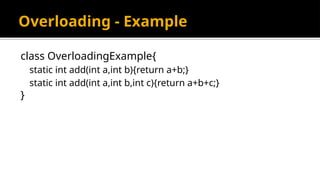
Overloading - Example
classOverloadingExample{
static int add(int a,int b){return a+b;}
static int add(int a,int b,int c){return a+b+c;}
}
19.
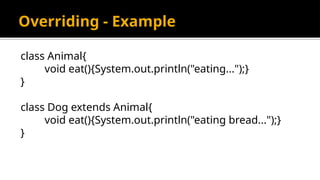
Overriding - Example
classAnimal{
void eat(){System.out.println("eating...");}
}
class Dog extends Animal{
void eat(){System.out.println("eating bread...");}
}




![Understanding the problem without method
overriding
//Java Program to demonstrate why we need method overriding
//Here, we are calling the method of parent class with child
//class object.
//Creating a parent class
class Vehicle{
void run(){
System.out.println("Vehicle is running");
}
}
//Creating a child class
class Bike extends Vehicle{
public static void main(String args[]){
//creating an instance of child class
Bike obj = new Bike();
//calling the method with child class instance
obj.run();
}
}
Output:
Vehicle is running
Problem is that I have to provide a specific
implementation of run() method in subclass
that is why we use method overriding.](https://image.slidesharecdn.com/methodoverriding-250526160202-d483acca/85/Oop-concepts-classes-Method-Overriding-pptx-6-320.jpg)
![Method Overriding – Example 1
//Java Program to illustrate the use of Java Method Overriding
//Creating a parent class.
class Vehicle{
//defining a method
void run(){System.out.println("Vehicle is running");}
}
//Creating a child class
class Bike2 extends Vehicle{
//defining the same method as in the parent class
void run(){System.out.println("Bike is running safely");}
public static void main(String args[]){
Bike2 obj = new Bike2();//creating object
obj.run();//calling method
}
}
Output:
Bike is running safely](https://image.slidesharecdn.com/methodoverriding-250526160202-d483acca/85/Oop-concepts-classes-Method-Overriding-pptx-7-320.jpg)
![Method Overriding - A real example
of Java
//Java Program to demonstrate the real scenario of
Java Method Overriding
//where three classes are overriding the method of a
parent class.
//Creating a parent class.
class Bank{
int getRateOfInterest(){return 0;}
}
//Creating child classes.
class SBI extends Bank{
int getRateOfInterest(){return 8;}
}
class ICICI extends Bank{
int getRateOfInterest(){return 7;}
}
class AXIS extends Bank{
int getRateOfInterest(){return 9;}
}
//Test class to create objects and call the methods
class Test2{
public static void main(String args[]){
SBI s=new SBI();
ICICI i=new ICICI();
AXIS a=new AXIS();
System.out.println("SBI Rate of Interest:
"+s.getRateOfInterest());
System.out.println("ICICI Rate of Interest:
"+i.getRateOfInterest());
System.out.println("AXIS Rate of Interest:
"+a.getRateOfInterest());
}
}
Output:
SBI Rate of Interest: 8
ICICI Rate of Interest: 7
AXIS Rate of Interest: 9](https://image.slidesharecdn.com/methodoverriding-250526160202-d483acca/85/Oop-concepts-classes-Method-Overriding-pptx-9-320.jpg)
![Method overriding – Example 3
// Method overriding.
class A {
int i, j;
A(int a, int b) {
i = a;
j = b;
}
// display i and j
void show() {
System.out.println("i and j: " + i + " " + j);
}
}
class B extends A {
int k;
B(int a, int b, int c) {
super(a, b);
k = c;
}
// display k – this overrides show() in A
void show() {
System.out.println("k: " + k);
}
}
class Override {
public static void main(String args[]) {
B subOb = new B(1, 2, 3);
subOb.show(); // this calls show() in B
}
}
Output:
k = 3](https://image.slidesharecdn.com/methodoverriding-250526160202-d483acca/85/Oop-concepts-classes-Method-Overriding-pptx-10-320.jpg)