NEGOTIATION SKILLS
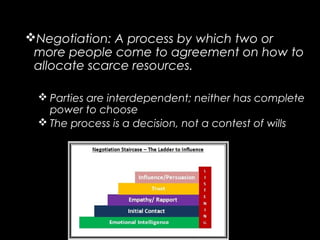
Negotiation: A process by which two or
more people come to agreement on how to
allocate scarce resources.
 Parties are interdependent; neither has complete
power to choose
 The process is a decision, not a contest of wills
COMMON PROBLEMS IN
NEGOTIATION
Leaving money on the table (lose-lose
negotiation)
Settling for too little (winner’s curse)
Walking away from the table
Settling for terms that are worse than
your current situation (agreement bias)
WHY ARE PEOPLE INEFFECTIVE
NEGOTIATORS?
Absence of relevant and diagnostic
feedback
 Search for confirming information
 Egocentrism
Satisficing
 Versus Optimizing
Self-reinforcement
 Fear of change and experimentation
MYTHS
Good negotiators are born, not made
Experience is a great teacher
Good negotiators are risk-takers
Good negotiators rely on intuition
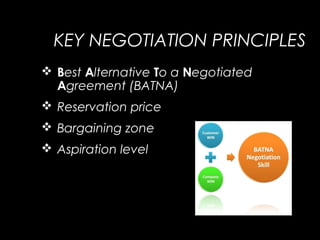
KEY NEGOTIATION PRINCIPLES
 Best Alternative To a Negotiated
Agreement (BATNA)
 Reservation price
 Bargaining zone
 Aspiration level
KEY NEGOTIATION PRINCIPLES
 Best Alternative To a Negotiated
Agreement (BATNA)
 Reservation price
 Bargaining zone
 Aspiration level
BATNA TIPS
 Know your BATNA
 Do not think of your BATNA in aggregate
terms
 Improve your BATNA before you
negotiate
 “Fall in love with three” rule
 You want your counterpart to think
you have a good BATNA
KEY NEGOTIATION PRINCIPLES
 Best Alternative To a Negotiated
Agreement (BATNA)
 Reservation price
 Bargaining zone
 Aspiration level
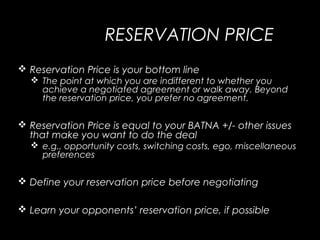
RESERVATION PRICE
 Reservation Price is your bottom line
 The point at which you are indifferent to whether you
achieve a negotiated agreement or walk away. Beyond
the reservation price, you prefer no agreement.
 Reservation Price is equal to your BATNA +/- other issues
that make you want to do the deal
 e.g., opportunity costs, switching costs, ego, miscellaneous
preferences
 Define your reservation price before negotiating
 Learn your opponents’ reservation price, if possible
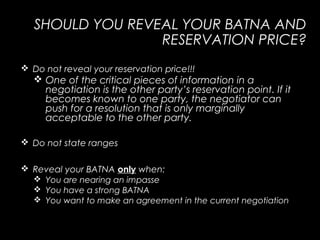
SHOULD YOU REVEAL YOUR BATNA AND
RESERVATION PRICE?
 Do not reveal your reservation price!!!
 One of the critical pieces of information in a
negotiation is the other party’s reservation point. If it
becomes known to one party, the negotiator can
push for a resolution that is only marginally
acceptable to the other party.
 Do not state ranges
 Reveal your BATNA only when:
 You are nearing an impasse
 You have a strong BATNA
 You want to make an agreement in the current negotiation
KEY NEGOTIATION PRINCIPLES
 Best Alternative To a Negotiated
Agreement (BATNA)
 Reservation price
 Bargaining zone
 Aspiration level
KEY NEGOTIATION
PRINCIPLES
 Best Alternative To a Negotiated
Agreement (BATNA)
 Reservation price
 Bargaining zone
 Aspiration level
DISTRIBUTIVE BARGAINING
TACTICS
 First offers
 Concessions
 Persuasion
FIRST OFFERS
Who made the first offer?
How did the first offer affect the
negotiation?
THE FIRST OFFER
 How high should the first offer be?
 “As high as you can go without embarrassing
yourself in front of a respected 3rd
party” (Fisher &
Ury, 1991)
 What’s embarrassing? What’s optimistic? Learn
the market!
 Only let the other party make the first offer when
 You have no information
 It is inappropriate to do so (e.g., job negotiations)
 Immediately re-anchor if your counterpart makes the first
offer
CONCESSIONS & PERSUASION
 Allow yourself room to make concessions
 Don’t go in with a “first and final offer”
 Make bi-lateral, not uni-lateral concessions
 Make your concessions smaller as you
approach your goal
 Use objective rationale to support your
argument
 Again, learn the market
NEGOTIATION STRATEGIES
 Know your BATNA
 Strengthen your BATNA whenever possible
 Know your reservation price
 Do not reveal your reservation price
 Research the other party’s BATNA/reservation price
 Define your aspiration level and focus on that
 Make first offers whenever possible
 If they make the first offer, immediately re-anchor
 Watch how you are making concessions
 Prepare objective rationale for your arguments

Negotiation skills

  • 1.
  • 2.
    Negotiation: A processby which two or more people come to agreement on how to allocate scarce resources.  Parties are interdependent; neither has complete power to choose  The process is a decision, not a contest of wills
  • 3.
    COMMON PROBLEMS IN NEGOTIATION Leavingmoney on the table (lose-lose negotiation) Settling for too little (winner’s curse) Walking away from the table Settling for terms that are worse than your current situation (agreement bias)
  • 4.
    WHY ARE PEOPLEINEFFECTIVE NEGOTIATORS? Absence of relevant and diagnostic feedback  Search for confirming information  Egocentrism Satisficing  Versus Optimizing Self-reinforcement  Fear of change and experimentation
  • 5.
    MYTHS Good negotiators areborn, not made Experience is a great teacher Good negotiators are risk-takers Good negotiators rely on intuition
  • 6.
    KEY NEGOTIATION PRINCIPLES Best Alternative To a Negotiated Agreement (BATNA)  Reservation price  Bargaining zone  Aspiration level
  • 7.
    KEY NEGOTIATION PRINCIPLES Best Alternative To a Negotiated Agreement (BATNA)  Reservation price  Bargaining zone  Aspiration level
  • 8.
    BATNA TIPS  Knowyour BATNA  Do not think of your BATNA in aggregate terms  Improve your BATNA before you negotiate  “Fall in love with three” rule  You want your counterpart to think you have a good BATNA
  • 9.
    KEY NEGOTIATION PRINCIPLES Best Alternative To a Negotiated Agreement (BATNA)  Reservation price  Bargaining zone  Aspiration level
  • 10.
    RESERVATION PRICE  ReservationPrice is your bottom line  The point at which you are indifferent to whether you achieve a negotiated agreement or walk away. Beyond the reservation price, you prefer no agreement.  Reservation Price is equal to your BATNA +/- other issues that make you want to do the deal  e.g., opportunity costs, switching costs, ego, miscellaneous preferences  Define your reservation price before negotiating  Learn your opponents’ reservation price, if possible
  • 11.
    SHOULD YOU REVEALYOUR BATNA AND RESERVATION PRICE?  Do not reveal your reservation price!!!  One of the critical pieces of information in a negotiation is the other party’s reservation point. If it becomes known to one party, the negotiator can push for a resolution that is only marginally acceptable to the other party.  Do not state ranges  Reveal your BATNA only when:  You are nearing an impasse  You have a strong BATNA  You want to make an agreement in the current negotiation
  • 12.
    KEY NEGOTIATION PRINCIPLES Best Alternative To a Negotiated Agreement (BATNA)  Reservation price  Bargaining zone  Aspiration level
  • 13.
    KEY NEGOTIATION PRINCIPLES  BestAlternative To a Negotiated Agreement (BATNA)  Reservation price  Bargaining zone  Aspiration level
  • 14.
    DISTRIBUTIVE BARGAINING TACTICS  Firstoffers  Concessions  Persuasion
  • 15.
    FIRST OFFERS Who madethe first offer? How did the first offer affect the negotiation?
  • 16.
    THE FIRST OFFER How high should the first offer be?  “As high as you can go without embarrassing yourself in front of a respected 3rd party” (Fisher & Ury, 1991)  What’s embarrassing? What’s optimistic? Learn the market!  Only let the other party make the first offer when  You have no information  It is inappropriate to do so (e.g., job negotiations)  Immediately re-anchor if your counterpart makes the first offer
  • 17.
    CONCESSIONS & PERSUASION Allow yourself room to make concessions  Don’t go in with a “first and final offer”  Make bi-lateral, not uni-lateral concessions  Make your concessions smaller as you approach your goal  Use objective rationale to support your argument  Again, learn the market
  • 18.
    NEGOTIATION STRATEGIES  Knowyour BATNA  Strengthen your BATNA whenever possible  Know your reservation price  Do not reveal your reservation price  Research the other party’s BATNA/reservation price  Define your aspiration level and focus on that  Make first offers whenever possible  If they make the first offer, immediately re-anchor  Watch how you are making concessions  Prepare objective rationale for your arguments