Zeeshan Yousuf
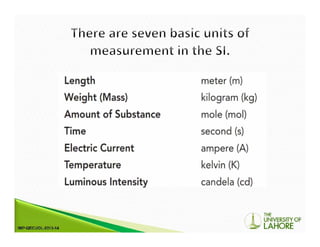
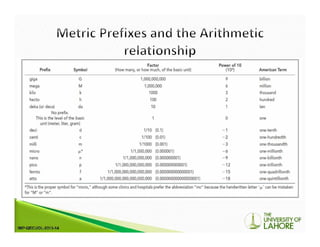
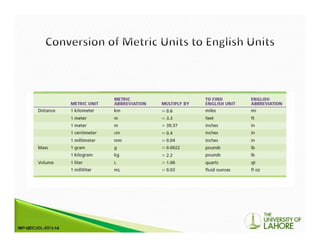
 The International System of Units, abbreviated “SI” for
the French Système International d’Unités, is a modern
version of the metric system.
 Established in 1960, the SI has become the most widely
used sys- tem of measurement in the world, although
the United States still employs customary units
alongside it.
 Most laboratory reagents are solutions, homogeneous
mixtures of two or more substances.
 Solutions are made by combining a solute, the
substance being dissolved, with a solvent, a
dissolving agent.
 Water is the most familiar and widely used
solvent. Laboratory procedures can require dilution of
a reagent or a serum.
 A dilution is a solution that is made less concentrated
by adding a solvent.
 Lyophilized controls and standards are reagents
with the liquid removed. These are rehydrated by
adding the diluting fluid recommended by the
manufacturer.
 Examples of lyophilized reagents include chemistry
standards and controls, positive and negative serum
and plasma immunology controls, and urine chemistry
controls.
 All grades of water begin as distilled, deionized, or
reverse osmosis water.
 Distilled water is the condensate collected from steam
created when water is boiled. This process removes
most of the common minerals such as iron, calcium,
and magnesium but does not remove volatiles such as
carbon dioxide, chlorine, and ammonia.
 Deionized water is prepared by passing tap or
distilled water through a resin column containing
charged particles. The unwanted impurities in the
water bind to these charged particles and are
removed from the water. However, not all organic
substances, particulate matter, or microorganisms are
removed.
Resin
 Reverse osmosis (RO), a process that forces water through a
semi-permeable membrane, can also be used as an initial water
purification step. RO removes nearly all bacteria, colloidal silica,
particulates, organics, and a large percentage of ionic
contaminants from water.
 To make CLRW from RO water, the RO water is passed through a
high-quality resin to remove remaining ions and through a
small-pore filter (0.22 μm) to exclude any remaining
bacteria from the water.
 CLRW can also be obtained by processing deionized water
using membrane filters to remove microorganisms and
insoluble matter and charcoal absorption to remove organic
matter. Distilled water must be passed over resin and then
be membrane-filtered to become CLRW.
 CLRW is the purest grade and is used to prepare
standards, control solutions, and buffers for analytical
procedures. Many of the standards and controls used in
the laboratory are lyophilized (freeze-dried) material.
 CLRW is used to reconstitute (bring into solution) these
materials because it does not contain substances that
can interfere with the analysis being performed.
 CLRW and Special Reagent Water are used for special
analyses such as trace metals, electrolytes, and enzymes.
Using Proportion to Make Dilutions
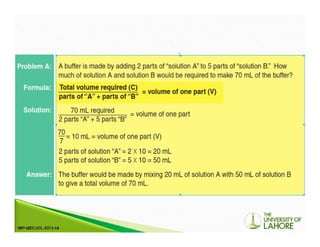
 A dilution is usually expressed as a ratio,
proportion, or fraction. For example, if a serum has
been diluted 1:5, it means that 1 part of the serum has
been combined with 4 parts of a diluent to create
5 total parts.
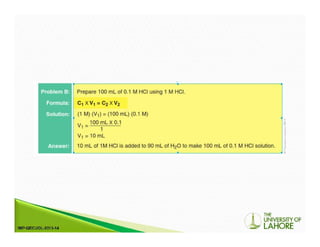
 Sometimes it is necessary to prepare a dilute solution
from a concentrated solution. For instance, 0.1 M HCl can
be made from a concentrated solution of HCl, such as a
1 M solution.
 The general formula is:
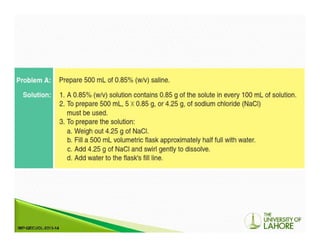
 Percent solutions can be made by dissolving a specific
weight of a solute (chemical) in 100 mL of solution (water
or other liquid). This is called a weight-to-volume (w/v)
solution.
 One example is the 0.85% physiological saline solution
used in many serological and bacteriological
procedures. Using the definition of a percent solution,
100 mL of 0.85% saline contains 0.85 g of sodium
chloride (NaCl) in 100 mL of solution. This would be
prepared by placing approximately 50 mL of CLRW into a
100-mL volumetric flask, adding 0.85 g NaCl, mixing
thoroughly until the NaCl dissolves, and then adding CLRW
to the flask’s fill line.
 Another type of percent solution is called a volume-to-
volume (v/v) solution, in which a certain volume of
one liquid is added to a specific volume of another.
 One 100mL of a 10% solution of bleach can be
prepared by adding 10 mL of chlorine bleach (sodium
hypochlorite) to 90 mL of water, for a total volume of
100 mL. Figure shows how 500 mL of a v/v
solution would be prepared.
 A percent solution can also be prepared by weighing
both the solute and the solvent. For these types of
solutions, the laboratory balance must be zeroed with the
empty container on the balance pan. The solution
volume is determined by its weight.
 For example, a 5% solution would require that
approximately 90 g of water be added to the empty
container (with the scale set to zero). Five grams of a
chemical would then be added to the container. With
the container still on the balance, water is added until the
total solution weight is 100 g. This type of percent
solution is rarely used in the clinical laboratory.
 In some cases laboratory workers have to make serial
dilutions of a sample to find the titer of a particular
component in the sample.
 The titer of a component is the measure of reactivity
or strength of the component and is reported as the
reciprocal of the highest dilution giving a reaction. (An
example of reciprocal is: 16 is the reciprocal of 1/16,
and 1/16 is the reciprocal of 16.
 In other words, if a tube containing a 1/16 dilution is
the last one showing a reaction, the titer is 16.)
 Titers are useful when a component cannot be easily
analyzed using available chemical methods.
 Titers are often used in immunology to indicate the
level of a particular antibody in a serum sample.
 Dilutions of serum are used in certain tests such as the
rheumatoid factor (RF) test for rheumatoid arthritis or
tests measuring levels of antibodies to infectious
agents.
1. Set up 9 tubes, each containing one mL of diluent.
2. Transfer one mL of patient serum to tube 1.
3. Mix the serum and diluent, and transfer one mL of the
mixture to tube 2.
4. Repeat the procedure, transferring one mL each time
after mixing with diluent.
5. Discard one mL from the last tube.
6. When dilution series is complete, each of the nine
tubes should contain one mL.
Basic_Laboratory_Mathematics.pdfffffffff

Basic_Laboratory_Mathematics.pdfffffffff

  • 1.
  • 2.
     The InternationalSystem of Units, abbreviated “SI” for the French Système International d’Unités, is a modern version of the metric system.  Established in 1960, the SI has become the most widely used sys- tem of measurement in the world, although the United States still employs customary units alongside it.
  • 10.
     Most laboratoryreagents are solutions, homogeneous mixtures of two or more substances.  Solutions are made by combining a solute, the substance being dissolved, with a solvent, a dissolving agent.  Water is the most familiar and widely used solvent. Laboratory procedures can require dilution of a reagent or a serum.  A dilution is a solution that is made less concentrated by adding a solvent.
  • 11.
     Lyophilized controlsand standards are reagents with the liquid removed. These are rehydrated by adding the diluting fluid recommended by the manufacturer.  Examples of lyophilized reagents include chemistry standards and controls, positive and negative serum and plasma immunology controls, and urine chemistry controls.
  • 12.
     All gradesof water begin as distilled, deionized, or reverse osmosis water.  Distilled water is the condensate collected from steam created when water is boiled. This process removes most of the common minerals such as iron, calcium, and magnesium but does not remove volatiles such as carbon dioxide, chlorine, and ammonia.
  • 13.
     Deionized wateris prepared by passing tap or distilled water through a resin column containing charged particles. The unwanted impurities in the water bind to these charged particles and are removed from the water. However, not all organic substances, particulate matter, or microorganisms are removed.
  • 14.
  • 15.
     Reverse osmosis(RO), a process that forces water through a semi-permeable membrane, can also be used as an initial water purification step. RO removes nearly all bacteria, colloidal silica, particulates, organics, and a large percentage of ionic contaminants from water.  To make CLRW from RO water, the RO water is passed through a high-quality resin to remove remaining ions and through a small-pore filter (0.22 μm) to exclude any remaining bacteria from the water.  CLRW can also be obtained by processing deionized water using membrane filters to remove microorganisms and insoluble matter and charcoal absorption to remove organic matter. Distilled water must be passed over resin and then be membrane-filtered to become CLRW.
  • 16.
     CLRW isthe purest grade and is used to prepare standards, control solutions, and buffers for analytical procedures. Many of the standards and controls used in the laboratory are lyophilized (freeze-dried) material.  CLRW is used to reconstitute (bring into solution) these materials because it does not contain substances that can interfere with the analysis being performed.  CLRW and Special Reagent Water are used for special analyses such as trace metals, electrolytes, and enzymes.
  • 17.
    Using Proportion toMake Dilutions  A dilution is usually expressed as a ratio, proportion, or fraction. For example, if a serum has been diluted 1:5, it means that 1 part of the serum has been combined with 4 parts of a diluent to create 5 total parts.
  • 19.
     Sometimes itis necessary to prepare a dilute solution from a concentrated solution. For instance, 0.1 M HCl can be made from a concentrated solution of HCl, such as a 1 M solution.  The general formula is:
  • 21.
     Percent solutionscan be made by dissolving a specific weight of a solute (chemical) in 100 mL of solution (water or other liquid). This is called a weight-to-volume (w/v) solution.  One example is the 0.85% physiological saline solution used in many serological and bacteriological procedures. Using the definition of a percent solution, 100 mL of 0.85% saline contains 0.85 g of sodium chloride (NaCl) in 100 mL of solution. This would be prepared by placing approximately 50 mL of CLRW into a 100-mL volumetric flask, adding 0.85 g NaCl, mixing thoroughly until the NaCl dissolves, and then adding CLRW to the flask’s fill line.
  • 23.
     Another typeof percent solution is called a volume-to- volume (v/v) solution, in which a certain volume of one liquid is added to a specific volume of another.  One 100mL of a 10% solution of bleach can be prepared by adding 10 mL of chlorine bleach (sodium hypochlorite) to 90 mL of water, for a total volume of 100 mL. Figure shows how 500 mL of a v/v solution would be prepared.
  • 25.
     A percentsolution can also be prepared by weighing both the solute and the solvent. For these types of solutions, the laboratory balance must be zeroed with the empty container on the balance pan. The solution volume is determined by its weight.  For example, a 5% solution would require that approximately 90 g of water be added to the empty container (with the scale set to zero). Five grams of a chemical would then be added to the container. With the container still on the balance, water is added until the total solution weight is 100 g. This type of percent solution is rarely used in the clinical laboratory.
  • 26.
     In somecases laboratory workers have to make serial dilutions of a sample to find the titer of a particular component in the sample.  The titer of a component is the measure of reactivity or strength of the component and is reported as the reciprocal of the highest dilution giving a reaction. (An example of reciprocal is: 16 is the reciprocal of 1/16, and 1/16 is the reciprocal of 16.  In other words, if a tube containing a 1/16 dilution is the last one showing a reaction, the titer is 16.)
  • 27.
     Titers areuseful when a component cannot be easily analyzed using available chemical methods.  Titers are often used in immunology to indicate the level of a particular antibody in a serum sample.  Dilutions of serum are used in certain tests such as the rheumatoid factor (RF) test for rheumatoid arthritis or tests measuring levels of antibodies to infectious agents.
  • 28.
    1. Set up9 tubes, each containing one mL of diluent. 2. Transfer one mL of patient serum to tube 1. 3. Mix the serum and diluent, and transfer one mL of the mixture to tube 2. 4. Repeat the procedure, transferring one mL each time after mixing with diluent. 5. Discard one mL from the last tube. 6. When dilution series is complete, each of the nine tubes should contain one mL.