The metric system
&
reagents preparation
By/ Ebraheem Al-nawd
BSc. Medical Laboratory
MSc. Clinical Biochemistry
PhD candidate
Systems of Measure
• Two systems in use predominantly:
–English (America)
–Metric or SI (European)
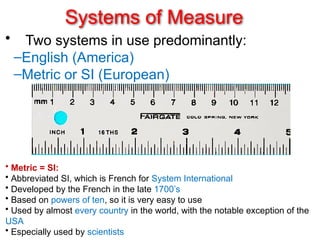
• Metric = SI:
• Abbreviated SI, which is French for System International
• Developed by the French in the late 1700’s
• Based on powers of ten, so it is very easy to use
• Used by almost every country in the world, with the notable exception of the
USA
• Especially used by scientists
Systems of Measure:
Metric or SI (European)
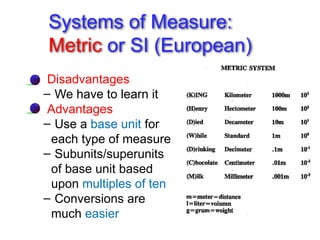
• Disadvantages
– We have to learn it
• Advantages
– Use a base unit for
each type of measure
– Subunits/superunits
of base unit based
upon multiples of ten
– Conversions are
much easier
• Disadvantages
– No standard base unit for each kind of
measurement
– Subunits within units not based upon a
consistent multiplication factor
– Difficult to make conversions between
units
• Advantages
– We already know it e.g. pound
Systems of Measure:
English (America)
The Metric System
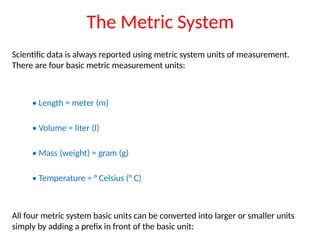
Scientific data is always reported using metric system units of measurement.
There are four basic metric measurement units:
• Length = meter (m)
• Volume = liter (l)
• Mass (weight) = gram (g)
• Temperature = ° Celsius (° C)
All four metric system basic units can be converted into larger or smaller units
simply by adding a prefix in front of the basic unit:
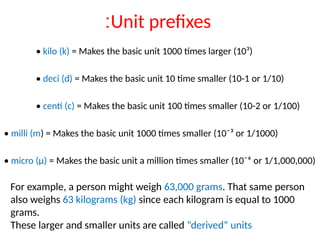
Unit prefixes
:
• kilo (k) = Makes the basic unit 1000 times larger (10³)
• deci (d) = Makes the basic unit 10 time smaller (10-1 or 1/10)
• centi (c) = Makes the basic unit 100 times smaller (10-2 or 1/100)
• milli (m) = Makes the basic unit 1000 times smaller (10¯³ or 1/1000)
• micro (µ) = Makes the basic unit a million times smaller (10¯⁶ or 1/1,000,000)
For example, a person might weigh 63,000 grams. That same person
also weighs 63 kilograms (kg) since each kilogram is equal to 1000
grams.
These larger and smaller units are called “derived” units
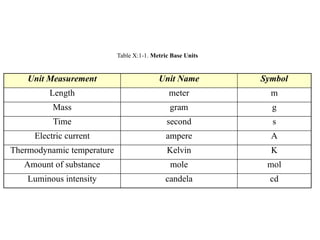
Table X:1-1. Metric Base Units
Unit Measurement Unit Name Symbol
Length meter m
Mass gram g
Time second s
Electric current ampere A
Thermodynamic temperature Kelvin K
Amount of substance mole mol
Luminous intensity candela cd
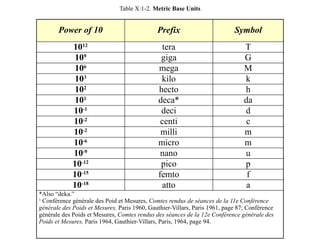
Table X:1-2. Metric Base Units
Power of 10 Prefix Symbol
1012
tera T
109
giga G
106
mega M
103
kilo k
102
hecto h
101
deca* da
10-1
deci d
10-2
centi c
10-2
milli m
10-6
micro m
10-9
nano u
10-12
pico p
10-15
femto f
10-18
atto a
*Also “deka.”
1
Conférence générale des Poid et Mesures, Comtes rendus de séances de la 11e Conférence
générale des Poids et Mesures, Paris 1960, Gauthier-Villars, Paris 1961, page 87; Conférence
générale des Poids et Mesures, Comtes rendus des séances de la 12e Conférence générale des
Poids et Mesures, Paris 1964, Gauthier-Villars, Paris, 1964, page 94.
Reagents preparation
• Errors in the preparation of stains and reagents
Most errors that occur in the preparation of stains and reagents
are due to:
1- Incorrect preparation techniques.
2- Calculating incorrectly the weight or volumes of constituents.
3- Making dilution errors.
• Important: Following the preparation of a stain or
chemical reagent, its performance must be checked
before it is put into routine use.
PREPARATION TECHNIQUE
When preparing a solution decide whether the solution
requires an accurate volumetric preparation,
e.g. a calibrant (standard), or a less accurate method of
preparation, e.g. a stain.
Preparing accurate solutions:
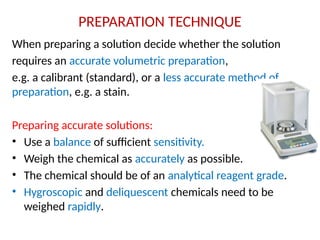
• Use a balance of sufficient sensitivity.
• Weigh the chemical as accurately as possible.
• The chemical should be of an analytical reagent grade.
• Hygroscopic and deliquescent chemicals need to be
weighed rapidly.
Analytical reagents
- Purchase chemicals that are labelled Analar, Univar, AR (Analytical
Reagent), or GR (Guaranteed Reagent). LG (Laboratory Grade)
reagents are of lower purity but may be suitable for some purposes.
-Technical and Industrial grade chemicals, although less expensive,
must not be used to prepare calibrants or any reagent which
requires a pure chemical.
- Use calibrated, chemically clean glassware.
- Read carefully the graduation marks and other information on
flasks and pipettes.
- Use a funnel to transfer the chemical from the weighing container
to a volumetric flask. Wash any chemical remaining in the container
into the flask with a little of the solvent.
- Make the solution up to its final volume. If warm, make up to
volume only when the solution has cooled to the temperature used
to graduate the flask (written on the flask).
- To avoid over-shooting the graduation mark, use a Pasteur pipette
or wash-bottle to add the final volume of solvent to the flask.
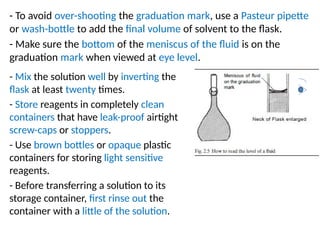
- Make sure the bottom of the meniscus of the fluid is on the
graduation mark when viewed at eye level.
- Mix the solution well by inverting the
flask at least twenty times.
- Store reagents in completely clean
containers that have leak-proof airtight
screw-caps or stoppers.
- Use brown bottles or opaque plastic
containers for storing light sensitive
reagents.
- Before transferring a solution to its
storage container, first rinse out the
container with a little of the solution.
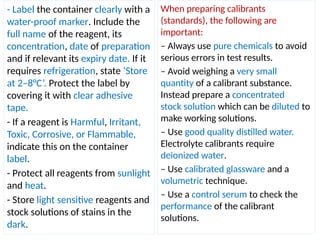
- Label the container clearly with a
water-proof marker. Include the
full name of the reagent, its
concentration, date of preparation
and if relevant its expiry date. If it
requires refrigeration, state ‘Store
at 2–8°C’. Protect the label by
covering it with clear adhesive
tape.
- If a reagent is Harmful, Irritant,
Toxic, Corrosive, or Flammable,
indicate this on the container
label.
- Protect all reagents from sunlight
and heat.
- Store light sensitive reagents and
stock solutions of stains in the
dark.
When preparing calibrants
(standards), the following are
important:
– Always use pure chemicals to avoid
serious errors in test results.
– Avoid weighing a very small
quantity of a calibrant substance.
Instead prepare a concentrated
stock solution which can be diluted to
make working solutions.
– Use good quality distilled water.
Electrolyte calibrants require
deionized water.
– Use calibrated glassware and a
volumetric technique.
– Use a control serum to check the
performance of the calibrant
solutions.
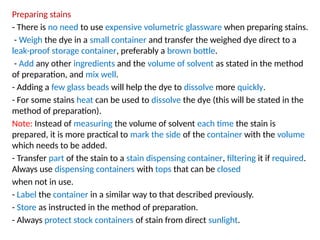
Preparing stains
- There is no need to use expensive volumetric glassware when preparing stains.
- Weigh the dye in a small container and transfer the weighed dye direct to a
leak-proof storage container, preferably a brown bottle.
- Add any other ingredients and the volume of solvent as stated in the method
of preparation, and mix well.
- Adding a few glass beads will help the dye to dissolve more quickly.
- For some stains heat can be used to dissolve the dye (this will be stated in the
method of preparation).
Note: Instead of measuring the volume of solvent each time the stain is
prepared, it is more practical to mark the side of the container with the volume
which needs to be added.
- Transfer part of the stain to a stain dispensing container, filtering it if required.
Always use dispensing containers with tops that can be closed
when not in use.
- Label the container in a similar way to that described previously.
- Store as instructed in the method of preparation.
- Always protect stock containers of stain from direct sunlight.
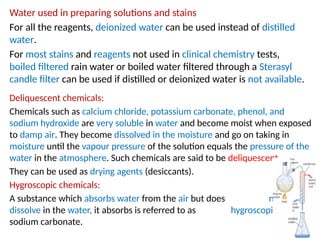
Water used in preparing solutions and stains
For all the reagents, deionized water can be used instead of distilled
water.
For most stains and reagents not used in clinical chemistry tests,
boiled filtered rain water or boiled water filtered through a Sterasyl
candle filter can be used if distilled or deionized water is not available.
Deliquescent chemicals:
Chemicals such as calcium chloride, potassium carbonate, phenol, and
sodium hydroxide are very soluble in water and become moist when exposed
to damp air. They become dissolved in the moisture and go on taking in
moisture until the vapour pressure of the solution equals the pressure of the
water in the atmosphere. Such chemicals are said to be deliquescent.
They can be used as drying agents (desiccants).
Hygroscopic chemicals:
A substance which absorbs water from the air but does not
dissolve in the water, it absorbs is referred to as hygroscopic, e.g.
sodium carbonate.
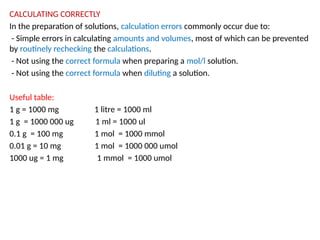
CALCULATING CORRECTLY
In the preparation of solutions, calculation errors commonly occur due to:
- Simple errors in calculating amounts and volumes, most of which can be prevented
by routinely rechecking the calculations.
- Not using the correct formula when preparing a mol/l solution.
- Not using the correct formula when diluting a solution.
Useful table:
1 g = 1000 mg 1 litre = 1000 ml
1 g = 1000 000 ug 1 ml = 1000 ul
0.1 g = 100 mg 1 mol = 1000 mmol
0.01 g = 10 mg 1 mol = 1000 000 umol
1000 ug = 1 mg 1 mmol = 1000 umol
Preparing mol/l solutions
Based on the fact that chemicals interact in relation to their molecular
masses, it is recommended that the concentration of solutions be
expressed in terms of the number of moles of solute per liter of
solution.
Only when the relative molecular mass of a substance is not known,
should the concentration of such a substance in solution be expressed
in terms of mass (weight) concentration, i.e. grams or milligrams per
liter (per 100 ml should be discontinued).
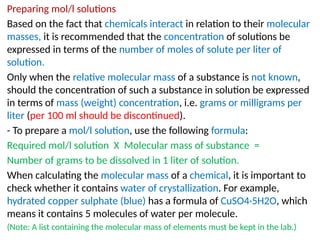
- To prepare a mol/l solution, use the following formula:
Required mol/l solution X Molecular mass of substance =
Number of grams to be dissolved in 1 liter of solution.
When calculating the molecular mass of a chemical, it is important to
check whether it contains water of crystallization. For example,
hydrated copper sulphate (blue) has a formula of CuSO4·5H2O, which
means it contains 5 molecules of water per molecule.
(Note: A list containing the molecular mass of elements must be kept in the lab.)
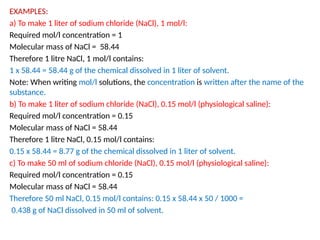
EXAMPLES:
a) To make 1 liter of sodium chloride (NaCl), 1 mol/l:
Required mol/l concentration = 1
Molecular mass of NaCl = 58.44
Therefore 1 litre NaCl, 1 mol/l contains:
1 x 58.44 = 58.44 g of the chemical dissolved in 1 liter of solvent.
Note: When writing mol/l solutions, the concentration is written after the name of the
substance.
b) To make 1 liter of sodium chloride (NaCl), 0.15 mol/l (physiological saline):
Required mol/l concentration = 0.15
Molecular mass of NaCl = 58.44
Therefore 1 litre NaCl, 0.15 mol/l contains:
0.15 x 58.44 = 8.77 g of the chemical dissolved in 1 liter of solvent.
c) To make 50 ml of sodium chloride (NaCl), 0.15 mol/l (physiological saline):
Required mol/l concentration = 0.15
Molecular mass of NaCl = 58.44
Therefore 50 ml NaCl, 0.15 mol/l contains: 0.15 x 58.44 x 50 / 1000 =
0.438 g of NaCl dissolved in 50 ml of solvent.
5. metric system &reagents preparation.pptx

5. metric system &reagents preparation.pptx

  • 1.
    The metric system & reagentspreparation By/ Ebraheem Al-nawd BSc. Medical Laboratory MSc. Clinical Biochemistry PhD candidate
  • 2.
    Systems of Measure •Two systems in use predominantly: –English (America) –Metric or SI (European) • Metric = SI: • Abbreviated SI, which is French for System International • Developed by the French in the late 1700’s • Based on powers of ten, so it is very easy to use • Used by almost every country in the world, with the notable exception of the USA • Especially used by scientists
  • 3.
    Systems of Measure: Metricor SI (European) • Disadvantages – We have to learn it • Advantages – Use a base unit for each type of measure – Subunits/superunits of base unit based upon multiples of ten – Conversions are much easier
  • 4.
    • Disadvantages – Nostandard base unit for each kind of measurement – Subunits within units not based upon a consistent multiplication factor – Difficult to make conversions between units • Advantages – We already know it e.g. pound Systems of Measure: English (America)
  • 5.
    The Metric System Scientificdata is always reported using metric system units of measurement. There are four basic metric measurement units: • Length = meter (m) • Volume = liter (l) • Mass (weight) = gram (g) • Temperature = ° Celsius (° C) All four metric system basic units can be converted into larger or smaller units simply by adding a prefix in front of the basic unit:
  • 6.
    Unit prefixes : • kilo(k) = Makes the basic unit 1000 times larger (10³) • deci (d) = Makes the basic unit 10 time smaller (10-1 or 1/10) • centi (c) = Makes the basic unit 100 times smaller (10-2 or 1/100) • milli (m) = Makes the basic unit 1000 times smaller (10¯³ or 1/1000) • micro (µ) = Makes the basic unit a million times smaller (10¯⁶ or 1/1,000,000) For example, a person might weigh 63,000 grams. That same person also weighs 63 kilograms (kg) since each kilogram is equal to 1000 grams. These larger and smaller units are called “derived” units
  • 7.
    Table X:1-1. MetricBase Units Unit Measurement Unit Name Symbol Length meter m Mass gram g Time second s Electric current ampere A Thermodynamic temperature Kelvin K Amount of substance mole mol Luminous intensity candela cd
  • 8.
    Table X:1-2. MetricBase Units Power of 10 Prefix Symbol 1012 tera T 109 giga G 106 mega M 103 kilo k 102 hecto h 101 deca* da 10-1 deci d 10-2 centi c 10-2 milli m 10-6 micro m 10-9 nano u 10-12 pico p 10-15 femto f 10-18 atto a *Also “deka.” 1 Conférence générale des Poid et Mesures, Comtes rendus de séances de la 11e Conférence générale des Poids et Mesures, Paris 1960, Gauthier-Villars, Paris 1961, page 87; Conférence générale des Poids et Mesures, Comtes rendus des séances de la 12e Conférence générale des Poids et Mesures, Paris 1964, Gauthier-Villars, Paris, 1964, page 94.
  • 9.
    Reagents preparation • Errorsin the preparation of stains and reagents Most errors that occur in the preparation of stains and reagents are due to: 1- Incorrect preparation techniques. 2- Calculating incorrectly the weight or volumes of constituents. 3- Making dilution errors. • Important: Following the preparation of a stain or chemical reagent, its performance must be checked before it is put into routine use.
  • 10.
    PREPARATION TECHNIQUE When preparinga solution decide whether the solution requires an accurate volumetric preparation, e.g. a calibrant (standard), or a less accurate method of preparation, e.g. a stain. Preparing accurate solutions: • Use a balance of sufficient sensitivity. • Weigh the chemical as accurately as possible. • The chemical should be of an analytical reagent grade. • Hygroscopic and deliquescent chemicals need to be weighed rapidly.
  • 11.
    Analytical reagents - Purchasechemicals that are labelled Analar, Univar, AR (Analytical Reagent), or GR (Guaranteed Reagent). LG (Laboratory Grade) reagents are of lower purity but may be suitable for some purposes. -Technical and Industrial grade chemicals, although less expensive, must not be used to prepare calibrants or any reagent which requires a pure chemical. - Use calibrated, chemically clean glassware. - Read carefully the graduation marks and other information on flasks and pipettes. - Use a funnel to transfer the chemical from the weighing container to a volumetric flask. Wash any chemical remaining in the container into the flask with a little of the solvent. - Make the solution up to its final volume. If warm, make up to volume only when the solution has cooled to the temperature used to graduate the flask (written on the flask).
  • 12.
    - To avoidover-shooting the graduation mark, use a Pasteur pipette or wash-bottle to add the final volume of solvent to the flask. - Make sure the bottom of the meniscus of the fluid is on the graduation mark when viewed at eye level. - Mix the solution well by inverting the flask at least twenty times. - Store reagents in completely clean containers that have leak-proof airtight screw-caps or stoppers. - Use brown bottles or opaque plastic containers for storing light sensitive reagents. - Before transferring a solution to its storage container, first rinse out the container with a little of the solution.
  • 13.
    - Label thecontainer clearly with a water-proof marker. Include the full name of the reagent, its concentration, date of preparation and if relevant its expiry date. If it requires refrigeration, state ‘Store at 2–8°C’. Protect the label by covering it with clear adhesive tape. - If a reagent is Harmful, Irritant, Toxic, Corrosive, or Flammable, indicate this on the container label. - Protect all reagents from sunlight and heat. - Store light sensitive reagents and stock solutions of stains in the dark. When preparing calibrants (standards), the following are important: – Always use pure chemicals to avoid serious errors in test results. – Avoid weighing a very small quantity of a calibrant substance. Instead prepare a concentrated stock solution which can be diluted to make working solutions. – Use good quality distilled water. Electrolyte calibrants require deionized water. – Use calibrated glassware and a volumetric technique. – Use a control serum to check the performance of the calibrant solutions.
  • 14.
    Preparing stains - Thereis no need to use expensive volumetric glassware when preparing stains. - Weigh the dye in a small container and transfer the weighed dye direct to a leak-proof storage container, preferably a brown bottle. - Add any other ingredients and the volume of solvent as stated in the method of preparation, and mix well. - Adding a few glass beads will help the dye to dissolve more quickly. - For some stains heat can be used to dissolve the dye (this will be stated in the method of preparation). Note: Instead of measuring the volume of solvent each time the stain is prepared, it is more practical to mark the side of the container with the volume which needs to be added. - Transfer part of the stain to a stain dispensing container, filtering it if required. Always use dispensing containers with tops that can be closed when not in use. - Label the container in a similar way to that described previously. - Store as instructed in the method of preparation. - Always protect stock containers of stain from direct sunlight.
  • 15.
    Water used inpreparing solutions and stains For all the reagents, deionized water can be used instead of distilled water. For most stains and reagents not used in clinical chemistry tests, boiled filtered rain water or boiled water filtered through a Sterasyl candle filter can be used if distilled or deionized water is not available. Deliquescent chemicals: Chemicals such as calcium chloride, potassium carbonate, phenol, and sodium hydroxide are very soluble in water and become moist when exposed to damp air. They become dissolved in the moisture and go on taking in moisture until the vapour pressure of the solution equals the pressure of the water in the atmosphere. Such chemicals are said to be deliquescent. They can be used as drying agents (desiccants). Hygroscopic chemicals: A substance which absorbs water from the air but does not dissolve in the water, it absorbs is referred to as hygroscopic, e.g. sodium carbonate.
  • 16.
    CALCULATING CORRECTLY In thepreparation of solutions, calculation errors commonly occur due to: - Simple errors in calculating amounts and volumes, most of which can be prevented by routinely rechecking the calculations. - Not using the correct formula when preparing a mol/l solution. - Not using the correct formula when diluting a solution. Useful table: 1 g = 1000 mg 1 litre = 1000 ml 1 g = 1000 000 ug 1 ml = 1000 ul 0.1 g = 100 mg 1 mol = 1000 mmol 0.01 g = 10 mg 1 mol = 1000 000 umol 1000 ug = 1 mg 1 mmol = 1000 umol
  • 17.
    Preparing mol/l solutions Basedon the fact that chemicals interact in relation to their molecular masses, it is recommended that the concentration of solutions be expressed in terms of the number of moles of solute per liter of solution. Only when the relative molecular mass of a substance is not known, should the concentration of such a substance in solution be expressed in terms of mass (weight) concentration, i.e. grams or milligrams per liter (per 100 ml should be discontinued). - To prepare a mol/l solution, use the following formula: Required mol/l solution X Molecular mass of substance = Number of grams to be dissolved in 1 liter of solution. When calculating the molecular mass of a chemical, it is important to check whether it contains water of crystallization. For example, hydrated copper sulphate (blue) has a formula of CuSO4·5H2O, which means it contains 5 molecules of water per molecule. (Note: A list containing the molecular mass of elements must be kept in the lab.)
  • 18.
    EXAMPLES: a) To make1 liter of sodium chloride (NaCl), 1 mol/l: Required mol/l concentration = 1 Molecular mass of NaCl = 58.44 Therefore 1 litre NaCl, 1 mol/l contains: 1 x 58.44 = 58.44 g of the chemical dissolved in 1 liter of solvent. Note: When writing mol/l solutions, the concentration is written after the name of the substance. b) To make 1 liter of sodium chloride (NaCl), 0.15 mol/l (physiological saline): Required mol/l concentration = 0.15 Molecular mass of NaCl = 58.44 Therefore 1 litre NaCl, 0.15 mol/l contains: 0.15 x 58.44 = 8.77 g of the chemical dissolved in 1 liter of solvent. c) To make 50 ml of sodium chloride (NaCl), 0.15 mol/l (physiological saline): Required mol/l concentration = 0.15 Molecular mass of NaCl = 58.44 Therefore 50 ml NaCl, 0.15 mol/l contains: 0.15 x 58.44 x 50 / 1000 = 0.438 g of NaCl dissolved in 50 ml of solvent.