
Classic Paxos Implemented in Orc
Hemanth Kumar Mantri
Makarand Damle
Term Project CS380D (Distributed Computing)
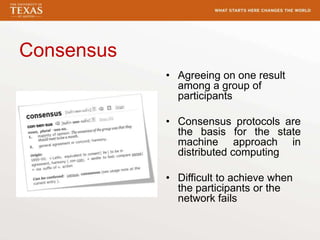
Consensus
• Agreeing on one result
among a group of
participants
• Consensus protocols are
the basis for the state
machine approach in
distributed computing
• Difficult to achieve when
the participants or the
network fails
Introduction
• To deal with Concurrency
– Mutex and semaphore
– Read/Write locks in 2PL for transaction
• In distributed system
– No global master to issue locks
– Nodes/Channels Fail
Applications
• Chubby
– Distributed lock service by Google
– Provides Coarse grained locking for
distributed resources
• Petal
– Distributed virtual disks
• Frangipani
– A scalable distributed file system.
Why Paxos?
• Two Phase Commit (2PC)
– Coordinator Failures!!
• Three Phase Commit (3PC)
– Network Partition!!!
• Paxos
– Correctness guaranteed
– No liveness guaranteed
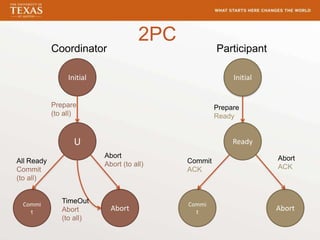
2PC
Initial
U
Abort
Commi
t
Prepare
(to all)
Abort
Abort (to all)All Ready
Commit
(to all)
TimeOut
Abort
(to all)
Initial
Ready
Abort
Commi
t
Prepare
Ready
Abort
ACK
Commit
ACK
Coordinator Participant
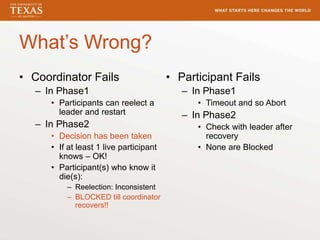
What’s Wrong?
• Coordinator Fails
– In Phase1
• Participants can reelect a
leader and restart
– In Phase2
• Decision has been taken
• If at least 1 live participant
knows – OK!
• Participant(s) who know it
die(s):
– Reelection: Inconsistent
– BLOCKED till coordinator
recovers!!
• Participant Fails
– In Phase1
• Timeout and so Abort
– In Phase2
• Check with leader after
recovery
• None are Blocked
Problems
• 2PC not resilient to coordinator failures in
2nd phase
• Participants didn’t know about the leader’s
decision: Abort/Commit
• So, a new phase is introduced to avoid
this ambiguity
• ‘Prepare to Commit’
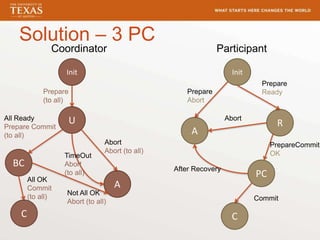
Solution – 3 PC
Init
U
A
C
Prepare
(to all)
Abort
Abort (to all)
All OK
Commit
(to all)
TimeOut
Abort
(to all)
Init
R
A
C
Prepare
Ready
PrepareCommit
OK
Commit
Coordinator Participant
BC
All Ready
Prepare Commit
(to all)
Not All OK
Abort (to all)
Prepare
Abort
PC
Abort
After Recovery
Recovery
• Coordinator Fails in 2nd Phase and also a
participant fails
– Participant: Should have been in PC
– Coordinator: Should have been in BC
– Others can re-elect and restart 3PC (nothing
committed)
• Coordinator fails in 3rd Phase:
– Decision Taken and we know what it is
– No need to BLOCK!
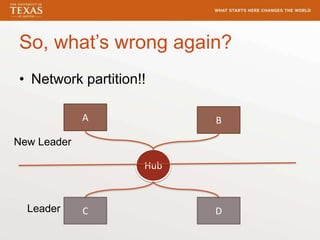
So, what’s wrong again?
• Network partition!!
A
D
B
C
Hub
Leader
New Leader
Problem
How to reach consensus/data consistency in
a given distributed system that can tolerate
non-malicious failures?
Requirements
• Safety
– Only a value that has been proposed may be chosen
– Only one value is chosen
– A node never learns that a value has been chosen unless
it actually has been
• Liveness
– Eventually,
• some proposed value is chosen
• a node can learn the chosen value
• When the protocol is run in 2F+1 processes, F
processes can fail
Terminology
• Classes/Roles of agents:
– Client
• issues a request, waits for response
– Proposers
• Proposes the Client’s request, convinces the Acceptors,
resolves conflicts
– Acceptors
• Accept/Reject proposed values and let the learners know if
accepted
– Learners
• Mostly serve as a replication factor
• A node can act as more than one agent!
Paxos Algorithm
• Phase 1:
– Proposer (Prepare)
• selects a proposal number N
• sends a prepare request with number N to all acceptors
– Acceptor (Promise)
• If number N greater than that of any prepare
request it saw
– Respond a promise not to accept any more proposals
numbered less than N
• Otherwise, reject the proposal and also indicate
the highest proposal number it is considering
Paxos algorithm Contd.
• Phase 2
– Proposer (Accept):
• If N was accepted by majority of acceptors, send accept
request to all acceptors along with a value ‘v’
– Acceptor (Accepted):
• Receives (N,v) and accept the proposal unless it has already
responded to a prepare request having a number greater
than N.
• If accepted, send this value to the Listeners to store it.
Paxos’ properties
• P1: Any proposal number is unique
– If there are T nodes in the system, ith node
uses {i, i+T, i+2T, ……}
• P2: Any two set of acceptors have at least
one acceptor in common.
• P3: Value sent out in phase 2 is the value
of the highest-numbered proposal of all
the responses in phase 1.
Learning a chosen value
• Various Options:
– Each acceptor, whenever it accepts a
proposal, informs all the learners
• Our implementation
– Acceptors inform a distinguished learner
(usually the proposer) and let the
distinguished learner broadcast the result.
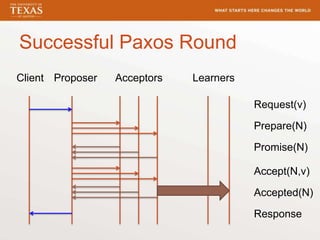
Successful Paxos Round
Client Proposer Acceptors Learners
Request(v)
Prepare(N)
Promise(N)
Accept(N,v)
Accepted(N)
Response
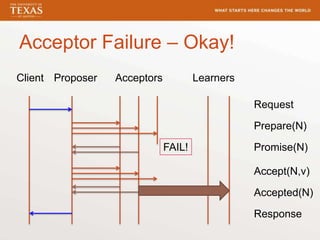
Acceptor Failure – Okay!
Client Proposer Acceptors Learners
Request
Prepare(N)
Promise(N)
Accept(N,v)
Accepted(N)
Response
FAIL!
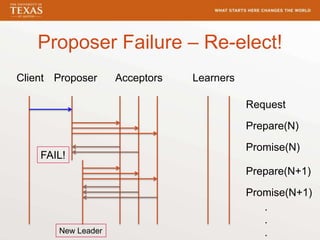
Proposer Failure – Re-elect!
Client Proposer Acceptors Learners
Request
Prepare(N)
Promise(N)
Prepare(N+1)
Promise(N+1)
FAIL!
New Leader
.
.
.
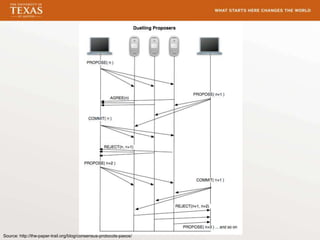
Dueling Proposers
Source: http://the-paper-trail.org/blog/consensus-protocols-paxos/
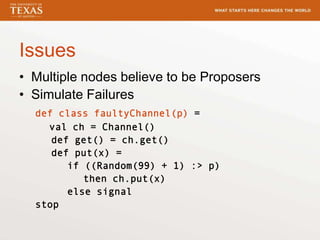
Issues
• Multiple nodes believe to be Proposers
• Simulate Failures
def class faultyChannel(p) =
val ch = Channel()
def get() = ch.get()
def put(x) =
if ((Random(99) + 1) :> p)
then ch.put(x)
else signal
stop
Implementation
• Learn which nodes are alive
– HeartBeat messages, Timeouts
• Simulate Node Failures
– Same as failing its out channels
• Stress test
– Fail and Unfail nodes at random times
– Ensure leader is elected and the protocol
continues
Optimizations
• Not required for correctness
• Proposer:
– Send only to majority of live acceptors (Cheap
Paxos’ Key)
• Acceptor can Reject:
– Prepare(N) if answered Prepare(M): M > N
– Accept(N,v) if answered Accept(M,u): M > N
– Prepare(N) if answered Accept(M,u): M > N
Possible Future Work
• Extend to include Multi-Paxos, Fast
Paxos, Byzantine Paxos etc
• Use remoteChannels to run across nodes
Questions
References
• Paxos made Simple, Leslie Lamport
• Orc Reference Guide
– http://orc.csres.utexas.edu/
• http://the-paper-trail.org/
• Prof Seif Haridi’s Youtube Video Lectures

Basic Paxos Implementation in Orc

  • 1.
    Classic Paxos Implementedin Orc Hemanth Kumar Mantri Makarand Damle Term Project CS380D (Distributed Computing)
  • 2.
    Consensus • Agreeing onone result among a group of participants • Consensus protocols are the basis for the state machine approach in distributed computing • Difficult to achieve when the participants or the network fails
  • 3.
    Introduction • To dealwith Concurrency – Mutex and semaphore – Read/Write locks in 2PL for transaction • In distributed system – No global master to issue locks – Nodes/Channels Fail
  • 4.
    Applications • Chubby – Distributedlock service by Google – Provides Coarse grained locking for distributed resources • Petal – Distributed virtual disks • Frangipani – A scalable distributed file system.
  • 5.
    Why Paxos? • TwoPhase Commit (2PC) – Coordinator Failures!! • Three Phase Commit (3PC) – Network Partition!!! • Paxos – Correctness guaranteed – No liveness guaranteed
  • 6.
    2PC Initial U Abort Commi t Prepare (to all) Abort Abort (toall)All Ready Commit (to all) TimeOut Abort (to all) Initial Ready Abort Commi t Prepare Ready Abort ACK Commit ACK Coordinator Participant
  • 7.
    What’s Wrong? • CoordinatorFails – In Phase1 • Participants can reelect a leader and restart – In Phase2 • Decision has been taken • If at least 1 live participant knows – OK! • Participant(s) who know it die(s): – Reelection: Inconsistent – BLOCKED till coordinator recovers!! • Participant Fails – In Phase1 • Timeout and so Abort – In Phase2 • Check with leader after recovery • None are Blocked
  • 8.
    Problems • 2PC notresilient to coordinator failures in 2nd phase • Participants didn’t know about the leader’s decision: Abort/Commit • So, a new phase is introduced to avoid this ambiguity • ‘Prepare to Commit’
  • 9.
    Solution – 3PC Init U A C Prepare (to all) Abort Abort (to all) All OK Commit (to all) TimeOut Abort (to all) Init R A C Prepare Ready PrepareCommit OK Commit Coordinator Participant BC All Ready Prepare Commit (to all) Not All OK Abort (to all) Prepare Abort PC Abort After Recovery
  • 10.
    Recovery • Coordinator Failsin 2nd Phase and also a participant fails – Participant: Should have been in PC – Coordinator: Should have been in BC – Others can re-elect and restart 3PC (nothing committed) • Coordinator fails in 3rd Phase: – Decision Taken and we know what it is – No need to BLOCK!
  • 11.
    So, what’s wrongagain? • Network partition!! A D B C Hub Leader New Leader
  • 12.
    Problem How to reachconsensus/data consistency in a given distributed system that can tolerate non-malicious failures?
  • 13.
    Requirements • Safety – Onlya value that has been proposed may be chosen – Only one value is chosen – A node never learns that a value has been chosen unless it actually has been • Liveness – Eventually, • some proposed value is chosen • a node can learn the chosen value • When the protocol is run in 2F+1 processes, F processes can fail
  • 14.
    Terminology • Classes/Roles ofagents: – Client • issues a request, waits for response – Proposers • Proposes the Client’s request, convinces the Acceptors, resolves conflicts – Acceptors • Accept/Reject proposed values and let the learners know if accepted – Learners • Mostly serve as a replication factor • A node can act as more than one agent!
  • 15.
    Paxos Algorithm • Phase1: – Proposer (Prepare) • selects a proposal number N • sends a prepare request with number N to all acceptors – Acceptor (Promise) • If number N greater than that of any prepare request it saw – Respond a promise not to accept any more proposals numbered less than N • Otherwise, reject the proposal and also indicate the highest proposal number it is considering
  • 16.
    Paxos algorithm Contd. •Phase 2 – Proposer (Accept): • If N was accepted by majority of acceptors, send accept request to all acceptors along with a value ‘v’ – Acceptor (Accepted): • Receives (N,v) and accept the proposal unless it has already responded to a prepare request having a number greater than N. • If accepted, send this value to the Listeners to store it.
  • 17.
    Paxos’ properties • P1:Any proposal number is unique – If there are T nodes in the system, ith node uses {i, i+T, i+2T, ……} • P2: Any two set of acceptors have at least one acceptor in common. • P3: Value sent out in phase 2 is the value of the highest-numbered proposal of all the responses in phase 1.
  • 18.
    Learning a chosenvalue • Various Options: – Each acceptor, whenever it accepts a proposal, informs all the learners • Our implementation – Acceptors inform a distinguished learner (usually the proposer) and let the distinguished learner broadcast the result.
  • 19.
    Successful Paxos Round ClientProposer Acceptors Learners Request(v) Prepare(N) Promise(N) Accept(N,v) Accepted(N) Response
  • 20.
    Acceptor Failure –Okay! Client Proposer Acceptors Learners Request Prepare(N) Promise(N) Accept(N,v) Accepted(N) Response FAIL!
  • 21.
    Proposer Failure –Re-elect! Client Proposer Acceptors Learners Request Prepare(N) Promise(N) Prepare(N+1) Promise(N+1) FAIL! New Leader . . .
  • 22.
  • 23.
    Issues • Multiple nodesbelieve to be Proposers • Simulate Failures def class faultyChannel(p) = val ch = Channel() def get() = ch.get() def put(x) = if ((Random(99) + 1) :> p) then ch.put(x) else signal stop
  • 24.
    Implementation • Learn whichnodes are alive – HeartBeat messages, Timeouts • Simulate Node Failures – Same as failing its out channels • Stress test – Fail and Unfail nodes at random times – Ensure leader is elected and the protocol continues
  • 25.
    Optimizations • Not requiredfor correctness • Proposer: – Send only to majority of live acceptors (Cheap Paxos’ Key) • Acceptor can Reject: – Prepare(N) if answered Prepare(M): M > N – Accept(N,v) if answered Accept(M,u): M > N – Prepare(N) if answered Accept(M,u): M > N
  • 26.
    Possible Future Work •Extend to include Multi-Paxos, Fast Paxos, Byzantine Paxos etc • Use remoteChannels to run across nodes
  • 27.
  • 28.
    References • Paxos madeSimple, Leslie Lamport • Orc Reference Guide – http://orc.csres.utexas.edu/ • http://the-paper-trail.org/ • Prof Seif Haridi’s Youtube Video Lectures