Flexible Paxos:
Reaching agreement
without majorities
Heidi Howard, Dahlia Malkhi, Alexander Spiegelman
University of Cambridge, VMware Research, Technion
heidi.howard@cl.cam.ac.uk
@heidiann360
hh360.user.srcf.net
fpaxos.github.io
1
2
3
TL;DR Majorities are not necessary to safety reach
distributed consensus.
4
Aims
1. Understand the widely adopted Paxos algorithm
and how Flexible Paxos safely generalizes it
2. Introduce a broad spectrum of possibilities for
reaching consensus and
3. Promote the idea that Paxos is not the best point
on this spectrum for most practical systems
5
Defining Consensus
Reaching agreement in an asynchronous distributed
system in the face of crash failures.
More specifically:
• Compromising safety is never an option
• No clock synchronization is assumed
• Participants fail by crashing and messages may be
lost but neither can act arbitrarily
6
Consensus is not a solved
problem
• Consensus is not scalable - often limited to 3, 5 or 7
participants.
• Consensus is slow - each decision requires at least
majority agreement, more when failures occur.
• Consensus is not available - cannot handle majority
failures or many network partitions.
You pay a high price even if no failures occur. Consider by
many as “best avoided”
7
Back in the good old days
…
8
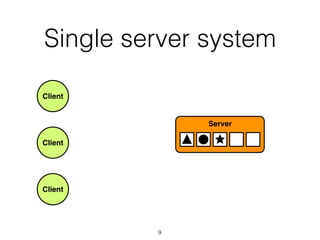
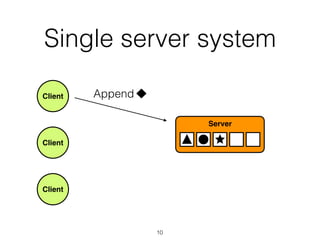
Single server system
Client
Client
Client
Server
9
Single server system
Client
Client
Client
Server
Append
10
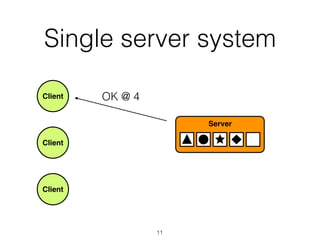
Single server system
Client
Client
Client
Server
OK @ 4
11
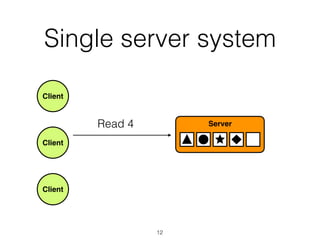
Single server system
Client
Client
Client
ServerRead 4
12
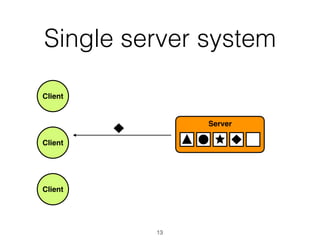
Single server system
Client
Client
Client
Server
13
Single server system
Client
Client
Client
Server
14
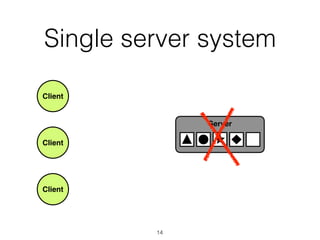
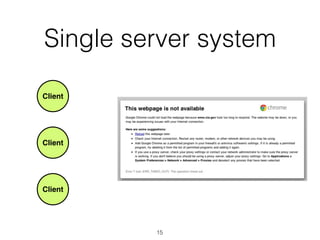
Single server system
Client
Client
Client
Server
15
Distributed systems
came to the rescue
16
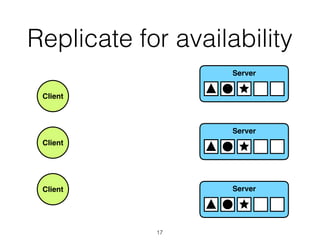
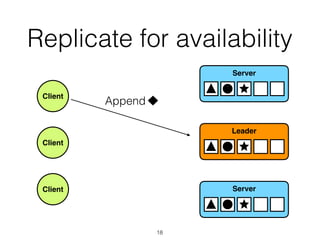
Replicate for availability
Client
Client
Client
Server
Server
Server
17
Replicate for availability
Client
Client
Client
Leader
Server
Server
Append
18
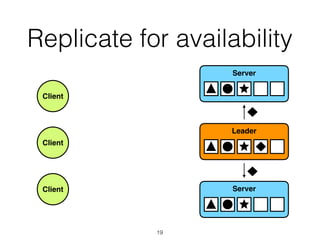
Replicate for availability
Client
Client
Client
Leader
Server
Server
19
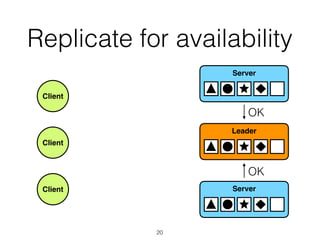
Replicate for availability
Client
Client
Client
Leader
Server
Server
OK
OK
20
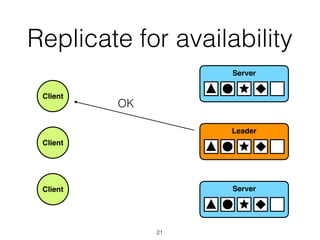
Replicate for availability
Client
Client
Client
Leader
Server
Server
OK
21
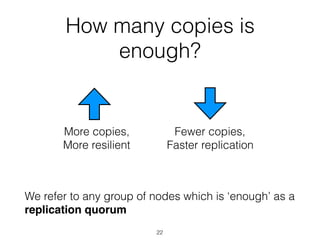
How many copies is
enough?
We refer to any group of nodes which is ‘enough’ as a
replication quorum
More copies,
More resilient
Fewer copies,
Faster replication
22
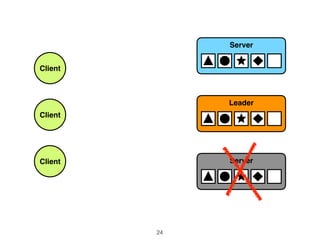
Now what happens when a
server fails?
23
Client
Client
Client
Leader
Server
Server
24
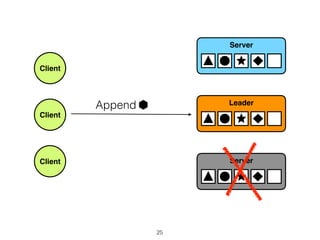
Client
Client
Client
Leader
Server
Server
Append
25
Client
Client
Client
Leader
Server
Server
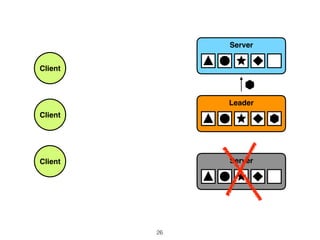
26
Client
Client
Client
Leader
Server
Server
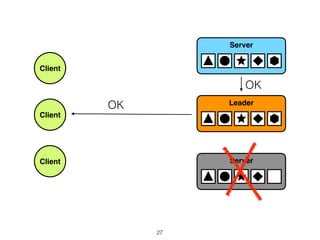
27
OK
OK
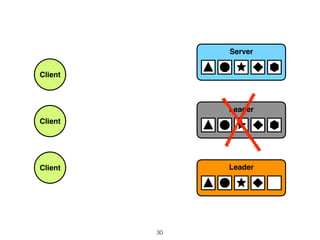
What happens when the
leader fails?
28
Client
Client
Client
Leader
Server
Server
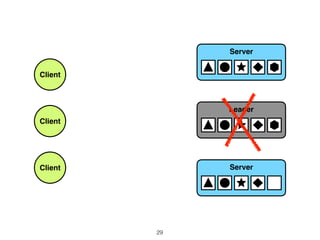
29
Client
Client
Client
Leader
Server
Leader
30
Recall that we never
compromise safety
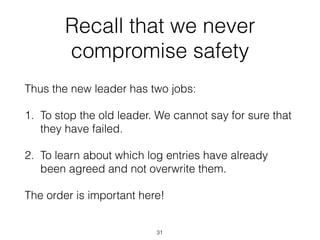
Thus the new leader has two jobs:
1. To stop the old leader. We cannot say for sure that
they have failed.
2. To learn about which log entries have already
been agreed and not overwrite them.
The order is important here!
31
How to stop past leaders?
They may come back to haunt us.
• Ask them to stop
• Use leases and wait for them to expire
• Ignore them by having nodes promise to stop
replicating for them
32
How many promises are
enough?
Leaders cannot wait forever.
We need a minimum of one node from each
replication quorum to promise not to replicate new
entries.
We refer to this as the leader election quorum.
33
Promises are tricky to safely
break
Let’s assume each leadership term has a unique term
number.
Problem: We don’t always know who the past
leaders are. We need a deterministic scheme for
breaking promises.
Solution: Each node stores the promise as “ignore
all smaller terms”.
34
Learn all committed entries
The new leader must never overwrite committed
entries.
It must learn about the committed entries before it
starts adding new entries without leaving holes.
35
Safely handle in-progress
commands
Any in-progress entries already replicated on the
leader election quorum nodes must be finished by
the new leader.
If there are conflicting in-progress entries from
different leaders, we choose the log entry with the
highest view.
36
Context
This mechanism of views and promises is widely
utilised. This core idea is commonly referred to as
Paxos.
It’s a recurring foundation in the literature:
Viewstamped Replication [PODC’88], Paxos
[TOCS’98], Zab/Zookeeper [ATC’10] and Raft
[ATC’14] and many more.
37
What’s changed?
Traditionally, it was thought that all quorums needed
to intersect, regardless of whether the quorum was
used for replication or leader election.
Majorities are the widely adopted approach to this.
We have just seen that the only requirement is that
leader election quorums intersect with replication
quorums.
38
Implications
In theory:
• Helps us to understand Paxos
• Generalisation & weakening of the requirements
• Orthogonal to any particular algorithm built upon Paxos
In practice:
• Many new quorum schemes now become feasible
• Introduces a new breed of scalable, resilient consensus
algorithms.
39
Quorums Systems
40
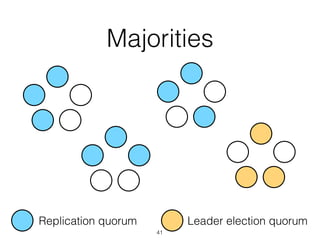
Majorities
Replication quorum Leader election quorum
41
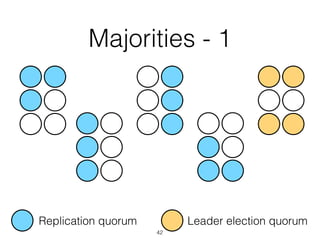
Majorities - 1
Replication quorum Leader election quorum
42
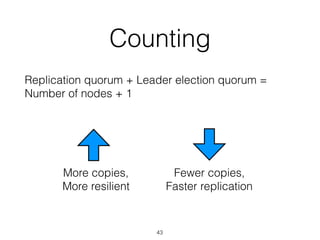
Counting
Replication quorum + Leader election quorum =
Number of nodes + 1
More copies,
More resilient
Fewer copies,
Faster replication
43
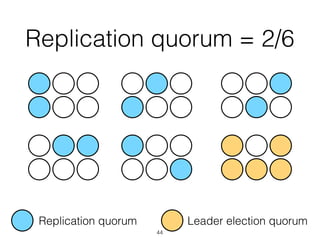
Replication quorum = 2/6
Replication quorum Leader election quorum
44
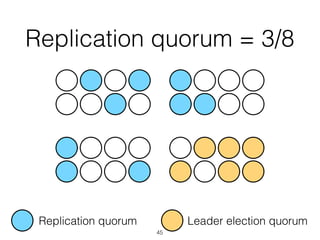
Replication quorum = 3/8
Replication quorum Leader election quorum
45
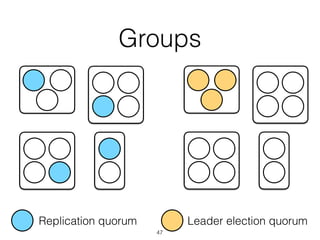
Not all members were
created equal
• Machines and the networks which connect them
are heterogeneous
• Failures are not independent: members are more
likely to simultaneously fail if they are located in the
same host, rack or even datacenter
46
Groups
Replication quorum Leader election quorum
47
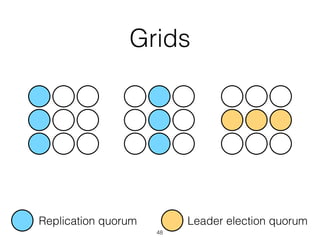
Grids
Replication quorum Leader election quorum
48
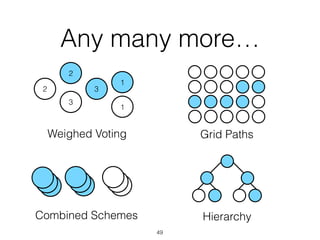
Any many more…
Weighed Voting
2
2
3
3
1
1
Grid Paths
Combined Schemes Hierarchy
49
Majorities are no longer
‘one size fits all’
Majorities are unlikely to be optimal for most practical
systems
• Requirements of real systems differ. Performance
really matters.
• Leader election is rare so often we optimize for the
common replication phase.
50
Summary
• The only quorum intersection requirement is that
leader election quorums must intersect with the
replication quorums.
• Majorities are not the only option for safely reaching
consensus and are often not best suited to
practical systems.
• Don’t give up on strong consistency guarantees.
Distributed consensus can be performant and
scalable.
51
Ongoing Work
• Adoption into existing production systems
• Building new algorithms offering interesting
compromises
• Practical analysis of quorum systems for
consensus
• Extending to other algorithms and different failures
models e.g. Flexible Fast Paxos and Flexible
Byzantine Paxos
52
Question?
Let’s continue the discussion:
Heidi Howard
heidi.howard@cl.cam.ac.uk
@heidiann360
53

Flexible Paxos: Reaching agreement without majorities