Basic life support (bls)
BY GOVIND
B.SC. CVT 3RD SEM
Introduction
 Basic life support is the immediate treatment or assistance given
to a person who is injured or suddenly becomes ill, using facilities
or materials available there at that time before regular medical
help is imparted.
 BLS is one of the essential assistance that should be given to a
person.
 Basic life support is the knowledge and skill necessary to respond,
mostly to breathing and cardiac emergency in adult, child and
infant patients.
Objectives of BLS
 To provide oxygen to heart and the brain.
 To sustain tissue capability until definitive electric or
medical treatment can restore spontaneous circulation.
 To preserve life.
 To make the victim as comfortable as possible to
conserve strength.
Cardio pulmonary resuscitation.
 The use of artificial ventilation with external heart compression is
called cardio pulmonary resuscitation (CPR).
 CPR should be started in all cases of cardiac and respiratory
arrest.
 CPR includes chest compression and mouth to mouth breath.
American Heart
Association(AHA)
 The American Heart Association is nonprofit organization in
the United States that funds cardiovascular medical
researches, educates consumer on healthy living and
encourage appropriate cardiac care in an effort to reduce
disability and deaths caused by cardiovascular disease.
 AHA is mainly dedicated to the reduction of death and
disability from cardiovascular disease, including heart
disease and stroke.
General concept of BLS according
to AHA
 According to AHA BLS includes :
• Quickly starting the Chain of Survival
• Delivering high quality chest compressions for adults, children and
infants
• Knowing where to locate and understanding how to use an Automatic
External Defibrillator (AED)
• Providing rescue breathing when appropriate
• Understanding how to perform as a team
• Knowing how to treat choking
Chain of survival
 Chain of survival refers to the chain of events that must occur in
rapid succession to maximize the chances of survival from sudden
cardiac arrest and respiratory arrest.
 A strong chain of survival can improve chances of survival and
recovery for victims of cardiac arrest and respiratory arrest.
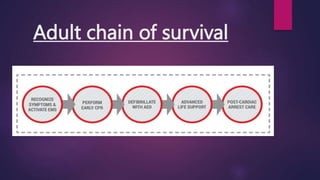
 The two chains of survival are: Adult chain of survival and
pediatric chain of survival.
Adult chain of survival
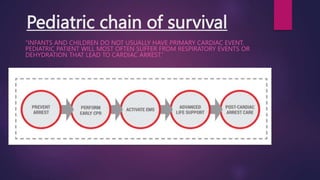
Pediatric chain of survival
“INFANTS AND CHILDREN DO NOT USUALLY HAVE PRIMARY CARDIAC EVENT.
PEDIATRIC PATIENT WILL MOST OFTEN SUFFER FROM RESPIRATORY EVENTS OR
DEHYDRATION THAT LEAD TO CARDIAC ARREST.”
BLS Algorithm
THE BASIC LIFE SUPPORT (BLS) ALGORITHMS PROVIDE A
DETAILED PROCESS FOR LIFE SAVING ACTIONS FOR ONE AND
TWO RESCUER SITUATIONS FOR INFANTS, CHILDREN AND
ADULTS.
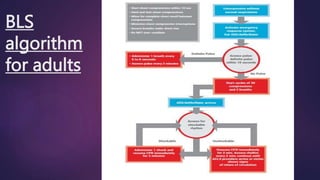
BLS
algorithm
for adults
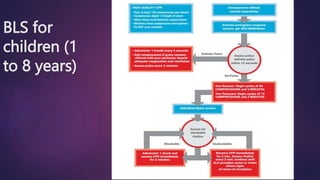
BLS for
children (1
to 8 years)
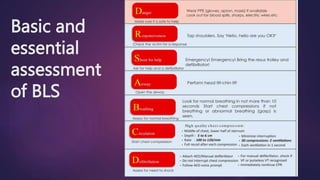
Basic and
essential
assessment
of BLS
Airway management
 Until an advanced airways inserted, the rescue teams should use mouth to mouth,
mouth to mask or bag mask ventilation.
 An advanced airway (laryngeal mask airway, or endotracheal tube) provides a more
stable way of providing breaths and should therefore be inserted as early as
possible in a resuscitation effort.
 Once an advanced Airways is placed, the compression/ breath ratio be adjusted as
noted below:
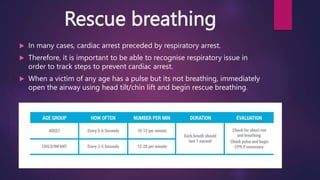
Rescue breathing
 In many cases, cardiac arrest preceded by respiratory arrest.
 Therefore, it is important to be able to recognise respiratory issue in
order to track steps to prevent cardiac arrest.
 When a victim of any age has a pulse but its not breathing, immediately
open the airway using head tilt/chin lift and begin rescue breathing.
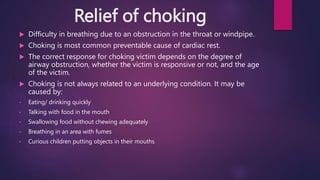
Relief of choking
 Difficulty in breathing due to an obstruction in the throat or windpipe..
 Choking is most common preventable cause of cardiac rest.
 The correct response for choking victim depends on the degree of
airway obstruction, whether the victim is responsive or not, and the age
of the victim.
 Choking is not always related to an underlying condition. It may be
caused by:
• Eating/ drinking quickly
• Talking with food in the mouth
• Swallowing food without chewing adequately
• Breathing in an area with fumes
• Curious children putting objects in their mouths
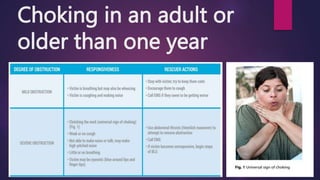
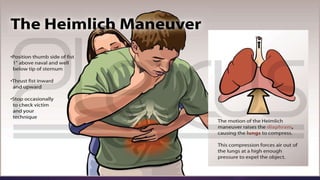
Choking in an adult or
older than one year
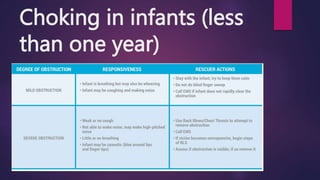
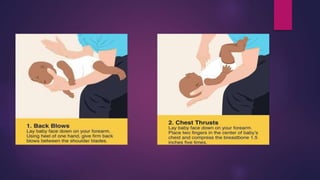
Choking in infants (less
than one year)
Thank you

Basic life support (bls).pptx

  • 1.
    Basic life support(bls) BY GOVIND B.SC. CVT 3RD SEM
  • 2.
    Introduction  Basic lifesupport is the immediate treatment or assistance given to a person who is injured or suddenly becomes ill, using facilities or materials available there at that time before regular medical help is imparted.  BLS is one of the essential assistance that should be given to a person.  Basic life support is the knowledge and skill necessary to respond, mostly to breathing and cardiac emergency in adult, child and infant patients.
  • 3.
    Objectives of BLS To provide oxygen to heart and the brain.  To sustain tissue capability until definitive electric or medical treatment can restore spontaneous circulation.  To preserve life.  To make the victim as comfortable as possible to conserve strength.
  • 4.
    Cardio pulmonary resuscitation. The use of artificial ventilation with external heart compression is called cardio pulmonary resuscitation (CPR).  CPR should be started in all cases of cardiac and respiratory arrest.  CPR includes chest compression and mouth to mouth breath.
  • 5.
    American Heart Association(AHA)  TheAmerican Heart Association is nonprofit organization in the United States that funds cardiovascular medical researches, educates consumer on healthy living and encourage appropriate cardiac care in an effort to reduce disability and deaths caused by cardiovascular disease.  AHA is mainly dedicated to the reduction of death and disability from cardiovascular disease, including heart disease and stroke.
  • 6.
    General concept ofBLS according to AHA  According to AHA BLS includes : • Quickly starting the Chain of Survival • Delivering high quality chest compressions for adults, children and infants • Knowing where to locate and understanding how to use an Automatic External Defibrillator (AED) • Providing rescue breathing when appropriate • Understanding how to perform as a team • Knowing how to treat choking
  • 7.
    Chain of survival Chain of survival refers to the chain of events that must occur in rapid succession to maximize the chances of survival from sudden cardiac arrest and respiratory arrest.  A strong chain of survival can improve chances of survival and recovery for victims of cardiac arrest and respiratory arrest.  The two chains of survival are: Adult chain of survival and pediatric chain of survival.
  • 8.
  • 9.
    Pediatric chain ofsurvival “INFANTS AND CHILDREN DO NOT USUALLY HAVE PRIMARY CARDIAC EVENT. PEDIATRIC PATIENT WILL MOST OFTEN SUFFER FROM RESPIRATORY EVENTS OR DEHYDRATION THAT LEAD TO CARDIAC ARREST.”
  • 10.
    BLS Algorithm THE BASICLIFE SUPPORT (BLS) ALGORITHMS PROVIDE A DETAILED PROCESS FOR LIFE SAVING ACTIONS FOR ONE AND TWO RESCUER SITUATIONS FOR INFANTS, CHILDREN AND ADULTS.
  • 11.
  • 12.
  • 13.
  • 14.
    Airway management  Untilan advanced airways inserted, the rescue teams should use mouth to mouth, mouth to mask or bag mask ventilation.  An advanced airway (laryngeal mask airway, or endotracheal tube) provides a more stable way of providing breaths and should therefore be inserted as early as possible in a resuscitation effort.  Once an advanced Airways is placed, the compression/ breath ratio be adjusted as noted below:
  • 15.
    Rescue breathing  Inmany cases, cardiac arrest preceded by respiratory arrest.  Therefore, it is important to be able to recognise respiratory issue in order to track steps to prevent cardiac arrest.  When a victim of any age has a pulse but its not breathing, immediately open the airway using head tilt/chin lift and begin rescue breathing.
  • 16.
    Relief of choking Difficulty in breathing due to an obstruction in the throat or windpipe..  Choking is most common preventable cause of cardiac rest.  The correct response for choking victim depends on the degree of airway obstruction, whether the victim is responsive or not, and the age of the victim.  Choking is not always related to an underlying condition. It may be caused by: • Eating/ drinking quickly • Talking with food in the mouth • Swallowing food without chewing adequately • Breathing in an area with fumes • Curious children putting objects in their mouths
  • 17.
    Choking in anadult or older than one year
  • 18.
    Choking in infants(less than one year)
  • 21.