First Aid
Definition
• Initial assistance given to a person suddenly taken ill or
injured before the arrival of ambulance, doctor or other
qualified medical personnel”
• “…provision of initial care for an illness or injury”
• This means that first aid can be anything from putting a
plaster to saving someone’s life
• You do not have to be a health practitioner to provide first aid.
Aims of first aid
Broadly, there are three main aims when administering first
aid:
 Preserve life
 Prevent deterioration :worsening of the condition (if
possible):
 Promote recovery
• These are also known as the “three Ps”
Preserve life
• Carrying out emergency first aid procedures.
E.g.: CPR, abdominal thrust
• Protect oneself from danger
• Protect the client from danger
Prevent deterioration
• Preventing further injuries
• Make the area as safe as possible and remove
any dangers
Promote recovery
• Arrange prompt emergency medical help
• Doing the right things you help make the
patient better
• Preventing complications
Roles of a first aider
• Manage incident and ensure continuing safety for
themselves, bystanders and casualty
• Assess casualties and find out the nature and cause of
their injuries
• Arrange for further medical help or other emergencies to
attend
Roles of a first aider
• Priorities casualties according to need
• Provide appropriate first aid as trained
• If able, make notes/observations on casualties
• Fill out paperwork as required
• Provide handover when further medical help
arrives
First aid priorities
• Assess situation quickly and calmly;
• Protect yourself and casualty from danger
• Prevent cross infection between the first aider and casualty
• Give early treatment and treat casualties with life threatening
conditions first.
• Comfort and reassure casualties at all times where possible
• Assess the casualty; identify the nature of injury/ illness
affecting a casualty.
• Arrange for medical help
First Aid priorities
1. Assess situation quickly and calmly;
• Be calm
• Assess risks (to your self and others)
• Assess the cause (mechanism) of the injury or
illness.
• Assess the number of victims.
• Build and maintain trust
• Treat life threatening conditions first
• Call for appropriate emergency help
• Remember your needs
First Aid priorities…
2. Protect yourself and casualty from danger
• Identify any safety risks and assess resources available
• Assess situation, evaluate the three S’s
• Safety
– Dangers, do they still exist?
– Protective clothes?
• Scene
– Factors involved in the incident
– Mechanisms involved in injury
– Casualties present
– Potential injuries
• Situation
– What happened, people involved and their age
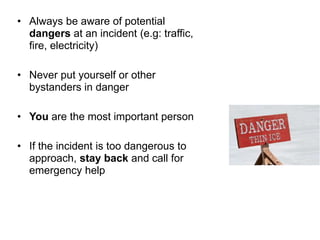
• Always be aware of potential
dangers at an incident (e.g: traffic,
fire, electricity)
• Never put yourself or other
bystanders in danger
• You are the most important person
• If the incident is too dangerous to
approach, stay back and call for
emergency help
First aid priorities cont…
3. Prevent cross infection between the first
aider and casualty
• Dispose all waste safely
• Do not touch wounds with bare hands
• Cover cuts and grazes before attending to
patients
• Do not breathe, sneeze or cough over a wound
while attending to a casualty.
Basic infection control
• Various diseases can be transmitted via blood and body
fluids
 NB; HIV and Hepatitis B & C precautions
• If possible, always wear disposable gloves when dealing
with bodily fluids
 This is not always practical!
 You can improvise and use anything to create a barrier.
e.g. a plastic bag
• Ensure any cuts/open injuries to your hands are covered
with waterproof plasters or dressings.
• Wash your hands with soap and warm water after dealing
with a casualty
First Aid Priorities…
4. Give early treatment and treat casualties with life
threatening conditions first.
• Triage; dynamic process of prioritizing casualties for
treatment and evacuation of wounded within the limits
of situation and resources.
• People walking towards you- least priority 3
• People who can move about but do not talk- priority 2
• No action, cry for help priority 1
5. Comfort and reassure casualties at all times where possible
6. Assess the casualty; identify the nature of injury/ illness
affecting a casualty.
• Primary survey
 Response
 Effective circulation – check the carotid pulse
 Clear Airway-check for any obstructions or
secretions and clear, position appropriately
 Adequate Breathing – assess for breathing
pattern, respiratory rate and intervene
 Look for any signs of shock, monitor, Intervene
by positioning or arresting any bleeding.
 Determine need for transport or calling for help
 Check for spine cord injury
Assessment of casualty cont…..
• Secondary survey
 Rapid Head-to toe examination for any DCAP-
BTLS- Deformity/Discolorations,
Contusions/Crepitus, Abrasions/Avulsions,
Puncture/penetration, Burns/Bruises,
Tenderness, Lacerations and
swellings/Symmetry
 Taking History by using SAMPLE acronym,
 Vital signs
 If time allows focused History
Assessment of casualty cont….
• Tertiary survey
 Environmental clues
 Continuous monitoring of casualty
First Aid Priorities cont…
7. Arrange for medical help
Always give the following information
 Name and telephone number
 Precise location of the incident
 Type of incident
 Seriousness of incident
 Age and number of casualties
 Condition of casualties
 Any hazards at the incident (….fire, leaking gas, spilt oil,etc)
Legal and Ethical Issues in First Aid
• No legal obligation to aid a stranger.
• Duty to act for those in certain occupations or professions.
• Follow accepted guidelines.
– “Reasonable-man” test- Did the First Aider act the same
way a normal, prudent person with similar training would
have acted under the same circumstances?
• Provide only the level of care you are trained to provide.
Legal and Ethical Issues in First Aid
• Do not put your own life or safety in jeopardy.
• Good Samaritan laws protect first aiders.
• Obtain consent.
– Actual consent- Informed consent
– Implied consent- Assumption that a victim of life-
threatening injury or illness would give consent
– Minor’s consent- The right of consent given to a
parent or guardian
• Explain treatments and involve victim in decisions where
possible
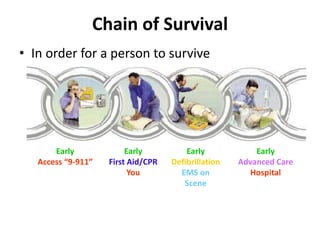
Chain of Survival
• In order for a person to survive
Early
Access “9-911”
Early
First Aid/CPR
You
Early
Defibrillation
EMS on
Scene
Early
Advanced Care
Hospital
22
Giving First Aid
RAP CABH
R is for Responsiveness
Is the victim conscious?
Touch their shoulder, ask if they are alright.
Ask if they need help.
If they say no, then proceed no further
If yes, or no response, then proceed to A
23
Giving First Aid
RAP CABH
A is for Activate EMS or 911
24
When To Move An Injured
Person
P is for Position
Only re-position the victim if the victim is in further
danger in their present location.
And / or there does not seem to be spinal injury
and additional care requires moving them.
25
 If there are suspected spinal injuries,
do not move the victim (except when
the victim is in a life threatening
situation).
Explain when an injured person
should and should not be moved?
26
 C is for circulation
Four Steps of Victim
Assessment
If there is not a pulse, then this person needs CPR.
The best place to check for a pulse is the carotid
artery along the side of the neck along the windpipe.
Use the mnemonic “CABH”
27
Four Steps of Victim
Assessment
A is for airway
-check to see if the airway is blocked.
28
 B is for breathing
Four Steps of Victim
Assessment
Look, listen and feel by watching the chest and placing
your cheek a few inches above the mouth of the victim to
sense any movement of air. If the victim is not breathing, they
may need their head repositioned.
Assessing Accident sites
• Accident: Event resulting in threat to a victim’s life that may
result in death or disability if no interventions are instituted
early
• Mass Casualty incident: Any event resulting in a number of
victims large enough to disrupt the normal course of
emergency and health care services
• Casualty management: Management of accident victim or
victims of a mass casualty event
• Objective is to minimize loss of life and disabilities
Approaches to Accident management
• “Scoop and Run”
• Classical Approach
• Casualty Management System
Scoop and Run
 Most common
 Does not require specific technical ability from
rescuers
 Justified for small numbers of victims occurring near a
hospital
 Involves evacuating casualties from accident site to
nearest hospital in shortest time possible
 Disadvantage
 May just transfer problem to the hospital
31
Classical Approach
• First responders are trained (basic triage and field
care)
• First aiders aim to stabilize the victims by
applying basic and advanced life support before
hospital treatment
• Disregard the receiving hospitals from the field
 Disadvantage
• Quickly result to chaos 32
Mass Casualty Management Approach
• Most sophisticated approach includes pre-
established procedures for:
a. resource mobilization
b. field management
c. hospital reception
33
Mass Casualty Management Approach
• Various level of responders are trained
• Incorporates links between field and health
care facilities
• Command Post
• Multi-sectoral Response
• Dependent on the availability of large
amounts of human & material resources
34
What is Triage ?
• French word meaning to “Sort”
• Utilized to identify treatment priorities
• Process by which a decision is made on which
victim receives treatment and which does not
• Involves identifying four basic priorities of patient
treatment and transport
35
Priorities
Highest Priority
– Patients that require immediate care and transportation
– Patients receive treatment at the scene for life
threatening injuries
– First to be sent to available medical facilities
Red – Immediate care : Life threatening
injuries
36
Priorities
Intermediate priority
• Patient treatment and transport can be delayed
Yellow: Urgent care: delay treatment and
transport up to 4 hours
37
Priorities
Delayed or Low Priority
• Referred to as “walking wounded”
• Injuries require medical care at some point
• Treatment and transport can be delayed
• Monitor patients and reassess
Green – Walking wounded: delay treatment and
transport
24 hours
38
Priorities
Lowest Priority
• Patients have either died or are near death
• If still alive they have suffered severe or
serious injuries with little chance of survival
• When resources are limited, patients must be
ignored
Black: No care required: patient is dead or near
death
39
Triaging
• Assess situation
• Ensure safe approach and scene survey
• Activate additional resources
 Number of victims
 Size of the incident
 Requesting more equipment and personnel
40
Triaging
• First Step is to make an announcement for all people
able to get up and walk to specific area
• Allows responder to focus on injured
• People who successfully move should be tagged
“Green”
• Tell people to look out for each other and notify
responders of any significant changes
41
Triaging
• Second step is to conduct an orderly survey of
remaining victims
• Decide how to move through area
• Perform quick assessment on each person and label or
tag
• No more than 10 seconds per patient
42
Triage
• Correct life threatening : airway or breathing problem
and profuse bleeding
• The objective is to: locate, identify and tag priority
one patients who require immediate care and
transportation
• Assess victims’ respiration, pulse and mental status to
identify
43
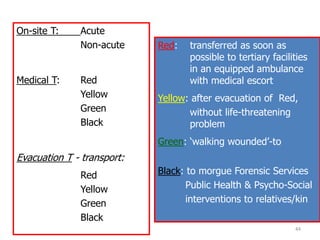
On-site T: Acute
Non-acute
Medical T: Red
Yellow
Green
Black
Evacuation T - transport:
Red
Yellow
Green
Black
Red: transferred as soon as
possible to tertiary facilities
in an equipped ambulance
with medical escort
Yellow: after evacuation of Red,
without life-threatening
problem
Green: ‘walking wounded’-to
Black: to morgue Forensic Services
Public Health & Psycho-Social
interventions to relatives/kin
44
45
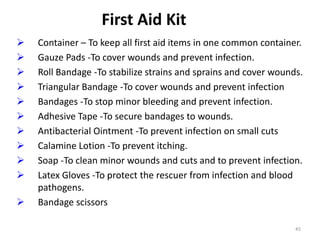
First Aid Kit
 Container – To keep all first aid items in one common container.
 Gauze Pads -To cover wounds and prevent infection.
 Roll Bandage -To stabilize strains and sprains and cover wounds.
 Triangular Bandage -To cover wounds and prevent infection
 Bandages -To stop minor bleeding and prevent infection.
 Adhesive Tape -To secure bandages to wounds.
 Antibacterial Ointment -To prevent infection on small cuts
 Calamine Lotion -To prevent itching.
 Soap -To clean minor wounds and cuts and to prevent infection.
 Latex Gloves -To protect the rescuer from infection and blood
pathogens.
 Bandage scissors

Basic life suport (1).pptx...................

  • 1.
    First Aid Definition • Initialassistance given to a person suddenly taken ill or injured before the arrival of ambulance, doctor or other qualified medical personnel” • “…provision of initial care for an illness or injury” • This means that first aid can be anything from putting a plaster to saving someone’s life • You do not have to be a health practitioner to provide first aid.
  • 2.
    Aims of firstaid Broadly, there are three main aims when administering first aid:  Preserve life  Prevent deterioration :worsening of the condition (if possible):  Promote recovery • These are also known as the “three Ps”
  • 3.
    Preserve life • Carryingout emergency first aid procedures. E.g.: CPR, abdominal thrust • Protect oneself from danger • Protect the client from danger
  • 4.
    Prevent deterioration • Preventingfurther injuries • Make the area as safe as possible and remove any dangers
  • 5.
    Promote recovery • Arrangeprompt emergency medical help • Doing the right things you help make the patient better • Preventing complications
  • 6.
    Roles of afirst aider • Manage incident and ensure continuing safety for themselves, bystanders and casualty • Assess casualties and find out the nature and cause of their injuries • Arrange for further medical help or other emergencies to attend
  • 7.
    Roles of afirst aider • Priorities casualties according to need • Provide appropriate first aid as trained • If able, make notes/observations on casualties • Fill out paperwork as required • Provide handover when further medical help arrives
  • 8.
    First aid priorities •Assess situation quickly and calmly; • Protect yourself and casualty from danger • Prevent cross infection between the first aider and casualty • Give early treatment and treat casualties with life threatening conditions first. • Comfort and reassure casualties at all times where possible • Assess the casualty; identify the nature of injury/ illness affecting a casualty. • Arrange for medical help
  • 9.
    First Aid priorities 1.Assess situation quickly and calmly; • Be calm • Assess risks (to your self and others) • Assess the cause (mechanism) of the injury or illness. • Assess the number of victims. • Build and maintain trust • Treat life threatening conditions first • Call for appropriate emergency help • Remember your needs
  • 10.
    First Aid priorities… 2.Protect yourself and casualty from danger • Identify any safety risks and assess resources available • Assess situation, evaluate the three S’s • Safety – Dangers, do they still exist? – Protective clothes? • Scene – Factors involved in the incident – Mechanisms involved in injury – Casualties present – Potential injuries • Situation – What happened, people involved and their age
  • 11.
    • Always beaware of potential dangers at an incident (e.g: traffic, fire, electricity) • Never put yourself or other bystanders in danger • You are the most important person • If the incident is too dangerous to approach, stay back and call for emergency help
  • 12.
    First aid prioritiescont… 3. Prevent cross infection between the first aider and casualty • Dispose all waste safely • Do not touch wounds with bare hands • Cover cuts and grazes before attending to patients • Do not breathe, sneeze or cough over a wound while attending to a casualty.
  • 13.
    Basic infection control •Various diseases can be transmitted via blood and body fluids  NB; HIV and Hepatitis B & C precautions • If possible, always wear disposable gloves when dealing with bodily fluids  This is not always practical!  You can improvise and use anything to create a barrier. e.g. a plastic bag • Ensure any cuts/open injuries to your hands are covered with waterproof plasters or dressings. • Wash your hands with soap and warm water after dealing with a casualty
  • 14.
    First Aid Priorities… 4.Give early treatment and treat casualties with life threatening conditions first. • Triage; dynamic process of prioritizing casualties for treatment and evacuation of wounded within the limits of situation and resources. • People walking towards you- least priority 3 • People who can move about but do not talk- priority 2 • No action, cry for help priority 1 5. Comfort and reassure casualties at all times where possible
  • 15.
    6. Assess thecasualty; identify the nature of injury/ illness affecting a casualty. • Primary survey  Response  Effective circulation – check the carotid pulse  Clear Airway-check for any obstructions or secretions and clear, position appropriately  Adequate Breathing – assess for breathing pattern, respiratory rate and intervene  Look for any signs of shock, monitor, Intervene by positioning or arresting any bleeding.  Determine need for transport or calling for help  Check for spine cord injury
  • 16.
    Assessment of casualtycont….. • Secondary survey  Rapid Head-to toe examination for any DCAP- BTLS- Deformity/Discolorations, Contusions/Crepitus, Abrasions/Avulsions, Puncture/penetration, Burns/Bruises, Tenderness, Lacerations and swellings/Symmetry  Taking History by using SAMPLE acronym,  Vital signs  If time allows focused History
  • 17.
    Assessment of casualtycont…. • Tertiary survey  Environmental clues  Continuous monitoring of casualty
  • 18.
    First Aid Prioritiescont… 7. Arrange for medical help Always give the following information  Name and telephone number  Precise location of the incident  Type of incident  Seriousness of incident  Age and number of casualties  Condition of casualties  Any hazards at the incident (….fire, leaking gas, spilt oil,etc)
  • 19.
    Legal and EthicalIssues in First Aid • No legal obligation to aid a stranger. • Duty to act for those in certain occupations or professions. • Follow accepted guidelines. – “Reasonable-man” test- Did the First Aider act the same way a normal, prudent person with similar training would have acted under the same circumstances? • Provide only the level of care you are trained to provide.
  • 20.
    Legal and EthicalIssues in First Aid • Do not put your own life or safety in jeopardy. • Good Samaritan laws protect first aiders. • Obtain consent. – Actual consent- Informed consent – Implied consent- Assumption that a victim of life- threatening injury or illness would give consent – Minor’s consent- The right of consent given to a parent or guardian • Explain treatments and involve victim in decisions where possible
  • 21.
    Chain of Survival •In order for a person to survive Early Access “9-911” Early First Aid/CPR You Early Defibrillation EMS on Scene Early Advanced Care Hospital
  • 22.
    22 Giving First Aid RAPCABH R is for Responsiveness Is the victim conscious? Touch their shoulder, ask if they are alright. Ask if they need help. If they say no, then proceed no further If yes, or no response, then proceed to A
  • 23.
    23 Giving First Aid RAPCABH A is for Activate EMS or 911
  • 24.
    24 When To MoveAn Injured Person P is for Position Only re-position the victim if the victim is in further danger in their present location. And / or there does not seem to be spinal injury and additional care requires moving them.
  • 25.
    25  If thereare suspected spinal injuries, do not move the victim (except when the victim is in a life threatening situation). Explain when an injured person should and should not be moved?
  • 26.
    26  C isfor circulation Four Steps of Victim Assessment If there is not a pulse, then this person needs CPR. The best place to check for a pulse is the carotid artery along the side of the neck along the windpipe. Use the mnemonic “CABH”
  • 27.
    27 Four Steps ofVictim Assessment A is for airway -check to see if the airway is blocked.
  • 28.
    28  B isfor breathing Four Steps of Victim Assessment Look, listen and feel by watching the chest and placing your cheek a few inches above the mouth of the victim to sense any movement of air. If the victim is not breathing, they may need their head repositioned.
  • 29.
    Assessing Accident sites •Accident: Event resulting in threat to a victim’s life that may result in death or disability if no interventions are instituted early • Mass Casualty incident: Any event resulting in a number of victims large enough to disrupt the normal course of emergency and health care services • Casualty management: Management of accident victim or victims of a mass casualty event • Objective is to minimize loss of life and disabilities
  • 30.
    Approaches to Accidentmanagement • “Scoop and Run” • Classical Approach • Casualty Management System
  • 31.
    Scoop and Run Most common  Does not require specific technical ability from rescuers  Justified for small numbers of victims occurring near a hospital  Involves evacuating casualties from accident site to nearest hospital in shortest time possible  Disadvantage  May just transfer problem to the hospital 31
  • 32.
    Classical Approach • Firstresponders are trained (basic triage and field care) • First aiders aim to stabilize the victims by applying basic and advanced life support before hospital treatment • Disregard the receiving hospitals from the field  Disadvantage • Quickly result to chaos 32
  • 33.
    Mass Casualty ManagementApproach • Most sophisticated approach includes pre- established procedures for: a. resource mobilization b. field management c. hospital reception 33
  • 34.
    Mass Casualty ManagementApproach • Various level of responders are trained • Incorporates links between field and health care facilities • Command Post • Multi-sectoral Response • Dependent on the availability of large amounts of human & material resources 34
  • 35.
    What is Triage? • French word meaning to “Sort” • Utilized to identify treatment priorities • Process by which a decision is made on which victim receives treatment and which does not • Involves identifying four basic priorities of patient treatment and transport 35
  • 36.
    Priorities Highest Priority – Patientsthat require immediate care and transportation – Patients receive treatment at the scene for life threatening injuries – First to be sent to available medical facilities Red – Immediate care : Life threatening injuries 36
  • 37.
    Priorities Intermediate priority • Patienttreatment and transport can be delayed Yellow: Urgent care: delay treatment and transport up to 4 hours 37
  • 38.
    Priorities Delayed or LowPriority • Referred to as “walking wounded” • Injuries require medical care at some point • Treatment and transport can be delayed • Monitor patients and reassess Green – Walking wounded: delay treatment and transport 24 hours 38
  • 39.
    Priorities Lowest Priority • Patientshave either died or are near death • If still alive they have suffered severe or serious injuries with little chance of survival • When resources are limited, patients must be ignored Black: No care required: patient is dead or near death 39
  • 40.
    Triaging • Assess situation •Ensure safe approach and scene survey • Activate additional resources  Number of victims  Size of the incident  Requesting more equipment and personnel 40
  • 41.
    Triaging • First Stepis to make an announcement for all people able to get up and walk to specific area • Allows responder to focus on injured • People who successfully move should be tagged “Green” • Tell people to look out for each other and notify responders of any significant changes 41
  • 42.
    Triaging • Second stepis to conduct an orderly survey of remaining victims • Decide how to move through area • Perform quick assessment on each person and label or tag • No more than 10 seconds per patient 42
  • 43.
    Triage • Correct lifethreatening : airway or breathing problem and profuse bleeding • The objective is to: locate, identify and tag priority one patients who require immediate care and transportation • Assess victims’ respiration, pulse and mental status to identify 43
  • 44.
    On-site T: Acute Non-acute MedicalT: Red Yellow Green Black Evacuation T - transport: Red Yellow Green Black Red: transferred as soon as possible to tertiary facilities in an equipped ambulance with medical escort Yellow: after evacuation of Red, without life-threatening problem Green: ‘walking wounded’-to Black: to morgue Forensic Services Public Health & Psycho-Social interventions to relatives/kin 44
  • 45.
    45 First Aid Kit Container – To keep all first aid items in one common container.  Gauze Pads -To cover wounds and prevent infection.  Roll Bandage -To stabilize strains and sprains and cover wounds.  Triangular Bandage -To cover wounds and prevent infection  Bandages -To stop minor bleeding and prevent infection.  Adhesive Tape -To secure bandages to wounds.  Antibacterial Ointment -To prevent infection on small cuts  Calamine Lotion -To prevent itching.  Soap -To clean minor wounds and cuts and to prevent infection.  Latex Gloves -To protect the rescuer from infection and blood pathogens.  Bandage scissors

Editor's Notes