section 1-4 1
`
The basics
section 1-4 2
Introduction
 Angles will be used in virtually every
chapter in Geometry this year. It is very
important to know the basics of angles
before moving into further chapters.
section 1-4 3
Topics of Discussion
 Angle parts
 Types of angles
 Relationships between angles
 Angle Addition Postulate
section 1-4 4
Angle Parts
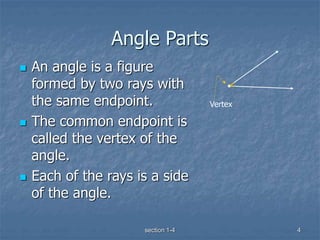
 An angle is a figure
formed by two rays with
the same endpoint.
 The common endpoint is
called the vertex of the
angle.
 Each of the rays is a side
of the angle.
Vertex
section 1-4 5
Measure of an Angle
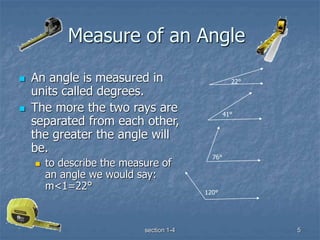
 An angle is measured in
units called degrees.
 The more the two rays are
separated from each other,
the greater the angle will
be.
 to describe the measure of
an angle we would say:
m<1=22°
22°
41°
76°
120°
section 1-4 6
Naming the Angle
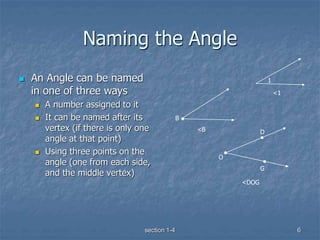
 An Angle can be named
in one of three ways
 A number assigned to it
 It can be named after its
vertex (if there is only one
angle at that point)
 Using three points on the
angle (one from each side,
and the middle vertex)
1
G
D
B
O
<1
<B
<DOG
section 1-4 7
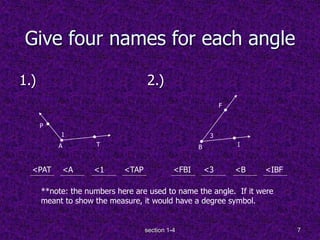
Give four names for each angle
1.) 2.)
A T
P
1
B I
F
3
**note: the numbers here are used to name the angle. If it were
meant to show the measure, it would have a degree symbol.
<PAT <A <1 <TAP <IBF
<B
<3
<FBI
section 1-4 8
Types of Angles
 Angles are classified by
their measure
 Acute angles are less
than 90°
 Obtuse angles are
greater than 90°
 Right angles are exactly
90°
 Straight angles are 180
°
section 1-4 9
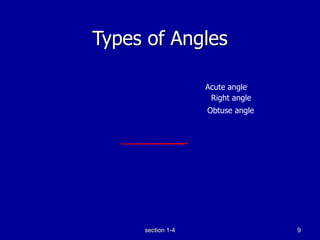
Types of Angles
Acute angle
Obtuse angle
Right angle
section 1-4 10
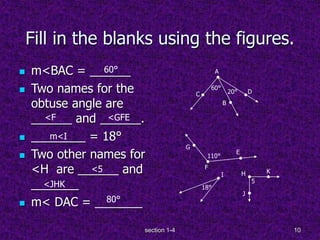
Fill in the blanks using the figures.
 m<BAC = ______
 Two names for the
obtuse angle are
______ and ______.
 ________ = 18°
 Two other names for
<H are ______ and
_______
 m< DAC = _______
F
E
H
G
110°
A
D
C
B
60°
20°
J
K
I
18°
60°
<GFE
<F
5
m<I
<5
<JHK
80°
section 1-4 11
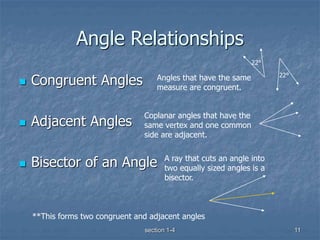
Angle Relationships
 Congruent Angles
 Adjacent Angles
 Bisector of an Angle
Angles that have the same
measure are congruent.
Coplanar angles that have the
same vertex and one common
side are adjacent.
A ray that cuts an angle into
two equally sized angles is a
bisector.
22°
22°
**This forms two congruent and adjacent angles
section 1-4 12
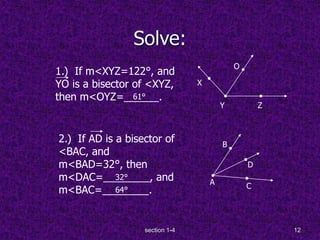
Solve:
1.) If m<XYZ=122°, and
YO is a bisector of <XYZ,
then m<OYZ=______.
O
2.) If AD is a bisector of
<BAC, and
m<BAD=32°, then
m<DAC=________, and
m<BAC=________.
X
Y Z
D
C
B
A
61°
64°
32°
section 1-4 13
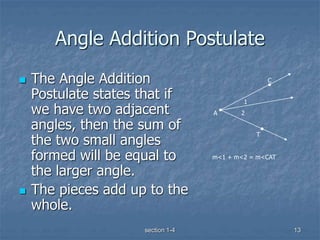
Angle Addition Postulate
 The Angle Addition
Postulate states that if
we have two adjacent
angles, then the sum of
the two small angles
formed will be equal to
the larger angle.
 The pieces add up to the
whole.
1
2
A
C
T
m<1 + m<2 = m<CAT
section 1-4 14
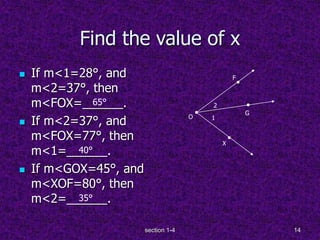
Find the value of x
 If m<1=28°, and
m<2=37°, then
m<FOX=______.
 If m<2=37°, and
m<FOX=77°, then
m<1=______.
 If m<GOX=45°, and
m<XOF=80°, then
m<2=______.
2
1
O
X
F
G
65°
40°
35°
section 1-4 15
Summary
 Angles are formed by intersecting rays.
 Angles are named in three ways.
 There are three main types of angles we
will use.
 Special angle relationships exist that show
connection between angles.

Geo 1-4 Angles.ppt

  • 1.
  • 2.
    section 1-4 2 Introduction Angles will be used in virtually every chapter in Geometry this year. It is very important to know the basics of angles before moving into further chapters.
  • 3.
    section 1-4 3 Topicsof Discussion  Angle parts  Types of angles  Relationships between angles  Angle Addition Postulate
  • 4.
    section 1-4 4 AngleParts  An angle is a figure formed by two rays with the same endpoint.  The common endpoint is called the vertex of the angle.  Each of the rays is a side of the angle. Vertex
  • 5.
    section 1-4 5 Measureof an Angle  An angle is measured in units called degrees.  The more the two rays are separated from each other, the greater the angle will be.  to describe the measure of an angle we would say: m<1=22° 22° 41° 76° 120°
  • 6.
    section 1-4 6 Namingthe Angle  An Angle can be named in one of three ways  A number assigned to it  It can be named after its vertex (if there is only one angle at that point)  Using three points on the angle (one from each side, and the middle vertex) 1 G D B O <1 <B <DOG
  • 7.
    section 1-4 7 Givefour names for each angle 1.) 2.) A T P 1 B I F 3 **note: the numbers here are used to name the angle. If it were meant to show the measure, it would have a degree symbol. <PAT <A <1 <TAP <IBF <B <3 <FBI
  • 8.
    section 1-4 8 Typesof Angles  Angles are classified by their measure  Acute angles are less than 90°  Obtuse angles are greater than 90°  Right angles are exactly 90°  Straight angles are 180 °
  • 9.
    section 1-4 9 Typesof Angles Acute angle Obtuse angle Right angle
  • 10.
    section 1-4 10 Fillin the blanks using the figures.  m<BAC = ______  Two names for the obtuse angle are ______ and ______.  ________ = 18°  Two other names for <H are ______ and _______  m< DAC = _______ F E H G 110° A D C B 60° 20° J K I 18° 60° <GFE <F 5 m<I <5 <JHK 80°
  • 11.
    section 1-4 11 AngleRelationships  Congruent Angles  Adjacent Angles  Bisector of an Angle Angles that have the same measure are congruent. Coplanar angles that have the same vertex and one common side are adjacent. A ray that cuts an angle into two equally sized angles is a bisector. 22° 22° **This forms two congruent and adjacent angles
  • 12.
    section 1-4 12 Solve: 1.)If m<XYZ=122°, and YO is a bisector of <XYZ, then m<OYZ=______. O 2.) If AD is a bisector of <BAC, and m<BAD=32°, then m<DAC=________, and m<BAC=________. X Y Z D C B A 61° 64° 32°
  • 13.
    section 1-4 13 AngleAddition Postulate  The Angle Addition Postulate states that if we have two adjacent angles, then the sum of the two small angles formed will be equal to the larger angle.  The pieces add up to the whole. 1 2 A C T m<1 + m<2 = m<CAT
  • 14.
    section 1-4 14 Findthe value of x  If m<1=28°, and m<2=37°, then m<FOX=______.  If m<2=37°, and m<FOX=77°, then m<1=______.  If m<GOX=45°, and m<XOF=80°, then m<2=______. 2 1 O X F G 65° 40° 35°
  • 15.
    section 1-4 15 Summary Angles are formed by intersecting rays.  Angles are named in three ways.  There are three main types of angles we will use.  Special angle relationships exist that show connection between angles.