By:
Josh Moulin
Police Officer / Fire Investigator
2003
January 2003 © Josh Moulin 1
Instructor Background
 8 years of Fire/EMS experience
 Left the fire service as a Lieutenant / Fire
Prevention Officer when hired as a Police
Officer
 Certified Fire Code Inspector
 Multiple NFPA Certifications
 Graduated from the National Fire Academy
Fire/Arson School in Emmitsburg Maryland
 Conducted multiple Fire/Arson investigations
January 2003 © Josh Moulin 2
Objectives
 Develop a basic understanding of scientific
principles of fire behavior
 Relationship between local fire agencies and
law enforcement
 Terminology used in fire investigation
 Role law enforcement plays in fire
investigation
January 2003 © Josh Moulin 3
Objectives
 Identify common fire patterns and how they
relate to fire behavior
 What makes a fire scene suspicious
 Properly document a fire scene
 Evidence collection principles for fire scene
January 2003 © Josh Moulin 4
Objectives
 Case law involving the investigation of fire
scenes
 Motives of a fire setter
 Courtroom testimony for fire investigation
January 2003 © Josh Moulin 5
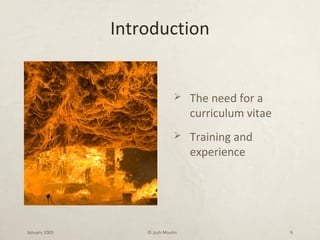
Introduction
 The need for a
curriculum vitae
 Training and
experience
January 2003 © Josh Moulin 6
Expectations of this Course
 What resources are needed for a proper fire
investigation
 What should you do if you are assigned to a
fire investigation
 How do you contact resources you may need
 Where does the fire department’s authority
stop and yours begin
January 2003 © Josh Moulin 7
Legal Aspects of Fire Investigations
 Oregon Revised Statue gives local fire
agencies statutory authority to conduct an
“origin and cause” investigation
 No warrant needed and no consent needed
 Investigation must occur “within a
reasonable amount of time”
 Fire department must remain on scene
January 2003 © Josh Moulin 8
Legal Aspects of Fire Investigation
 DA’s office interpretation
 Consent forms
 Civil litigation
 NFPA 921 – Systematic approach to fire
Investigation
 Exigent Circumstances
January 2003 © Josh Moulin 9
Administrative Search Warrants
 Primary objective must be a neutral plan based on
specific criteria
 Must show a fire of undetermined origin has occurred
on the premises
 Cannot unnecessarily intrude on victim’s privacy
 Evidence found in plain view may be seized in
administrative search warrant
 Cannot “roam freely” through fire victim’s private
residence
 Handout
January 2003 © Josh Moulin 10
Additional Information
 Firefighters may make forceful, unannounced,
nonconsensual, warrantless entry into building
 Firefighters have the right to remain on premises,
not only until fire is extinguished and no danger of
rekindling exists, but also to investigate
 After origin and cause determined, additional
search of premises may be conducted only
pursuant to valid warrant
January 2003 © Josh Moulin 11
Fourth Amendment Applied to Fire
Scenes
 Exigent circumstances allow firefighters to enter to
fight a fire (Michigan v. Clifford 464 U.S. 287, 294 &
Michigan v. Tyler, 436 U.S. 499
 Post fire searches are admissible when conducted
within a reasonable time
 Additional entries, after a reasonable time has
passed, must be made pursuant to the warrant
procedure
January 2003 © Josh Moulin 12
Fourth Amendment Applied to
Fire Scenes
 Additional investigation after fire is
extinguished and firefighters and police have
left generally must be made pursuant to a
warrant or new exigency.
January 2003 © Josh Moulin 13
Oregon Fire Laws
 Arson I
 Arson II
 Reckless burning
 Criminal mischief
 Reckless endangering
January 2003 © Josh Moulin 14
Motivations of Fire Setting
 Spite / revenge
 Pyromania
 Crime concealment
 Arson for profit
 Civil disorder
 Vanity
 Gangs
 Cults
 Serial arsonist
 Drugs
January 2003 © Josh Moulin 15
Profile of Serial Arsonist
 Single white male
 20 to 27 years old
 Unstable family environment
 High school educated
 Considered an under-achiever
 Sloppy and unkept appearance
 Poorly adjusted socially and sexually
 If married, usually has periods of separation
 Feels sense of satisfaction after the fire
 If arrested, shows no remorse
January 2003 © Josh Moulin 16
Resources Available
 Local fire department / district
 Regional Fire Investigation Team
 Local law enforcement
 Local insurance companies
 IAAI
 UL / www.CPSC.gov
January 2003 © Josh Moulin 17
Basic Fire Behavior
 What is fire?
 Rapid, self-sustained oxidation process
with the evolution of heat and light in
varying intensities
 Fire must have four things to survive
 Heat
 Oxygen
 Fuel
 Chemical Chain Reaction
January 2003 © Josh Moulin 18
Fire Components
January 2003 © Josh Moulin 19
Heat
Fuel
Oxygen
Uninhibited Chain Reaction
Steps of Fire Process
 Input heat
 Fuel
 Oxygen
 Mixing
 Proportioning
 Ignition continuity
January 2003 © Josh Moulin 20
Classes of Fire
 Class A – Ordinary combustibles
 Class B – Flammable / combustible liquids
 Class C – Energized electrical equipment
 Class D – Combustible metals
January 2003 © Josh Moulin 21
Stages of Fire
 Incipient stage (growth)
 Free burning stage (development)
 Smoldering (decay)
January 2003 © Josh Moulin 22
Oxygen Needed for Combustion
 Atmosphere has 20.8 % oxygen content
 Open flaming combustion will stop at 15 – 16
%
January 2003 © Josh Moulin 23
Fire Phenomena
 Flashover
 Backdraft – dangerous to police and
bystanders especially
 Signs of backdraft
 Fire gases, superheated gases, soot, smoke
January 2003 © Josh Moulin 24
Signs of Fire
 Physical effects that can be seen or measured
 Lines of demarcation – borders defining heat and
smoke
 Movement patterns
 Intensity patterns
 Spalling
 Clean burn
 Calcination
January 2003 © Josh Moulin 25
Char
 Depth of char as indicator
 Consider ventilation
 Shows duration
January 2003 © Josh Moulin 26
Temperatures
 Aluminum melts at 1220 F
 Copper melts at 1981 F
 Glass melts at 1100 – 2600 F
 Cigarette 550 F at end, 1250 in center
 Collapsed springs at 750 F
 Hardwood – 595-740 F
 Gasoline – 853 F
 Average house fire – 1300 F
January 2003 © Josh Moulin 27
Fire Patterns
 Fire will usually go up and out – path of least resistance
 Shadowing
 Protection
 “V” patterns
 Inverted “V” patterns
 “U” patterns
 Light bulbs
 Arrow patterns
January 2003 © Josh Moulin 28
Firefighting Tactics Changing
Patterns
 Importance of
interviewing Fire
Department
 Hose Streams
 Ventilation
 Overhaul
January 2003 © Josh Moulin 29
Fire Causes
January 2003 © Josh Moulin 30
Natural Fires
Lightning
Earthquake
Wind
No direct human
intervention
“Acts of God”
January 2003 © Josh Moulin 31
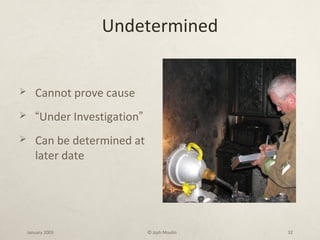
Undetermined
 Cannot prove cause
 “Under Investigation”
 Can be determined at
later date
January 2003 © Josh Moulin 32
Incendiary Fire
 Deliberately set fire
 Suspect knows fire
should not been set
 Mindset of suspect
 Never call a fire
“suspicious”
January 2003 © Josh Moulin 33
Signs of Incendiary Fire
 Must first eliminate ALL possible accidental causes
 Multiple fires
 Trailers
 Presence of accelerants
 Low level burning
 Splash patterns
 Odors
 Flashback
 Containers
 Removal of household contents
January 2003 © Josh Moulin 34
Signs of Incendiary Fire, Cont.
 Absence of personal papers and items
 Location of the fire
 Evidence of other crimes
 Unnatural fire spread
 Previous fires in same structure or with same people
 Injuries to occupants or others
 Time of day
 Limited / blocked entrance or view
January 2003 © Josh Moulin 35
Certainty of Opinions
 Conclusive
 All reasonable alternatives to hypothesis are
considered and eliminated
 Probable
 More likely than not
 Possible
 Hypothesis can be demonstrated to be feasible but
cannot be declared probable
 Suspected
 Hypothesis may be true, but insufficient data to draw
a conclusion to the exclusion of other reasonable
conclusions
January 2003 © Josh Moulin 36
Oregon State Fire Marshal’s Office
 Required to be notified anytime a fire fatality
occurs
 Has additional resources
January 2003 © Josh Moulin 37
Fire Fatalities
 Team of fire department, OSFM, local L.E.,
medical examiner
 Two individual investigations
 Origin and cause
 Death investigation
 Considerations about moving the body
 Additional damage
 OSFM and ME approval
 Photography
 Fire debris around the body
January 2003 © Josh Moulin 38
Fire Fatalities Cont.
 Why didn’t the person get out?
 Obstacles
 Locks
 Past history of people and buildings
 Fire and life insurance coverage
 Cause of death
 Thermal injury v. CO asphyxiation
 If unknown remains exists, consider everything
human remains
 Typical injuries and conditions found
 Lividity
 Eviscerations
January 2003 © Josh Moulin 39
There’s a Fire…Now What?
 Evaluate scene for
safety
 Secure scene
perimeter
 Use “team” approach
 Consider respiratory
hazards
 Always talk with IC
January 2003 © Josh Moulin 40
There’s a Fire…Now What? Cont.,
 Solicit information about fire suppression
 Difficulties
 Flashback
 Unusual findings
 Forcible entry
 Time and method of alarm
 Weather conditions
 Color of flames and smoke
January 2003 © Josh Moulin 41
There’s a Fire…Now What?
Cont.,
 Scene evaluation “backwards theory”
 Reconstruction of fire scene
 Debris removal
 Determine fire origin
 Determine fire cause
 Document
 Field notes
 Photograph
 Sketch
 Report
January 2003 © Josh Moulin 42
Evidence Collection
 Follow standard chain of custody
 Realize fire department is usually not well versed in
evidence and may need your help
 Contamination
 Specialized containers
 Samples taken at scene
 Trace evidence
 Accelerant detection K-9’s
January 2003 © Josh Moulin 43
Common Law Enforcement Role
 Assist with interviews, interrogations,
neighborhood canvassing
 Assist with evidence collection
 Criminal checks on suspects
 Investigation may be “handed” off to you if
suspect is developed or fire is determined to
be incendiary
January 2003 © Josh Moulin 44
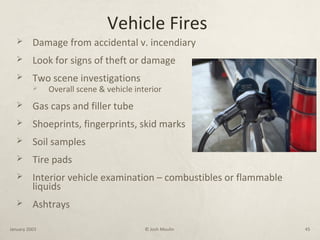
Vehicle Fires
 Damage from accidental v. incendiary
 Look for signs of theft or damage
 Two scene investigations
 Overall scene & vehicle interior
 Gas caps and filler tube
 Shoeprints, fingerprints, skid marks
 Soil samples
 Tire pads
 Interior vehicle examination – combustibles or flammable
liquids
 Ashtrays
January 2003 © Josh Moulin 45
Vehicle Fires, Cont.
 Window position
 Door positions
 Attempts taken to extinguish
 Presence of personal items
 Engine compartment
 Vin number and license plates
 Fire objectives
January 2003 © Josh Moulin 46
Vehicle Fire Objectives
 Identify point of origin
 Usually lowest point and greatest damage
 Find the heat source
 Energy which ignited fire
 Determine fuel source
 Material ignited by heat source
 Determine the event of the fire
 How did heat source and fuel combine to start fire
 Determine category of fire
 Must accomplish 1 – 4 first.
January 2003 © Josh Moulin 47
Motives of Vehicle Arson
 Mechanical problems
 Vehicle is lemon, cannot afford needed
mechanical work
 Owner’s financial problems
 Conduct financial check
 Status on car payments
 Witnesses
January 2003 © Josh Moulin 48
Terrorism Related
Fires / Explosions
 ELF / ALF
 Use of common devices
 ATF notification
 Use of tagging
 Websites – Anarchist’s
cook book
January 2003 © Josh Moulin 49
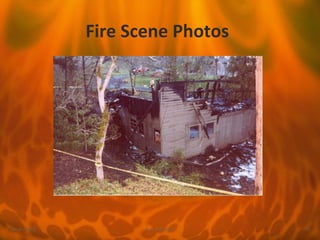
Fire Scene Photos
January 2003 © Josh Moulin 50
Roof Condition
January 2003 © Josh Moulin 51
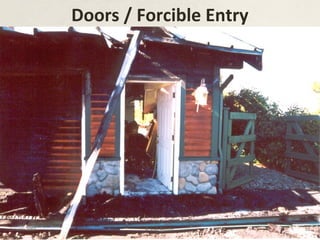
Doors / Forcible Entry
January 2003 © Josh Moulin 52
Exterior 360 Degree
January 2003 © Josh Moulin 53
Arial View
January 2003 © Josh Moulin 54
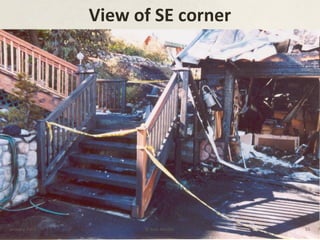
View of SE corner
January 2003 © Josh Moulin 55
Interior Garage - Area of Least Damage
January 2003 © Josh Moulin 56
South Interior Garage
January 2003 © Josh Moulin 57
Electrical Panel
January 2003 © Josh Moulin 58
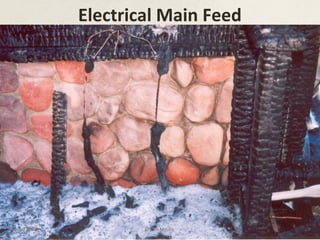
Electrical Main Feed
January 2003 © Josh Moulin 59
Top of Porch Landing
January 2003 © Josh Moulin 60
North Side of Landing
January 2003 © Josh Moulin 61
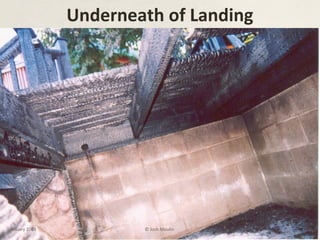
Underneath of Landing
January 2003 © Josh Moulin 62
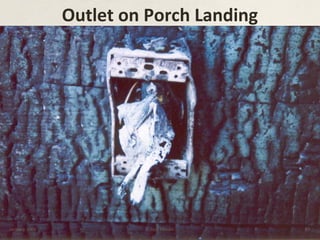
Outlet on Porch Landing
January 2003 © Josh Moulin 63
Stain Cans
January 2003 © Josh Moulin 64
Close-up of Stain Cans
January 2003 © Josh Moulin 65
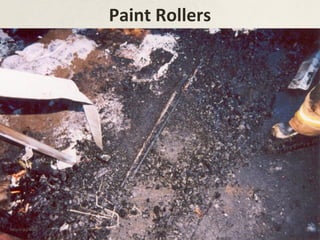
Paint Rollers
January 2003 © Josh Moulin 66
Heat Damage
January 2003 © Josh Moulin 67
Cigarette Butts
January 2003 © Josh Moulin 68
Heat Damage
January 2003 © Josh Moulin 69
Heat Damage
January 2003 © Josh Moulin 70
“V-Pattern”
January 2003 © Josh Moulin 71
Wide View of V-Pattern
January 2003 © Josh Moulin 72
Fire Damage
January 2003 © Josh Moulin 73
Fire Patterns
January 2003 © Josh Moulin 74
January 2003 © Josh Moulin 75
Questions?

Josh Moulin: Basic Fire Investigation for Law Enforcement

  • 1.
    By: Josh Moulin Police Officer/ Fire Investigator 2003 January 2003 © Josh Moulin 1
  • 2.
    Instructor Background  8years of Fire/EMS experience  Left the fire service as a Lieutenant / Fire Prevention Officer when hired as a Police Officer  Certified Fire Code Inspector  Multiple NFPA Certifications  Graduated from the National Fire Academy Fire/Arson School in Emmitsburg Maryland  Conducted multiple Fire/Arson investigations January 2003 © Josh Moulin 2
  • 3.
    Objectives  Develop abasic understanding of scientific principles of fire behavior  Relationship between local fire agencies and law enforcement  Terminology used in fire investigation  Role law enforcement plays in fire investigation January 2003 © Josh Moulin 3
  • 4.
    Objectives  Identify commonfire patterns and how they relate to fire behavior  What makes a fire scene suspicious  Properly document a fire scene  Evidence collection principles for fire scene January 2003 © Josh Moulin 4
  • 5.
    Objectives  Case lawinvolving the investigation of fire scenes  Motives of a fire setter  Courtroom testimony for fire investigation January 2003 © Josh Moulin 5
  • 6.
    Introduction  The needfor a curriculum vitae  Training and experience January 2003 © Josh Moulin 6
  • 7.
    Expectations of thisCourse  What resources are needed for a proper fire investigation  What should you do if you are assigned to a fire investigation  How do you contact resources you may need  Where does the fire department’s authority stop and yours begin January 2003 © Josh Moulin 7
  • 8.
    Legal Aspects ofFire Investigations  Oregon Revised Statue gives local fire agencies statutory authority to conduct an “origin and cause” investigation  No warrant needed and no consent needed  Investigation must occur “within a reasonable amount of time”  Fire department must remain on scene January 2003 © Josh Moulin 8
  • 9.
    Legal Aspects ofFire Investigation  DA’s office interpretation  Consent forms  Civil litigation  NFPA 921 – Systematic approach to fire Investigation  Exigent Circumstances January 2003 © Josh Moulin 9
  • 10.
    Administrative Search Warrants Primary objective must be a neutral plan based on specific criteria  Must show a fire of undetermined origin has occurred on the premises  Cannot unnecessarily intrude on victim’s privacy  Evidence found in plain view may be seized in administrative search warrant  Cannot “roam freely” through fire victim’s private residence  Handout January 2003 © Josh Moulin 10
  • 11.
    Additional Information  Firefightersmay make forceful, unannounced, nonconsensual, warrantless entry into building  Firefighters have the right to remain on premises, not only until fire is extinguished and no danger of rekindling exists, but also to investigate  After origin and cause determined, additional search of premises may be conducted only pursuant to valid warrant January 2003 © Josh Moulin 11
  • 12.
    Fourth Amendment Appliedto Fire Scenes  Exigent circumstances allow firefighters to enter to fight a fire (Michigan v. Clifford 464 U.S. 287, 294 & Michigan v. Tyler, 436 U.S. 499  Post fire searches are admissible when conducted within a reasonable time  Additional entries, after a reasonable time has passed, must be made pursuant to the warrant procedure January 2003 © Josh Moulin 12
  • 13.
    Fourth Amendment Appliedto Fire Scenes  Additional investigation after fire is extinguished and firefighters and police have left generally must be made pursuant to a warrant or new exigency. January 2003 © Josh Moulin 13
  • 14.
    Oregon Fire Laws Arson I  Arson II  Reckless burning  Criminal mischief  Reckless endangering January 2003 © Josh Moulin 14
  • 15.
    Motivations of FireSetting  Spite / revenge  Pyromania  Crime concealment  Arson for profit  Civil disorder  Vanity  Gangs  Cults  Serial arsonist  Drugs January 2003 © Josh Moulin 15
  • 16.
    Profile of SerialArsonist  Single white male  20 to 27 years old  Unstable family environment  High school educated  Considered an under-achiever  Sloppy and unkept appearance  Poorly adjusted socially and sexually  If married, usually has periods of separation  Feels sense of satisfaction after the fire  If arrested, shows no remorse January 2003 © Josh Moulin 16
  • 17.
    Resources Available  Localfire department / district  Regional Fire Investigation Team  Local law enforcement  Local insurance companies  IAAI  UL / www.CPSC.gov January 2003 © Josh Moulin 17
  • 18.
    Basic Fire Behavior What is fire?  Rapid, self-sustained oxidation process with the evolution of heat and light in varying intensities  Fire must have four things to survive  Heat  Oxygen  Fuel  Chemical Chain Reaction January 2003 © Josh Moulin 18
  • 19.
    Fire Components January 2003© Josh Moulin 19 Heat Fuel Oxygen Uninhibited Chain Reaction
  • 20.
    Steps of FireProcess  Input heat  Fuel  Oxygen  Mixing  Proportioning  Ignition continuity January 2003 © Josh Moulin 20
  • 21.
    Classes of Fire Class A – Ordinary combustibles  Class B – Flammable / combustible liquids  Class C – Energized electrical equipment  Class D – Combustible metals January 2003 © Josh Moulin 21
  • 22.
    Stages of Fire Incipient stage (growth)  Free burning stage (development)  Smoldering (decay) January 2003 © Josh Moulin 22
  • 23.
    Oxygen Needed forCombustion  Atmosphere has 20.8 % oxygen content  Open flaming combustion will stop at 15 – 16 % January 2003 © Josh Moulin 23
  • 24.
    Fire Phenomena  Flashover Backdraft – dangerous to police and bystanders especially  Signs of backdraft  Fire gases, superheated gases, soot, smoke January 2003 © Josh Moulin 24
  • 25.
    Signs of Fire Physical effects that can be seen or measured  Lines of demarcation – borders defining heat and smoke  Movement patterns  Intensity patterns  Spalling  Clean burn  Calcination January 2003 © Josh Moulin 25
  • 26.
    Char  Depth ofchar as indicator  Consider ventilation  Shows duration January 2003 © Josh Moulin 26
  • 27.
    Temperatures  Aluminum meltsat 1220 F  Copper melts at 1981 F  Glass melts at 1100 – 2600 F  Cigarette 550 F at end, 1250 in center  Collapsed springs at 750 F  Hardwood – 595-740 F  Gasoline – 853 F  Average house fire – 1300 F January 2003 © Josh Moulin 27
  • 28.
    Fire Patterns  Firewill usually go up and out – path of least resistance  Shadowing  Protection  “V” patterns  Inverted “V” patterns  “U” patterns  Light bulbs  Arrow patterns January 2003 © Josh Moulin 28
  • 29.
    Firefighting Tactics Changing Patterns Importance of interviewing Fire Department  Hose Streams  Ventilation  Overhaul January 2003 © Josh Moulin 29
  • 30.
    Fire Causes January 2003© Josh Moulin 30
  • 31.
    Natural Fires Lightning Earthquake Wind No directhuman intervention “Acts of God” January 2003 © Josh Moulin 31
  • 32.
    Undetermined  Cannot provecause  “Under Investigation”  Can be determined at later date January 2003 © Josh Moulin 32
  • 33.
    Incendiary Fire  Deliberatelyset fire  Suspect knows fire should not been set  Mindset of suspect  Never call a fire “suspicious” January 2003 © Josh Moulin 33
  • 34.
    Signs of IncendiaryFire  Must first eliminate ALL possible accidental causes  Multiple fires  Trailers  Presence of accelerants  Low level burning  Splash patterns  Odors  Flashback  Containers  Removal of household contents January 2003 © Josh Moulin 34
  • 35.
    Signs of IncendiaryFire, Cont.  Absence of personal papers and items  Location of the fire  Evidence of other crimes  Unnatural fire spread  Previous fires in same structure or with same people  Injuries to occupants or others  Time of day  Limited / blocked entrance or view January 2003 © Josh Moulin 35
  • 36.
    Certainty of Opinions Conclusive  All reasonable alternatives to hypothesis are considered and eliminated  Probable  More likely than not  Possible  Hypothesis can be demonstrated to be feasible but cannot be declared probable  Suspected  Hypothesis may be true, but insufficient data to draw a conclusion to the exclusion of other reasonable conclusions January 2003 © Josh Moulin 36
  • 37.
    Oregon State FireMarshal’s Office  Required to be notified anytime a fire fatality occurs  Has additional resources January 2003 © Josh Moulin 37
  • 38.
    Fire Fatalities  Teamof fire department, OSFM, local L.E., medical examiner  Two individual investigations  Origin and cause  Death investigation  Considerations about moving the body  Additional damage  OSFM and ME approval  Photography  Fire debris around the body January 2003 © Josh Moulin 38
  • 39.
    Fire Fatalities Cont. Why didn’t the person get out?  Obstacles  Locks  Past history of people and buildings  Fire and life insurance coverage  Cause of death  Thermal injury v. CO asphyxiation  If unknown remains exists, consider everything human remains  Typical injuries and conditions found  Lividity  Eviscerations January 2003 © Josh Moulin 39
  • 40.
    There’s a Fire…NowWhat?  Evaluate scene for safety  Secure scene perimeter  Use “team” approach  Consider respiratory hazards  Always talk with IC January 2003 © Josh Moulin 40
  • 41.
    There’s a Fire…NowWhat? Cont.,  Solicit information about fire suppression  Difficulties  Flashback  Unusual findings  Forcible entry  Time and method of alarm  Weather conditions  Color of flames and smoke January 2003 © Josh Moulin 41
  • 42.
    There’s a Fire…NowWhat? Cont.,  Scene evaluation “backwards theory”  Reconstruction of fire scene  Debris removal  Determine fire origin  Determine fire cause  Document  Field notes  Photograph  Sketch  Report January 2003 © Josh Moulin 42
  • 43.
    Evidence Collection  Followstandard chain of custody  Realize fire department is usually not well versed in evidence and may need your help  Contamination  Specialized containers  Samples taken at scene  Trace evidence  Accelerant detection K-9’s January 2003 © Josh Moulin 43
  • 44.
    Common Law EnforcementRole  Assist with interviews, interrogations, neighborhood canvassing  Assist with evidence collection  Criminal checks on suspects  Investigation may be “handed” off to you if suspect is developed or fire is determined to be incendiary January 2003 © Josh Moulin 44
  • 45.
    Vehicle Fires  Damagefrom accidental v. incendiary  Look for signs of theft or damage  Two scene investigations  Overall scene & vehicle interior  Gas caps and filler tube  Shoeprints, fingerprints, skid marks  Soil samples  Tire pads  Interior vehicle examination – combustibles or flammable liquids  Ashtrays January 2003 © Josh Moulin 45
  • 46.
    Vehicle Fires, Cont. Window position  Door positions  Attempts taken to extinguish  Presence of personal items  Engine compartment  Vin number and license plates  Fire objectives January 2003 © Josh Moulin 46
  • 47.
    Vehicle Fire Objectives Identify point of origin  Usually lowest point and greatest damage  Find the heat source  Energy which ignited fire  Determine fuel source  Material ignited by heat source  Determine the event of the fire  How did heat source and fuel combine to start fire  Determine category of fire  Must accomplish 1 – 4 first. January 2003 © Josh Moulin 47
  • 48.
    Motives of VehicleArson  Mechanical problems  Vehicle is lemon, cannot afford needed mechanical work  Owner’s financial problems  Conduct financial check  Status on car payments  Witnesses January 2003 © Josh Moulin 48
  • 49.
    Terrorism Related Fires /Explosions  ELF / ALF  Use of common devices  ATF notification  Use of tagging  Websites – Anarchist’s cook book January 2003 © Josh Moulin 49
  • 50.
    Fire Scene Photos January2003 © Josh Moulin 50
  • 51.
    Roof Condition January 2003© Josh Moulin 51
  • 52.
    Doors / ForcibleEntry January 2003 © Josh Moulin 52
  • 53.
    Exterior 360 Degree January2003 © Josh Moulin 53
  • 54.
    Arial View January 2003© Josh Moulin 54
  • 55.
    View of SEcorner January 2003 © Josh Moulin 55
  • 56.
    Interior Garage -Area of Least Damage January 2003 © Josh Moulin 56
  • 57.
    South Interior Garage January2003 © Josh Moulin 57
  • 58.
  • 59.
    Electrical Main Feed January2003 © Josh Moulin 59
  • 60.
    Top of PorchLanding January 2003 © Josh Moulin 60
  • 61.
    North Side ofLanding January 2003 © Josh Moulin 61
  • 62.
    Underneath of Landing January2003 © Josh Moulin 62
  • 63.
    Outlet on PorchLanding January 2003 © Josh Moulin 63
  • 64.
    Stain Cans January 2003© Josh Moulin 64
  • 65.
    Close-up of StainCans January 2003 © Josh Moulin 65
  • 66.
    Paint Rollers January 2003© Josh Moulin 66
  • 67.
    Heat Damage January 2003© Josh Moulin 67
  • 68.
  • 69.
    Heat Damage January 2003© Josh Moulin 69
  • 70.
    Heat Damage January 2003© Josh Moulin 70
  • 71.
  • 72.
    Wide View ofV-Pattern January 2003 © Josh Moulin 72
  • 73.
    Fire Damage January 2003© Josh Moulin 73
  • 74.
    Fire Patterns January 2003© Josh Moulin 74
  • 75.
    January 2003 ©Josh Moulin 75 Questions?