Basic Electrical Design
NEC Code Applications
Class 101
Jim Fuller
4/9/08
Two basic principles
• Heat is your Enemy
• Harmonic overheat transformers
• Overheating motors
• Overheating wire and circuit breaker
• Energy is conserve: Law of Conservation
• Transformer: Input = Output + losses
• Motor: input = output + losses
Objective
• Electrical Codes
• Enclosures
• Basic Electrical Formulas
• Conduit Sizing
• Cable Ampacity Table NEC 310-16
• Conductor Sizing
• Sizing Transformer CB, Cable and Conduit
• Transformer Formula
• Ground Wire Sizing
• Sizing Conductor and OCPD for 480V Motors
• Rule of Thumb
Electrical Codes
• NFPA 70 = NEC (national Electrical code)
(sizing wire, conduit, transformer, safety and etc.)
• NFPA (National Fire Protection Assoc.)
(example NFPA 101 – life safety fire alarm, egress and etc..)
• UL = national laboratory
(testing lab for quality of equipment)
• NEMA – National Electrical Manuf Assoc.
(Quality of equipment, size i.e. MG-1 for motors
• IEEE
(Manuf criteria, example BIL level, short circuit rating)
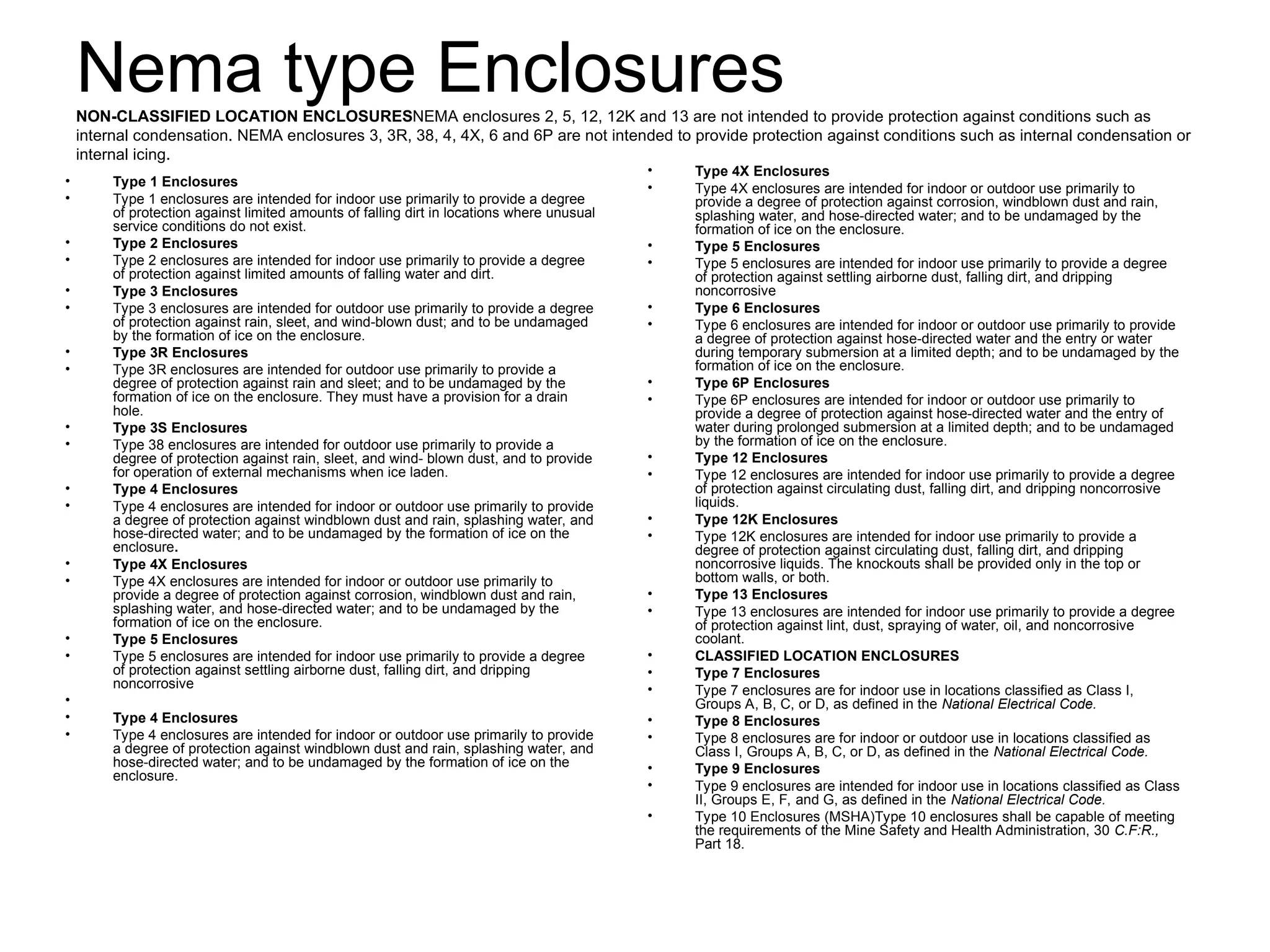
Nema type Enclosures
NON-CLASSIFIED LOCATION ENCLOSURESNEMA enclosures 2, 5, 12, 12K and 13 are not intended to provide protection against conditions such as
internal condensation. NEMA enclosures 3, 3R, 38, 4, 4X, 6 and 6P are not intended to provide protection against conditions such as internal condensation or
internal icing.
• Type 1 Enclosures
• Type 1 enclosures are intended for indoor use primarily to provide a degree
of protection against limited amounts of falling dirt in locations where unusual
service conditions do not exist.
• Type 2 Enclosures
• Type 2 enclosures are intended for indoor use primarily to provide a degree
of protection against limited amounts of falling water and dirt.
• Type 3 Enclosures
• Type 3 enclosures are intended for outdoor use primarily to provide a degree
of protection against rain, sleet, and wind-blown dust; and to be undamaged
by the formation of ice on the enclosure.
• Type 3R Enclosures
• Type 3R enclosures are intended for outdoor use primarily to provide a
degree of protection against rain and sleet; and to be undamaged by the
formation of ice on the enclosure. They must have a provision for a drain
hole.
• Type 3S Enclosures
• Type 38 enclosures are intended for outdoor use primarily to provide a
degree of protection against rain, sleet, and wind- blown dust, and to provide
for operation of external mechanisms when ice laden.
• Type 4 Enclosures
• Type 4 enclosures are intended for indoor or outdoor use primarily to provide
a degree of protection against windblown dust and rain, splashing water, and
hose-directed water; and to be undamaged by the formation of ice on the
enclosure.
• Type 4X Enclosures
• Type 4X enclosures are intended for indoor or outdoor use primarily to
provide a degree of protection against corrosion, windblown dust and rain,
splashing water, and hose-directed water; and to be undamaged by the
formation of ice on the enclosure.
• Type 5 Enclosures
• Type 5 enclosures are intended for indoor use primarily to provide a degree
of protection against settling airborne dust, falling dirt, and dripping
noncorrosive
•
• Type 4 Enclosures
• Type 4 enclosures are intended for indoor or outdoor use primarily to provide
a degree of protection against windblown dust and rain, splashing water, and
hose-directed water; and to be undamaged by the formation of ice on the
enclosure.
• Type 4X Enclosures
• Type 4X enclosures are intended for indoor or outdoor use primarily to
provide a degree of protection against corrosion, windblown dust and rain,
splashing water, and hose-directed water; and to be undamaged by the
formation of ice on the enclosure.
• Type 5 Enclosures
• Type 5 enclosures are intended for indoor use primarily to provide a degree
of protection against settling airborne dust, falling dirt, and dripping
noncorrosive
• Type 6 Enclosures
• Type 6 enclosures are intended for indoor or outdoor use primarily to provide
a degree of protection against hose-directed water and the entry or water
during temporary submersion at a limited depth; and to be undamaged by the
formation of ice on the enclosure.
• Type 6P Enclosures
• Type 6P enclosures are intended for indoor or outdoor use primarily to
provide a degree of protection against hose-directed water and the entry of
water during prolonged submersion at a limited depth; and to be undamaged
by the formation of ice on the enclosure.
• Type 12 Enclosures
• Type 12 enclosures are intended for indoor use primarily to provide a degree
of protection against circulating dust, falling dirt, and dripping noncorrosive
liquids.
• Type 12K Enclosures
• Type 12K enclosures are intended for indoor use primarily to provide a
degree of protection against circulating dust, falling dirt, and dripping
noncorrosive liquids. The knockouts shall be provided only in the top or
bottom walls, or both.
• Type 13 Enclosures
• Type 13 enclosures are intended for indoor use primarily to provide a degree
of protection against lint, dust, spraying of water, oil, and noncorrosive
coolant.
• CLASSIFIED LOCATION ENCLOSURES
• Type 7 Enclosures
• Type 7 enclosures are for indoor use in locations classified as Class I,
Groups A, B, C, or D, as defined in the National Electrical Code.
• Type 8 Enclosures
• Type 8 enclosures are for indoor or outdoor use in locations classified as
Class I, Groups A, B, C, or D, as defined in the National Electrical Code.
• Type 9 Enclosures
• Type 9 enclosures are intended for indoor use in locations classified as Class
II, Groups E, F, and G, as defined in the National Electrical Code.
• Type 10 Enclosures (MSHA)Type 10 enclosures shall be capable of meeting
the requirements of the Mine Safety and Health Administration, 30 C.F:R.,
Part 18.
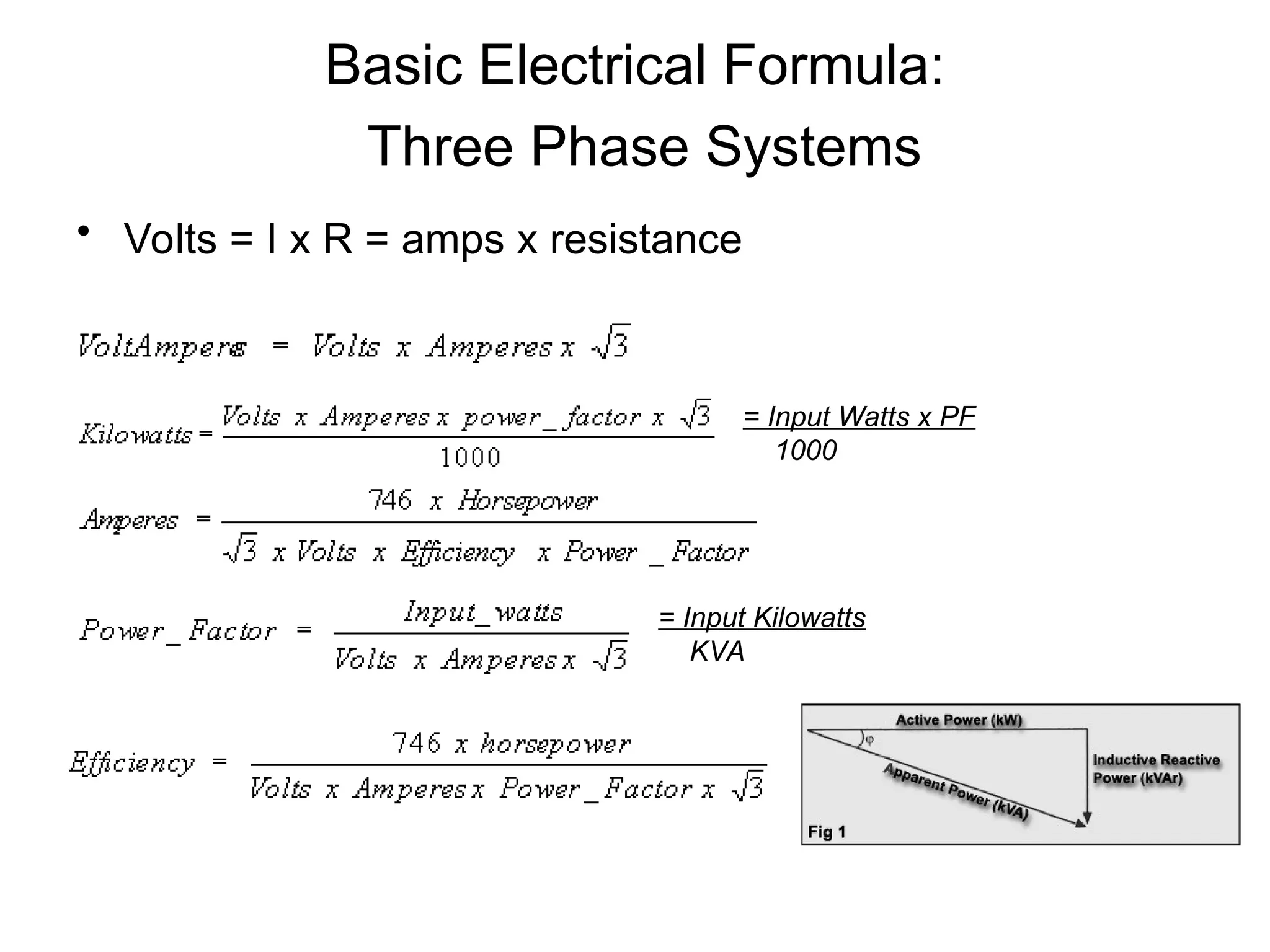
Basic Electrical Formula:
Three Phase Systems
• Volts = I x R = amps x resistance
= Input Kilowatts
KVA
= Input Watts x PF
1000
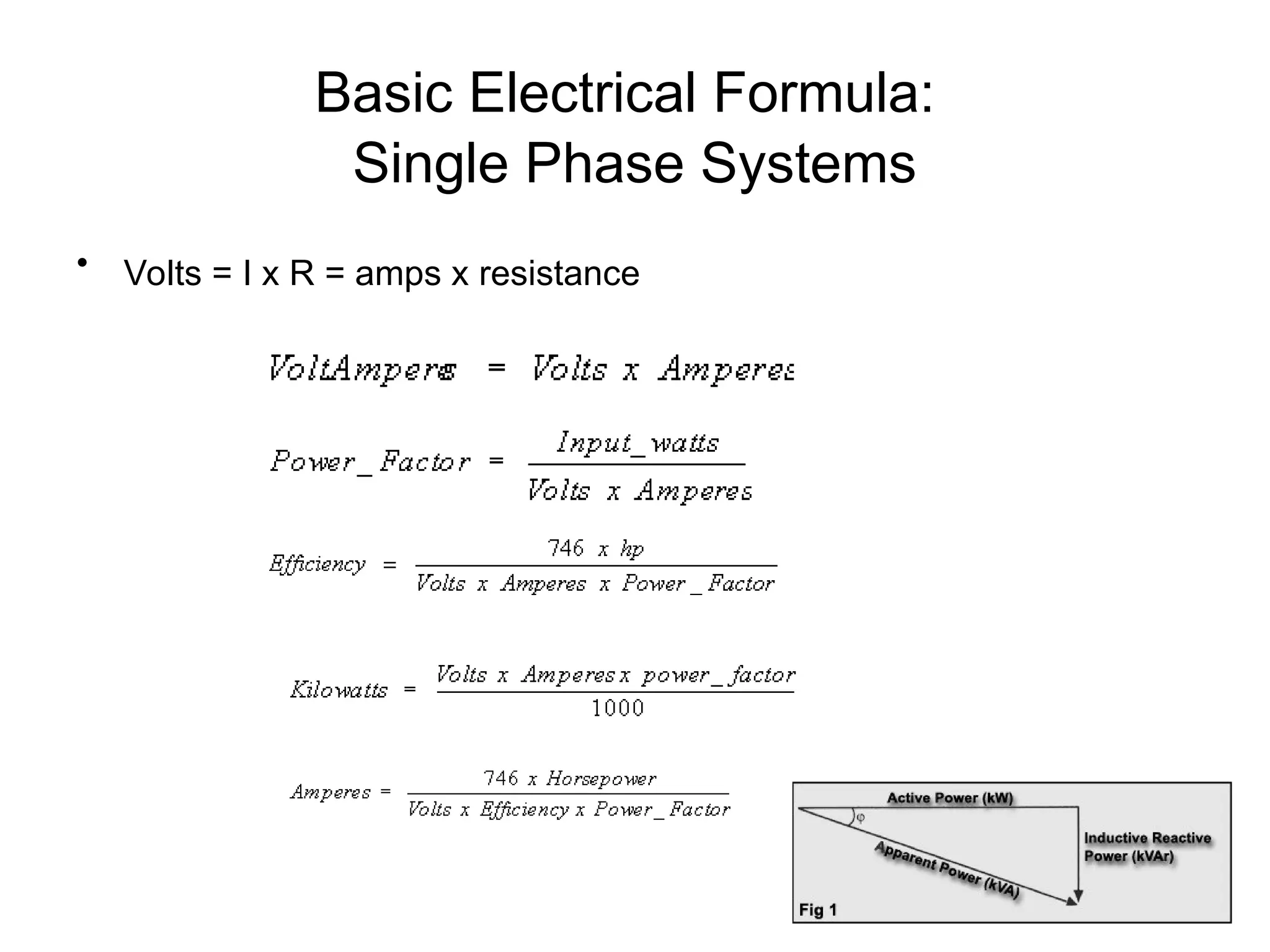
Basic Electrical Formula:
Single Phase Systems
• Volts = I x R = amps x resistance
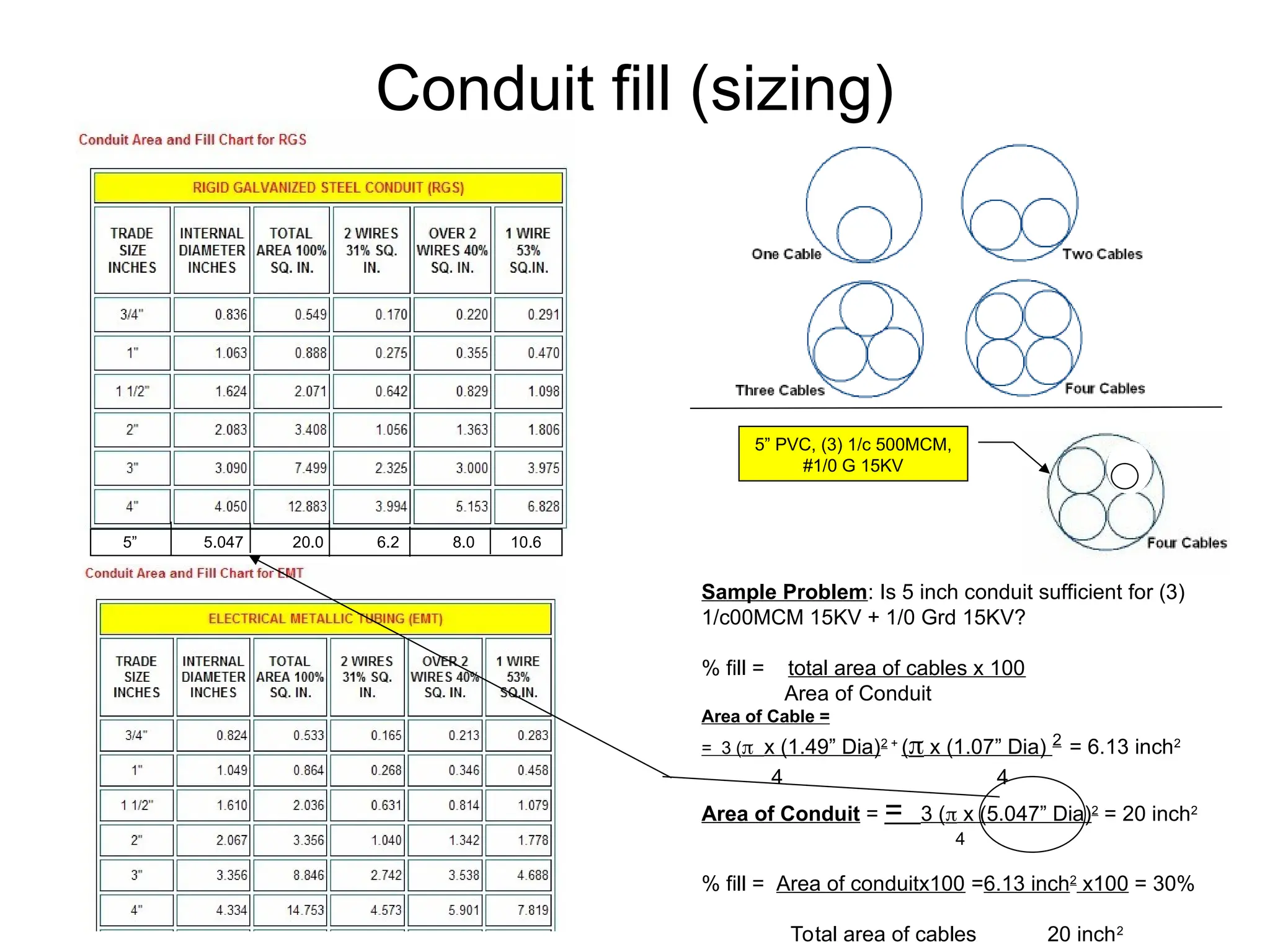
Conduit fill (sizing)
Sample Problem: Is 5 inch conduit sufficient for (3)
1/c00MCM 15KV + 1/0 Grd 15KV?
% fill = total area of cables x 100
Area of Conduit
Area of Cable =
= 3 (x (1.49” Dia)2 +
( x (1.07” Dia) 2
= 6.13 inch2
4 4
Area of Conduit = = 3 ( x (5.047” Dia)2
= 20 inch2
4
% fill = Area of conduitx100 =6.13 inch2
x100 = 30%
Total area of cables 20 inch2
5” PVC, (3) 1/c 500MCM,
#1/0 G 15KV
5” 5.047 20.0 6.2 8.0 10.6
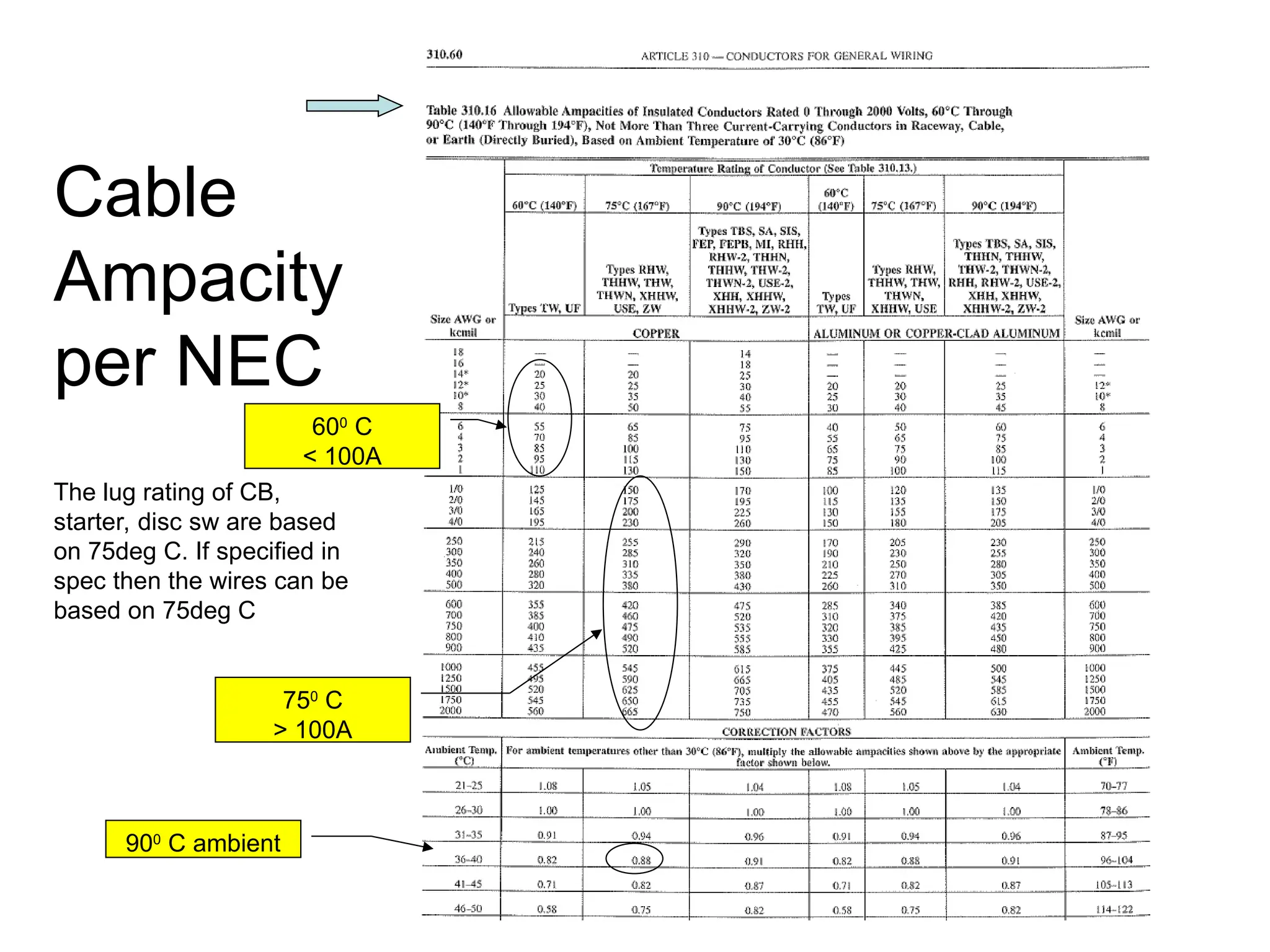
Cable
Ampacity
per NEC
The lug rating of CB,
starter, disc sw are based
on 75deg C. If specified in
spec then the wires can be
based on 75deg C
600
C
< 100A
750
C
> 100A
900
C ambient
Conductor Sizing
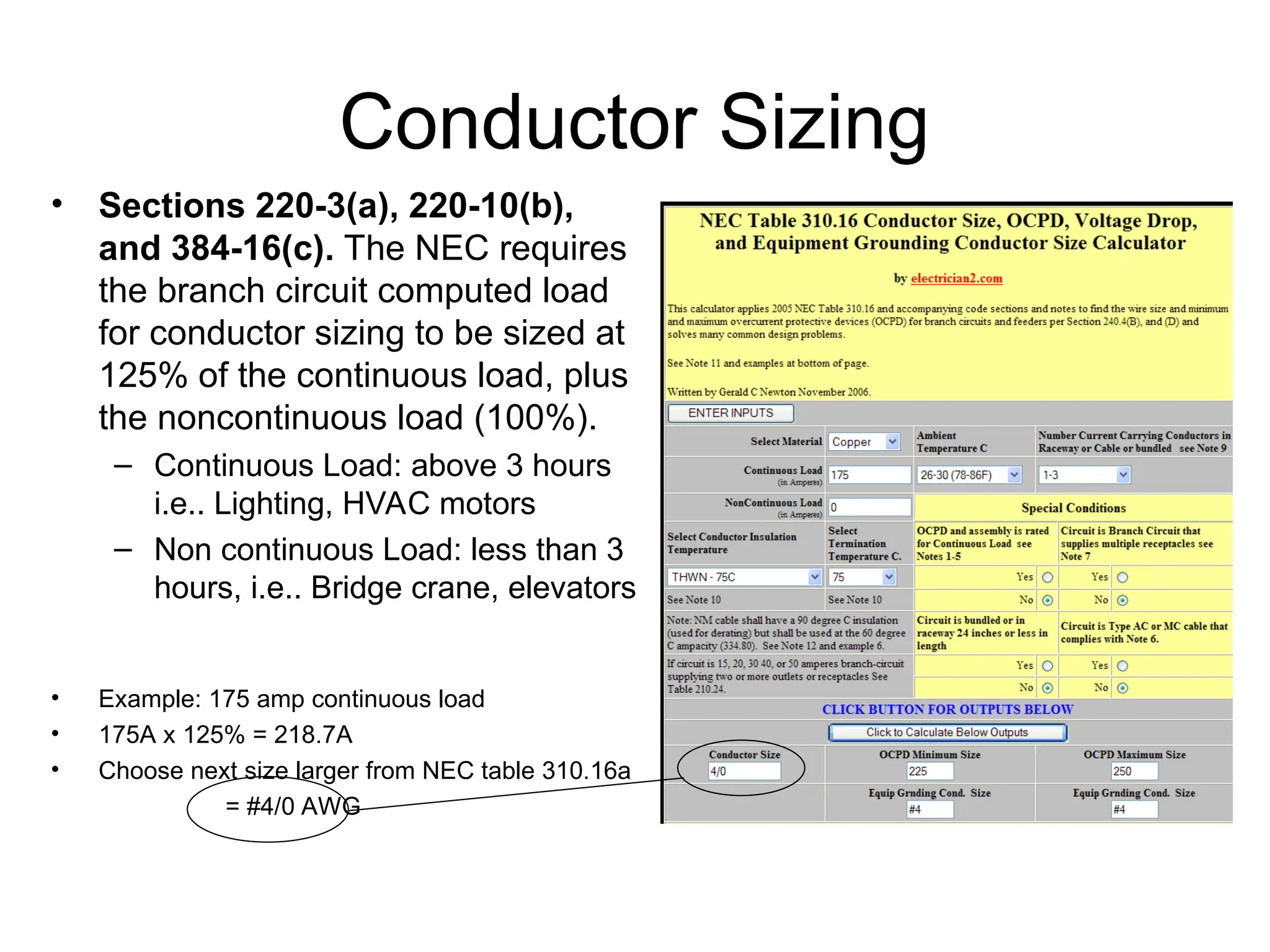
• Sections 220-3(a), 220-10(b),
and 384-16(c). The NEC requires
the branch circuit computed load
for conductor sizing to be sized at
125% of the continuous load, plus
the noncontinuous load (100%).
– Continuous Load: above 3 hours
i.e.. Lighting, HVAC motors
– Non continuous Load: less than 3
hours, i.e.. Bridge crane, elevators
• Example: 175 amp continuous load
• 175A x 125% = 218.7A
• Choose next size larger from NEC table 310.16a
= #4/0 AWG
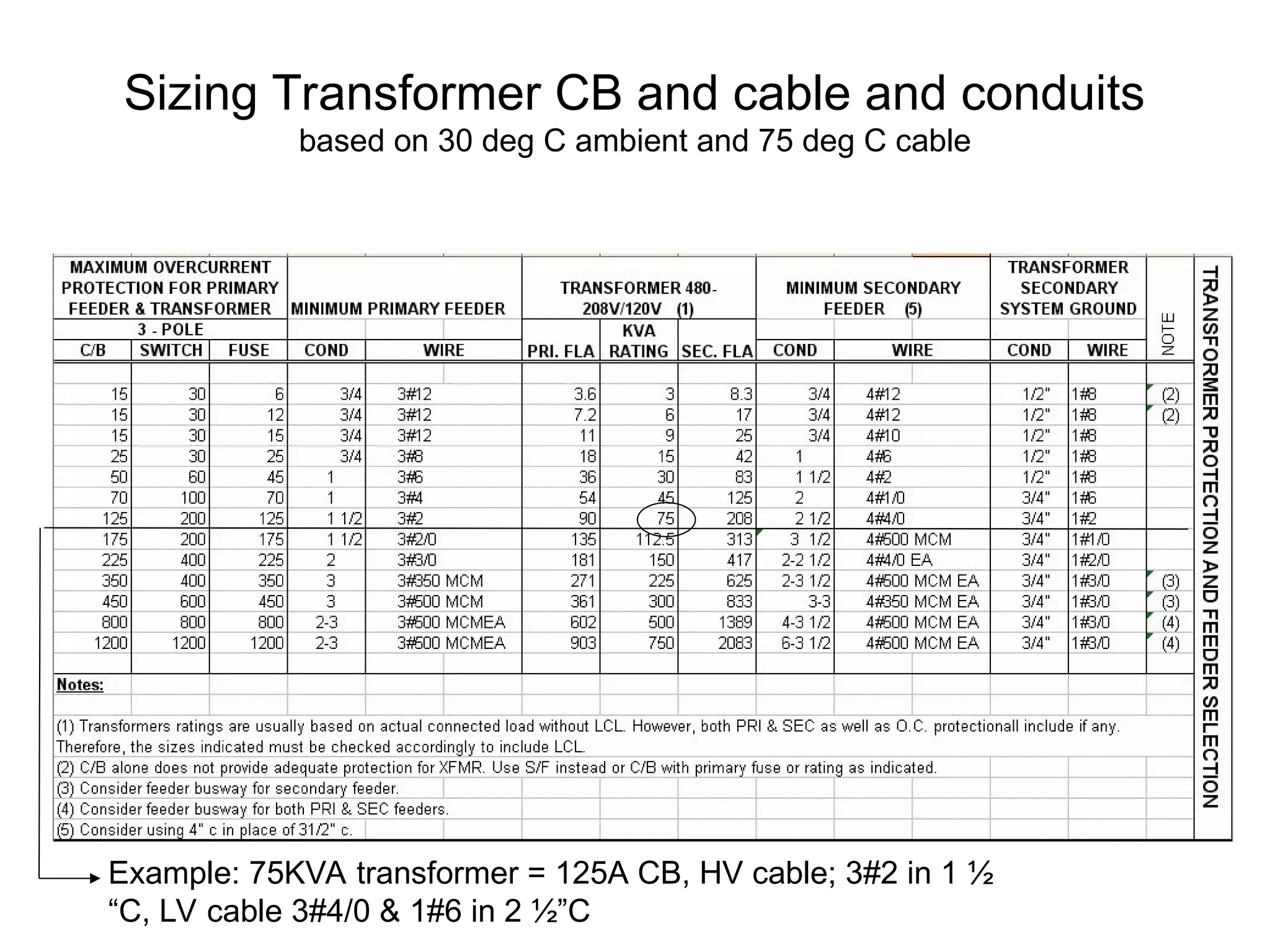
Sizing Transformer CB and cable and conduits
based on 30 deg C ambient and 75 deg C cable
Example: 75KVA transformer = 125A CB, HV cable; 3#2 in 1 ½
“C, LV cable 3#4/0 & 1#6 in 2 ½”C
Transformer Formula
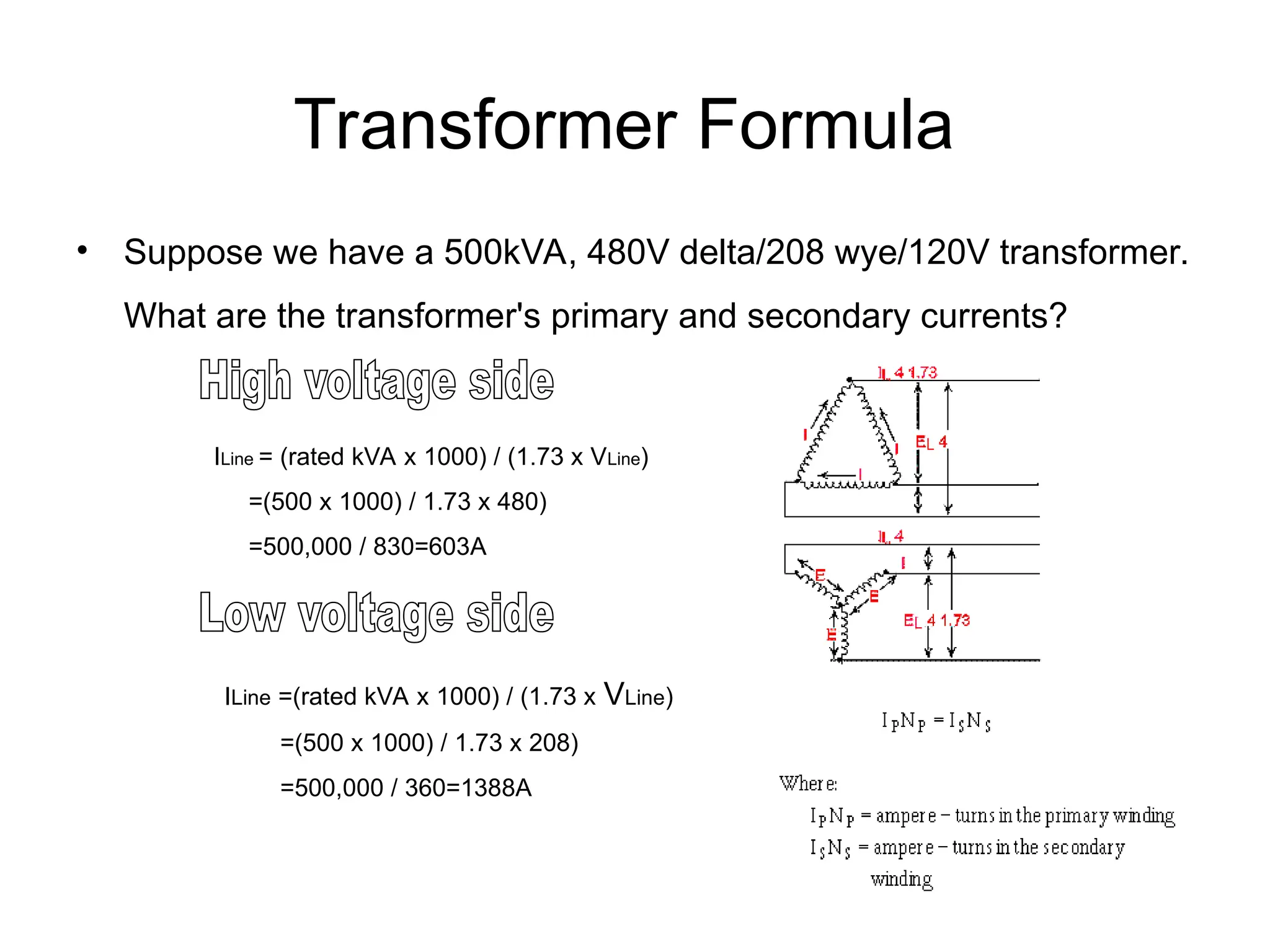
• Suppose we have a 500kVA, 480V delta/208 wye/120V transformer.
What are the transformer's primary and secondary currents?
ILine = (rated kVA x 1000) / (1.73 x VLine)
=(500 x 1000) / 1.73 x 480)
=500,000 / 830=603A
ILine =(rated kVA x 1000) / (1.73 x VLine)
=(500 x 1000) / 1.73 x 208)
=500,000 / 360=1388A
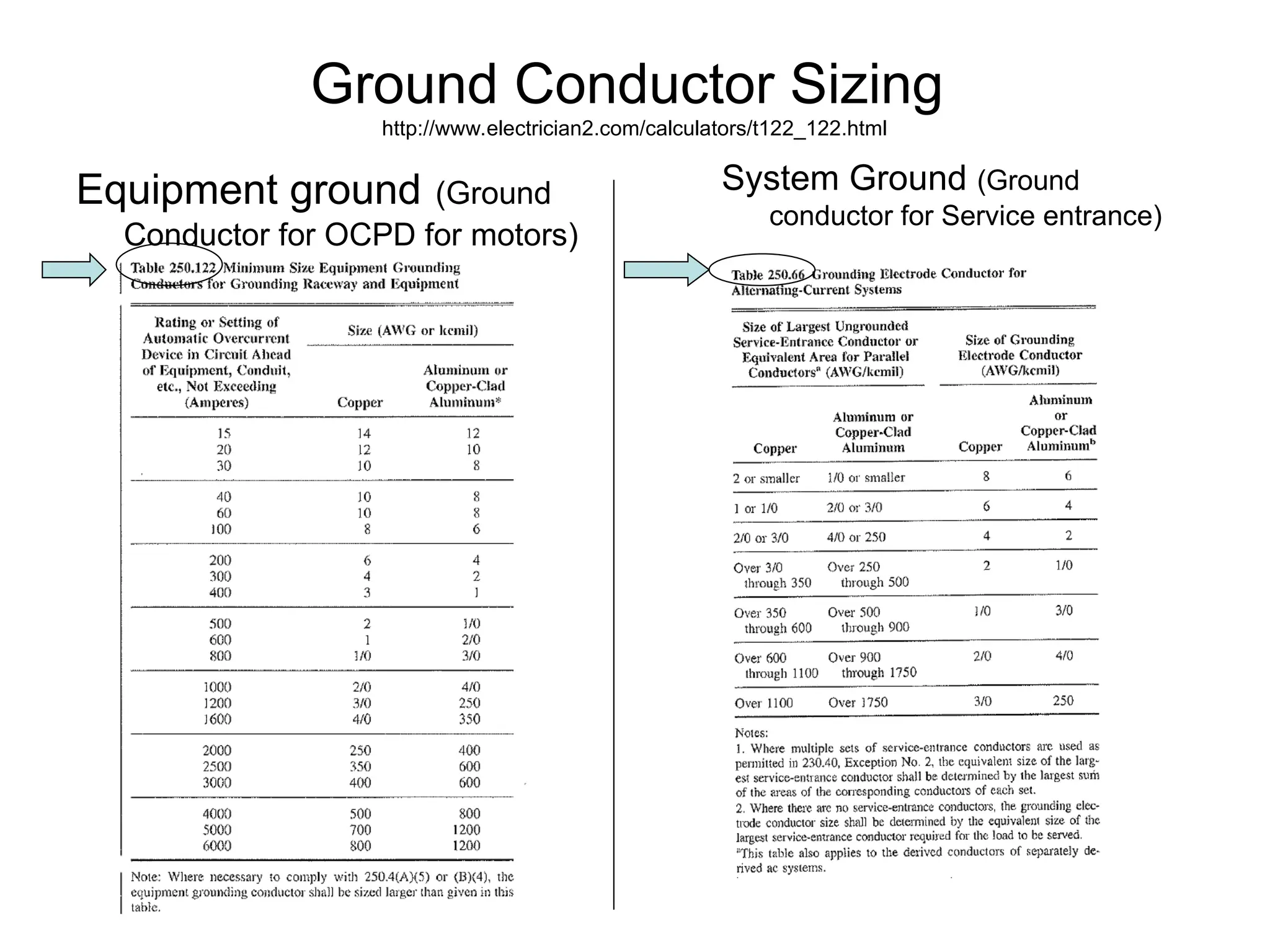
Ground Conductor Sizing
http://www.electrician2.com/calculators/t122_122.html
Equipment ground (Ground
Conductor for OCPD for motors)
System Ground (Ground
conductor for Service entrance)
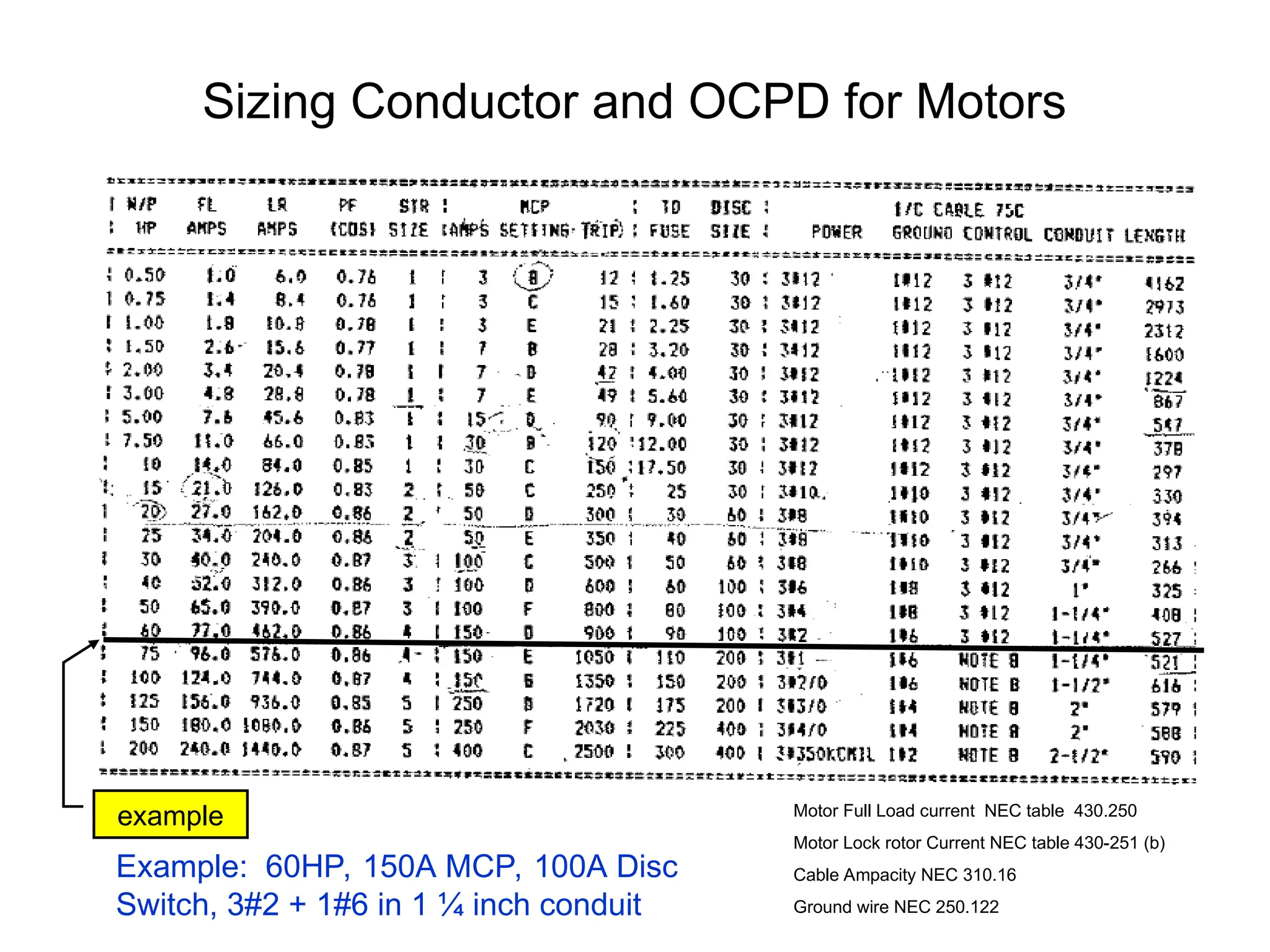
Sizing Conductor and OCPD for Motors
Motor Full Load current NEC table 430.250
Motor Lock rotor Current NEC table 430-251 (b)
Cable Ampacity NEC 310.16
Ground wire NEC 250.122
Example: 60HP, 150A MCP, 100A Disc
Switch, 3#2 + 1#6 in 1 ¼ inch conduit
example
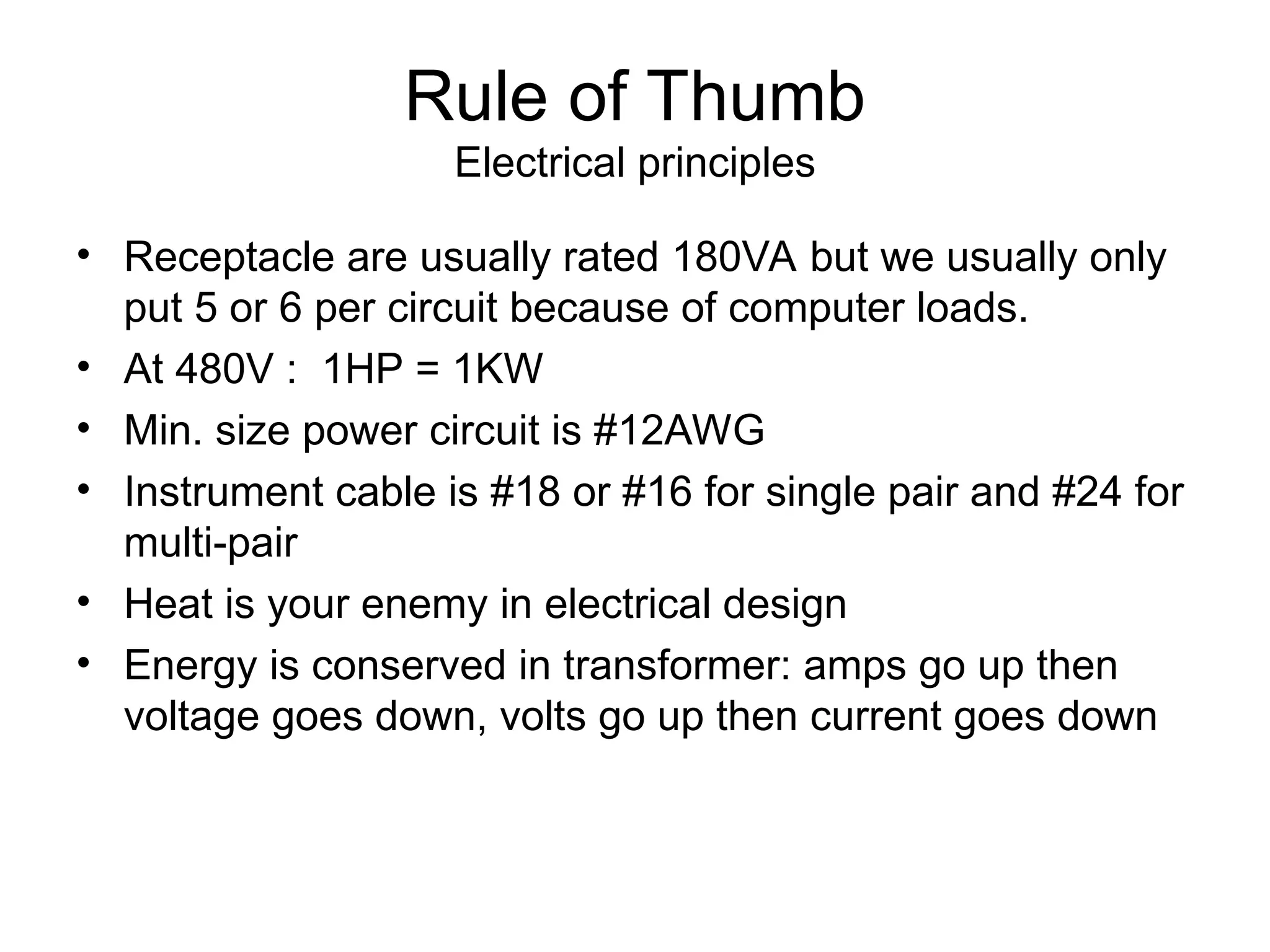
Rule of Thumb
Electrical principles
• Receptacle are usually rated 180VA but we usually only
put 5 or 6 per circuit because of computer loads.
• At 480V : 1HP = 1KW
• Min. size power circuit is #12AWG
• Instrument cable is #18 or #16 for single pair and #24 for
multi-pair
• Heat is your enemy in electrical design
• Energy is conserved in transformer: amps go up then
voltage goes down, volts go up then current goes down
Conclusion
• Electrical Codes
• Enclosures
• Basic Electrical Formulas
• Conduit Sizing
• Cable Ampacity Table NEC 310-16
• Conductor Sizing
• Sizing Transformer CB, Cable and Conduit
• Transformer Formula
• Ground Wire Sizing
• Sizing Conductor and OCPD for 480V Motors
• Rule of Thumb

Basic electrical Design class NEC Code 101.ppt

  • 1.
    Basic Electrical Design NECCode Applications Class 101 Jim Fuller 4/9/08
  • 2.
    Two basic principles •Heat is your Enemy • Harmonic overheat transformers • Overheating motors • Overheating wire and circuit breaker • Energy is conserve: Law of Conservation • Transformer: Input = Output + losses • Motor: input = output + losses
  • 3.
    Objective • Electrical Codes •Enclosures • Basic Electrical Formulas • Conduit Sizing • Cable Ampacity Table NEC 310-16 • Conductor Sizing • Sizing Transformer CB, Cable and Conduit • Transformer Formula • Ground Wire Sizing • Sizing Conductor and OCPD for 480V Motors • Rule of Thumb
  • 4.
    Electrical Codes • NFPA70 = NEC (national Electrical code) (sizing wire, conduit, transformer, safety and etc.) • NFPA (National Fire Protection Assoc.) (example NFPA 101 – life safety fire alarm, egress and etc..) • UL = national laboratory (testing lab for quality of equipment) • NEMA – National Electrical Manuf Assoc. (Quality of equipment, size i.e. MG-1 for motors • IEEE (Manuf criteria, example BIL level, short circuit rating)
  • 5.
    Nema type Enclosures NON-CLASSIFIEDLOCATION ENCLOSURESNEMA enclosures 2, 5, 12, 12K and 13 are not intended to provide protection against conditions such as internal condensation. NEMA enclosures 3, 3R, 38, 4, 4X, 6 and 6P are not intended to provide protection against conditions such as internal condensation or internal icing. • Type 1 Enclosures • Type 1 enclosures are intended for indoor use primarily to provide a degree of protection against limited amounts of falling dirt in locations where unusual service conditions do not exist. • Type 2 Enclosures • Type 2 enclosures are intended for indoor use primarily to provide a degree of protection against limited amounts of falling water and dirt. • Type 3 Enclosures • Type 3 enclosures are intended for outdoor use primarily to provide a degree of protection against rain, sleet, and wind-blown dust; and to be undamaged by the formation of ice on the enclosure. • Type 3R Enclosures • Type 3R enclosures are intended for outdoor use primarily to provide a degree of protection against rain and sleet; and to be undamaged by the formation of ice on the enclosure. They must have a provision for a drain hole. • Type 3S Enclosures • Type 38 enclosures are intended for outdoor use primarily to provide a degree of protection against rain, sleet, and wind- blown dust, and to provide for operation of external mechanisms when ice laden. • Type 4 Enclosures • Type 4 enclosures are intended for indoor or outdoor use primarily to provide a degree of protection against windblown dust and rain, splashing water, and hose-directed water; and to be undamaged by the formation of ice on the enclosure. • Type 4X Enclosures • Type 4X enclosures are intended for indoor or outdoor use primarily to provide a degree of protection against corrosion, windblown dust and rain, splashing water, and hose-directed water; and to be undamaged by the formation of ice on the enclosure. • Type 5 Enclosures • Type 5 enclosures are intended for indoor use primarily to provide a degree of protection against settling airborne dust, falling dirt, and dripping noncorrosive • • Type 4 Enclosures • Type 4 enclosures are intended for indoor or outdoor use primarily to provide a degree of protection against windblown dust and rain, splashing water, and hose-directed water; and to be undamaged by the formation of ice on the enclosure. • Type 4X Enclosures • Type 4X enclosures are intended for indoor or outdoor use primarily to provide a degree of protection against corrosion, windblown dust and rain, splashing water, and hose-directed water; and to be undamaged by the formation of ice on the enclosure. • Type 5 Enclosures • Type 5 enclosures are intended for indoor use primarily to provide a degree of protection against settling airborne dust, falling dirt, and dripping noncorrosive • Type 6 Enclosures • Type 6 enclosures are intended for indoor or outdoor use primarily to provide a degree of protection against hose-directed water and the entry or water during temporary submersion at a limited depth; and to be undamaged by the formation of ice on the enclosure. • Type 6P Enclosures • Type 6P enclosures are intended for indoor or outdoor use primarily to provide a degree of protection against hose-directed water and the entry of water during prolonged submersion at a limited depth; and to be undamaged by the formation of ice on the enclosure. • Type 12 Enclosures • Type 12 enclosures are intended for indoor use primarily to provide a degree of protection against circulating dust, falling dirt, and dripping noncorrosive liquids. • Type 12K Enclosures • Type 12K enclosures are intended for indoor use primarily to provide a degree of protection against circulating dust, falling dirt, and dripping noncorrosive liquids. The knockouts shall be provided only in the top or bottom walls, or both. • Type 13 Enclosures • Type 13 enclosures are intended for indoor use primarily to provide a degree of protection against lint, dust, spraying of water, oil, and noncorrosive coolant. • CLASSIFIED LOCATION ENCLOSURES • Type 7 Enclosures • Type 7 enclosures are for indoor use in locations classified as Class I, Groups A, B, C, or D, as defined in the National Electrical Code. • Type 8 Enclosures • Type 8 enclosures are for indoor or outdoor use in locations classified as Class I, Groups A, B, C, or D, as defined in the National Electrical Code. • Type 9 Enclosures • Type 9 enclosures are intended for indoor use in locations classified as Class II, Groups E, F, and G, as defined in the National Electrical Code. • Type 10 Enclosures (MSHA)Type 10 enclosures shall be capable of meeting the requirements of the Mine Safety and Health Administration, 30 C.F:R., Part 18.
  • 6.
    Basic Electrical Formula: ThreePhase Systems • Volts = I x R = amps x resistance = Input Kilowatts KVA = Input Watts x PF 1000
  • 7.
    Basic Electrical Formula: SinglePhase Systems • Volts = I x R = amps x resistance
  • 8.
    Conduit fill (sizing) SampleProblem: Is 5 inch conduit sufficient for (3) 1/c00MCM 15KV + 1/0 Grd 15KV? % fill = total area of cables x 100 Area of Conduit Area of Cable = = 3 (x (1.49” Dia)2 + ( x (1.07” Dia) 2 = 6.13 inch2 4 4 Area of Conduit = = 3 ( x (5.047” Dia)2 = 20 inch2 4 % fill = Area of conduitx100 =6.13 inch2 x100 = 30% Total area of cables 20 inch2 5” PVC, (3) 1/c 500MCM, #1/0 G 15KV 5” 5.047 20.0 6.2 8.0 10.6
  • 9.
    Cable Ampacity per NEC The lugrating of CB, starter, disc sw are based on 75deg C. If specified in spec then the wires can be based on 75deg C 600 C < 100A 750 C > 100A 900 C ambient
  • 10.
    Conductor Sizing • Sections220-3(a), 220-10(b), and 384-16(c). The NEC requires the branch circuit computed load for conductor sizing to be sized at 125% of the continuous load, plus the noncontinuous load (100%). – Continuous Load: above 3 hours i.e.. Lighting, HVAC motors – Non continuous Load: less than 3 hours, i.e.. Bridge crane, elevators • Example: 175 amp continuous load • 175A x 125% = 218.7A • Choose next size larger from NEC table 310.16a = #4/0 AWG
  • 11.
    Sizing Transformer CBand cable and conduits based on 30 deg C ambient and 75 deg C cable Example: 75KVA transformer = 125A CB, HV cable; 3#2 in 1 ½ “C, LV cable 3#4/0 & 1#6 in 2 ½”C
  • 12.
    Transformer Formula • Supposewe have a 500kVA, 480V delta/208 wye/120V transformer. What are the transformer's primary and secondary currents? ILine = (rated kVA x 1000) / (1.73 x VLine) =(500 x 1000) / 1.73 x 480) =500,000 / 830=603A ILine =(rated kVA x 1000) / (1.73 x VLine) =(500 x 1000) / 1.73 x 208) =500,000 / 360=1388A
  • 13.
    Ground Conductor Sizing http://www.electrician2.com/calculators/t122_122.html Equipmentground (Ground Conductor for OCPD for motors) System Ground (Ground conductor for Service entrance)
  • 14.
    Sizing Conductor andOCPD for Motors Motor Full Load current NEC table 430.250 Motor Lock rotor Current NEC table 430-251 (b) Cable Ampacity NEC 310.16 Ground wire NEC 250.122 Example: 60HP, 150A MCP, 100A Disc Switch, 3#2 + 1#6 in 1 ¼ inch conduit example
  • 15.
    Rule of Thumb Electricalprinciples • Receptacle are usually rated 180VA but we usually only put 5 or 6 per circuit because of computer loads. • At 480V : 1HP = 1KW • Min. size power circuit is #12AWG • Instrument cable is #18 or #16 for single pair and #24 for multi-pair • Heat is your enemy in electrical design • Energy is conserved in transformer: amps go up then voltage goes down, volts go up then current goes down
  • 16.
    Conclusion • Electrical Codes •Enclosures • Basic Electrical Formulas • Conduit Sizing • Cable Ampacity Table NEC 310-16 • Conductor Sizing • Sizing Transformer CB, Cable and Conduit • Transformer Formula • Ground Wire Sizing • Sizing Conductor and OCPD for 480V Motors • Rule of Thumb