E
D
U
C
2
1
1
M
O
D
E
R
N
T
R
E
N
D
S
A
N
D
I
N
N
O
V
A
T
I
O
N
I
N
E
D
U
C
A
T
I
O
N
BASIC EDUCATION
LEARNING
CONTINUITY
PLAN
Camille F. Romero
D E P E D O R D E R N O . 1 2 , S . 2 0 2 0
RATIONALE
02
- Purpose of which is to provide clear
guidance to all offices, units, schools
and community learning centers amidst
the Pandemic.
- The LCP will help engage the internal
and external stakeholders for inputs in
the design of delivery strategy and
operational direction that ensures
health, safety, and well-being of
learners, teachers, and personnel of
the Department.
BASIC EDUCATION
LEARNING CONTINUITY PLAN
A package of education interventions
that will respond to basic education
challenges brought about by the COVID-
19 pandemic.
THE BE-LCP STANDS ON THE
FOLLOWING PRINCIPLES:
• Protect health and safety of learners, teachers
and personnel and prevent the further
transmission of COVID-19.
• Ensure learning continuity by:
a. Doing curricular adjustments
b. Alignment of learning materials
c. Deployment of multiple learning modalities
d. Training of teachers, leaders & parents
PRINCIPLES ADOPTED BEHIND
THE BE-LCP
• Facilitate the safe return of teaching and non-
teaching personnel to workplaces
• Be sensitive to equity considerations and concerns
and endeavor to address them best that we can.
• Link and bridge the BE-LCP to DepEd's pivot to
quality and future education
BE-LCP
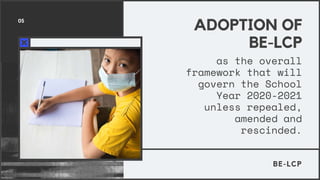
ADOPTION OF
BE-LCP
as the overall
framework that will
govern the School
Year 2020-2021
unless repealed,
amended and
rescinded.
05
BE-LCP
ADOPTION OF MOST
ESSENTIAL LEARNING
COMPETENCIES (MELC)
The key elements of the learning strategies that
shall operationalize the BE-LCP are the
streamlining of the K to 12 Curriculum into the
Most Essential Learning Competencies (MELCs),
and allowing of multiple learning delivery
modalities such as distance learning and
blended learning, either on top or in place of
face-to-face learning.
BE-LCP
MELCs
The MELCs are
defined as the
competencies that a
learner needs in
order to continue to
subsequent grades,
and ultimately to
have a successful
life.
05
The characteristics of the MELCs are:
a. It is aligned with national standards or frameworks,
such as, for example, “holistic Filipino learners with 21st
Century skills.”
b. They connect the content to higher concepts across
content areas. 30
c. They are applicable to real-life situations.
d. They are important for students to acquire, even if a
student drops out from school.
e. They cannot be expected to be ordinarily learned by
students if not taught in school.
NO FACE-
TO- FACE
CLASSES
UNTIL SAFE
LEARNING
DELIVERY
MODALITIES
1.FACE-TO-FACE
2.DISTANCE LEARNING
• Modular Distance
Learning
• Online Distance Learning
• TV/Radio-Based
Instruction
3. BLENDED LEARNING
4. HOME SCHOOLING
06
BE-LCP
FLEXIBLE
LEARNING
CHED MEMORANDUM NO.4, S. 2020
08
In accordance with the pertinent provisions
of Republic Act (RA) No.7722, otherwise known
as the "Higher Education Act of 1994",
Republic Act No. 11469, otherwise known as
the "Bayanihan to Heal as One Act",
and by virtue of Commission en Banc
(CEB) Resolution No. 412-2020, series of
2020, the Commission on Higher Education
(CHED) hereby adopts and promulgates the
following Guidelines on Flexible Learning
(FL) to be implemented by public and private
Higher Education Institutions (HEls).
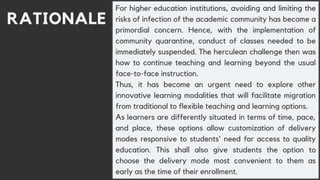
RATIONALE
For higher education institutions, avoiding and limiting the
risks of infection of the academic community has become a
primordial concern. Hence, with the implementation of
community quarantine, conduct of classes needed to be
immediately suspended. The herculean challenge then was
how to continue teaching and learning beyond the usual
face-to-face instruction.
Thus, it has become an urgent need to explore other
innovative learning modalities that will facilitate migration
from traditional to flexible teaching and learning options.
As learners are differently situated in terms of time, pace,
and place, these options allow customization of delivery
modes responsive to students' need for access to quality
education. This shall also give students the option to
choose the delivery mode most convenient to them as
early as the time of their enrollment.
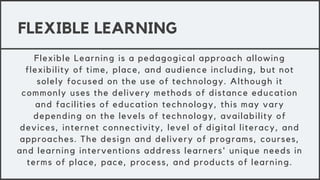
FLEXIBLE LEARNING
Flexible Learning is a pedagogical approach allowing
flexibility of time, place, and audience including, but not
solely focused on the use of technology. Although it
commonly uses the delivery methods of distance education
and facilities of education technology, this may vary
depending on the levels of technology, availability of
devices, internet connectivity, level of digital literacy, and
approaches. The design and delivery of programs, courses,
and learning interventions address learners' unique needs in
terms of place, pace, process, and products of learning.
FLEXIBLE LEARNING
It involves the use of digital and non-digital technology and
covers both face-to-face or in-person learning, out-of-
classroom learning modes of delivery, or a combination of
modes of delivery. It ensures the continuity of inclusive and
accessible education when the use of traditional modes of
teaching is not feasible, as in the occurrence of national
emergencies.
THANK YOU!
THANK
YOU!

EDUC 211 Basic Education Learning Continuity Plan

  • 1.
  • 2.
    RATIONALE 02 - Purpose ofwhich is to provide clear guidance to all offices, units, schools and community learning centers amidst the Pandemic. - The LCP will help engage the internal and external stakeholders for inputs in the design of delivery strategy and operational direction that ensures health, safety, and well-being of learners, teachers, and personnel of the Department.
  • 3.
    BASIC EDUCATION LEARNING CONTINUITYPLAN A package of education interventions that will respond to basic education challenges brought about by the COVID- 19 pandemic.
  • 4.
    THE BE-LCP STANDSON THE FOLLOWING PRINCIPLES: • Protect health and safety of learners, teachers and personnel and prevent the further transmission of COVID-19. • Ensure learning continuity by: a. Doing curricular adjustments b. Alignment of learning materials c. Deployment of multiple learning modalities d. Training of teachers, leaders & parents
  • 5.
    PRINCIPLES ADOPTED BEHIND THEBE-LCP • Facilitate the safe return of teaching and non- teaching personnel to workplaces • Be sensitive to equity considerations and concerns and endeavor to address them best that we can. • Link and bridge the BE-LCP to DepEd's pivot to quality and future education
  • 6.
    BE-LCP ADOPTION OF BE-LCP as theoverall framework that will govern the School Year 2020-2021 unless repealed, amended and rescinded. 05
  • 7.
    BE-LCP ADOPTION OF MOST ESSENTIALLEARNING COMPETENCIES (MELC) The key elements of the learning strategies that shall operationalize the BE-LCP are the streamlining of the K to 12 Curriculum into the Most Essential Learning Competencies (MELCs), and allowing of multiple learning delivery modalities such as distance learning and blended learning, either on top or in place of face-to-face learning.
  • 8.
    BE-LCP MELCs The MELCs are definedas the competencies that a learner needs in order to continue to subsequent grades, and ultimately to have a successful life. 05
  • 9.
    The characteristics ofthe MELCs are: a. It is aligned with national standards or frameworks, such as, for example, “holistic Filipino learners with 21st Century skills.” b. They connect the content to higher concepts across content areas. 30 c. They are applicable to real-life situations. d. They are important for students to acquire, even if a student drops out from school. e. They cannot be expected to be ordinarily learned by students if not taught in school.
  • 10.
  • 11.
    LEARNING DELIVERY MODALITIES 1.FACE-TO-FACE 2.DISTANCE LEARNING • ModularDistance Learning • Online Distance Learning • TV/Radio-Based Instruction 3. BLENDED LEARNING 4. HOME SCHOOLING 06 BE-LCP
  • 12.
    FLEXIBLE LEARNING CHED MEMORANDUM NO.4,S. 2020 08 In accordance with the pertinent provisions of Republic Act (RA) No.7722, otherwise known as the "Higher Education Act of 1994", Republic Act No. 11469, otherwise known as the "Bayanihan to Heal as One Act", and by virtue of Commission en Banc (CEB) Resolution No. 412-2020, series of 2020, the Commission on Higher Education (CHED) hereby adopts and promulgates the following Guidelines on Flexible Learning (FL) to be implemented by public and private Higher Education Institutions (HEls).
  • 13.
    RATIONALE For higher educationinstitutions, avoiding and limiting the risks of infection of the academic community has become a primordial concern. Hence, with the implementation of community quarantine, conduct of classes needed to be immediately suspended. The herculean challenge then was how to continue teaching and learning beyond the usual face-to-face instruction. Thus, it has become an urgent need to explore other innovative learning modalities that will facilitate migration from traditional to flexible teaching and learning options. As learners are differently situated in terms of time, pace, and place, these options allow customization of delivery modes responsive to students' need for access to quality education. This shall also give students the option to choose the delivery mode most convenient to them as early as the time of their enrollment.
  • 14.
    FLEXIBLE LEARNING Flexible Learningis a pedagogical approach allowing flexibility of time, place, and audience including, but not solely focused on the use of technology. Although it commonly uses the delivery methods of distance education and facilities of education technology, this may vary depending on the levels of technology, availability of devices, internet connectivity, level of digital literacy, and approaches. The design and delivery of programs, courses, and learning interventions address learners' unique needs in terms of place, pace, process, and products of learning.
  • 15.
    FLEXIBLE LEARNING It involvesthe use of digital and non-digital technology and covers both face-to-face or in-person learning, out-of- classroom learning modes of delivery, or a combination of modes of delivery. It ensures the continuity of inclusive and accessible education when the use of traditional modes of teaching is not feasible, as in the occurrence of national emergencies.
  • 16.