Basic Concept
of Software
Quality
BY: Adeel Rasheed
Quality
o Some key points from various definitions of
quality are as follows.
o Meeting explicit as well as implicit
customer requirements
o Continually improving the software process
o Removing defects throughout the process
o Developing a product that is fit for use
What is software quality?
What are software quality factors?
To build quality software products, the Quality
requirements of a product need to be clearly defined
so that software engineering can aim to achieve them.
The quality requirements of a product being developed
can be specified in terms of the quality factors.
Categories of quality
factors
Product operation
Product revision
Product transition
Product Pperation
The product operation category includes
factors that help us to Understand the
operational characteristics of a product. The
factors in this category are:
 Correctness
 Reliability
 Efficiency
 Integrity
 Usability
Product Revision
 What is product revision?
 •The product revision category of framework includes
the factors that contribute to ease in revising a product
These are:
 Maintainability
 Testability
 Flexibility
 •If a product cannot be revised easily, then:
 Enhancements cannot be made to meet the changing
requirements.
 Defects cannot be fixed or are very costly to fix.
 Any changes made might add more defects.
Product Transition
Interoperability
•McCall defines interoperability as the effort
required to couple one system to another
•Interoperability is concerned with the exchange
of data and services between systems.
Types of relationship
between quality factors
 Indifferent .
 Complementary.
 Conflicting.
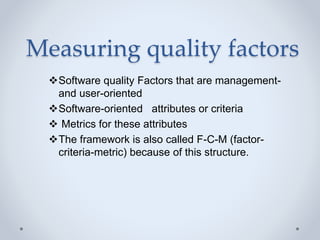
Measuring quality factors
Software quality Factors that are management-
and user-oriented
Software-oriented attributes or criteria
 Metrics for these attributes
The framework is also called F-C-M (factor-
criteria-metric) because of this structure.
Errors and Defects
 •Defects are the problems that are found either by the
customer or by the software professionals after a product
as been delivered.
 •Defects lower the customer perspective on product
quality.
 We use the term 'error' for the problems that are found
using formal processes but are detected before the
delivery of a product to the customer.
Categories of metrics for
quality
 Technical metrics
 After-the-fact metrics
Technical metrics enable action in time
•Technical metrics are based on measures of the
technical attributes of a product made by software
engineers as part of the software process.
•Technical metrics provide a good understanding of
the technical quality of the product while it is being
made.
•Software engineers use technical metrics to improve
the way they work and to create better design and
code.
Technical Metrics
After-the-fact metrics
 •After-the-fact metrics are based on the measures
made at the end of a project.
 •They are simple summary metrics and are usually
relatively easy to collect.
 •They are based on the measures visible to
managers and do not require technical insight into
the process.
Basic Concept of Software Quality

Basic Concept of Software Quality

  • 1.
  • 2.
  • 3.
    Quality o Some keypoints from various definitions of quality are as follows. o Meeting explicit as well as implicit customer requirements o Continually improving the software process o Removing defects throughout the process o Developing a product that is fit for use
  • 4.
    What is softwarequality? What are software quality factors? To build quality software products, the Quality requirements of a product need to be clearly defined so that software engineering can aim to achieve them. The quality requirements of a product being developed can be specified in terms of the quality factors.
  • 5.
    Categories of quality factors Productoperation Product revision Product transition
  • 6.
    Product Pperation The productoperation category includes factors that help us to Understand the operational characteristics of a product. The factors in this category are:  Correctness  Reliability  Efficiency  Integrity  Usability
  • 7.
    Product Revision  Whatis product revision?  •The product revision category of framework includes the factors that contribute to ease in revising a product These are:  Maintainability  Testability  Flexibility  •If a product cannot be revised easily, then:  Enhancements cannot be made to meet the changing requirements.  Defects cannot be fixed or are very costly to fix.  Any changes made might add more defects.
  • 8.
    Product Transition Interoperability •McCall definesinteroperability as the effort required to couple one system to another •Interoperability is concerned with the exchange of data and services between systems.
  • 9.
    Types of relationship betweenquality factors  Indifferent .  Complementary.  Conflicting.
  • 10.
    Measuring quality factors Softwarequality Factors that are management- and user-oriented Software-oriented attributes or criteria  Metrics for these attributes The framework is also called F-C-M (factor- criteria-metric) because of this structure.
  • 11.
    Errors and Defects •Defects are the problems that are found either by the customer or by the software professionals after a product as been delivered.  •Defects lower the customer perspective on product quality.  We use the term 'error' for the problems that are found using formal processes but are detected before the delivery of a product to the customer.
  • 12.
    Categories of metricsfor quality  Technical metrics  After-the-fact metrics
  • 13.
    Technical metrics enableaction in time •Technical metrics are based on measures of the technical attributes of a product made by software engineers as part of the software process. •Technical metrics provide a good understanding of the technical quality of the product while it is being made. •Software engineers use technical metrics to improve the way they work and to create better design and code. Technical Metrics
  • 14.
    After-the-fact metrics  •After-the-factmetrics are based on the measures made at the end of a project.  •They are simple summary metrics and are usually relatively easy to collect.  •They are based on the measures visible to managers and do not require technical insight into the process.