Digital Logic Design
In this video, It will delve into the fascinating world
of digital logic design, exploring its fundamentals,
circuitry components and applications.
Dr.Irshad Ahmed
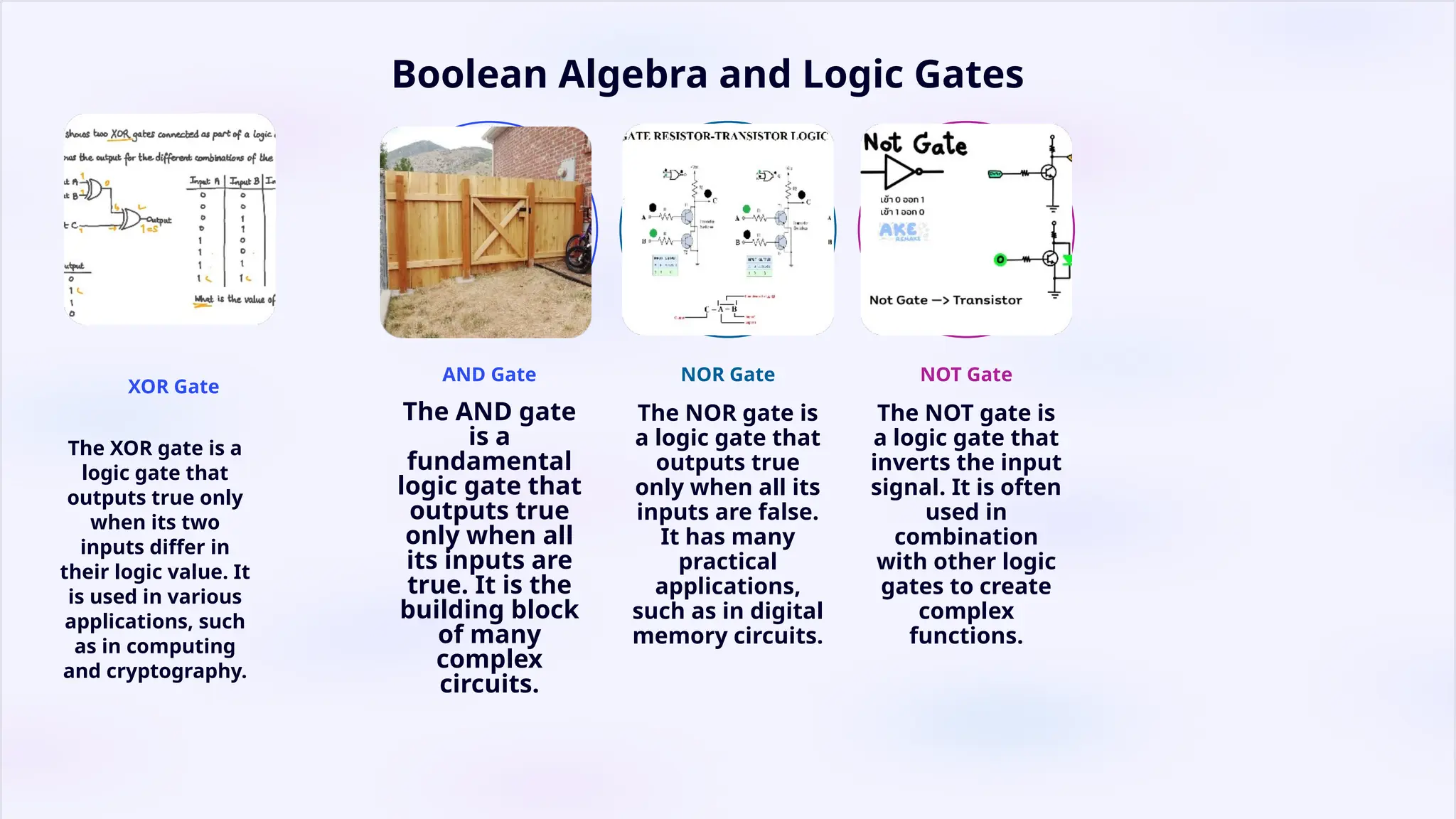
Boolean Algebra and Logic Gates
AND Gate
The AND gate
is a
fundamental
logic gate that
outputs true
only when all
its inputs are
true. It is the
building block
of many
complex
circuits.
NOR Gate
The NOR gate is
a logic gate that
outputs true
only when all its
inputs are false.
It has many
practical
applications,
such as in digital
memory circuits.
NOT Gate
The NOT gate is
a logic gate that
inverts the input
signal. It is often
used in
combination
with other logic
gates to create
complex
functions.
XOR Gate
The XOR gate is a
logic gate that
outputs true only
when its two
inputs differ in
their logic value. It
is used in various
applications, such
as in computing
and cryptography.
Combinational Logic Circuits
1 Decoder
The decoder is a combinational logic circuit that converts binary code into a
set of outputs. It is widely used in digital electronics, such as in memory chips
and microprocessors.
2 Multiplexer
The multiplexer is a combinational logic circuit that selects one of several
input signals and forwards the selected signal to the output. It is an essential
component of many communication systems, such as telephony and data
networks.
3 Comparator
The comparator is a combinational logic circuit that compares two binary
values and outputs a signal indicating their relationship (greater, less, or
equal). It is widely used in digital signal processing, control systems, and
scientific calculations.
Sequential Logic Circuits
S-R Latch
The S-R (set-reset)
latch is a sequential
logic circuit that
stores a single binary
digit (bit) and allows
its value to be set or
reset through input
signals. It is used in
various applications,
such as in flip-flops
and memory cells.
D Flip-Flop
The D flip-flop is a
sequential logic
circuit that stores a
single bit and latches
its value on the rising
edge of a clock signal.
It is extensively used
in digital systems,
such as in
microprocessors, data
storage devices, and
communication
protocols.
Counter
The counter is a
sequential logic
circuit that counts the
number of pulses
applied to its inputs
and outputs a binary
code representing the
count value. It is a
crucial component of
many digital systems,
such as in clocks,
timers, and frequency
dividers.
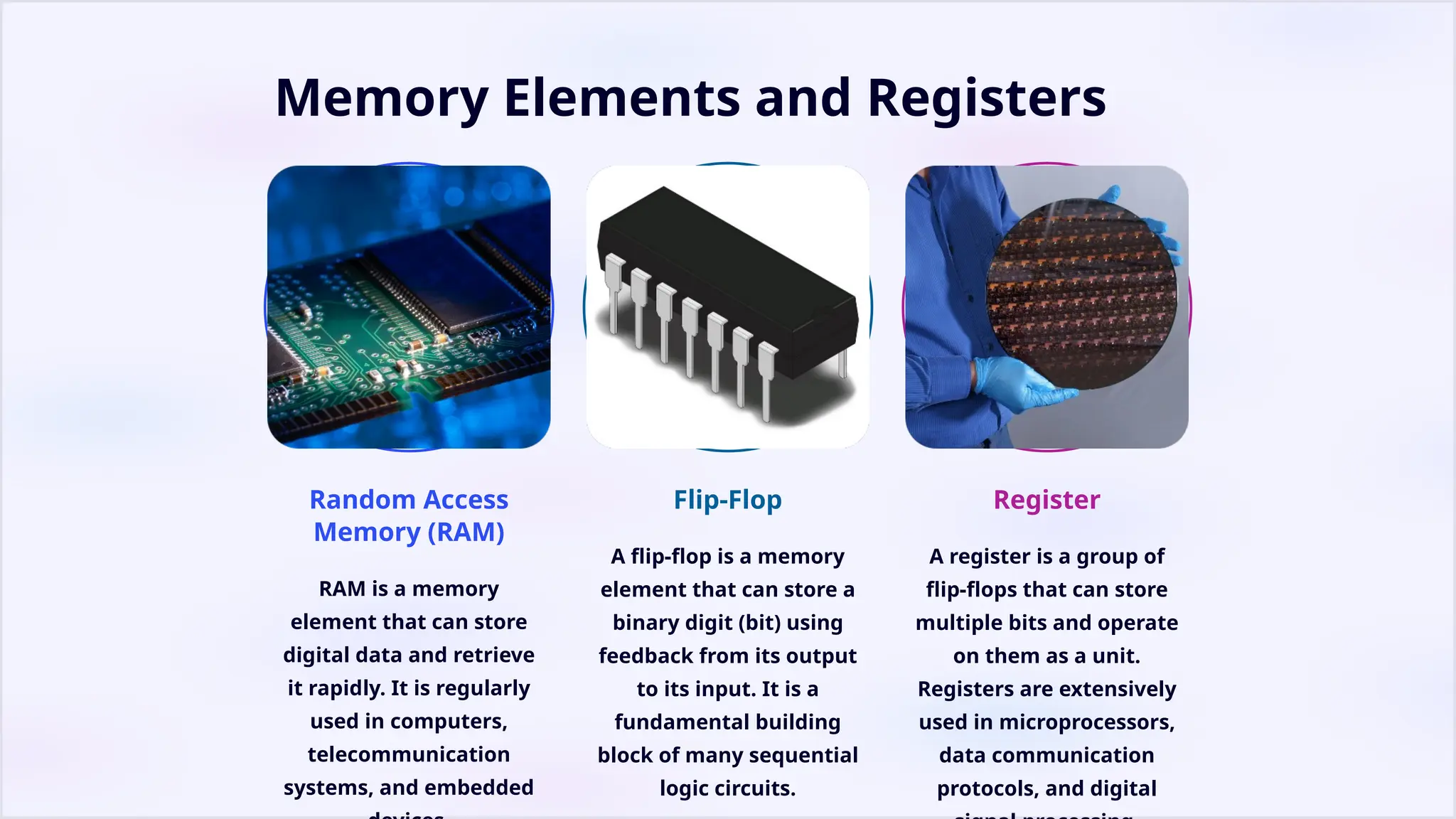
Memory Elements and Registers
Random Access
Memory (RAM)
RAM is a memory
element that can store
digital data and retrieve
it rapidly. It is regularly
used in computers,
telecommunication
systems, and embedded
Flip-Flop
A flip-flop is a memory
element that can store a
binary digit (bit) using
feedback from its output
to its input. It is a
fundamental building
block of many sequential
logic circuits.
Register
A register is a group of
flip-flops that can store
multiple bits and operate
on them as a unit.
Registers are extensively
used in microprocessors,
data communication
protocols, and digital
Microprocessors and
Microcontrollers
1 Functionality
Microprocessors and
microcontrollers are
programmable digital devices
that can perform
computation, control, and
communication tasks
autonomously or under
human supervision.
2 Differences
A microprocessor is a general-
purpose computing device
that requires external
memory and input/output
components. A
microcontroller is a
specialized device that
integrates memory,
input/output, and other
peripherals into a single chip.
3 Applications
Microprocessors and microcontrollers are used in a vast range of
applications, such as in computers, mobile devices, cars, drones,
appliances, industrial controllers, and entertainment systems.
Applications of Digital Logic Design
Telecommunicat
ions
Digital logic design is
essential for the
development of
communication systems,
such as telephones,
mobile phones, modems,
routers, and satellite
networks. It enables
efficient signal
processing, switching,
multiplexing, and error
correction.
Computing
Digital logic design
underpins the
architecture and
operation of computers,
from microprocessors to
high-performance
clusters. It enables the
execution of complex
algorithms, the
management of
memories and devices,
and the interaction with
humans.
Automation
Digital logic design plays
a central role in
automation systems that
control and monitor
industrial processes, such
as factories, power plants,
and transportation
networks. It enables the
integration of sensors,
actuators, logic
controllers, and human-
machine interfaces.
Basic Concept of Digital-Logic-Design(DLD) and its applications

Basic Concept of Digital-Logic-Design(DLD) and its applications

  • 1.
    Digital Logic Design Inthis video, It will delve into the fascinating world of digital logic design, exploring its fundamentals, circuitry components and applications. Dr.Irshad Ahmed
  • 2.
    Boolean Algebra andLogic Gates AND Gate The AND gate is a fundamental logic gate that outputs true only when all its inputs are true. It is the building block of many complex circuits. NOR Gate The NOR gate is a logic gate that outputs true only when all its inputs are false. It has many practical applications, such as in digital memory circuits. NOT Gate The NOT gate is a logic gate that inverts the input signal. It is often used in combination with other logic gates to create complex functions. XOR Gate The XOR gate is a logic gate that outputs true only when its two inputs differ in their logic value. It is used in various applications, such as in computing and cryptography.
  • 3.
    Combinational Logic Circuits 1Decoder The decoder is a combinational logic circuit that converts binary code into a set of outputs. It is widely used in digital electronics, such as in memory chips and microprocessors. 2 Multiplexer The multiplexer is a combinational logic circuit that selects one of several input signals and forwards the selected signal to the output. It is an essential component of many communication systems, such as telephony and data networks. 3 Comparator The comparator is a combinational logic circuit that compares two binary values and outputs a signal indicating their relationship (greater, less, or equal). It is widely used in digital signal processing, control systems, and scientific calculations.
  • 4.
    Sequential Logic Circuits S-RLatch The S-R (set-reset) latch is a sequential logic circuit that stores a single binary digit (bit) and allows its value to be set or reset through input signals. It is used in various applications, such as in flip-flops and memory cells. D Flip-Flop The D flip-flop is a sequential logic circuit that stores a single bit and latches its value on the rising edge of a clock signal. It is extensively used in digital systems, such as in microprocessors, data storage devices, and communication protocols. Counter The counter is a sequential logic circuit that counts the number of pulses applied to its inputs and outputs a binary code representing the count value. It is a crucial component of many digital systems, such as in clocks, timers, and frequency dividers.
  • 5.
    Memory Elements andRegisters Random Access Memory (RAM) RAM is a memory element that can store digital data and retrieve it rapidly. It is regularly used in computers, telecommunication systems, and embedded Flip-Flop A flip-flop is a memory element that can store a binary digit (bit) using feedback from its output to its input. It is a fundamental building block of many sequential logic circuits. Register A register is a group of flip-flops that can store multiple bits and operate on them as a unit. Registers are extensively used in microprocessors, data communication protocols, and digital
  • 6.
    Microprocessors and Microcontrollers 1 Functionality Microprocessorsand microcontrollers are programmable digital devices that can perform computation, control, and communication tasks autonomously or under human supervision. 2 Differences A microprocessor is a general- purpose computing device that requires external memory and input/output components. A microcontroller is a specialized device that integrates memory, input/output, and other peripherals into a single chip. 3 Applications Microprocessors and microcontrollers are used in a vast range of applications, such as in computers, mobile devices, cars, drones, appliances, industrial controllers, and entertainment systems.
  • 7.
    Applications of DigitalLogic Design Telecommunicat ions Digital logic design is essential for the development of communication systems, such as telephones, mobile phones, modems, routers, and satellite networks. It enables efficient signal processing, switching, multiplexing, and error correction. Computing Digital logic design underpins the architecture and operation of computers, from microprocessors to high-performance clusters. It enables the execution of complex algorithms, the management of memories and devices, and the interaction with humans. Automation Digital logic design plays a central role in automation systems that control and monitor industrial processes, such as factories, power plants, and transportation networks. It enables the integration of sensors, actuators, logic controllers, and human- machine interfaces.