BASIC CISCO
Memakai Cisco
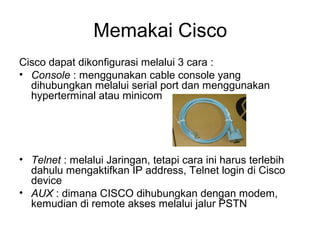
Cisco dapat dikonfigurasi melalui 3 cara :
• Console : menggunakan cable console yang
dihubungkan melalui serial port dan menggunakan
hyperterminal atau minicom
• Telnet : melalui Jaringan, tetapi cara ini harus terlebih
dahulu mengaktifkan IP address, Telnet login di Cisco
device
• AUX : dimana CISCO dihubungkan dengan modem,
kemudian di remote akses melalui jalur PSTN
Mode Prompt
Pada perangkat CISCO terdapat 3 mode prompt
• Usermode prompt : dimana ini merupakan awal
login di perangkat CISCO (user biasa)
• Privilegedmode prompt : pada mode ini dapat
mencari informasi dari perangkat CISCO (user
admin)
• Configuremode prompt : pada mode ini dapat
dilakukan perubahan terhadap perangkat
CISCO, tetapi tidak bisa dilakukan pengambilan
informasi (Super Admin)
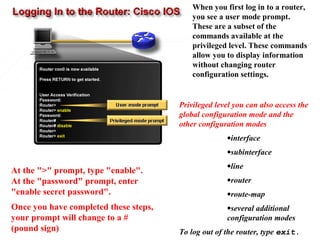
When you first log in to a router,
you see a user mode prompt.
These are a subset of the
commands available at the
privileged level. These commands
allow you to display information
without changing router
configuration settings.
At the ">" prompt, type "enable".
At the "password" prompt, enter
"enable secret password".
Once you have completed these steps,
your prompt will change to a #
(pound sign)
Privileged level you can also access the
global configuration mode and the
other configuration modes
•interface
•subinterface
•line
•router
•route-map
•several additional
configuration modes
To log out of the router, type exit.
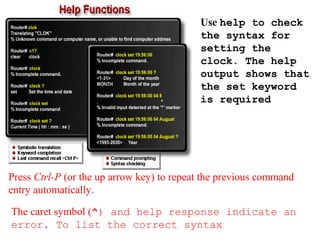
Use help to check
the syntax for
setting the
clock. The help
output shows that
the set keyword
is required
Press Ctrl-P (or the up arrow key) to repeat the previous command
entry automatically.
The caret symbol (^) and help response indicate an
error. To list the correct syntax
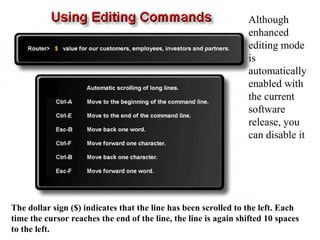
Although
enhanced
editing mode
is
automatically
enabled with
the current
software
release, you
can disable it
The dollar sign ($) indicates that the line has been scrolled to the left. Each
time the cursor reaches the end of the line, the line is again shifted 10 spaces
to the left.
For many of the prompts in the system configuration dialog of the setup
command facility, default answers appear in square
brackets [] following the question. Press the Return key
to use these defaults. If the system has been previously
configured, the defaults that will appear will be the
currently configured values. If you are configuring the
system for the first time, the factory defaults will be
provided. If there is no factory default, as in the case
of passwords, nothing is displayed after the question
One of the routines for
initial configuration is the
setup mode. The main
purpose of the setup mode
is to bring up, quickly, a
minimal configuration for
any router that cannot find
its configuration from some
other source.
When the console prompt requests global parameters, use the
configuration values that you have selected for your router.
Whenever you answer yes to a prompt, additional
questions may appear regarding the protocol.
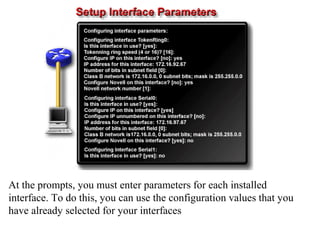
At the prompts, you must enter parameters for each installed
interface. To do this, you can use the configuration values that you
have already selected for your interfaces
You use the privileged EXEC command configure to enter global configuration
mode. When you enter this command, the EXEC prompts you for the source of the
configuration commands.
You can then specify the terminal, NVRAM, or a file stored on a network server as
the source.
The default is to type in commands from the terminal console. Pressing the Return
key begins this configuration method.
Global configuration
commands apply to
features that affect the
system as a whole.
At the prompts, you must enter parameters for each installed
interface. To do this, you can use the configuration values that you
have already selected for your interfaces
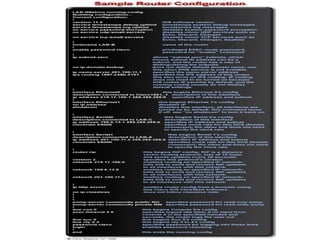
After a routing protocol is enabled by a global command, the router
configuration mode prompt Router (config-router)# is displayed.
Type a question mark (?) to list the routing protocol configuration sub-
commands.
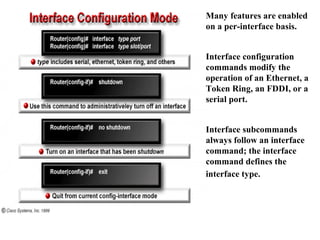
Many features are enabled
on a per-interface basis.
Interface configuration
commands modify the
operation of an Ethernet, a
Token Ring, an FDDI, or a
serial port.
Interface subcommands
always follow an interface
command; the interface
command defines the
interface type.
Basic Cisco Vishak Microsense

Basic Cisco Vishak Microsense

  • 1.
  • 2.
    Memakai Cisco Cisco dapatdikonfigurasi melalui 3 cara : • Console : menggunakan cable console yang dihubungkan melalui serial port dan menggunakan hyperterminal atau minicom • Telnet : melalui Jaringan, tetapi cara ini harus terlebih dahulu mengaktifkan IP address, Telnet login di Cisco device • AUX : dimana CISCO dihubungkan dengan modem, kemudian di remote akses melalui jalur PSTN
  • 3.
    Mode Prompt Pada perangkatCISCO terdapat 3 mode prompt • Usermode prompt : dimana ini merupakan awal login di perangkat CISCO (user biasa) • Privilegedmode prompt : pada mode ini dapat mencari informasi dari perangkat CISCO (user admin) • Configuremode prompt : pada mode ini dapat dilakukan perubahan terhadap perangkat CISCO, tetapi tidak bisa dilakukan pengambilan informasi (Super Admin)
  • 4.
    When you firstlog in to a router, you see a user mode prompt. These are a subset of the commands available at the privileged level. These commands allow you to display information without changing router configuration settings. At the ">" prompt, type "enable". At the "password" prompt, enter "enable secret password". Once you have completed these steps, your prompt will change to a # (pound sign) Privileged level you can also access the global configuration mode and the other configuration modes •interface •subinterface •line •router •route-map •several additional configuration modes To log out of the router, type exit.
  • 6.
    Use help tocheck the syntax for setting the clock. The help output shows that the set keyword is required Press Ctrl-P (or the up arrow key) to repeat the previous command entry automatically. The caret symbol (^) and help response indicate an error. To list the correct syntax
  • 7.
    Although enhanced editing mode is automatically enabled with thecurrent software release, you can disable it The dollar sign ($) indicates that the line has been scrolled to the left. Each time the cursor reaches the end of the line, the line is again shifted 10 spaces to the left.
  • 8.
    For many ofthe prompts in the system configuration dialog of the setup command facility, default answers appear in square brackets [] following the question. Press the Return key to use these defaults. If the system has been previously configured, the defaults that will appear will be the currently configured values. If you are configuring the system for the first time, the factory defaults will be provided. If there is no factory default, as in the case of passwords, nothing is displayed after the question One of the routines for initial configuration is the setup mode. The main purpose of the setup mode is to bring up, quickly, a minimal configuration for any router that cannot find its configuration from some other source.
  • 9.
    When the consoleprompt requests global parameters, use the configuration values that you have selected for your router. Whenever you answer yes to a prompt, additional questions may appear regarding the protocol.
  • 10.
    At the prompts,you must enter parameters for each installed interface. To do this, you can use the configuration values that you have already selected for your interfaces
  • 11.
    You use theprivileged EXEC command configure to enter global configuration mode. When you enter this command, the EXEC prompts you for the source of the configuration commands. You can then specify the terminal, NVRAM, or a file stored on a network server as the source. The default is to type in commands from the terminal console. Pressing the Return key begins this configuration method. Global configuration commands apply to features that affect the system as a whole.
  • 12.
    At the prompts,you must enter parameters for each installed interface. To do this, you can use the configuration values that you have already selected for your interfaces
  • 13.
    After a routingprotocol is enabled by a global command, the router configuration mode prompt Router (config-router)# is displayed. Type a question mark (?) to list the routing protocol configuration sub- commands.
  • 14.
    Many features areenabled on a per-interface basis. Interface configuration commands modify the operation of an Ethernet, a Token Ring, an FDDI, or a serial port. Interface subcommands always follow an interface command; the interface command defines the interface type.