Basic 8D Problem Solving:
Tools & Methods
- © 2015 -
A.R. Alvarez
ARA TRAINING
ARA TRAINING
ARA (Dec 2015)
Basic Problem Solving
ARA TRAINING
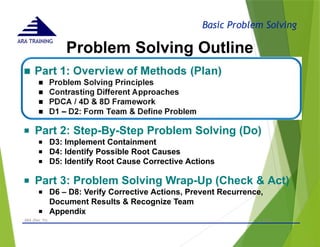
Problem Solving Outline
- © 2015 -
ARA (Dec 15) 2
■ Part 1: Overview of Methods (Plan)
■ Problem Solving Principles
■ Contrasting Different Approaches
■ PDCA / 4D & 8D Framework
■ D1 – D2: Form Team & Define Problem
■ Part 2: Step-By-Step Problem Solving (Do)
■ D3: Implement Containment
■ D4: Identify Possible Root Causes
■ D5: Identify Root Cause Corrective Actions
■ Part 3: Problem Solving Wrap-Up (Check & Act)
■ D6 – D8: Verify Corrective Actions, Prevent Recurrence,
Document Results & Recognize Team
■ Appendix
Basic Problem Solving
- © 2015 -
ARA (Dec 15) 3
ARA TRAINING
Methods For Problem Solving ?
Basic Problem Solving
ARA TRAINING
No One Way to Problem Solving
Success
- © 2015 -
ARA (Dec 15) 4
But Some Are Better Than Others
Good Ones Have Many Common
Elements
Basic Problem Solving
ARA TRAINING
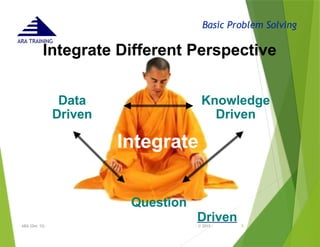
Integrate Different Perspective
Data
Driven
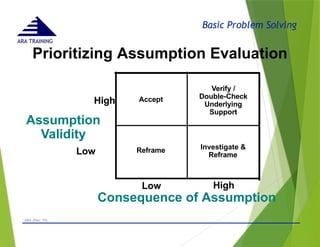
Knowledge
Driven
Question
Driven
Integrate
- © 2015 -
ARA (Dec 15) 5
Basic Problem Solving
- © 2015 -
ARA (Dec 15) 6
ARA TRAINING
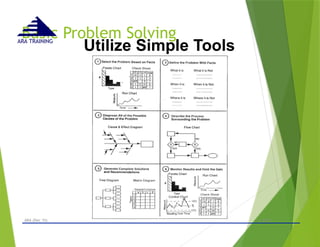
Utilize Simple Tools
Basic Problem Solving
ARA TRAINING
Ask & Answer Simple Questions
- © 2015 -
ARA (Dec 15) 7
■ What is The Problem?
■ Why is it a Problem?
■ What Are The Goals?
■ How Long Will it Take to Solve?
■ How Much Will it Cost to Solve?
Get Tracked & Managed Like a Project
Basic Problem Solving
ARA TRAINING
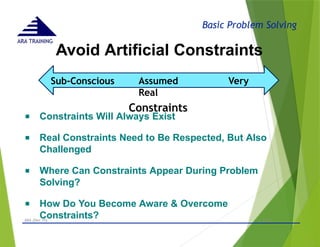
Avoid Artificial Constraints
- © 2015 -
ARA (Dec 15) 8
■ Constraints Will Always Exist
■ Real Constraints Need to Be Respected, But Also
Challenged
■ Where Can Constraints Appear During Problem
Solving?
■ How Do You Become Aware & Overcome
Constraints?
Sub-Conscious Assumed Very
Real
Constraints
Basic Problem Solving
ARA TRAINING
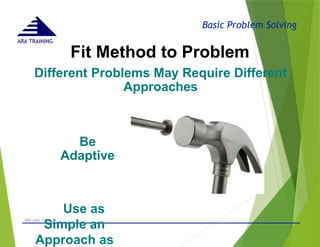
Fit Method to Problem
- © 2015 -
ARA (Dec 15) 9
Different Problems May Require Different
Approaches
Be
Adaptive
Use as
Simple an
Approach as
Basic Problem Solving
ARA TRAINING
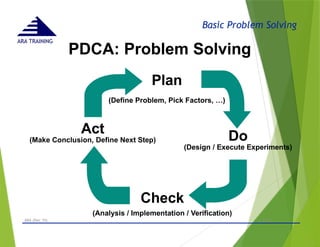
PDCA: Problem Solving
- © 2015 -
ARA (Dec 15) 10
Plan
(Define Problem, Pick Factors, …)
Do
(Design / Execute Experiments)
Check
(Analysis / Implementation / Verification)
Act
(Make Conclusion, Define Next Step)
Basic Problem Solving
ARA TRAINING
FOCUS Problem Solving Method
- © 2015 -
ARA (Dec 15) 11
■ Find the Problem (Often the Problem Finds You)
■ Organize a Team
■ Clarify Problem
■ Understand Problem
■ Select Solution
How is It Similar? How Different? How Complete?
http://www.mindtools.com/pages/article/focus-model.htm?utm_source=nl&utm_medium=email&utm_campaign=13May14#np
Basic Problem Solving
ARA TRAINING
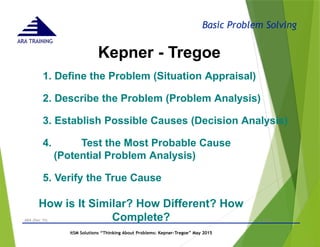
Kepner - Tregoe
- © 2015 -
ARA (Dec 15) 12
1. Define the Problem (Situation Appraisal)
2. Describe the Problem (Problem Analysis)
3. Establish Possible Causes (Decision Analysis)
4. Test the Most Probable Cause
(Potential Problem Analysis)
5. Verify the True Cause
How is It Similar? How Different? How
Complete?
itSM Solutions “Thinking About Problems: Kepner-Tregoe” May 2015
Basic Problem Solving
ARA TRAINING
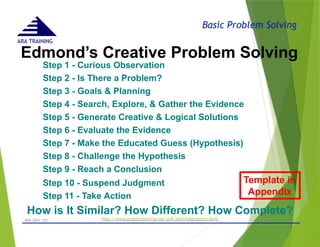
Edmond’s Creative Problem Solving
- © 2015 -
ARA (Dec 15) 13
Step 1 - Curious Observation
Step 2 - Is There a Problem?
Step 3 - Goals & Planning
Step 4 - Search, Explore, & Gather the Evidence
Step 5 - Generate Creative & Logical Solutions
Step 6 - Evaluate the Evidence
Step 7 - Make the Educated Guess (Hypothesis)
Step 8 - Challenge the Hypothesis
Step 9 - Reach a Conclusion
Step 10 - Suspend Judgment
Step 11 - Take Action
How is It Similar? How Different? How Complete?
http://www.problemsolving.net/ps9-3of4-fullproblem.html
Template in
Appendix
Basic Problem Solving
ARA TRAINING
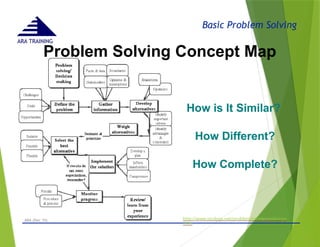
Problem Solving Concept Map
- © 2015 -
ARA (Dec 15) 14
How is It Similar?
How Different?
How Complete?
http://www.studygs.net/problem/problemsolvingo
.htm
Basic Problem Solving
ARA TRAINING
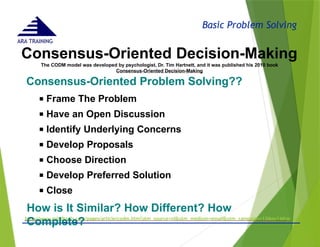
Consensus-Oriented Decision-Making
- © 2015 -
ARA (Dec 15) 15
http://www.mindtools.com/pages/article/codm.htm?utm_source=nl&utm_medium=email&utm_campaign=13May14#np
The CODM model was developed by psychologist, Dr. Tim Hartnett, and it was published his 2010 book
Consensus-Oriented Decision-Making
Consensus-Oriented Problem Solving??
■ Frame The Problem
■ Have an Open Discussion
■ Identify Underlying Concerns
■ Develop Proposals
■ Choose Direction
■ Develop Preferred Solution
■ Close
How is It Similar? How Different? How
Complete?
Basic Problem Solving
- © 2015 -
ARA (Dec 15)
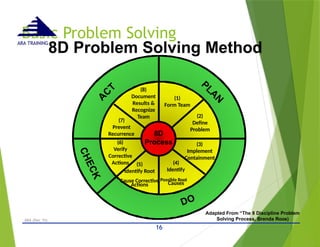
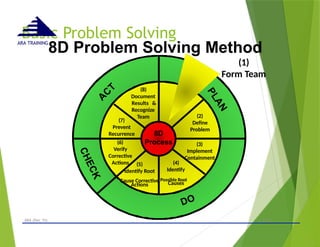
(4)
16
Identify
Causes
(3)
Implement
Containment
(2)
Define
Problem
(1)
Form Team
(7)
Prevent
Recurrence
(8)
Document
Results &
Recognize
Team
(5)
Identify Root
Cause Corrective Possible Root
Actions
(6)
Verify
Corrective
Actions
8D
Process
ARA TRAINING
8D Problem Solving Method
Adapted From “The 8 Discipline Problem
Solving Process, Brenda Roos)
Basic Problem Solving
ARA TRAINING
8D Problem Solving Method
- © 2015 -
ARA (Dec 15) 17
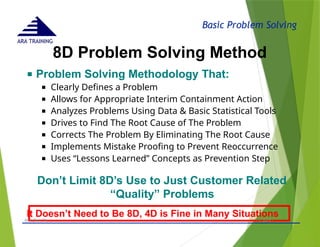
■ Problem Solving Methodology That:
■ Clearly Defines a Problem
■ Allows for Appropriate Interim Containment Action
■ Analyzes Problems Using Data & Basic Statistical Tools
■ Drives to Find The Root Cause of The Problem
■ Corrects The Problem By Eliminating The Root Cause
■ Implements Mistake Proofing to Prevent Reoccurrence
■ Uses “Lessons Learned” Concepts as Prevention Step
Don’t Limit 8D’s Use to Just Customer Related
“Quality” Problems
It Doesn’t Need to Be 8D, 4D is Fine in Many Situations
Basic Problem Solving
ARA
TRAINING
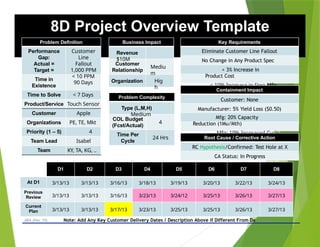
8D Project Overview Template
- © 2015 -
ARA (Dec 15) 18
Revenue
$10M
Mediu
m
Customer
Relationship
Organization Hig
h
D1 D2 D3 D4 D5 D6 D7 D8
At D1 3/13/13 3/13/13 3/16/13 3/18/13 3/19/13 3/20/13 3/22/13 3/24/13
Previous
Review 3/13/13 3/13/13 3/16/13 3/23/13 3/24/12 3/25/13 3/26/13 3/27/13
Current
Plan 3/13/13 3/13/13 3/17/13 3/23/13 3/25/13 3/25/13 3/26/13 3/27/13
Key Requirements
Eliminate Customer Line Fallout
No Change in Any Product Spec
< 3% Increase in
Product Cost
< 10% Increase in Step Mfg
Cycle Time
Problem Definition Business Impact
Customer
Line
Fallout
1,000 PPM
< 10 PPM
90 Days
Performance
Gap:
Actual =
Target =
Time in
Existence
Time to Solve
Product/Service
< 7 Days
Touch Sensor
Customer
Organizations
Priority (1 – 5)
Team Lead
Team
Apple
PE, TE, Mkt
4
Isabel
KY, TA, KG, ..
Problem Complexity
Type (L,M,H)
Medium
4
COL Budget
(Fcst/Actual)
Time Per
Cycle
24 Hrs
Containment Impact
Customer: None
Manufacturer: 5% Yield Loss ($0.50)
Mfg: 20% Capacity
Reduction (1Mu/Mth)
Mfg: 10% Increased Cycle
Time (6 Hrs)
Root Cause / Corrective Action
RC Hypothesis/Confirmed: Test Hole at X
CA Status: In Progress
Note: Add Any Key Customer Delivery Dates / Description Above if Different From Dx
Basic Problem Solving
ARA
TRAINING
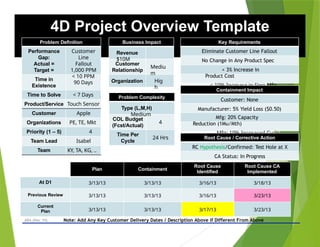
4D Project Overview Template
- © 2015 -
ARA (Dec 15) 19
Revenue
$10M
Mediu
m
Customer
Relationship
Organization Hig
h
Plan Containment
Root Cause
Identified
Root Cause CA
Implemented
At D1 3/13/13 3/13/13 3/16/13 3/18/13
Previous Review 3/13/13 3/13/13 3/16/13 3/23/13
Current
Plan 3/13/13 3/13/13 3/17/13 3/23/13
Key Requirements
Eliminate Customer Line Fallout
No Change in Any Product Spec
< 3% Increase in
Product Cost
< 10% Increase in Step Mfg
Cycle Time
Problem Definition Business Impact
Customer
Line
Fallout
1,000 PPM
< 10 PPM
90 Days
Performance
Gap:
Actual =
Target =
Time in
Existence
Time to Solve
Product/Service
< 7 Days
Touch Sensor
Customer
Organizations
Priority (1 – 5)
Team Lead
Team
Apple
PE, TE, Mkt
4
Isabel
KY, TA, KG, ..
Problem Complexity
Type (L,M,H)
Medium
4
COL Budget
(Fcst/Actual)
Time Per
Cycle
24 Hrs
Containment Impact
Customer: None
Manufacturer: 5% Yield Loss ($0.50)
Mfg: 20% Capacity
Reduction (1Mu/Mth)
Mfg: 10% Increased Cycle
Time (6 Hrs)
Root Cause / Corrective Action
RC Hypothesis/Confirmed: Test Hole at X
CA Status: In Progress
Note: Add Any Key Customer Delivery Dates / Description Above if Different From Above
Basic Problem Solving
- © 2015 -
ARA (Dec 15)
ARA TRAINING
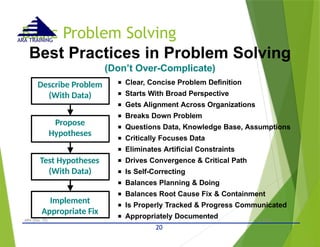
Best Practices in Problem Solving
(Don’t Over-Complicate)
■ Clear, Concise Problem Definition
■ Starts With Broad Perspective
■ Gets Alignment Across Organizations
■ Breaks Down Problem
■ Questions Data, Knowledge Base, Assumptions
■ Critically Focuses Data
■ Eliminates Artificial Constraints
■ Drives Convergence & Critical Path
■ Is Self-Correcting
■ Balances Planning & Doing
■ Balances Root Cause Fix & Containment
■ Is Properly Tracked & Progress Communicated
■ Appropriately Documented
Describe Problem
(With Data)
Propose
Hypotheses
Test Hypotheses
(With Data)
Implement
Appropriate Fix
20
Basic Problem Solving
- © 2015 -
ARA (Dec 15)
ARA TRAINING
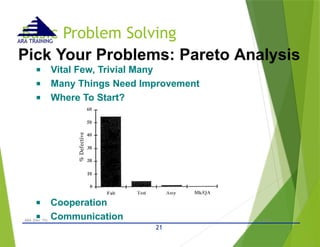
Pick Your Problems: Pareto Analysis
■ Vital Few, Trivial Many
■ Many Things Need Improvement
■ Where To Start?
■ Cooperation
■ Communication
21
Basic Problem Solving
- © 2015 -
ARA (Dec 15) 22
ARA TRAINING
Basic Problem Solving
ARA TRAINING
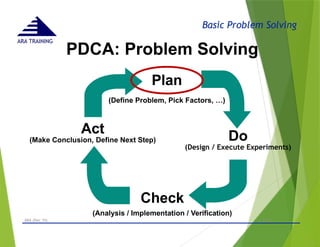
PDCA: Problem Solving
- © 2015 -
ARA (Dec 15) 23
Plan
(Define Problem, Pick Factors, …)
Do
(Design / Execute Experiments)
Check
(Analysis / Implementation / Verification)
Act
(Make Conclusion, Define Next Step)
Basic Problem Solving
- © 2015 -
ARA (Dec 15) 24
(3)
Implement
Containment
(2)
Define
Problem
(5)
Identify Root
Actions
8D
Process
(4)
Identify
Cause Corrective Possible Root
Causes
(6)
Verify
Corrective
Actions
(7)
Prevent
Recurrence
ARA TRAINING
8D Problem Solving Method
(1)
Form Team
(8)
Document
Results &
Recognize
Team
Basic Problem Solving
- © 2015 -
ARA (Dec 15) 25
ARA TRAINING
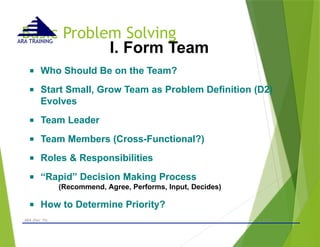
I. Form Team
■ Who Should Be on the Team?
■ Start Small, Grow Team as Problem Definition (D2)
Evolves
■ Team Leader
■ Team Members (Cross-Functional?)
■ Roles & Responsibilities
■ “Rapid” Decision Making Process
(Recommend, Agree, Performs, Input, Decides)
■ How to Determine Priority?
Basic Problem Solving
- © 2015 -
ARA (Dec 15) 26
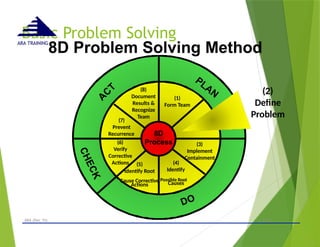
(3)
Implement
Containment
(2)
Define
Problem
(1)
Form Team
(5)
Identify Root
Actions
8D
Process
ARA TRAINING
8D Problem Solving Method
(4)
Identify
Cause Corrective Possible Root
Causes
(6)
Verify
Corrective
Actions
(7)
Prevent
Recurrence
(8)
Document
Results &
Recognize
Team
Basic Problem Solving
- © 2015 -
ARA (Dec 15) 27
ARA TRAINING
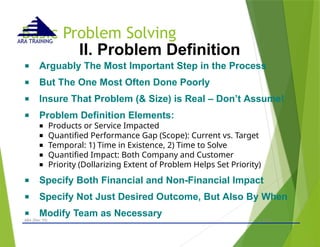
II. Problem Definition
■ Arguably The Most Important Step in the Process
■ But The One Most Often Done Poorly
■ Insure That Problem (& Size) is Real – Don’t Assume!
■ Problem Definition Elements:
■ Products or Service Impacted
■ Quantified Performance Gap (Scope): Current vs. Target
■ Temporal: 1) Time in Existence, 2) Time to Solve
■ Quantified Impact: Both Company and Customer
■ Priority (Dollarizing Extent of Problem Helps Set Priority)
■ Specify Both Financial and Non-Financial Impact
■ Specify Not Just Desired Outcome, But Also By When
■ Modify Team as Necessary
Basic Problem Solving
ARA TRAINING
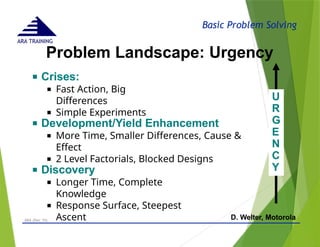
■ Crises:
■ Fast Action, Big
Differences
■ Simple Experiments
■ Development/Yield Enhancement
■ More Time, Smaller Differences, Cause &
Effect
■ 2 Level Factorials, Blocked Designs
■ Discovery
■ Longer Time, Complete
Knowledge
■ Response Surface, Steepest
Ascent
Problem Landscape: Urgency
- © 2015 -
ARA (Dec 15) 28
D. Welter, Motorola
U
R
G
E
N
C
Y
Basic Problem Solving
- © 2015 -
ARA (Dec 15) 29
ARA TRAINING
Problem Landscape: Assumptions
■ Assumptions Guide Behavior, Affect Thinking and
Therefore Problem Solving
■ Broad Categories: Casual, Prescriptive &
Paradigmatic
■ You Can’t Help But Make Assumptions; Dig Deep
Enough & You’ll Always Hit an Assumption
■ Implicit or Hidden Assumptions Abound
■ Some are Good, Even Necessary; Some Not So
Good
■ How to Uncover Assumptions?
■ How to Differentiate “Good” vs. “Bad”
Basic Problem Solving
ARA TRAINING
Problem Landscape: Data
- © 2015 -
ARA (Dec 15) 30
■ What Data Do You Need at This Stage?
■ What Do You Really Know? (Fact, Not Speculation)
■ How Much Data Do You Need?
■ How are You Going to Get It?
■ How Long is It Going to Take You to Get It?
Basic Problem Solving
ARA TRAINING
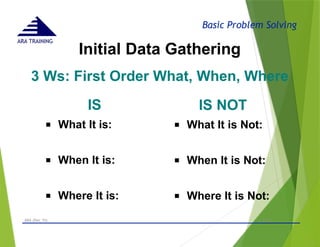
Initial Data Gathering
- © 2015 -
ARA (Dec 15) 31
IS
■ What It is:
■ When It is:
■ Where It is:
IS NOT
■ What It is Not:
■ When It is Not:
■ Where It is Not:
3 Ws: First Order What, When, Where
Basic Problem Solving
ARA TRAINING
Initial Data Gathering
- © 2015 -
ARA (Dec 15) 32
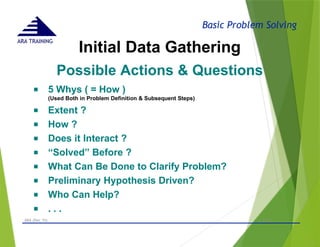
Possible Actions & Questions
■ 5 Whys ( = How )
(Used Both in Problem Definition & Subsequent Steps)
■ Extent ?
■ How ?
■ Does it Interact ?
■ “Solved” Before ?
■ What Can Be Done to Clarify Problem?
■ Preliminary Hypothesis Driven?
■ Who Can Help?
■ . . .
Basic Problem Solving
ARA TRAINING
Expanded Data Gathering
- © 2015 -
ARA (Dec 15) 33
Who
▪ Who is affected by the problem?
▪ Who first observed the problem?
▪ To whom was the problem
reported?
What
▪ What type of problem is it?
▪ What has the problem (part id, lot #s,
etc)?
▪ What is happening with the process?
▪ What changed?
▪ Do we have physical evidence of
problem?
Why
▪ Why is this a problem?
▪ Is the process stable (Or
Unstable)?
Who
▪ Who is not affected by the
problem?
▪ Who did not find the problem?
What
▪ What does not have the problem?
▪ What could be happening but is
not?
▪ What could be the problem but is
not?
Why
▪ Why is it not a problem?
After ABB 8D Worksheet
5 Ws . . . and . . . 2 Hs
(Who, What, Why, Where, When)
IS
(How Many, How Often)
IS NOT
Basic Problem Solving
ARA TRAINING
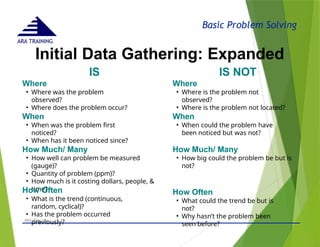
Initial Data Gathering: Expanded
- © 2015 -
ARA (Dec 15) 34
Where
▪ Where was the problem
observed?
▪ Where does the problem occur?
IS IS NOT
When
▪ When was the problem first
noticed?
▪ When has it been noticed since?
How Much/ Many
▪ How well can problem be measured
(gauge)?
▪ Quantity of problem (ppm)?
▪ How much is it costing dollars, people, &
time?
How Often
▪ What is the trend (continuous,
random, cyclical)?
▪ Has the problem occurred
previously?
Where
▪ Where is the problem not
observed?
▪ Where is the problem not located?
When
▪ When could the problem have
been noticed but was not?
How Much/ Many
▪ How big could the problem be but is
not?
How Often
▪ What could the trend be but is
not?
▪ Why hasn’t the problem been
seen before?
Basic Problem Solving
ARA TRAINING
Initial Data Gathering
- © 2015 -
ARA (Dec 15) 35
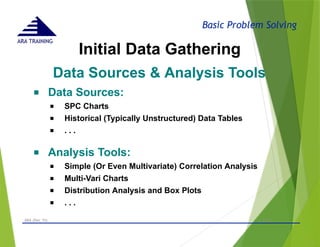
Data Sources & Analysis Tools
■ Data Sources:
■ SPC Charts
■ Historical (Typically Unstructured) Data Tables
■ . . .
■ Analysis Tools:
■ Simple (Or Even Multivariate) Correlation Analysis
■ Multi-Vari Charts
■ Distribution Analysis and Box Plots
■ . . .
Basic Problem Solving
- © 2015 -
ARA (Dec 15) 36
ARA TRAINING
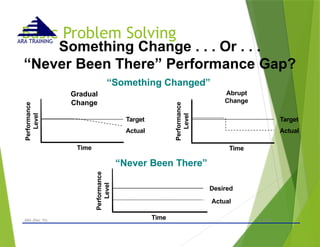
Something Change . . . Or . . .
“Never Been There” Performance Gap?
“Something Changed”
“Never Been There”
Time
Desired
Actual
Gradual
Change
Performance
Level
Time
Target
Actual
Abrupt
Change
Time
Performance
Level
Target
Actual
Performance
Level
Basic Problem Solving
- © 2015 -
ARA (Dec 15) 37
ARA TRAINING
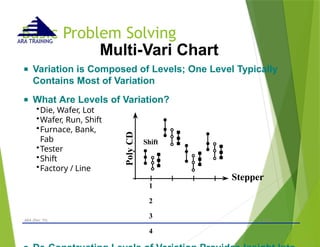
Multi-Vari Chart
■ Variation is Composed of Levels; One Level Typically
Contains Most of Variation
■ What Are Levels of Variation?
•Die, Wafer, Lot
•Wafer, Run, Shift
•Furnace, Bank,
Fab
•Tester
•Shift
•Factory / Line
Poly
CD
Shift
Stepper
1
2
3
4
Basic Problem Solving
ARA TRAINING
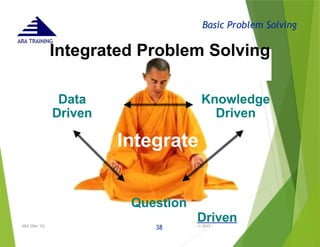
Integrated Problem Solving
Data
Driven
Knowledge
Driven
Question
Driven
Integrate
- © 2015 -
ARA (Dec 15)
38
Basic Problem Solving
ARA TRAINING
Data Driven: Good Data
- © 2015 -
ARA (Dec 15) 39
■ When is Data Bad ?
■ Under- vs. Over- Standing
■ Causality vs. Correlation
■ Data (Sample) Bias
■ Sufficiency
■ . . .
Don’t Take “Data” at Face Value
Basic Problem Solving
ARA TRAINING
Knowledge Driven: Good Knowledge
- © 2015 -
ARA (Dec 15) 40
■ When is Knowledge Bad ?
■ Under- vs. Over- Standing
■ Applicability
■ Capturing & Using Knowledge
■ . . .
Don’t Take “Knowledge” at Face Value
Basic Problem Solving
ARA TRAINING
Question Driven: Good Questions
- © 2015 - 41
After Dennis Matthies
ARA (Dec 15)
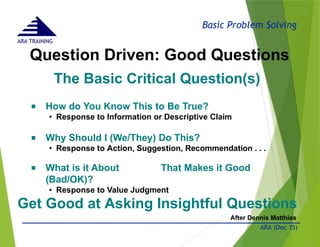
■ How do You Know This to Be True?
■ Response to Information or Descriptive Claim
■ Why Should I (We/They) Do This?
■ Response to Action, Suggestion, Recommendation . . .
■ What is it About That Makes it Good
(Bad/OK)?
■ Response to Value Judgment
The Basic Critical Question(s)
Get Good at Asking Insightful Questions
Basic Problem Solving
ARA TRAINING
Matthies’ PQ Basic 7 
8
- © 2015 - 42
After Dennis Matthies
ARA (Dec 15)
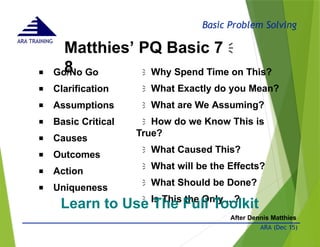
■ Go/No Go
■ Clarification
■ Assumptions
■ Basic Critical
■ Causes
■ Outcomes
■ Action
■ Uniqueness
 Why Spend Time on This?
 What Exactly do you Mean?
 What are We Assuming?
 How do we Know This is
True?
 What Caused This?
 What will be the Effects?
 What Should be Done?
 Is This the Only ...?
Learn to Use The Full Toolkit
Basic Problem Solving
ARA TRAINING
Argument Deconstruction
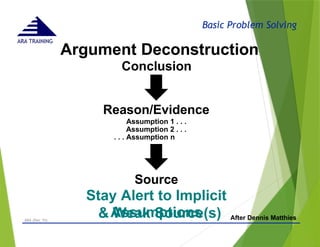
Conclusion
- © 2015 -
ARA (Dec 15) 43
Reason/Evidence
Assumption 1 . . .
Assumption 2 . . .
. . . Assumption n
Source
Stay Alert to Implicit
Assumptions
& Weak Source(s) After Dennis Matthies
Basic Problem Solving
- © 2015 -
ARA (Dec 15) 44
ARA TRAINING
Assumptions: Breaking Them Down
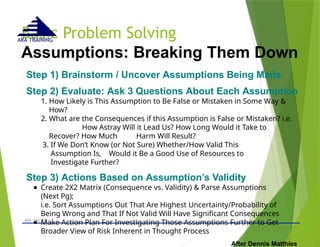
Step 1) Brainstorm / Uncover Assumptions Being Made
Step 2) Evaluate: Ask 3 Questions About Each Assumption
1. How Likely is This Assumption to Be False or Mistaken in Some Way &
How?
2. What are the Consequences if this Assumption is False or Mistaken? i.e.
How Astray Will it Lead Us? How Long Would it Take to
Recover? How Much Harm Will Result?
3. If We Don’t Know (or Not Sure) Whether/How Valid This
Assumption Is, Would it Be a Good Use of Resources to
Investigate Further?
Step 3) Actions Based on Assumption’s Validity
■ Create 2X2 Matrix (Consequence vs. Validity) & Parse Assumptions
(Next Pg);
i.e. Sort Assumptions Out That Are Highest Uncertainty/Probability of
Being Wrong and That If Not Valid Will Have Significant Consequences
■ Make Action Plan For Investigating Those Assumptions Further to Get
Broader View of Risk Inherent in Thought Process
After Dennis Matthies
Basic Problem Solving
ARA TRAINING
Prioritizing Assumption Evaluation
- © 2015 -
ARA (Dec 15) 45
Consequence of Assumption
Low High
High
Assumption
Validity
Low
Accept
Verify /
Double-Check
Underlying
Support
Reframe Investigate &
Reframe
Basic Problem Solving
ARA TRAINING
Assumptions: Basic Questions
- © 2015 - 46
Reference ??
ARA (Dec 15)
■ What Are You Assuming?
■ What is The Person Next to You Assuming?
■ What Inferences Are You Making From Your
Assumptions?
■ What Could Be Assumed Instead?
■ Why Would Someone Make This
Assumption?
Basic Problem Solving
ARA TRAINING
Assumptions: Sample Questions
- © 2015 - 47
■ You Seem to Be Assuming .
Do I Understand You Correctly?
■ Your Reasoning Depends on The Assumption
That . Why Have You Based Your
Reasoning on Instead of ?
■ What Background Information or Data Are
Your Assumptions Based On? Would
Knowing
Change Your Assumption in
Some Fashion?
Reference ??
ARA (Dec 15)
Basic Problem Solving
ARA TRAINING
Assumptions: Constraints
- © 2015 -
ARA (Dec 15) 48
■ Assumptions About Constraints Common
■ Sometimes They are Unconscious
■ Sometimes They are a Conscious Assumption
■ How Do You Uncover Them?
Basic Problem Solving
- © 2015 -
ARA (Dec 15) 49
ARA TRAINING
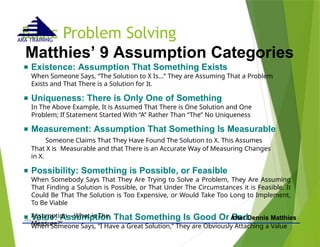
Matthies’ 9 Assumption Categories
■ Existence: Assumption That Something Exists
When Someone Says, “The Solution to X Is...” They are Assuming That a Problem
Exists and That There is a Solution for It.
■ Uniqueness: There is Only One of Something
In The Above Example, It is Assumed That There is One Solution and One
Problem; If Statement Started With “A” Rather Than “The” No Uniqueness
■ Measurement: Assumption That Something Is Measurable
Someone Claims That They Have Found The Solution to X. This Assumes
That X is Measurable and that There is an Accurate Way of Measuring Changes
in X.
■ Possibility: Something is Possible, or Feasible
When Somebody Says That They Are Trying to Solve a Problem, They Are Assuming
That Finding a Solution is Possible, or That Under The Circumstances it is Feasible. It
Could Be That The Solution is Too Expensive, or Would Take Too Long to Implement,
To Be Viable
■ Value: Assumption That Something Is Good Or Bad
When Someone Says, “I Have a Great Solution,” They are Obviously Attaching a Value
Assumption – What is The
Measure?”
After Dennis Matthies
Basic Problem Solving
- © 2015 -
ARA (Dec 15)
ARA TRAINING
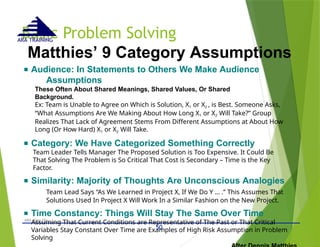
Matthies’ 9 Category Assumptions
■ Audience: In Statements to Others We Make Audience
Assumptions
These Often About Shared Meanings, Shared Values, Or Shared
Background.
Ex: Team is Unable to Agree on Which is Solution, X1 or X2 , is Best. Someone Asks,
“What Assumptions Are We Making About How Long X1 or X2 Will Take?” Group
Realizes That Lack of Agreement Stems From Different Assumptions at About How
Long (Or How Hard) X1 or X2 Will Take.
■ Category: We Have Categorized Something Correctly
Team Leader Tells Manager The Proposed Solution is Too Expensive. It Could Be
That Solving The Problem is So Critical That Cost is Secondary – Time is the Key
Factor.
■ Similarity: Majority of Thoughts Are Unconscious Analogies
Team Lead Says “As We Learned in Project X, If We Do Y … .” This Assumes That
Solutions Used In Project X Will Work In a Similar Fashion on the New Project.
■ Time Constancy: Things Will Stay The Same Over Time
Assuming That Current Conditions are Representative of The Past or That Critical
Variables Stay Constant Over Time are Examples of High Risk Assumption in Problem
Solving
50
Basic Problem Solving
ARA TRAINING
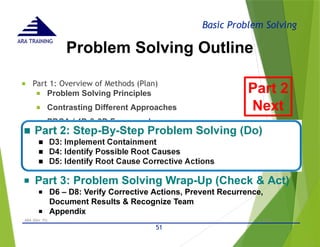
Problem Solving Outline
■ Part 1: Overview of Methods (Plan)
■ Problem Solving Principles
■ Contrasting Different Approaches
■ PDCA / 4D & 8D Framework
■ D1 – D2: Form Team & Define Problem
- © 2015 -
ARA (Dec 15)
■ Part 2: Step-By-Step Problem Solving (Do)
■ D3: Implement Containment
■ D4: Identify Possible Root Causes
■ D5: Identify Root Cause Corrective Actions
■ Part 3: Problem Solving Wrap-Up (Check & Act)
■ D6 – D8: Verify Corrective Actions, Prevent Recurrence,
Document Results & Recognize Team
■ Appendix
Part 2
Next
51
Basic Problem Solving
- © 2015 -
ARA (Dec 15)
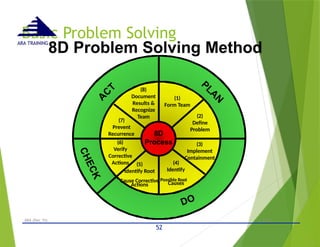
(4)
52
Identify
Causes
(3)
Implement
Containment
(2)
Define
Problem
(1)
Form Team
(7)
Prevent
Recurrence
(8)
Document
Results &
Recognize
Team
(5)
Identify Root
Cause Corrective Possible Root
Actions
(6)
Verify
Corrective
Actions
8D
Process
ARA TRAINING
8D Problem Solving Method

basic 8d problem solving tools methods.pptx

  • 1.
    Basic 8D ProblemSolving: Tools & Methods - © 2015 - A.R. Alvarez ARA TRAINING ARA TRAINING ARA (Dec 2015)
  • 2.
    Basic Problem Solving ARATRAINING Problem Solving Outline - © 2015 - ARA (Dec 15) 2 ■ Part 1: Overview of Methods (Plan) ■ Problem Solving Principles ■ Contrasting Different Approaches ■ PDCA / 4D & 8D Framework ■ D1 – D2: Form Team & Define Problem ■ Part 2: Step-By-Step Problem Solving (Do) ■ D3: Implement Containment ■ D4: Identify Possible Root Causes ■ D5: Identify Root Cause Corrective Actions ■ Part 3: Problem Solving Wrap-Up (Check & Act) ■ D6 – D8: Verify Corrective Actions, Prevent Recurrence, Document Results & Recognize Team ■ Appendix
  • 3.
    Basic Problem Solving -© 2015 - ARA (Dec 15) 3 ARA TRAINING Methods For Problem Solving ?
  • 4.
    Basic Problem Solving ARATRAINING No One Way to Problem Solving Success - © 2015 - ARA (Dec 15) 4 But Some Are Better Than Others Good Ones Have Many Common Elements
  • 5.
    Basic Problem Solving ARATRAINING Integrate Different Perspective Data Driven Knowledge Driven Question Driven Integrate - © 2015 - ARA (Dec 15) 5
  • 6.
    Basic Problem Solving -© 2015 - ARA (Dec 15) 6 ARA TRAINING Utilize Simple Tools
  • 7.
    Basic Problem Solving ARATRAINING Ask & Answer Simple Questions - © 2015 - ARA (Dec 15) 7 ■ What is The Problem? ■ Why is it a Problem? ■ What Are The Goals? ■ How Long Will it Take to Solve? ■ How Much Will it Cost to Solve? Get Tracked & Managed Like a Project
  • 8.
    Basic Problem Solving ARATRAINING Avoid Artificial Constraints - © 2015 - ARA (Dec 15) 8 ■ Constraints Will Always Exist ■ Real Constraints Need to Be Respected, But Also Challenged ■ Where Can Constraints Appear During Problem Solving? ■ How Do You Become Aware & Overcome Constraints? Sub-Conscious Assumed Very Real Constraints
  • 9.
    Basic Problem Solving ARATRAINING Fit Method to Problem - © 2015 - ARA (Dec 15) 9 Different Problems May Require Different Approaches Be Adaptive Use as Simple an Approach as
  • 10.
    Basic Problem Solving ARATRAINING PDCA: Problem Solving - © 2015 - ARA (Dec 15) 10 Plan (Define Problem, Pick Factors, …) Do (Design / Execute Experiments) Check (Analysis / Implementation / Verification) Act (Make Conclusion, Define Next Step)
  • 11.
    Basic Problem Solving ARATRAINING FOCUS Problem Solving Method - © 2015 - ARA (Dec 15) 11 ■ Find the Problem (Often the Problem Finds You) ■ Organize a Team ■ Clarify Problem ■ Understand Problem ■ Select Solution How is It Similar? How Different? How Complete? http://www.mindtools.com/pages/article/focus-model.htm?utm_source=nl&utm_medium=email&utm_campaign=13May14#np
  • 12.
    Basic Problem Solving ARATRAINING Kepner - Tregoe - © 2015 - ARA (Dec 15) 12 1. Define the Problem (Situation Appraisal) 2. Describe the Problem (Problem Analysis) 3. Establish Possible Causes (Decision Analysis) 4. Test the Most Probable Cause (Potential Problem Analysis) 5. Verify the True Cause How is It Similar? How Different? How Complete? itSM Solutions “Thinking About Problems: Kepner-Tregoe” May 2015
  • 13.
    Basic Problem Solving ARATRAINING Edmond’s Creative Problem Solving - © 2015 - ARA (Dec 15) 13 Step 1 - Curious Observation Step 2 - Is There a Problem? Step 3 - Goals & Planning Step 4 - Search, Explore, & Gather the Evidence Step 5 - Generate Creative & Logical Solutions Step 6 - Evaluate the Evidence Step 7 - Make the Educated Guess (Hypothesis) Step 8 - Challenge the Hypothesis Step 9 - Reach a Conclusion Step 10 - Suspend Judgment Step 11 - Take Action How is It Similar? How Different? How Complete? http://www.problemsolving.net/ps9-3of4-fullproblem.html Template in Appendix
  • 14.
    Basic Problem Solving ARATRAINING Problem Solving Concept Map - © 2015 - ARA (Dec 15) 14 How is It Similar? How Different? How Complete? http://www.studygs.net/problem/problemsolvingo .htm
  • 15.
    Basic Problem Solving ARATRAINING Consensus-Oriented Decision-Making - © 2015 - ARA (Dec 15) 15 http://www.mindtools.com/pages/article/codm.htm?utm_source=nl&utm_medium=email&utm_campaign=13May14#np The CODM model was developed by psychologist, Dr. Tim Hartnett, and it was published his 2010 book Consensus-Oriented Decision-Making Consensus-Oriented Problem Solving?? ■ Frame The Problem ■ Have an Open Discussion ■ Identify Underlying Concerns ■ Develop Proposals ■ Choose Direction ■ Develop Preferred Solution ■ Close How is It Similar? How Different? How Complete?
  • 16.
    Basic Problem Solving -© 2015 - ARA (Dec 15) (4) 16 Identify Causes (3) Implement Containment (2) Define Problem (1) Form Team (7) Prevent Recurrence (8) Document Results & Recognize Team (5) Identify Root Cause Corrective Possible Root Actions (6) Verify Corrective Actions 8D Process ARA TRAINING 8D Problem Solving Method Adapted From “The 8 Discipline Problem Solving Process, Brenda Roos)
  • 17.
    Basic Problem Solving ARATRAINING 8D Problem Solving Method - © 2015 - ARA (Dec 15) 17 ■ Problem Solving Methodology That: ■ Clearly Defines a Problem ■ Allows for Appropriate Interim Containment Action ■ Analyzes Problems Using Data & Basic Statistical Tools ■ Drives to Find The Root Cause of The Problem ■ Corrects The Problem By Eliminating The Root Cause ■ Implements Mistake Proofing to Prevent Reoccurrence ■ Uses “Lessons Learned” Concepts as Prevention Step Don’t Limit 8D’s Use to Just Customer Related “Quality” Problems It Doesn’t Need to Be 8D, 4D is Fine in Many Situations
  • 18.
    Basic Problem Solving ARA TRAINING 8DProject Overview Template - © 2015 - ARA (Dec 15) 18 Revenue $10M Mediu m Customer Relationship Organization Hig h D1 D2 D3 D4 D5 D6 D7 D8 At D1 3/13/13 3/13/13 3/16/13 3/18/13 3/19/13 3/20/13 3/22/13 3/24/13 Previous Review 3/13/13 3/13/13 3/16/13 3/23/13 3/24/12 3/25/13 3/26/13 3/27/13 Current Plan 3/13/13 3/13/13 3/17/13 3/23/13 3/25/13 3/25/13 3/26/13 3/27/13 Key Requirements Eliminate Customer Line Fallout No Change in Any Product Spec < 3% Increase in Product Cost < 10% Increase in Step Mfg Cycle Time Problem Definition Business Impact Customer Line Fallout 1,000 PPM < 10 PPM 90 Days Performance Gap: Actual = Target = Time in Existence Time to Solve Product/Service < 7 Days Touch Sensor Customer Organizations Priority (1 – 5) Team Lead Team Apple PE, TE, Mkt 4 Isabel KY, TA, KG, .. Problem Complexity Type (L,M,H) Medium 4 COL Budget (Fcst/Actual) Time Per Cycle 24 Hrs Containment Impact Customer: None Manufacturer: 5% Yield Loss ($0.50) Mfg: 20% Capacity Reduction (1Mu/Mth) Mfg: 10% Increased Cycle Time (6 Hrs) Root Cause / Corrective Action RC Hypothesis/Confirmed: Test Hole at X CA Status: In Progress Note: Add Any Key Customer Delivery Dates / Description Above if Different From Dx
  • 19.
    Basic Problem Solving ARA TRAINING 4DProject Overview Template - © 2015 - ARA (Dec 15) 19 Revenue $10M Mediu m Customer Relationship Organization Hig h Plan Containment Root Cause Identified Root Cause CA Implemented At D1 3/13/13 3/13/13 3/16/13 3/18/13 Previous Review 3/13/13 3/13/13 3/16/13 3/23/13 Current Plan 3/13/13 3/13/13 3/17/13 3/23/13 Key Requirements Eliminate Customer Line Fallout No Change in Any Product Spec < 3% Increase in Product Cost < 10% Increase in Step Mfg Cycle Time Problem Definition Business Impact Customer Line Fallout 1,000 PPM < 10 PPM 90 Days Performance Gap: Actual = Target = Time in Existence Time to Solve Product/Service < 7 Days Touch Sensor Customer Organizations Priority (1 – 5) Team Lead Team Apple PE, TE, Mkt 4 Isabel KY, TA, KG, .. Problem Complexity Type (L,M,H) Medium 4 COL Budget (Fcst/Actual) Time Per Cycle 24 Hrs Containment Impact Customer: None Manufacturer: 5% Yield Loss ($0.50) Mfg: 20% Capacity Reduction (1Mu/Mth) Mfg: 10% Increased Cycle Time (6 Hrs) Root Cause / Corrective Action RC Hypothesis/Confirmed: Test Hole at X CA Status: In Progress Note: Add Any Key Customer Delivery Dates / Description Above if Different From Above
  • 20.
    Basic Problem Solving -© 2015 - ARA (Dec 15) ARA TRAINING Best Practices in Problem Solving (Don’t Over-Complicate) ■ Clear, Concise Problem Definition ■ Starts With Broad Perspective ■ Gets Alignment Across Organizations ■ Breaks Down Problem ■ Questions Data, Knowledge Base, Assumptions ■ Critically Focuses Data ■ Eliminates Artificial Constraints ■ Drives Convergence & Critical Path ■ Is Self-Correcting ■ Balances Planning & Doing ■ Balances Root Cause Fix & Containment ■ Is Properly Tracked & Progress Communicated ■ Appropriately Documented Describe Problem (With Data) Propose Hypotheses Test Hypotheses (With Data) Implement Appropriate Fix 20
  • 21.
    Basic Problem Solving -© 2015 - ARA (Dec 15) ARA TRAINING Pick Your Problems: Pareto Analysis ■ Vital Few, Trivial Many ■ Many Things Need Improvement ■ Where To Start? ■ Cooperation ■ Communication 21
  • 22.
    Basic Problem Solving -© 2015 - ARA (Dec 15) 22 ARA TRAINING
  • 23.
    Basic Problem Solving ARATRAINING PDCA: Problem Solving - © 2015 - ARA (Dec 15) 23 Plan (Define Problem, Pick Factors, …) Do (Design / Execute Experiments) Check (Analysis / Implementation / Verification) Act (Make Conclusion, Define Next Step)
  • 24.
    Basic Problem Solving -© 2015 - ARA (Dec 15) 24 (3) Implement Containment (2) Define Problem (5) Identify Root Actions 8D Process (4) Identify Cause Corrective Possible Root Causes (6) Verify Corrective Actions (7) Prevent Recurrence ARA TRAINING 8D Problem Solving Method (1) Form Team (8) Document Results & Recognize Team
  • 25.
    Basic Problem Solving -© 2015 - ARA (Dec 15) 25 ARA TRAINING I. Form Team ■ Who Should Be on the Team? ■ Start Small, Grow Team as Problem Definition (D2) Evolves ■ Team Leader ■ Team Members (Cross-Functional?) ■ Roles & Responsibilities ■ “Rapid” Decision Making Process (Recommend, Agree, Performs, Input, Decides) ■ How to Determine Priority?
  • 26.
    Basic Problem Solving -© 2015 - ARA (Dec 15) 26 (3) Implement Containment (2) Define Problem (1) Form Team (5) Identify Root Actions 8D Process ARA TRAINING 8D Problem Solving Method (4) Identify Cause Corrective Possible Root Causes (6) Verify Corrective Actions (7) Prevent Recurrence (8) Document Results & Recognize Team
  • 27.
    Basic Problem Solving -© 2015 - ARA (Dec 15) 27 ARA TRAINING II. Problem Definition ■ Arguably The Most Important Step in the Process ■ But The One Most Often Done Poorly ■ Insure That Problem (& Size) is Real – Don’t Assume! ■ Problem Definition Elements: ■ Products or Service Impacted ■ Quantified Performance Gap (Scope): Current vs. Target ■ Temporal: 1) Time in Existence, 2) Time to Solve ■ Quantified Impact: Both Company and Customer ■ Priority (Dollarizing Extent of Problem Helps Set Priority) ■ Specify Both Financial and Non-Financial Impact ■ Specify Not Just Desired Outcome, But Also By When ■ Modify Team as Necessary
  • 28.
    Basic Problem Solving ARATRAINING ■ Crises: ■ Fast Action, Big Differences ■ Simple Experiments ■ Development/Yield Enhancement ■ More Time, Smaller Differences, Cause & Effect ■ 2 Level Factorials, Blocked Designs ■ Discovery ■ Longer Time, Complete Knowledge ■ Response Surface, Steepest Ascent Problem Landscape: Urgency - © 2015 - ARA (Dec 15) 28 D. Welter, Motorola U R G E N C Y
  • 29.
    Basic Problem Solving -© 2015 - ARA (Dec 15) 29 ARA TRAINING Problem Landscape: Assumptions ■ Assumptions Guide Behavior, Affect Thinking and Therefore Problem Solving ■ Broad Categories: Casual, Prescriptive & Paradigmatic ■ You Can’t Help But Make Assumptions; Dig Deep Enough & You’ll Always Hit an Assumption ■ Implicit or Hidden Assumptions Abound ■ Some are Good, Even Necessary; Some Not So Good ■ How to Uncover Assumptions? ■ How to Differentiate “Good” vs. “Bad”
  • 30.
    Basic Problem Solving ARATRAINING Problem Landscape: Data - © 2015 - ARA (Dec 15) 30 ■ What Data Do You Need at This Stage? ■ What Do You Really Know? (Fact, Not Speculation) ■ How Much Data Do You Need? ■ How are You Going to Get It? ■ How Long is It Going to Take You to Get It?
  • 31.
    Basic Problem Solving ARATRAINING Initial Data Gathering - © 2015 - ARA (Dec 15) 31 IS ■ What It is: ■ When It is: ■ Where It is: IS NOT ■ What It is Not: ■ When It is Not: ■ Where It is Not: 3 Ws: First Order What, When, Where
  • 32.
    Basic Problem Solving ARATRAINING Initial Data Gathering - © 2015 - ARA (Dec 15) 32 Possible Actions & Questions ■ 5 Whys ( = How ) (Used Both in Problem Definition & Subsequent Steps) ■ Extent ? ■ How ? ■ Does it Interact ? ■ “Solved” Before ? ■ What Can Be Done to Clarify Problem? ■ Preliminary Hypothesis Driven? ■ Who Can Help? ■ . . .
  • 33.
    Basic Problem Solving ARATRAINING Expanded Data Gathering - © 2015 - ARA (Dec 15) 33 Who ▪ Who is affected by the problem? ▪ Who first observed the problem? ▪ To whom was the problem reported? What ▪ What type of problem is it? ▪ What has the problem (part id, lot #s, etc)? ▪ What is happening with the process? ▪ What changed? ▪ Do we have physical evidence of problem? Why ▪ Why is this a problem? ▪ Is the process stable (Or Unstable)? Who ▪ Who is not affected by the problem? ▪ Who did not find the problem? What ▪ What does not have the problem? ▪ What could be happening but is not? ▪ What could be the problem but is not? Why ▪ Why is it not a problem? After ABB 8D Worksheet 5 Ws . . . and . . . 2 Hs (Who, What, Why, Where, When) IS (How Many, How Often) IS NOT
  • 34.
    Basic Problem Solving ARATRAINING Initial Data Gathering: Expanded - © 2015 - ARA (Dec 15) 34 Where ▪ Where was the problem observed? ▪ Where does the problem occur? IS IS NOT When ▪ When was the problem first noticed? ▪ When has it been noticed since? How Much/ Many ▪ How well can problem be measured (gauge)? ▪ Quantity of problem (ppm)? ▪ How much is it costing dollars, people, & time? How Often ▪ What is the trend (continuous, random, cyclical)? ▪ Has the problem occurred previously? Where ▪ Where is the problem not observed? ▪ Where is the problem not located? When ▪ When could the problem have been noticed but was not? How Much/ Many ▪ How big could the problem be but is not? How Often ▪ What could the trend be but is not? ▪ Why hasn’t the problem been seen before?
  • 35.
    Basic Problem Solving ARATRAINING Initial Data Gathering - © 2015 - ARA (Dec 15) 35 Data Sources & Analysis Tools ■ Data Sources: ■ SPC Charts ■ Historical (Typically Unstructured) Data Tables ■ . . . ■ Analysis Tools: ■ Simple (Or Even Multivariate) Correlation Analysis ■ Multi-Vari Charts ■ Distribution Analysis and Box Plots ■ . . .
  • 36.
    Basic Problem Solving -© 2015 - ARA (Dec 15) 36 ARA TRAINING Something Change . . . Or . . . “Never Been There” Performance Gap? “Something Changed” “Never Been There” Time Desired Actual Gradual Change Performance Level Time Target Actual Abrupt Change Time Performance Level Target Actual Performance Level
  • 37.
    Basic Problem Solving -© 2015 - ARA (Dec 15) 37 ARA TRAINING Multi-Vari Chart ■ Variation is Composed of Levels; One Level Typically Contains Most of Variation ■ What Are Levels of Variation? •Die, Wafer, Lot •Wafer, Run, Shift •Furnace, Bank, Fab •Tester •Shift •Factory / Line Poly CD Shift Stepper 1 2 3 4
  • 38.
    Basic Problem Solving ARATRAINING Integrated Problem Solving Data Driven Knowledge Driven Question Driven Integrate - © 2015 - ARA (Dec 15) 38
  • 39.
    Basic Problem Solving ARATRAINING Data Driven: Good Data - © 2015 - ARA (Dec 15) 39 ■ When is Data Bad ? ■ Under- vs. Over- Standing ■ Causality vs. Correlation ■ Data (Sample) Bias ■ Sufficiency ■ . . . Don’t Take “Data” at Face Value
  • 40.
    Basic Problem Solving ARATRAINING Knowledge Driven: Good Knowledge - © 2015 - ARA (Dec 15) 40 ■ When is Knowledge Bad ? ■ Under- vs. Over- Standing ■ Applicability ■ Capturing & Using Knowledge ■ . . . Don’t Take “Knowledge” at Face Value
  • 41.
    Basic Problem Solving ARATRAINING Question Driven: Good Questions - © 2015 - 41 After Dennis Matthies ARA (Dec 15) ■ How do You Know This to Be True? ■ Response to Information or Descriptive Claim ■ Why Should I (We/They) Do This? ■ Response to Action, Suggestion, Recommendation . . . ■ What is it About That Makes it Good (Bad/OK)? ■ Response to Value Judgment The Basic Critical Question(s) Get Good at Asking Insightful Questions
  • 42.
    Basic Problem Solving ARATRAINING Matthies’ PQ Basic 7  8 - © 2015 - 42 After Dennis Matthies ARA (Dec 15) ■ Go/No Go ■ Clarification ■ Assumptions ■ Basic Critical ■ Causes ■ Outcomes ■ Action ■ Uniqueness  Why Spend Time on This?  What Exactly do you Mean?  What are We Assuming?  How do we Know This is True?  What Caused This?  What will be the Effects?  What Should be Done?  Is This the Only ...? Learn to Use The Full Toolkit
  • 43.
    Basic Problem Solving ARATRAINING Argument Deconstruction Conclusion - © 2015 - ARA (Dec 15) 43 Reason/Evidence Assumption 1 . . . Assumption 2 . . . . . . Assumption n Source Stay Alert to Implicit Assumptions & Weak Source(s) After Dennis Matthies
  • 44.
    Basic Problem Solving -© 2015 - ARA (Dec 15) 44 ARA TRAINING Assumptions: Breaking Them Down Step 1) Brainstorm / Uncover Assumptions Being Made Step 2) Evaluate: Ask 3 Questions About Each Assumption 1. How Likely is This Assumption to Be False or Mistaken in Some Way & How? 2. What are the Consequences if this Assumption is False or Mistaken? i.e. How Astray Will it Lead Us? How Long Would it Take to Recover? How Much Harm Will Result? 3. If We Don’t Know (or Not Sure) Whether/How Valid This Assumption Is, Would it Be a Good Use of Resources to Investigate Further? Step 3) Actions Based on Assumption’s Validity ■ Create 2X2 Matrix (Consequence vs. Validity) & Parse Assumptions (Next Pg); i.e. Sort Assumptions Out That Are Highest Uncertainty/Probability of Being Wrong and That If Not Valid Will Have Significant Consequences ■ Make Action Plan For Investigating Those Assumptions Further to Get Broader View of Risk Inherent in Thought Process After Dennis Matthies
  • 45.
    Basic Problem Solving ARATRAINING Prioritizing Assumption Evaluation - © 2015 - ARA (Dec 15) 45 Consequence of Assumption Low High High Assumption Validity Low Accept Verify / Double-Check Underlying Support Reframe Investigate & Reframe
  • 46.
    Basic Problem Solving ARATRAINING Assumptions: Basic Questions - © 2015 - 46 Reference ?? ARA (Dec 15) ■ What Are You Assuming? ■ What is The Person Next to You Assuming? ■ What Inferences Are You Making From Your Assumptions? ■ What Could Be Assumed Instead? ■ Why Would Someone Make This Assumption?
  • 47.
    Basic Problem Solving ARATRAINING Assumptions: Sample Questions - © 2015 - 47 ■ You Seem to Be Assuming . Do I Understand You Correctly? ■ Your Reasoning Depends on The Assumption That . Why Have You Based Your Reasoning on Instead of ? ■ What Background Information or Data Are Your Assumptions Based On? Would Knowing Change Your Assumption in Some Fashion? Reference ?? ARA (Dec 15)
  • 48.
    Basic Problem Solving ARATRAINING Assumptions: Constraints - © 2015 - ARA (Dec 15) 48 ■ Assumptions About Constraints Common ■ Sometimes They are Unconscious ■ Sometimes They are a Conscious Assumption ■ How Do You Uncover Them?
  • 49.
    Basic Problem Solving -© 2015 - ARA (Dec 15) 49 ARA TRAINING Matthies’ 9 Assumption Categories ■ Existence: Assumption That Something Exists When Someone Says, “The Solution to X Is...” They are Assuming That a Problem Exists and That There is a Solution for It. ■ Uniqueness: There is Only One of Something In The Above Example, It is Assumed That There is One Solution and One Problem; If Statement Started With “A” Rather Than “The” No Uniqueness ■ Measurement: Assumption That Something Is Measurable Someone Claims That They Have Found The Solution to X. This Assumes That X is Measurable and that There is an Accurate Way of Measuring Changes in X. ■ Possibility: Something is Possible, or Feasible When Somebody Says That They Are Trying to Solve a Problem, They Are Assuming That Finding a Solution is Possible, or That Under The Circumstances it is Feasible. It Could Be That The Solution is Too Expensive, or Would Take Too Long to Implement, To Be Viable ■ Value: Assumption That Something Is Good Or Bad When Someone Says, “I Have a Great Solution,” They are Obviously Attaching a Value Assumption – What is The Measure?” After Dennis Matthies
  • 50.
    Basic Problem Solving -© 2015 - ARA (Dec 15) ARA TRAINING Matthies’ 9 Category Assumptions ■ Audience: In Statements to Others We Make Audience Assumptions These Often About Shared Meanings, Shared Values, Or Shared Background. Ex: Team is Unable to Agree on Which is Solution, X1 or X2 , is Best. Someone Asks, “What Assumptions Are We Making About How Long X1 or X2 Will Take?” Group Realizes That Lack of Agreement Stems From Different Assumptions at About How Long (Or How Hard) X1 or X2 Will Take. ■ Category: We Have Categorized Something Correctly Team Leader Tells Manager The Proposed Solution is Too Expensive. It Could Be That Solving The Problem is So Critical That Cost is Secondary – Time is the Key Factor. ■ Similarity: Majority of Thoughts Are Unconscious Analogies Team Lead Says “As We Learned in Project X, If We Do Y … .” This Assumes That Solutions Used In Project X Will Work In a Similar Fashion on the New Project. ■ Time Constancy: Things Will Stay The Same Over Time Assuming That Current Conditions are Representative of The Past or That Critical Variables Stay Constant Over Time are Examples of High Risk Assumption in Problem Solving 50
  • 51.
    Basic Problem Solving ARATRAINING Problem Solving Outline ■ Part 1: Overview of Methods (Plan) ■ Problem Solving Principles ■ Contrasting Different Approaches ■ PDCA / 4D & 8D Framework ■ D1 – D2: Form Team & Define Problem - © 2015 - ARA (Dec 15) ■ Part 2: Step-By-Step Problem Solving (Do) ■ D3: Implement Containment ■ D4: Identify Possible Root Causes ■ D5: Identify Root Cause Corrective Actions ■ Part 3: Problem Solving Wrap-Up (Check & Act) ■ D6 – D8: Verify Corrective Actions, Prevent Recurrence, Document Results & Recognize Team ■ Appendix Part 2 Next 51
  • 52.
    Basic Problem Solving -© 2015 - ARA (Dec 15) (4) 52 Identify Causes (3) Implement Containment (2) Define Problem (1) Form Team (7) Prevent Recurrence (8) Document Results & Recognize Team (5) Identify Root Cause Corrective Possible Root Actions (6) Verify Corrective Actions 8D Process ARA TRAINING 8D Problem Solving Method