Introduction to financial
management
Dr.Jayashree R. Kotnal
Asst. Professor & Head, M.Com Programme
SBS Arts & Commerce College for Women
Vijayapur
Key concepts and skills
• Have a good understanding of the:
– basic types of financial management decisions
and the role of the financial manager
– goal of financial management
– financial implications of the different forms of
business organisation
– conflicts of interest that can arise between
managers and owners
1-2
Chapter outline
• Finance: A quick look
• Business finance and the financial manager
• Forms of business organisation
• The goal of financial management
• The agency problem and control of the
corporation
• Financial markets and the corporation
1-3
The four basic areas of finance
1. Corporate finance or business finance
2. Investments
3. Financial institutions
4. International finance
1-4
Investments
• Working with financial assets such as
shares and bonds
• Value of financial assets, risk versus return
and asset allocation
• Job opportunities
– Stockbroker
– Financial advisor
– Portfolio manager
– Security analyst
1-5
Financial institutions
• Companies that specialise in financial
matters
– Banks─commercial and investment, credit
unions, savings and loans
– Insurance companies
– Brokerage firms
• Job opportunities
1-6
International finance
• This is an area of specialisation within one of
the areas discussed so far.
• Involves international aspects of corporate
finance or investments or financial institutions.
• It may allow you to work in other countries or
at least travel on a regular basis.
• Need to be familiar with exchange rates and
political risk.
• Need to understand the customs of other
countries and you would benefit from fluency
in a foreign language.
1-7
Why study finance?
• Marketing
– Budgets, marketing research, marketing financial
products
• Accounting
– Dual accounting and finance function, preparation of
financial statements
• Management
– Strategic thinking, job performance and profitability
• Personal finance
– Budgeting, retirement planning, university planning,
day-to-day cash flow management
1-8
Business finance
• Some important questions that are
answered using finance:
– What long-term investments should the firm
take on?
– Where will we get the long-term financing to
pay for the investment?
– How will we manage the everyday financial
activities of the firm?
1-9
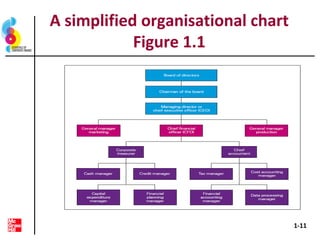
Financial manager
• Financial managers try to answer some or
all of these questions.
• The top financial manager within a firm is
usually the chief financial officer (CFO).
– Treasurer: oversees cash management, credit
management, capital expenditure and
financial planning
– Accountant: oversees taxes, cost accounting,
financial accounting and data processing
1-10
A simplified organisational chart
Figure 1.1
1-11
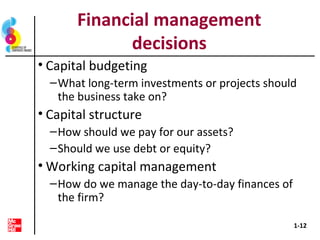
Financial management
decisions
• Capital budgeting
–What long-term investments or projects should
the business take on?
• Capital structure
–How should we pay for our assets?
–Should we use debt or equity?
• Working capital management
–How do we manage the day-to-day finances of
the firm?
1-12
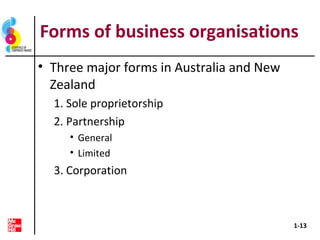
Forms of business organisations
• Three major forms in Australia and New
Zealand
1. Sole proprietorship
2. Partnership
• General
• Limited
3. Corporation
1-13
• Thank you
1-14

1.Introduction to Financial Management

  • 1.
    Introduction to financial management Dr.JayashreeR. Kotnal Asst. Professor & Head, M.Com Programme SBS Arts & Commerce College for Women Vijayapur
  • 2.
    Key concepts andskills • Have a good understanding of the: – basic types of financial management decisions and the role of the financial manager – goal of financial management – financial implications of the different forms of business organisation – conflicts of interest that can arise between managers and owners 1-2
  • 3.
    Chapter outline • Finance:A quick look • Business finance and the financial manager • Forms of business organisation • The goal of financial management • The agency problem and control of the corporation • Financial markets and the corporation 1-3
  • 4.
    The four basicareas of finance 1. Corporate finance or business finance 2. Investments 3. Financial institutions 4. International finance 1-4
  • 5.
    Investments • Working withfinancial assets such as shares and bonds • Value of financial assets, risk versus return and asset allocation • Job opportunities – Stockbroker – Financial advisor – Portfolio manager – Security analyst 1-5
  • 6.
    Financial institutions • Companiesthat specialise in financial matters – Banks─commercial and investment, credit unions, savings and loans – Insurance companies – Brokerage firms • Job opportunities 1-6
  • 7.
    International finance • Thisis an area of specialisation within one of the areas discussed so far. • Involves international aspects of corporate finance or investments or financial institutions. • It may allow you to work in other countries or at least travel on a regular basis. • Need to be familiar with exchange rates and political risk. • Need to understand the customs of other countries and you would benefit from fluency in a foreign language. 1-7
  • 8.
    Why study finance? •Marketing – Budgets, marketing research, marketing financial products • Accounting – Dual accounting and finance function, preparation of financial statements • Management – Strategic thinking, job performance and profitability • Personal finance – Budgeting, retirement planning, university planning, day-to-day cash flow management 1-8
  • 9.
    Business finance • Someimportant questions that are answered using finance: – What long-term investments should the firm take on? – Where will we get the long-term financing to pay for the investment? – How will we manage the everyday financial activities of the firm? 1-9
  • 10.
    Financial manager • Financialmanagers try to answer some or all of these questions. • The top financial manager within a firm is usually the chief financial officer (CFO). – Treasurer: oversees cash management, credit management, capital expenditure and financial planning – Accountant: oversees taxes, cost accounting, financial accounting and data processing 1-10
  • 11.
    A simplified organisationalchart Figure 1.1 1-11
  • 12.
    Financial management decisions • Capitalbudgeting –What long-term investments or projects should the business take on? • Capital structure –How should we pay for our assets? –Should we use debt or equity? • Working capital management –How do we manage the day-to-day finances of the firm? 1-12
  • 13.
    Forms of businessorganisations • Three major forms in Australia and New Zealand 1. Sole proprietorship 2. Partnership • General • Limited 3. Corporation 1-13
  • 14.

Editor's Notes

  • #5 Corporate finance may imply that the topics covered here are related to corporations only, but almost all the topics are much broader than that. Business finance is a little more descriptive but still too narrow to cover the basic financial ideas and principles that we discuss and are applicable across all the various areas of finance and beyond.
  • #6 These job opportunities in finance, like many areas in finance, share an interesting feature. They are very rewarding if done well but can be very demanding and competitive careers.
  • #7 Job opportunities at financial institutions include loan officers in banks and analysts in insurance companies.
  • #9 Marketing Have to work within a budget Marketing research is often very important to financial analysts; those doing the research need to understand what information the analysts need so that they ask the right questions Marketing financial products—including entire companies through IPOs and seasoned equity offerings, as well as insurance and other basic financial products Accounting In smaller businesses, accountants often perform both the accounting and finance functions Prepare the financial statements that financial analysts rely on for information Management Business strategy—have to understand the goals of the business and how cash flow works Understand how job performance affects profitability Personal finance For many students, emphasising the personal finance issues whenever possible can make the material more relevant Decisions about 401K plans, saving for houses, cars, kids’ college, etc., can be discussed throughout the course Day-to-day decisions about consumption vs saving can also be discussed within a finance framework
  • #10 Business finance, broadly speaking, is the study of ways to answer these questions. Emphasise that ‘business finance’ is just another name for the ‘corporate finance’ mentioned under the four basic types. Students often get confused by the terminology, especially when different terms are used to refer to the same thing.
  • #13 Capital budgeting: The process of planning and managing a firm’s long-term investments. Capital structure: The mixture of debt and equity maintained by the firm. Working capital: Firm’s short-term assets and liabilities. The three areas of corporate financial management—capital budgeting, capital structure and working capital management—are very broad categories. These broad areas will be discussed in detail in the chapters ahead. Provide some examples of capital budgeting decisions, such as what products or service will the firm sell, should it replace old equipment with newer, more advanced equipment, etc. Be sure to define debt and equity. Provide some examples of working capital management, such as who should the firm sell to on credit, how much inventory should it carry, when should it pay its suppliers, etc.
  • #14 Sole proprietorship: A business owned by a single individual Partnership: Business owned by two or more individuals or entities Corporation: A business created as a distinct legal entity owned by one or more individuals or entities, and having many of the rights, duties and privileges of an actual person.