BASIC BASE OILS
CHEMISTRY
• Almost every lubricant used in plants today started off as
just a base oil.
• The American Petroleum Institute (API) has categorized
base oils into five categories (API 1509, Appendix E).
• The first three groups are refined from petroleum crude oil.
• Group IV base oils are full synthetic (polyalphaolefin) oils.
• Group V is for all other base oils not included in Groups I
through IV.
• Before all the additives are added to the mixture,
lubricating oils begin as one or more of these five API
groups.
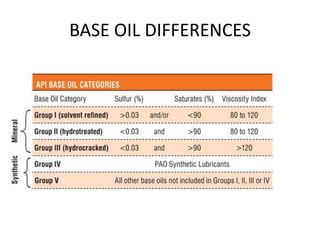
BASE OIL DIFFERENCES
GROUP 1 BASE OILS
• Group I base oils are classified as less than 90
percent saturates, greater than 0.03 percent
sulphur and with a viscosity-index range of 80
to 120.
• Group I base oils are solvent-refined, which is
a simpler refining process.
• This is why they are the cheapest base oils on
the market.
GROUP 2 BASE OILS
• Group 2 base oils are defined as being more than 90
percent saturates, less than 0.03 percent sulphur and with
a viscosity index of 80 to 120.
• They are often manufactured by hydrocracking, which is a
more complex process than what is used for Group 1 base
oils.
• Since all the hydrocarbon molecules of these oils are
saturated, Group 2 base oils have better anti-oxidation
properties.
• They also have a clearer colour and cost more in
comparison to Group I base oils.
• Still, Group 2 base oils are becoming very common on the
market today and are priced very close to Group 1 oils.
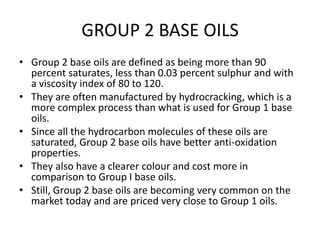
Paraffinic, Naphthenic and Aromatics
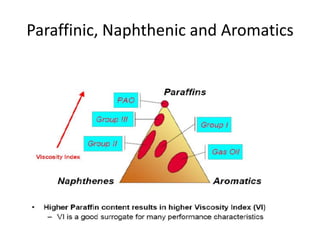
Synthetics Vs Mineral
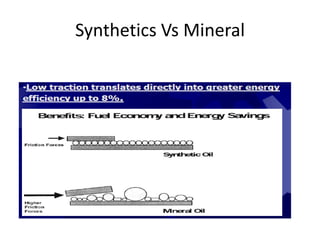
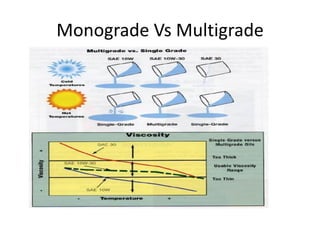
Monograde Vs Multigrade Oils
Monograde Vs Multigrade

Base oil chemistry

  • 1.
  • 2.
    • Almost everylubricant used in plants today started off as just a base oil. • The American Petroleum Institute (API) has categorized base oils into five categories (API 1509, Appendix E). • The first three groups are refined from petroleum crude oil. • Group IV base oils are full synthetic (polyalphaolefin) oils. • Group V is for all other base oils not included in Groups I through IV. • Before all the additives are added to the mixture, lubricating oils begin as one or more of these five API groups.
  • 3.
  • 4.
    GROUP 1 BASEOILS • Group I base oils are classified as less than 90 percent saturates, greater than 0.03 percent sulphur and with a viscosity-index range of 80 to 120. • Group I base oils are solvent-refined, which is a simpler refining process. • This is why they are the cheapest base oils on the market.
  • 5.
    GROUP 2 BASEOILS • Group 2 base oils are defined as being more than 90 percent saturates, less than 0.03 percent sulphur and with a viscosity index of 80 to 120. • They are often manufactured by hydrocracking, which is a more complex process than what is used for Group 1 base oils. • Since all the hydrocarbon molecules of these oils are saturated, Group 2 base oils have better anti-oxidation properties. • They also have a clearer colour and cost more in comparison to Group I base oils. • Still, Group 2 base oils are becoming very common on the market today and are priced very close to Group 1 oils.
  • 6.
  • 7.
  • 8.
  • 9.