





HOW DID YOU END
UP IN THE WORK
WITH YOUR
ORGANIZATION?
TAP GAME
Follow all the rules.
If you’re tapped once, repeat all the rules
OUT LOUD until the end of the game.
If you’re tapped twice, stand up and
repeat all the rules OUT LOUD until
the end of the game.
If you’re tapped three times,
do whatever you want.
Key
Definitions
Organizing
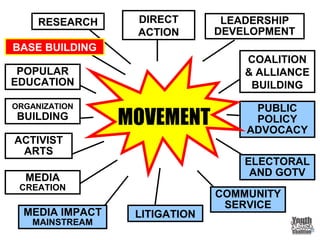
A process to involve people in a visioning and action plan that
leads to social change. Organizing either seeks to push the
system –with a goal of REFORMING institutions, services and
systems; or to rock the system with a goal of DISMANTLING
OR REVOLUTIONIZING institutions, services and systems.
While social services usually aim to serve people within the
current institutional structures, and help them to “accept and
survive” within those structures, organizing recognizes the
power inequalities that exist in every relationship, and
assumes that justice can only be achieved by challenging
inequalities, transferring power and wealth, and/or
demolishing unjust systems.
Youth Organizing
The Funders’ Collaborative for Youth Organizing defines
Youth Organizing as a comprehensive youth development and
social justice strategy that trains young people in community
organizing and advocacy, and assists them in employing
these skills to alter power relations and create meaningful
institutional change in their communities. Youth organizing
relies on the power and leadership of youth acting on issues
defined by and affecting young people and their communities,
and involves them in the design, implementation, and
evaluation of these efforts. Employing activities such as
community research, issue development, reflection, political
analysis and direct action, youth organizing increases civic
participation and builds the individual and collective leadership
capacity of young people.
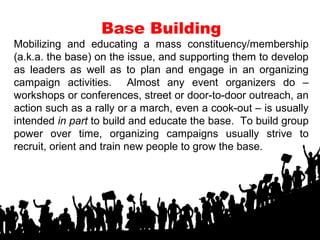
Base Building
Mobilizing and educating a mass constituency/membership
(a.k.a. the base) on the issue, and supporting them to develop
as leaders as well as to plan and engage in an organizing
campaign activities. Almost any event organizers do –
workshops or conferences, street or door-to-door outreach, an
action such as a rally or a march, even a cook-out – is usually
intended in part to build and educate the base. To build group
power over time, organizing campaigns usually strive to
recruit, orient and train new people to grow the base.
Action Plan
A march or protest alone, a series of public hearings to pass a
new law, releasing a report - any of those things alone IS NOT
ORGANIZING. Youth and community organizing involves
people in developing an ACTION PLAN to guide an
“campaign” and all the activities in the plan are what make up
the ORGANIZING. Action plans usually include: 
IDENTIFYING PROBLEMS/ISSUES, CAMPAIGN GOALS
AND OUTCOMES  CONDUCTING ISSUE, COMMUNITY
AND TARGET RESEARCH  IDENTIFYING A TARGET OR
TARGETS  CONDUCTING A POWER ANALYSIS 
IDENTIFYING ALLIES  DETERMINING TACTICS IN
ORDER OF ESCALATION (USUALLY FROM LEAST
THREATENING TO MOST CONFRONTATIONAL) 
LISTING AND RAISING RESOURCE NEEDS/CAMPAIGN
BUDGET  AND ESTABLISHING A TASK AND TIME-LINE.
Build
for a
Movement
Think of the mass movements you
have seen or studied? What made
them successful? What elements
did they have?
Movement Building
Occasionally, in history, organizing ignites the
collective imagination of millions of people, and
society is overcome by widespread and sweeping
change – major institutional and policy changes – but
also shifts in culture, beliefs and values. This is
characterized as a mass movement. A movement
cannot be built exactly. It happens when the
organizing you are engaged in collides with history
in a dramatic enough way that it causes the larger
community to act in planned and spontaneous ways, in
efforts you initiate, and in efforts you never envisioned.
The movement lives beyond your control. It is shaped
by many forces (youth and community, organizations,
activists, artists, coalitions, etc.) that all share the
movement’s vision and goals.
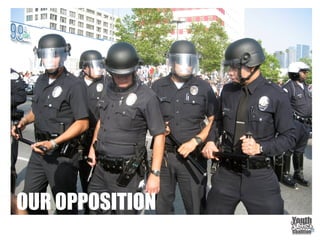
OUR OPPOSITION
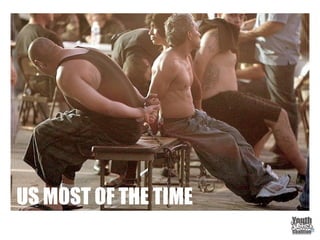
US MOST OF THE TIME
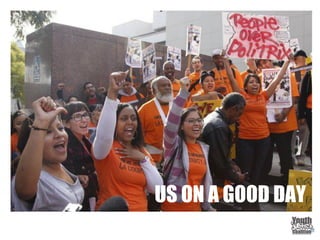
US ON A GOOD DAY
LEADERSHIP
DEVELOPMENT
COALITION
& ALLIANCE
BUILDING
LITIGATION
ACTIVIST
ARTS
POPULAR
EDUCATION
COMMUNITY
SERVICE
ELECTORAL
AND GOTV
MEDIA IMPACT
MAINSTREAM
MEDIA
CREATION
ORGANIZATION
BUILDING
DIRECT
ACTION
RESEARCH
BASE BUILDING
PUBLIC
POLICY
ADVOCACY
MOVEMENT
Base
Building
Plan
Who is
most
impacted?
Where are
they? Target
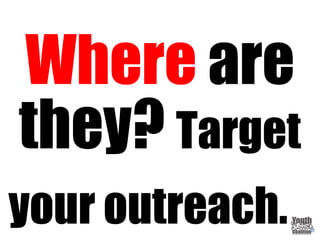
your outreach.
Where are
they? Target
your outreach.
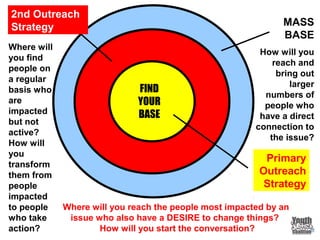
MASS
BASE
How will you
reach and
bring out
larger
numbers of
people who
have a direct
connection to
the issue?
2nd Outreach
Strategy
Primary
Outreach
Strategy
Where will you reach the people most impacted by an
issue who also have a DESIRE to change things?
How will you start the conversation?
Where will
you find
people on
a regular
basis who
are
impacted
but not
active?
How will
you
transform
them from
people
impacted
to people
who take
action?
FIND
YOUR
BASE
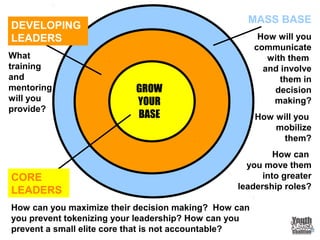
MASS BASE
How will you
communicate
with them
and involve
them in
decision
making?
How will you
mobilize
them?
How can
you move them
into greater
leadership roles?
DEVELOPING
LEADERS
CORE
LEADERS
How can you maximize their decision making? How can
you prevent tokenizing your leadership? How can you
prevent a small elite core that is not accountable?
What
training
and
mentoring
will you
provide?
GROW
YOUR
BASE
Find the TRUE
leaders - Who are
the people other
people talk to when
they are in trouble?
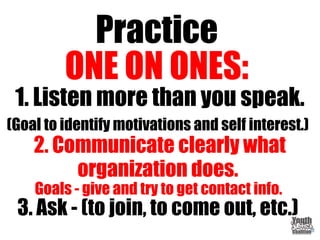
Practice
ONE ON ONES:
1. Listen more than you speak.
(Goal to identify motivations and self interest.)
2. Communicate clearly what
organization does.
Goals - give and try to get contact info.
3. Ask - (to join, to come out, etc.)
“Check yourself
before you wreck
yourself.” (ICE CUBE)
Erase Inhumane
Language
Empowerment
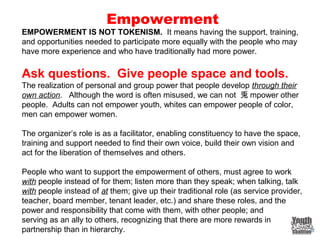
EMPOWERMENT IS NOT TOKENISM. It means having the support, training,
and opportunities needed to participate more equally with the people who may
have more experience and who have traditionally had more power.
Ask questions. Give people space and tools.
The realization of personal and group power that people develop through their
own action. Although the word is often misused, we can not 兎 mpower other
people. Adults can not empower youth, whites can empower people of color,
men can empower women.
The organizer’s role is as a facilitator, enabling constituency to have the space,
training and support needed to find their own voice, build their own vision and
act for the liberation of themselves and others.
People who want to support the empowerment of others, must agree to work
with people instead of for them; listen more than they speak; when talking, talk
with people instead of at them; give up their traditional role (as service provider,
teacher, board member, tenant leader, etc.) and share these roles, and the
power and responsibility that come with them, with other people; and
serving as an ally to others, recognizing that there are more rewards in
partnership than in hierarchy.
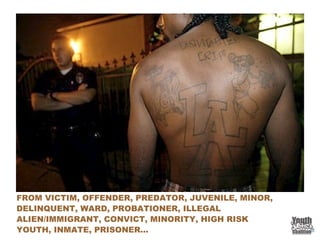
FROM VICTIM, OFFENDER, PREDATOR, JUVENILE, MINOR,
DELINQUENT, WARD, PROBATIONER, ILLEGAL
ALIEN/IMMIGRANT, CONVICT, MINORITY, HIGH RISK
YOUTH, INMATE, PRISONER…
TO HUMAN BEING: (PEOPLE/YOUTH IN PRISON, CONVICTED OR
UNDOCUMENTED PEOPLE, YOUTH IN CONFLICT WITH THE LAW.)
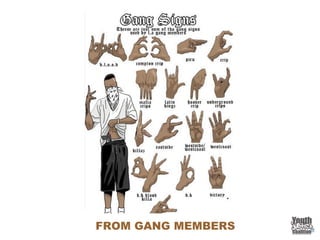
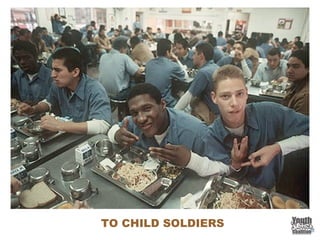
FROM GANG MEMBERS
TO CHILD SOLDIERS
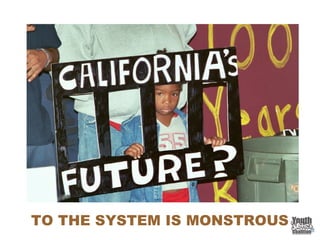
FROM YOUTH ARE MONSTERS
TO THE SYSTEM IS MONSTROUS
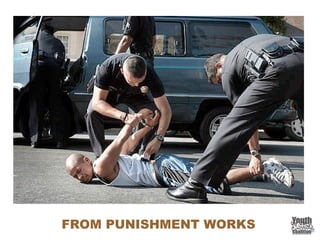
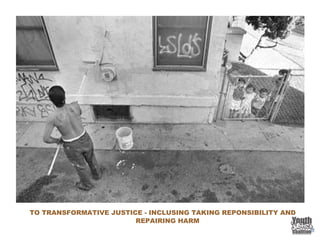
FROM PUNISHMENT WORKS
TO TRANSFORMATIVE JUSTICE - INCLUSING TAKING REPONSIBILITY AND
REPAIRING HARM
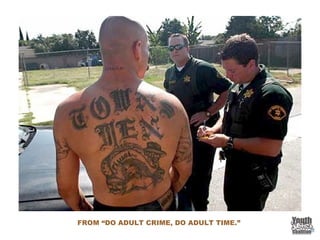
FROM “DO ADULT CRIME, DO ADULT TIME.”
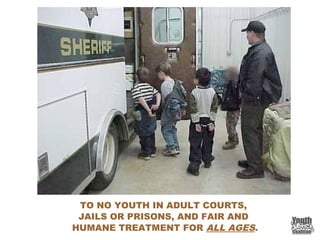
TO NO YOUTH IN ADULT COURTS,
JAILS OR PRISONS, AND FAIR AND
HUMANE TREATMENT FOR ALL AGES.
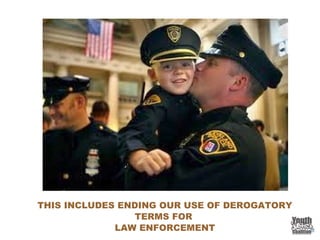
THIS INCLUDES ENDING OUR USE OF DEROGATORY
TERMS FOR
LAW ENFORCEMENT

Base Building for Direct Action Organizing Groups

  • 2.
    HOW DID YOUEND UP IN THE WORK WITH YOUR ORGANIZATION?
  • 3.
  • 4.
    Follow all therules. If you’re tapped once, repeat all the rules OUT LOUD until the end of the game. If you’re tapped twice, stand up and repeat all the rules OUT LOUD until the end of the game. If you’re tapped three times, do whatever you want.
  • 5.
  • 6.
    Organizing A process toinvolve people in a visioning and action plan that leads to social change. Organizing either seeks to push the system –with a goal of REFORMING institutions, services and systems; or to rock the system with a goal of DISMANTLING OR REVOLUTIONIZING institutions, services and systems. While social services usually aim to serve people within the current institutional structures, and help them to “accept and survive” within those structures, organizing recognizes the power inequalities that exist in every relationship, and assumes that justice can only be achieved by challenging inequalities, transferring power and wealth, and/or demolishing unjust systems.
  • 7.
    Youth Organizing The Funders’Collaborative for Youth Organizing defines Youth Organizing as a comprehensive youth development and social justice strategy that trains young people in community organizing and advocacy, and assists them in employing these skills to alter power relations and create meaningful institutional change in their communities. Youth organizing relies on the power and leadership of youth acting on issues defined by and affecting young people and their communities, and involves them in the design, implementation, and evaluation of these efforts. Employing activities such as community research, issue development, reflection, political analysis and direct action, youth organizing increases civic participation and builds the individual and collective leadership capacity of young people.
  • 8.
    Base Building Mobilizing andeducating a mass constituency/membership (a.k.a. the base) on the issue, and supporting them to develop as leaders as well as to plan and engage in an organizing campaign activities. Almost any event organizers do – workshops or conferences, street or door-to-door outreach, an action such as a rally or a march, even a cook-out – is usually intended in part to build and educate the base. To build group power over time, organizing campaigns usually strive to recruit, orient and train new people to grow the base.
  • 9.
    Action Plan A marchor protest alone, a series of public hearings to pass a new law, releasing a report - any of those things alone IS NOT ORGANIZING. Youth and community organizing involves people in developing an ACTION PLAN to guide an “campaign” and all the activities in the plan are what make up the ORGANIZING. Action plans usually include:  IDENTIFYING PROBLEMS/ISSUES, CAMPAIGN GOALS AND OUTCOMES  CONDUCTING ISSUE, COMMUNITY AND TARGET RESEARCH  IDENTIFYING A TARGET OR TARGETS  CONDUCTING A POWER ANALYSIS  IDENTIFYING ALLIES  DETERMINING TACTICS IN ORDER OF ESCALATION (USUALLY FROM LEAST THREATENING TO MOST CONFRONTATIONAL)  LISTING AND RAISING RESOURCE NEEDS/CAMPAIGN BUDGET  AND ESTABLISHING A TASK AND TIME-LINE.
  • 10.
  • 11.
    Think of themass movements you have seen or studied? What made them successful? What elements did they have?
  • 12.
    Movement Building Occasionally, inhistory, organizing ignites the collective imagination of millions of people, and society is overcome by widespread and sweeping change – major institutional and policy changes – but also shifts in culture, beliefs and values. This is characterized as a mass movement. A movement cannot be built exactly. It happens when the organizing you are engaged in collides with history in a dramatic enough way that it causes the larger community to act in planned and spontaneous ways, in efforts you initiate, and in efforts you never envisioned. The movement lives beyond your control. It is shaped by many forces (youth and community, organizations, activists, artists, coalitions, etc.) that all share the movement’s vision and goals.
  • 13.
  • 14.
    US MOST OFTHE TIME
  • 15.
    US ON AGOOD DAY
  • 16.
    LEADERSHIP DEVELOPMENT COALITION & ALLIANCE BUILDING LITIGATION ACTIVIST ARTS POPULAR EDUCATION COMMUNITY SERVICE ELECTORAL AND GOTV MEDIAIMPACT MAINSTREAM MEDIA CREATION ORGANIZATION BUILDING DIRECT ACTION RESEARCH BASE BUILDING PUBLIC POLICY ADVOCACY MOVEMENT
  • 17.
  • 18.
  • 19.
  • 20.
  • 21.
    MASS BASE How will you reachand bring out larger numbers of people who have a direct connection to the issue? 2nd Outreach Strategy Primary Outreach Strategy Where will you reach the people most impacted by an issue who also have a DESIRE to change things? How will you start the conversation? Where will you find people on a regular basis who are impacted but not active? How will you transform them from people impacted to people who take action? FIND YOUR BASE
  • 22.
    MASS BASE How willyou communicate with them and involve them in decision making? How will you mobilize them? How can you move them into greater leadership roles? DEVELOPING LEADERS CORE LEADERS How can you maximize their decision making? How can you prevent tokenizing your leadership? How can you prevent a small elite core that is not accountable? What training and mentoring will you provide? GROW YOUR BASE
  • 23.
    Find the TRUE leaders- Who are the people other people talk to when they are in trouble?
  • 24.
    Practice ONE ON ONES: 1.Listen more than you speak. (Goal to identify motivations and self interest.) 2. Communicate clearly what organization does. Goals - give and try to get contact info. 3. Ask - (to join, to come out, etc.)
  • 25.
    “Check yourself before youwreck yourself.” (ICE CUBE) Erase Inhumane Language
  • 26.
    Empowerment EMPOWERMENT IS NOTTOKENISM. It means having the support, training, and opportunities needed to participate more equally with the people who may have more experience and who have traditionally had more power. Ask questions. Give people space and tools. The realization of personal and group power that people develop through their own action. Although the word is often misused, we can not 兎 mpower other people. Adults can not empower youth, whites can empower people of color, men can empower women. The organizer’s role is as a facilitator, enabling constituency to have the space, training and support needed to find their own voice, build their own vision and act for the liberation of themselves and others. People who want to support the empowerment of others, must agree to work with people instead of for them; listen more than they speak; when talking, talk with people instead of at them; give up their traditional role (as service provider, teacher, board member, tenant leader, etc.) and share these roles, and the power and responsibility that come with them, with other people; and serving as an ally to others, recognizing that there are more rewards in partnership than in hierarchy.
  • 27.
    FROM VICTIM, OFFENDER,PREDATOR, JUVENILE, MINOR, DELINQUENT, WARD, PROBATIONER, ILLEGAL ALIEN/IMMIGRANT, CONVICT, MINORITY, HIGH RISK YOUTH, INMATE, PRISONER…
  • 28.
    TO HUMAN BEING:(PEOPLE/YOUTH IN PRISON, CONVICTED OR UNDOCUMENTED PEOPLE, YOUTH IN CONFLICT WITH THE LAW.)
  • 29.
  • 30.
  • 31.
  • 32.
    TO THE SYSTEMIS MONSTROUS
  • 33.
  • 34.
    TO TRANSFORMATIVE JUSTICE- INCLUSING TAKING REPONSIBILITY AND REPAIRING HARM
  • 35.
    FROM “DO ADULTCRIME, DO ADULT TIME.”
  • 36.
    TO NO YOUTHIN ADULT COURTS, JAILS OR PRISONS, AND FAIR AND HUMANE TREATMENT FOR ALL AGES.
  • 37.
    THIS INCLUDES ENDINGOUR USE OF DEROGATORY TERMS FOR LAW ENFORCEMENT

Editor's Notes

  • #5 Start with a basic set of questions: What happened? How many people were in pain? How did they feel? How many people saw other people in pain? How did they know others were in pain? Who had control, authority? Why? How were they treated by the facilitator? How did it feel repeating rules over and over? Was it a good use of your time? Challenge them on whether or not you in fact had any authority. Why did they “behave” you? If people rebelled at all, ask people who rebelled in small or large ways, why they made those decisions. Why didn’t they take it further? What could have shifted the response of others to be more challenging. What kind of suffering do we walk by every day without doing anything? Closing - organizing is all about challenging authority and having the courage to name suffering and intervene to stop it. We follow rules all the time because there’s a promise for a reward at the end, even though the rules might be unjust, unnecessary and/or hurting people,
  • #29 To be seen as a whole being, certain things you deserve as a human being. Preserving dignity and humanity of all people.