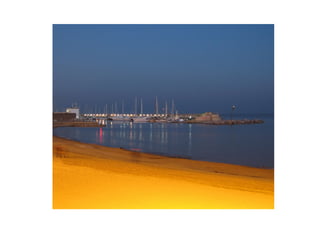
BARCELONA
Lemonia Ainalidou
Barcelona generally

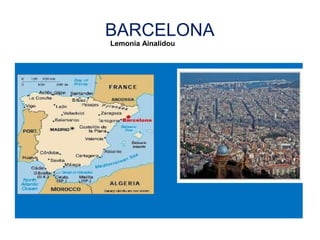
Barcelona is the capital of Catalonia and the
second largest city in Spain, after Madrid.

It is the sixth-most populous urban area in the
European Union after Paris, London, the Ruhr,
Madrid and Milan.

Barcelona is today one of the world's leading
tourist, economic, trade fair/exhibitions and
cultural-sports centres, and its influence in
commerce, education, entertainment, media,
fashion, science, and the arts all contribute to its
status as one of the world's major global cities

It is the fourth economically powerful city by GDP
in the European Union and 35th in the world with
an output amounting to €177 billion.

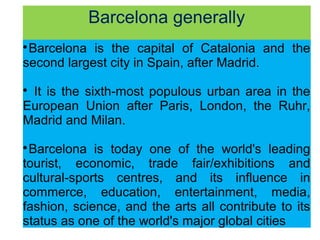
Barcelona is the transport hub with one of
Europe's principal ports, Barcelona international
airport, which handles above 34 million
passengers per year, extensive motorway
network and also is a hub of high-speed rail,
particularly that which is intended to link Spain
with France and the rest of Europe, as the second
longest in the world.
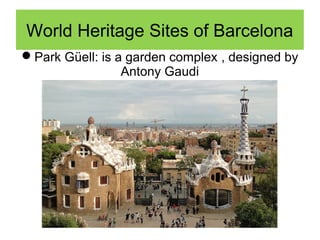
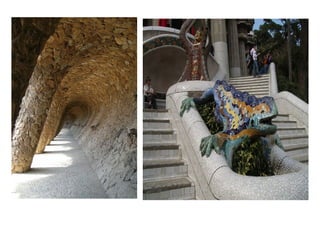
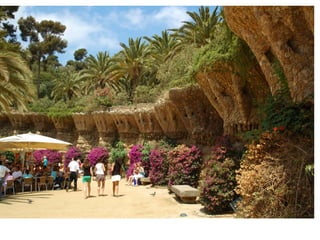
Park Güell: is a garden complex , designed by
Antony Gaudi
World Heritage Sites of Barcelona
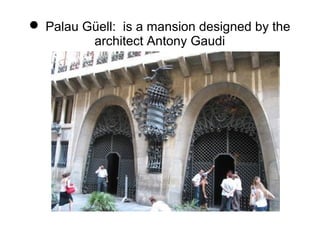
 Palau Güell: is a mansion designed by the
architect Antony Gaudi
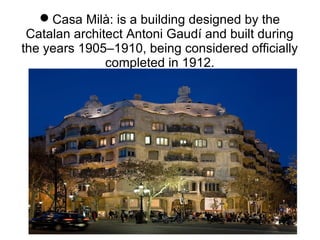
Casa Milà: is a building designed by the
Catalan architect Antoni Gaudí and built during
the years 1905–1910, being considered officially
completed in 1912.
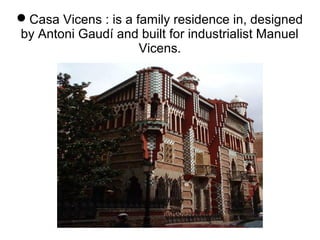
Casa Vicens : is a family residence in, designed
by Antoni Gaudí and built for industrialist Manuel
Vicens.
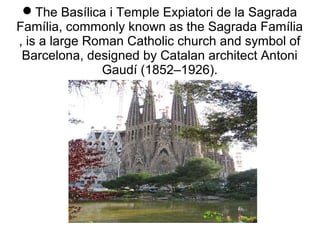
The Basílica i Temple Expiatori de la Sagrada
Família, commonly known as the Sagrada Família
, is a large Roman Catholic church and symbol of
Barcelona, designed by Catalan architect Antoni
Gaudí (1852–1926).
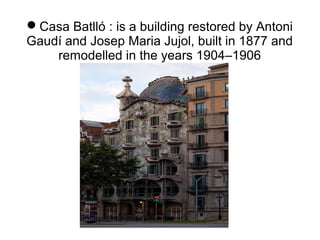
Casa Batlló : is a building restored by Antoni
Gaudí and Josep Maria Jujol, built in 1877 and
remodelled in the years 1904–1906
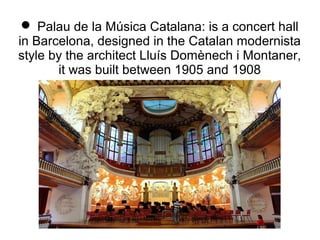
 Palau de la Música Catalana: is a concert hall
in Barcelona, designed in the Catalan modernista
style by the architect Lluís Domènech i Montaner,
it was built between 1905 and 1908
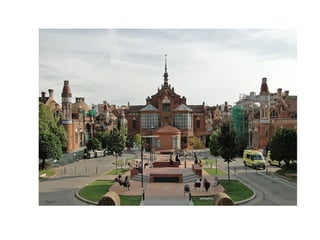
The former Hospital de la Santa Creu i Sant
Pau , English: Hospital of the Holy Cross and
Saint Paul) in the neighborhood of El Guinardó, ,
is a complex built between 1901 and 1930,
designed by the Catalan modernist architect Lluís
Domènech i Montaner.
It was a fully functioning hospital until June
2009, it is currently undergoing restoration for use
as a museum and cultural center.

The Museu Nacional d'Art de Catalunya,
abbreviated as MNAC, is the national museum of
Catalan visual art. It is especially notable for its
outstanding collection of romanesque church
paintings.

Picasso Museum

Fundació Joan Miró,

Cosmocaixa, a science museum that received
the European Museum of the Year Award in 2006.

Erotic Museum: set up with the clear purpose of
providing an educational and recreational centre
focusing on eroticism.
Museums

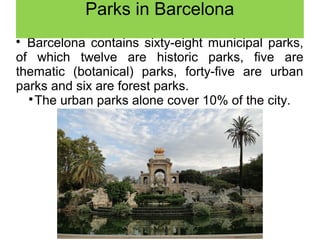
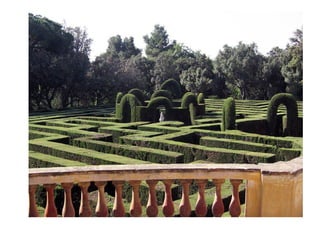
Barcelona contains sixty-eight municipal parks,
of which twelve are historic parks, five are
thematic (botanical) parks, forty-five are urban
parks and six are forest parks.

The urban parks alone cover 10% of the city.
Parks in Barcelona

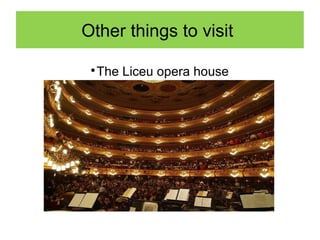
The Liceu opera house
Other things to visit
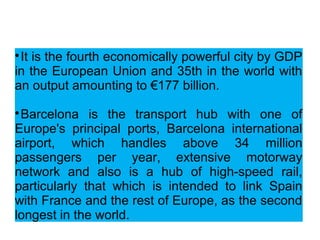
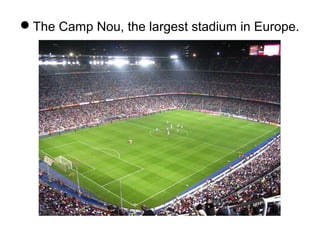
The Camp Nou, the largest stadium in Europe.
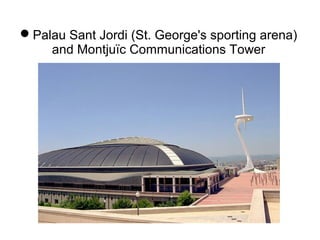
Palau Sant Jordi (St. George's sporting arena)
and Montjuïc Communications Tower
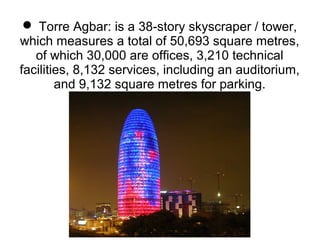
 Torre Agbar: is a 38-story skyscraper / tower,
which measures a total of 50,693 square metres,
of which 30,000 are offices, 3,210 technical
facilities, 8,132 services, including an auditorium,
and 9,132 square metres for parking.
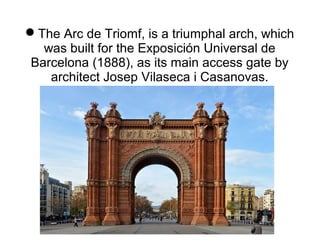
The Arc de Triomf, is a triumphal arch, which
was built for the Exposición Universal de
Barcelona (1888), as its main access gate by
architect Josep Vilaseca i Casanovas.
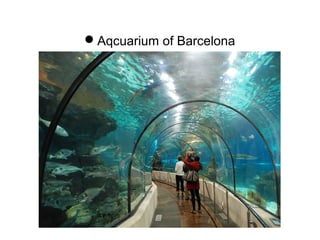
Aqcuarium of Barcelona
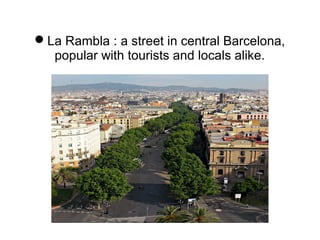
La Rambla : a street in central Barcelona,
popular with tourists and locals alike.
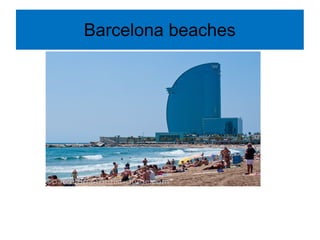
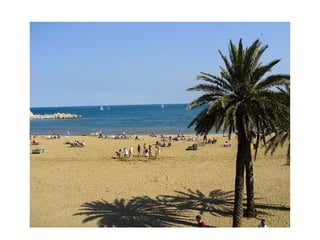
Barcelona beaches
Barcelona
Barcelona

Barcelona

  • 1.
  • 3.
    Barcelona generally  Barcelona isthe capital of Catalonia and the second largest city in Spain, after Madrid.  It is the sixth-most populous urban area in the European Union after Paris, London, the Ruhr, Madrid and Milan.  Barcelona is today one of the world's leading tourist, economic, trade fair/exhibitions and cultural-sports centres, and its influence in commerce, education, entertainment, media, fashion, science, and the arts all contribute to its status as one of the world's major global cities
  • 4.
     It is thefourth economically powerful city by GDP in the European Union and 35th in the world with an output amounting to €177 billion.  Barcelona is the transport hub with one of Europe's principal ports, Barcelona international airport, which handles above 34 million passengers per year, extensive motorway network and also is a hub of high-speed rail, particularly that which is intended to link Spain with France and the rest of Europe, as the second longest in the world.
  • 5.
    Park Güell: isa garden complex , designed by Antony Gaudi World Heritage Sites of Barcelona
  • 7.
     Palau Güell:is a mansion designed by the architect Antony Gaudi
  • 8.
    Casa Milà: isa building designed by the Catalan architect Antoni Gaudí and built during the years 1905–1910, being considered officially completed in 1912.
  • 9.
    Casa Vicens :is a family residence in, designed by Antoni Gaudí and built for industrialist Manuel Vicens.
  • 10.
    The Basílica iTemple Expiatori de la Sagrada Família, commonly known as the Sagrada Família , is a large Roman Catholic church and symbol of Barcelona, designed by Catalan architect Antoni Gaudí (1852–1926).
  • 11.
    Casa Batlló :is a building restored by Antoni Gaudí and Josep Maria Jujol, built in 1877 and remodelled in the years 1904–1906
  • 12.
     Palau dela Música Catalana: is a concert hall in Barcelona, designed in the Catalan modernista style by the architect Lluís Domènech i Montaner, it was built between 1905 and 1908
  • 13.
    The former Hospitalde la Santa Creu i Sant Pau , English: Hospital of the Holy Cross and Saint Paul) in the neighborhood of El Guinardó, , is a complex built between 1901 and 1930, designed by the Catalan modernist architect Lluís Domènech i Montaner. It was a fully functioning hospital until June 2009, it is currently undergoing restoration for use as a museum and cultural center.
  • 15.
     The Museu Nacionald'Art de Catalunya, abbreviated as MNAC, is the national museum of Catalan visual art. It is especially notable for its outstanding collection of romanesque church paintings.  Picasso Museum  Fundació Joan Miró,  Cosmocaixa, a science museum that received the European Museum of the Year Award in 2006.  Erotic Museum: set up with the clear purpose of providing an educational and recreational centre focusing on eroticism. Museums
  • 16.
     Barcelona contains sixty-eightmunicipal parks, of which twelve are historic parks, five are thematic (botanical) parks, forty-five are urban parks and six are forest parks.  The urban parks alone cover 10% of the city. Parks in Barcelona
  • 20.
     The Liceu operahouse Other things to visit
  • 21.
    The Camp Nou,the largest stadium in Europe.
  • 22.
    Palau Sant Jordi(St. George's sporting arena) and Montjuïc Communications Tower
  • 23.
     Torre Agbar:is a 38-story skyscraper / tower, which measures a total of 50,693 square metres, of which 30,000 are offices, 3,210 technical facilities, 8,132 services, including an auditorium, and 9,132 square metres for parking.
  • 24.
    The Arc deTriomf, is a triumphal arch, which was built for the Exposición Universal de Barcelona (1888), as its main access gate by architect Josep Vilaseca i Casanovas.
  • 25.
  • 26.
    La Rambla :a street in central Barcelona, popular with tourists and locals alike.
  • 27.