What was the first
service CrossRef
offered?
b.
What does DOI stand
for?
g.
http://www.doi.org/
DOI is a trademark of the
International DOI
Foundation The IDF
appoints registration
agencies like CrossRef
www.doi.org
What types of content have DOIs?
g.
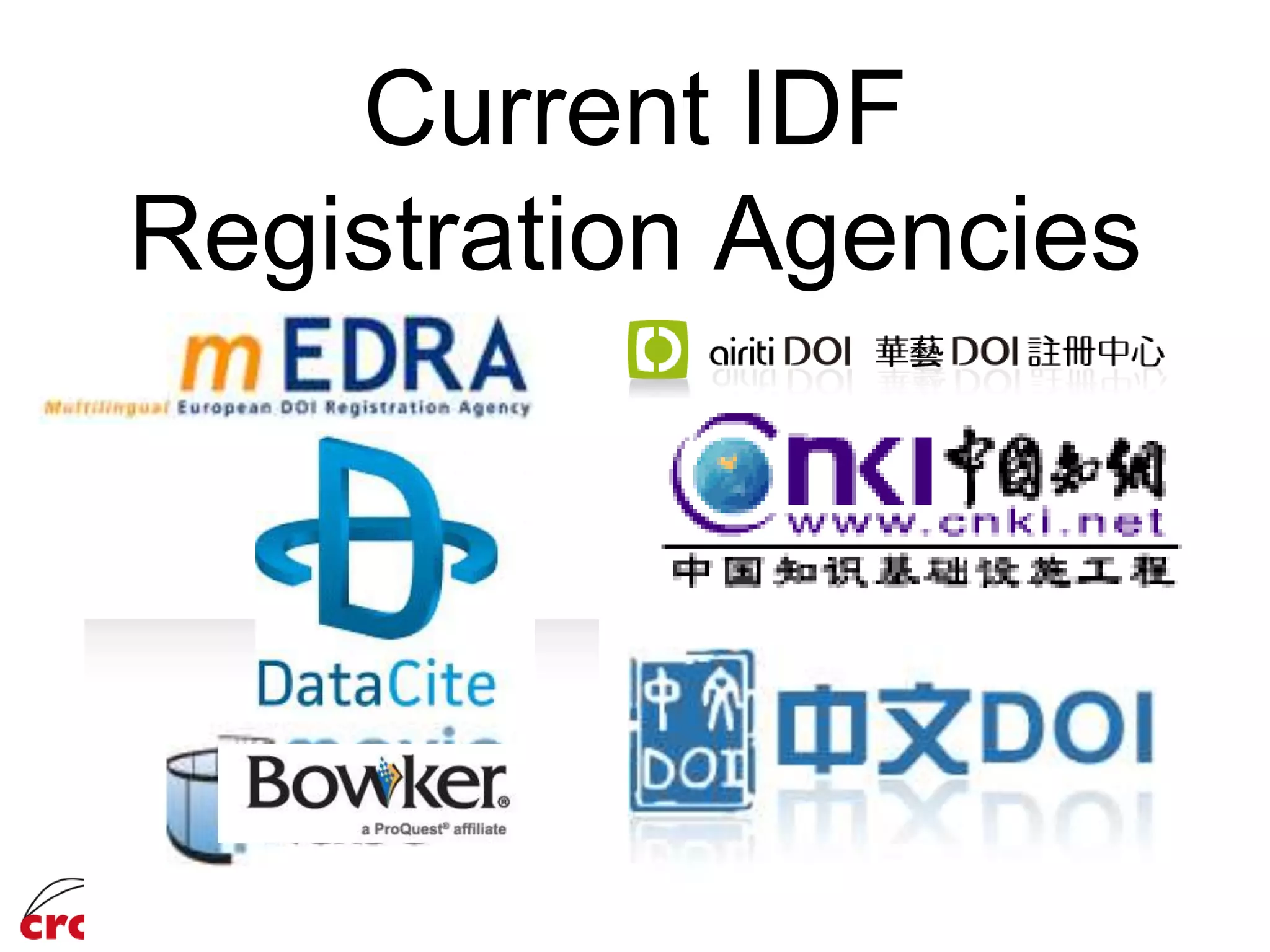
Current IDF
Registration Agencies
Which type of
organization was not
originally eligible to
participate in CrossRef?
a.Commercial Publishers
b.Society Publishers
c. Non-US Publishers
d.Secondary Publishers
d.
CrossRef was founded by a diverse group of publishers:
commercial companies, not-for-profit societies, and
publishers from North America, the UK, and Europe.
Abstracting and Indexing publishers, though, not eligible for
membership, quickly became able to participate as Affiliates.
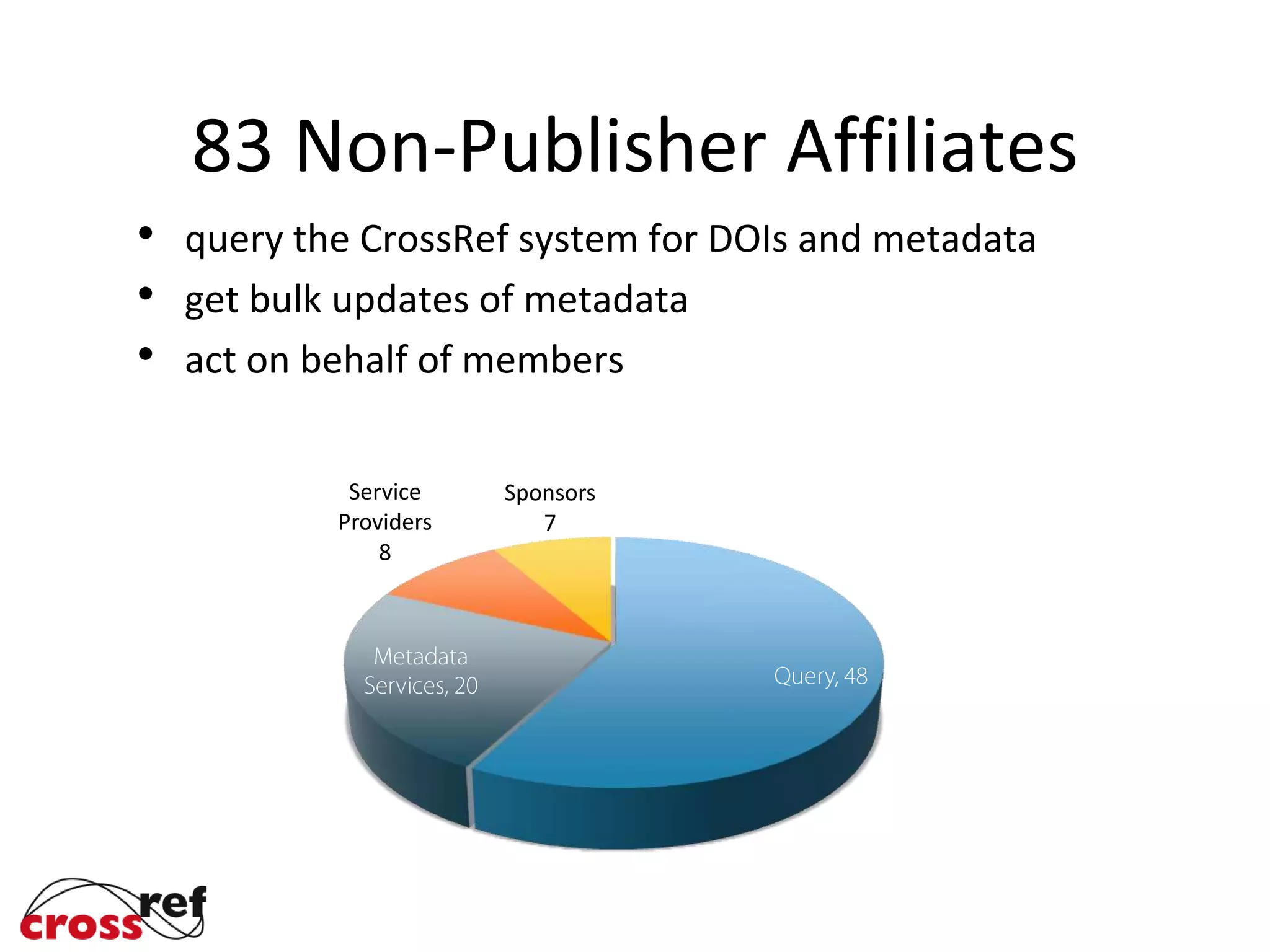
83 Non-Publisher Affiliates
query the CrossRef system for DOIs and metadata
get bulk updates of metadata
act on behalf of members
Service
Providers
8
Sponsors
7
What do academic &
research libraries have
to do with CrossRef?a. They send metadata queries to discover DOIs
b. They use CrossRef metadata to direct their users to the
licensed copy of an article
c. They assign DOIs to scholarly documents hosted in
institutional repositories
d. They educate students on reference skills including using
DOIs in academic papers
e. All of the above
f. None of the above
e.
CrossRef has 2000
Library Affiliates
Library Affiliates do substantial volume of querying at
CrossRef
Link Resolvers supplement library user metadata with
CrossRef metadata and/or DOIs. The link resolver looks up
institution’s holdings to direct users to a licensed copy.
Libraries join CrossRef as Publisher Members to assign
DOIs to content.
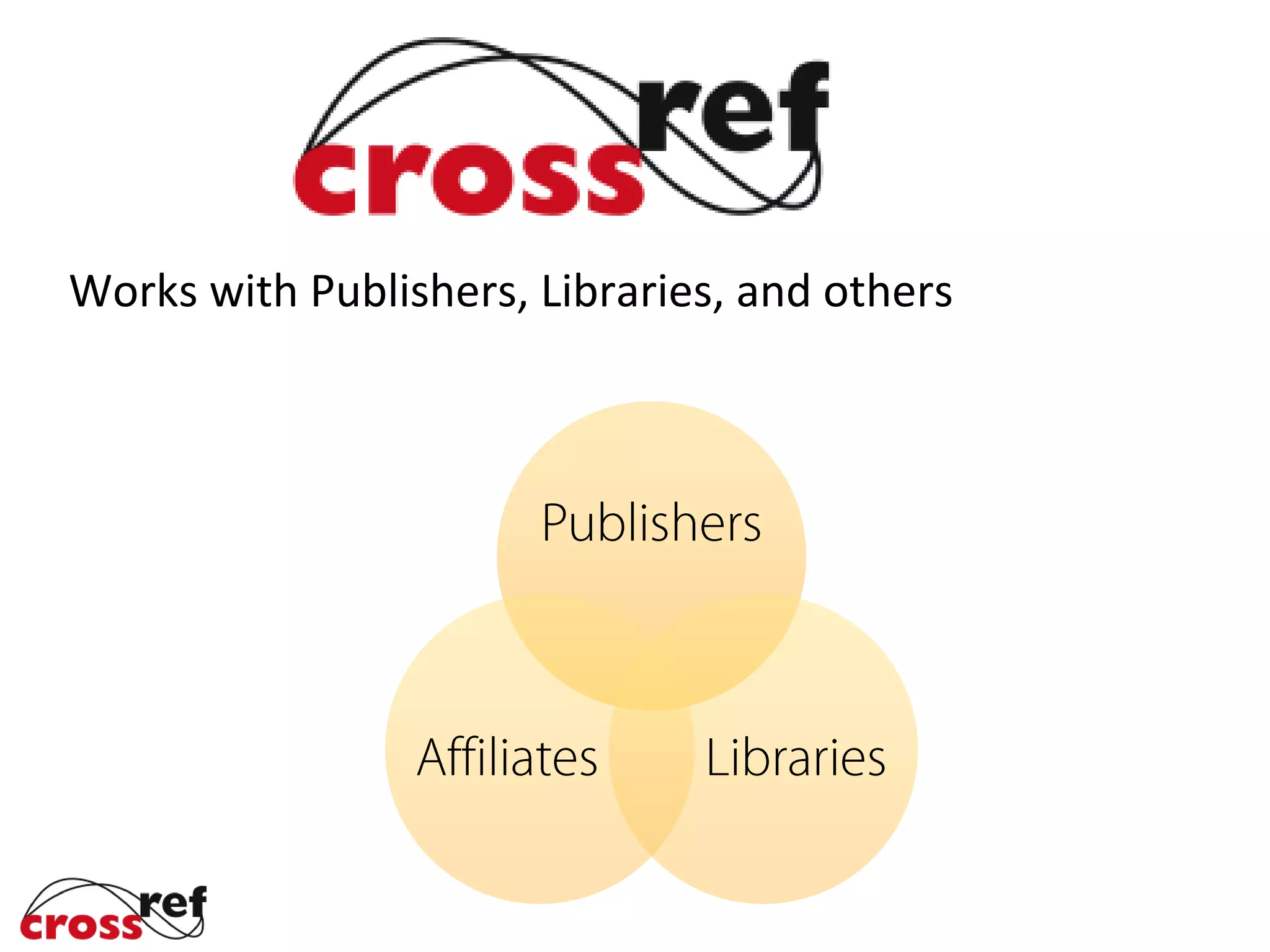
Works with Publishers, Libraries, and others
What is Forward
Linking?a. A way to tell which of your article references will
have content to link to in the future
b. The strategic planning process at CrossRef
c. Another name for CrossRef Cited-By Linking
d. All of the above
e. None of the Above
.
Cited-by Linking
Forward Linking was the original name for Cited-By
Linking, because links would be created to the article
(not from the article) after subsequent articles cited it.
Forward Linking should not be confused with Stored
Queries, which save unmatched queries at the time of
production and alert the publisher when DOIs are
assigned to the non-matched references.
b.
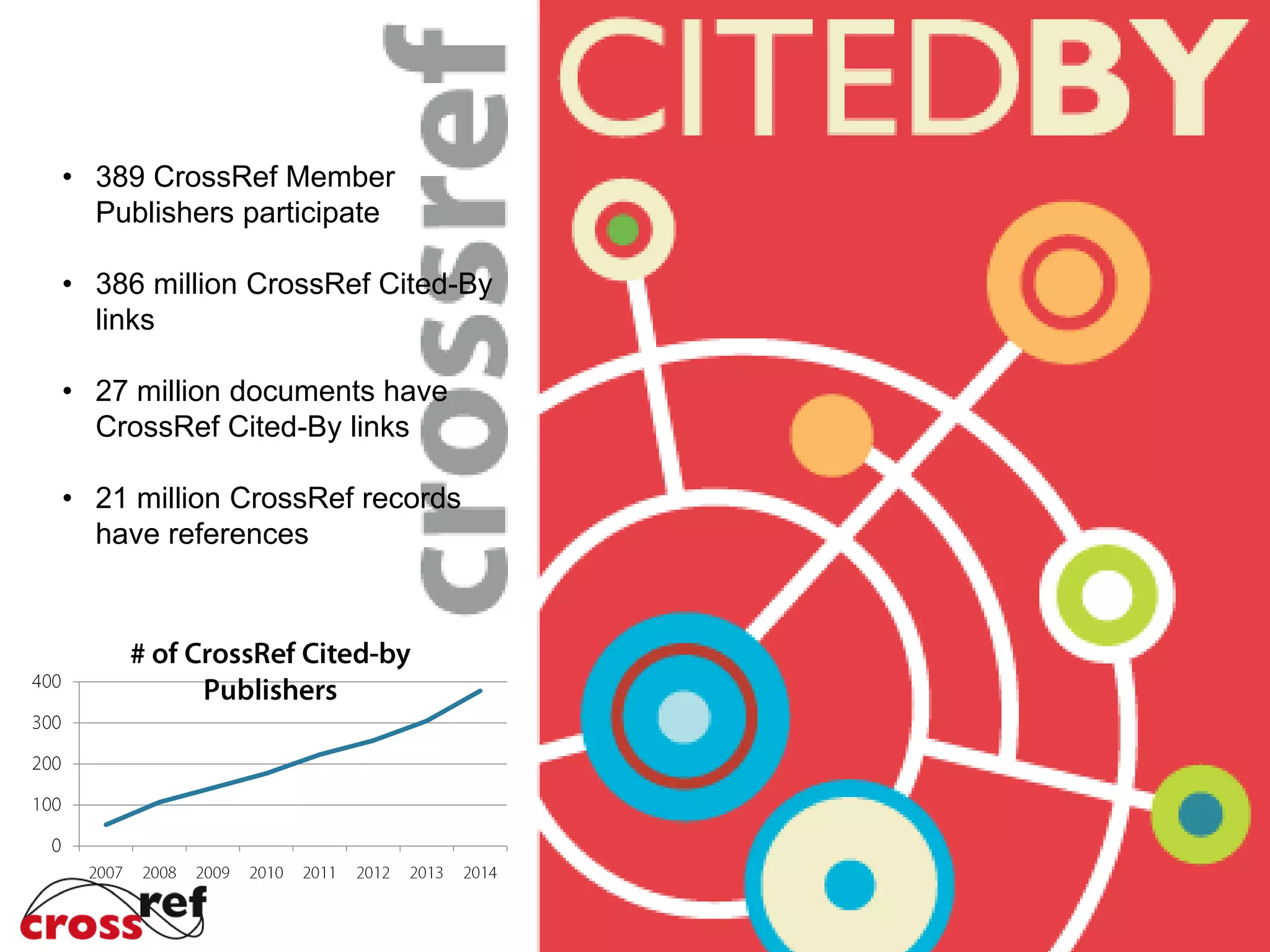
• 389 CrossRef Member
Publishers participate
• 386 million CrossRef Cited-By
links
• 27 million documents have
CrossRef Cited-By links
• 21 million CrossRef records
have references
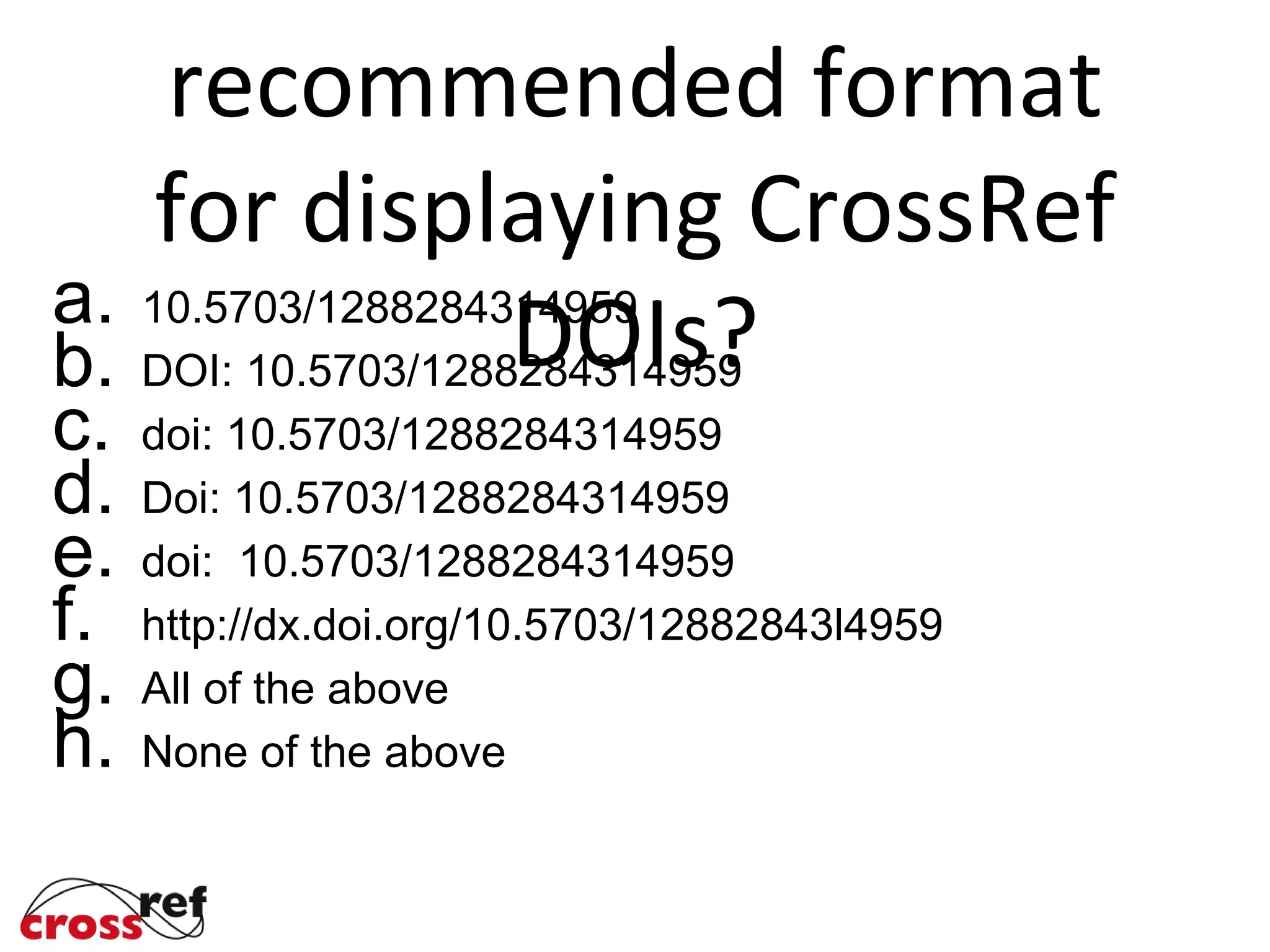
recommended format
for displaying CrossRef
DOIs?a. 10.5703/1288284314959
b. DOI: 10.5703/1288284314959
c. doi: 10.5703/1288284314959
d. Doi: 10.5703/1288284314959
e. doi: 10.5703/1288284314959
f. http://dx.doi.org/10.5703/12882843l4959
g. All of the above
h. None of the above
f.
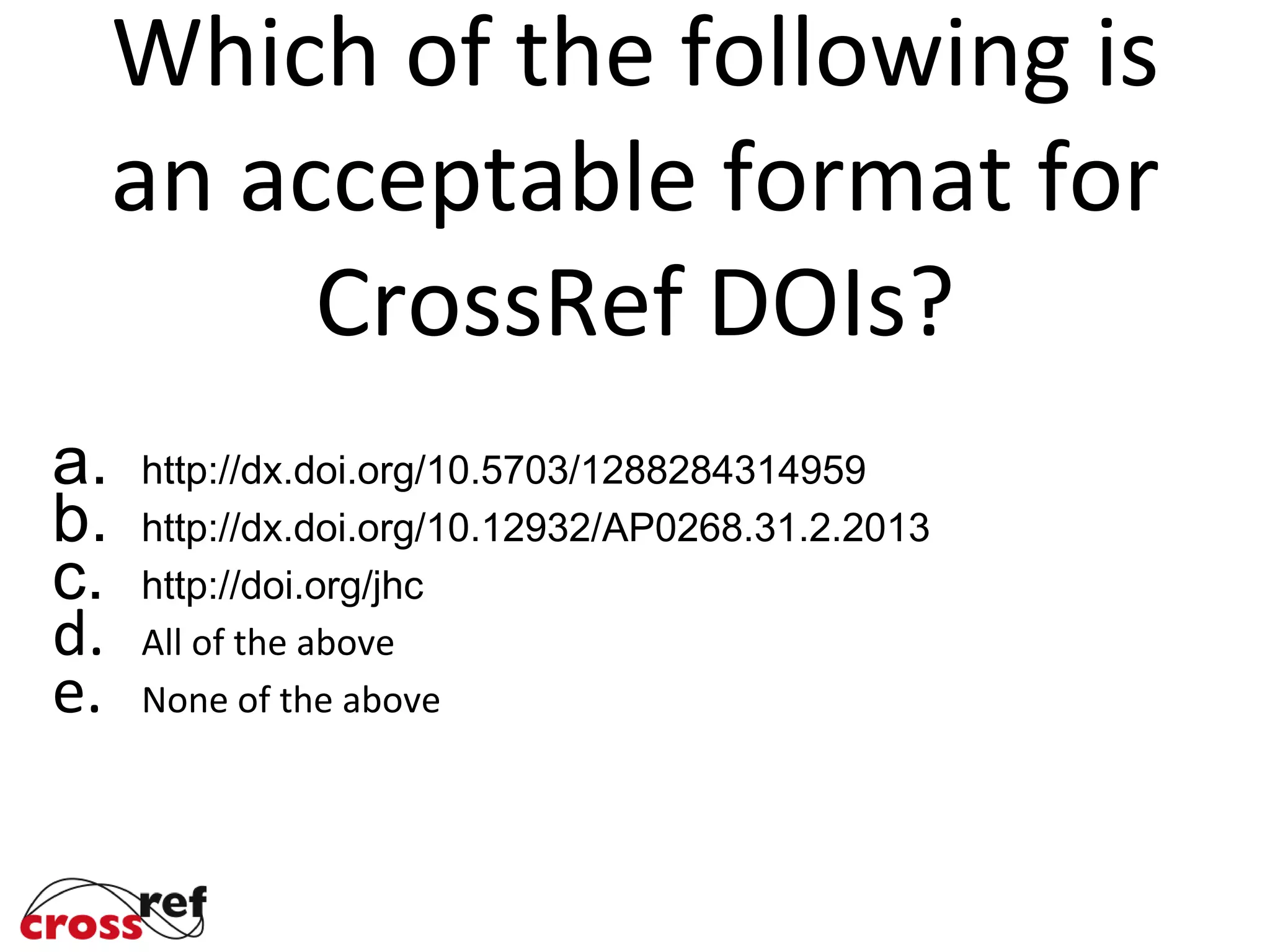
Which of the following is
an acceptable format for
CrossRef DOIs?
a. http://dx.doi.org/10.5703/1288284314959
b. http://dx.doi.org/10.12932/AP0268.31.2.2013
c. http://doi.org/jhc
d. All of the above
e. None of the above
d.
DOIs should be displayed as URIs (aka URLs) so they
are not only unique but they resolve.
Unwieldy DOIs can be shortened at shortdoi.org. Or
better yet, choose a short naming scheme.
CrossRef has exhausted all the “10.” prefixes with 6
digits and earlier this year began assigning 7 digit
prefixes.
http://shortdoi.org
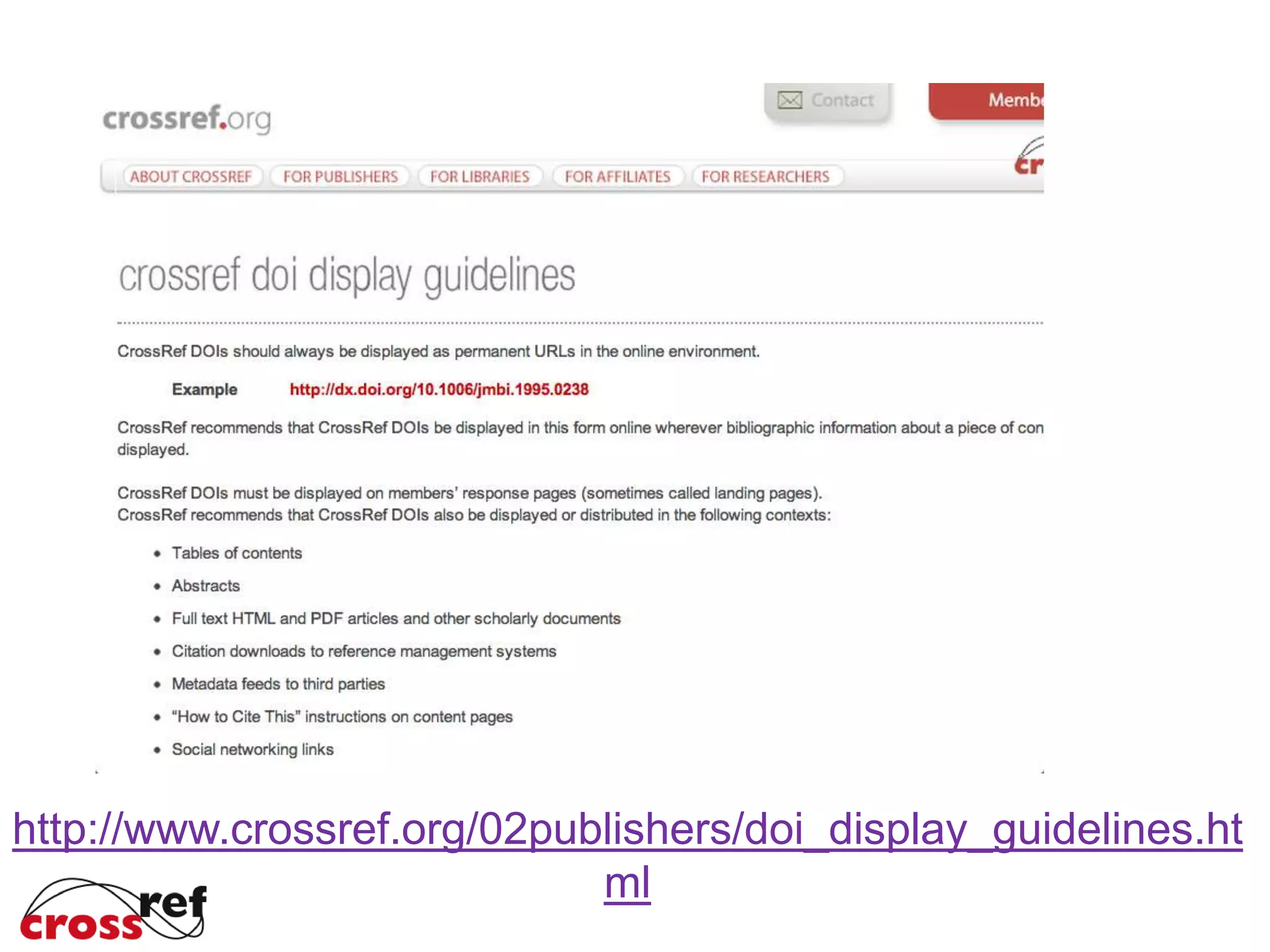
http://www.crossref.org/02publishers/doi_display_guidelines.ht
ml
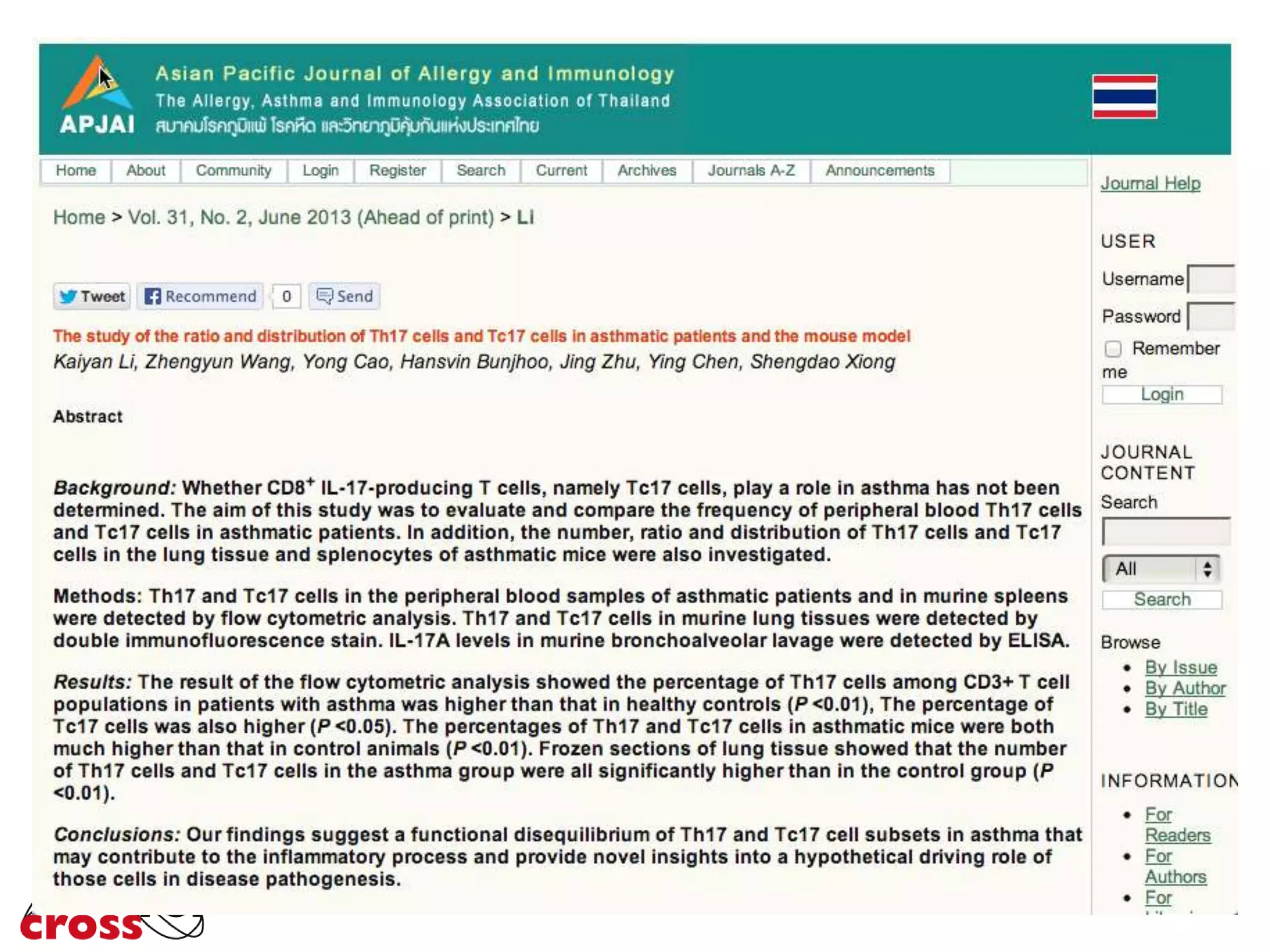
Take a look at the
following page
What is missing?
c.
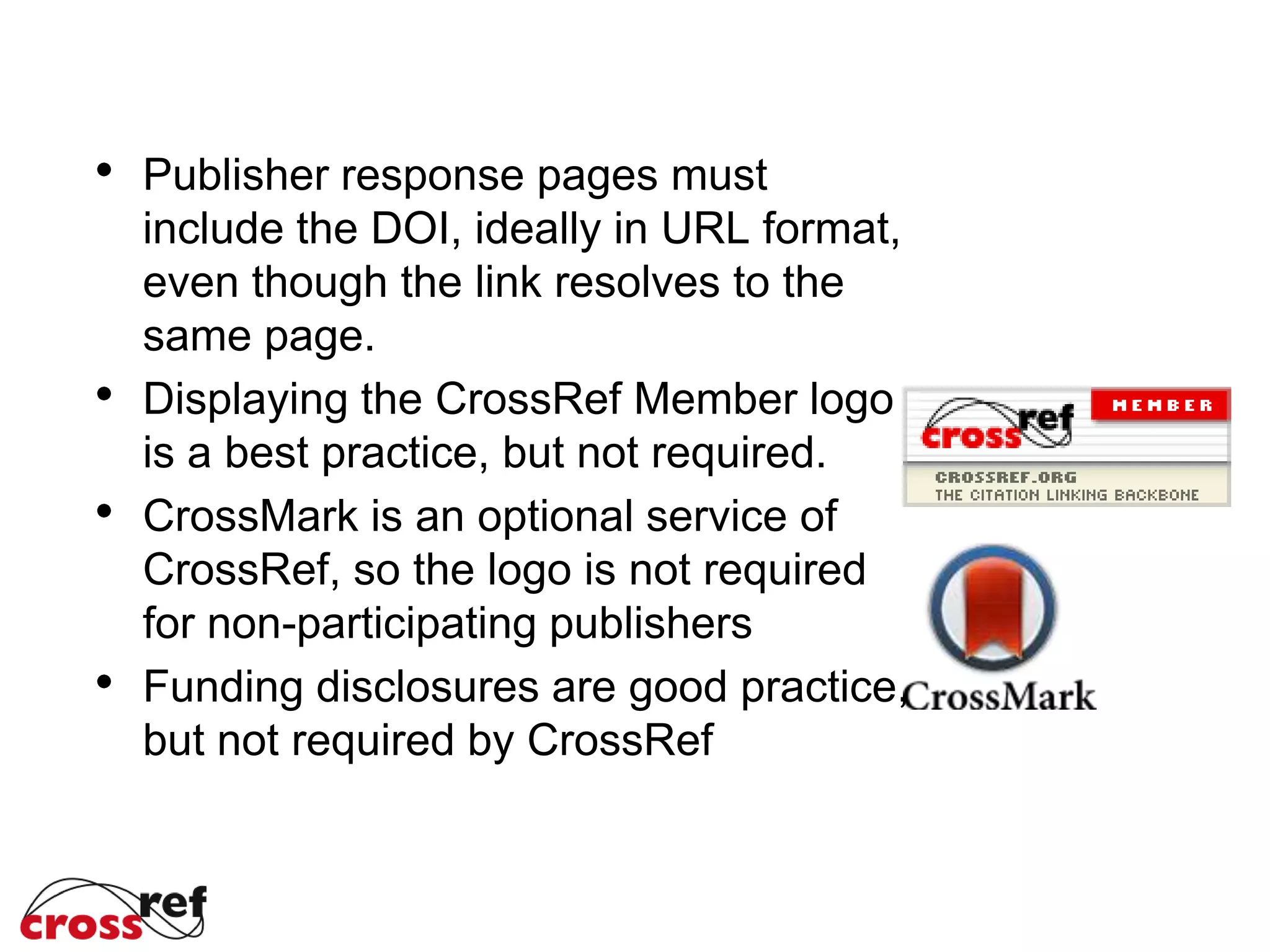
Publisher response pages must
include the DOI, ideally in URL format,
even though the link resolves to the
same page.
Displaying the CrossRef Member logo
is a best practice, but not required.
CrossMark is an optional service of
CrossRef, so the logo is not required
for non-participating publishers
Funding disclosures are good practice,
but not required by CrossRef
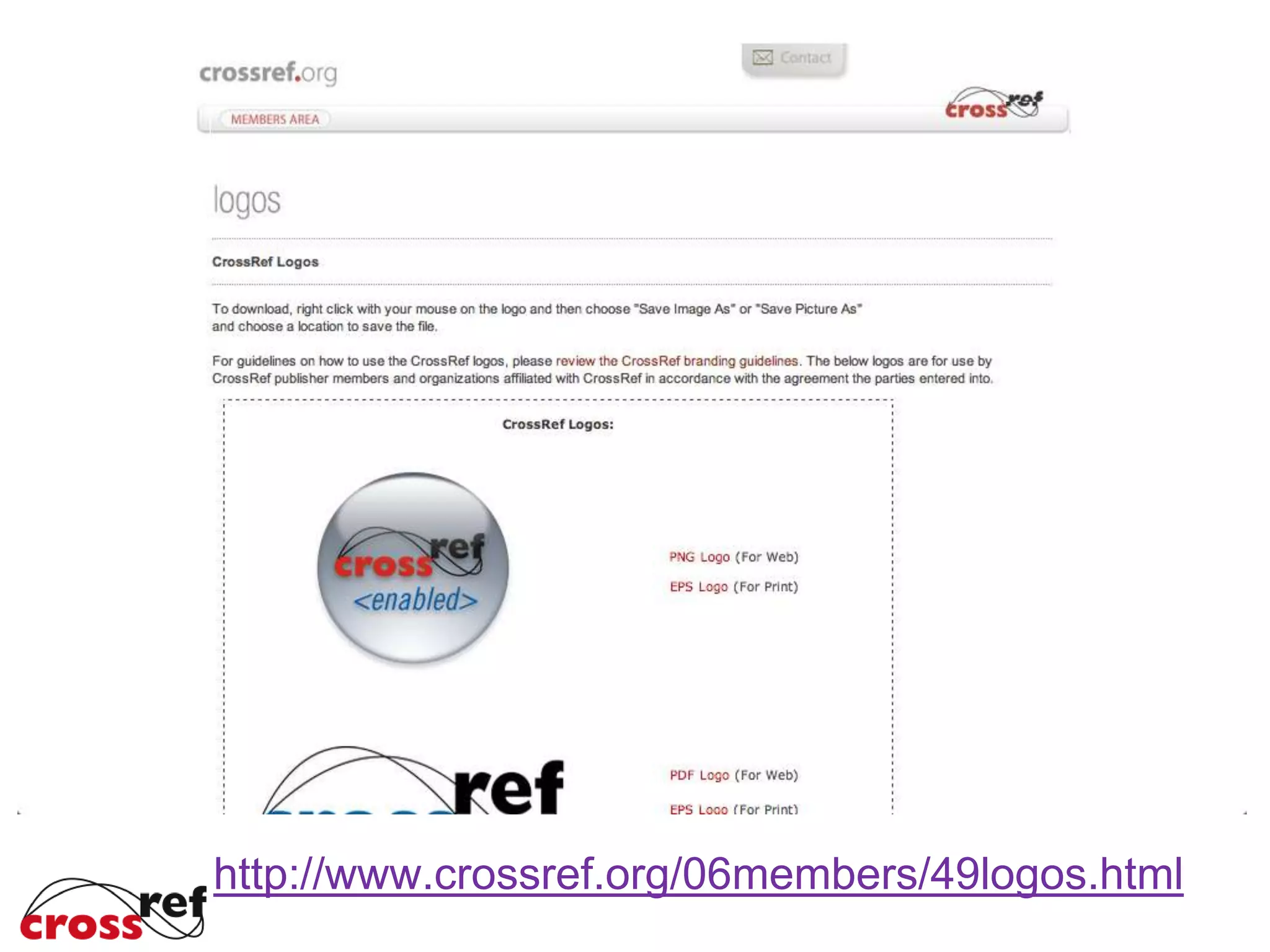
http://www.crossref.org/06members/49logos.html
When did CrossRef start allowing
publishers to assign DOIs to books?
a. 2000
b. 2005
c. 2010
d. Never, CrossRef doesn’t support book DOIs
e. None of the above
b
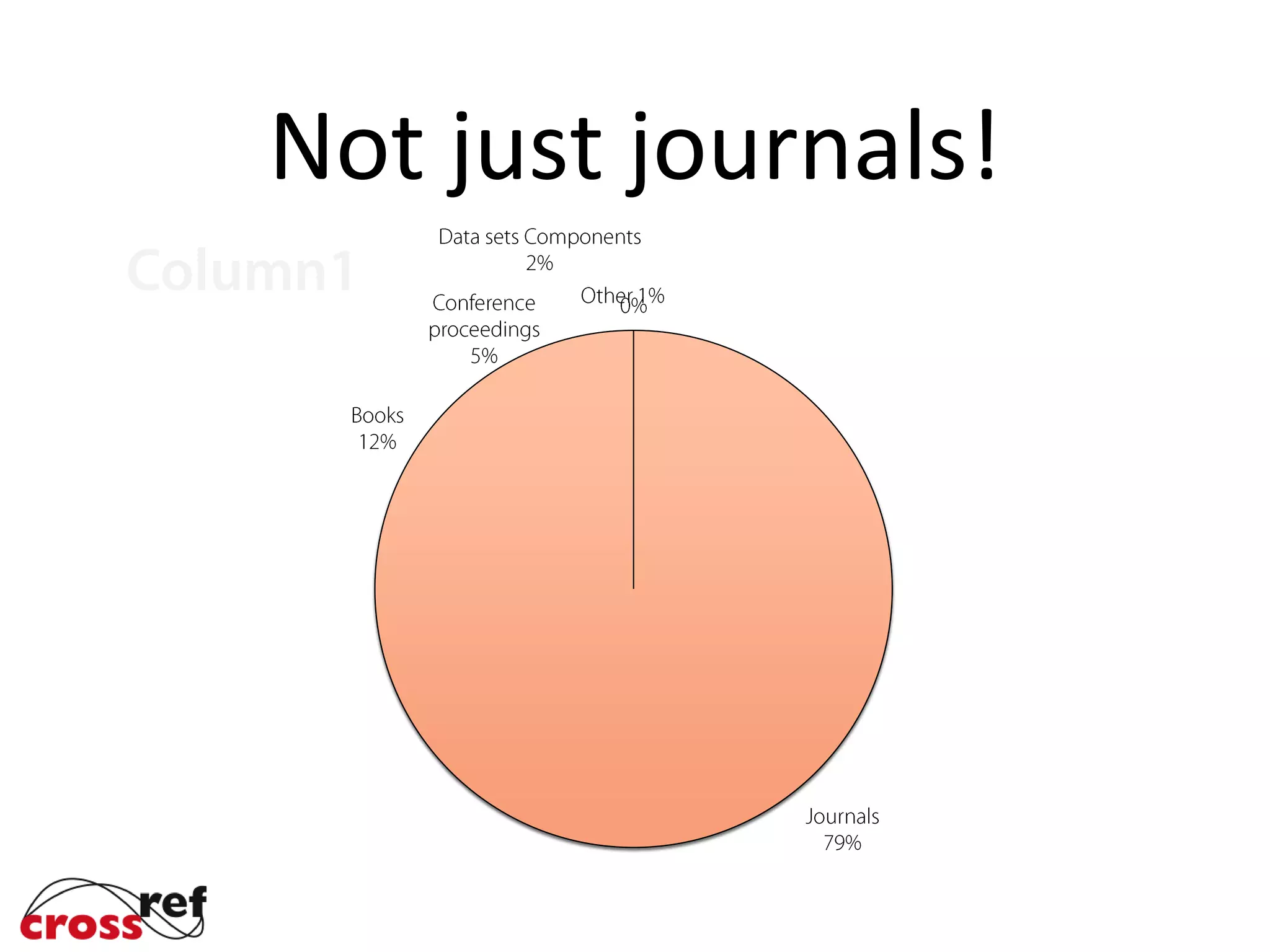
Not just journals!
Choose the answer that best
describes CrossRef
a.
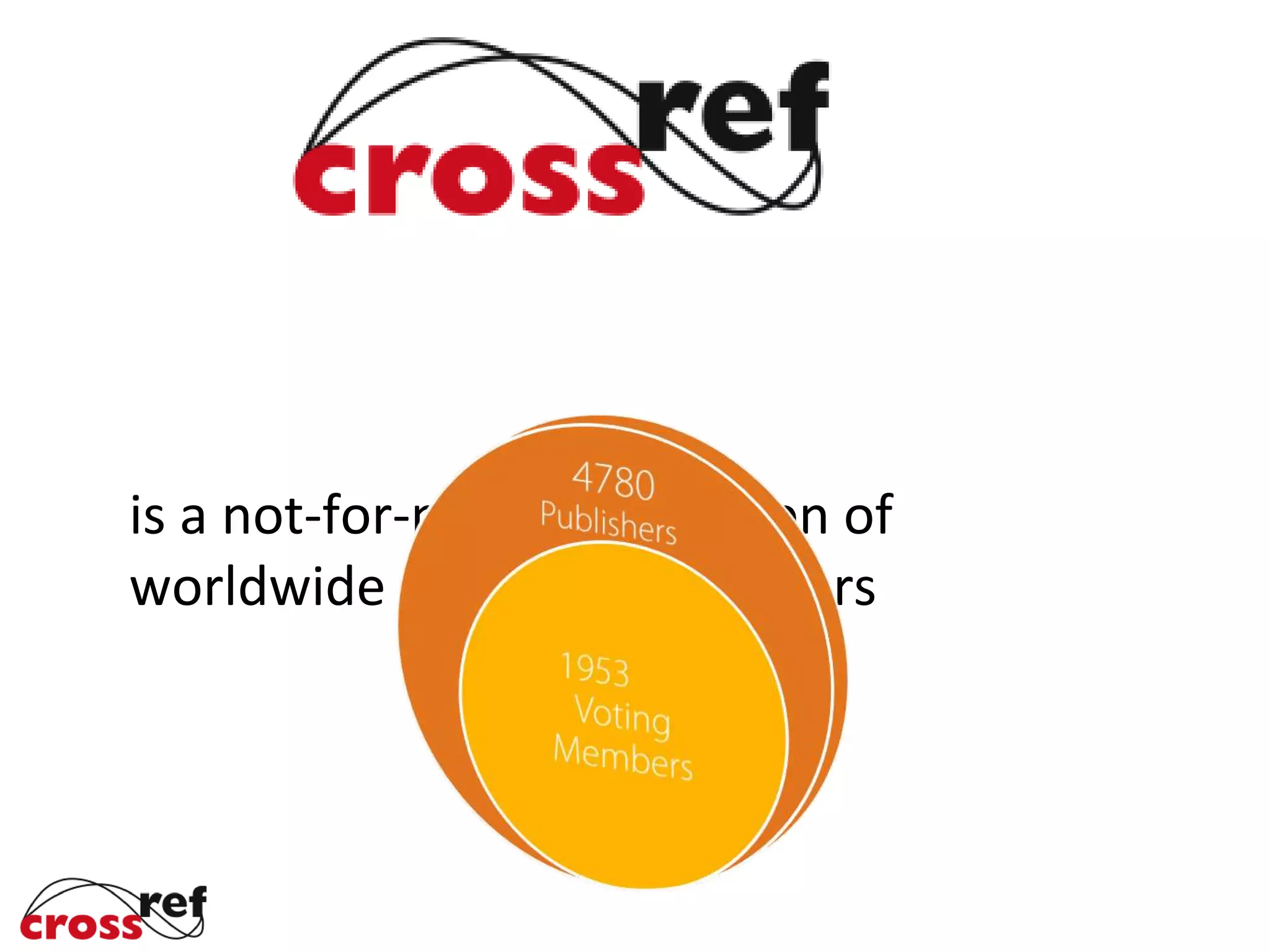
is a not-for-profit association of
worldwide scholarly publishers
CrossRef is not-for-profit
Organized as a trade association in New York
Financially independent
Members include publishers with both open access
and subscription models
Governed by a volunteer board of directors elected by
members,
http://www.crossref.org/02publishers/20pub_fees.html#deposit
What is the fastest growing content
type at CrossRef?
b.
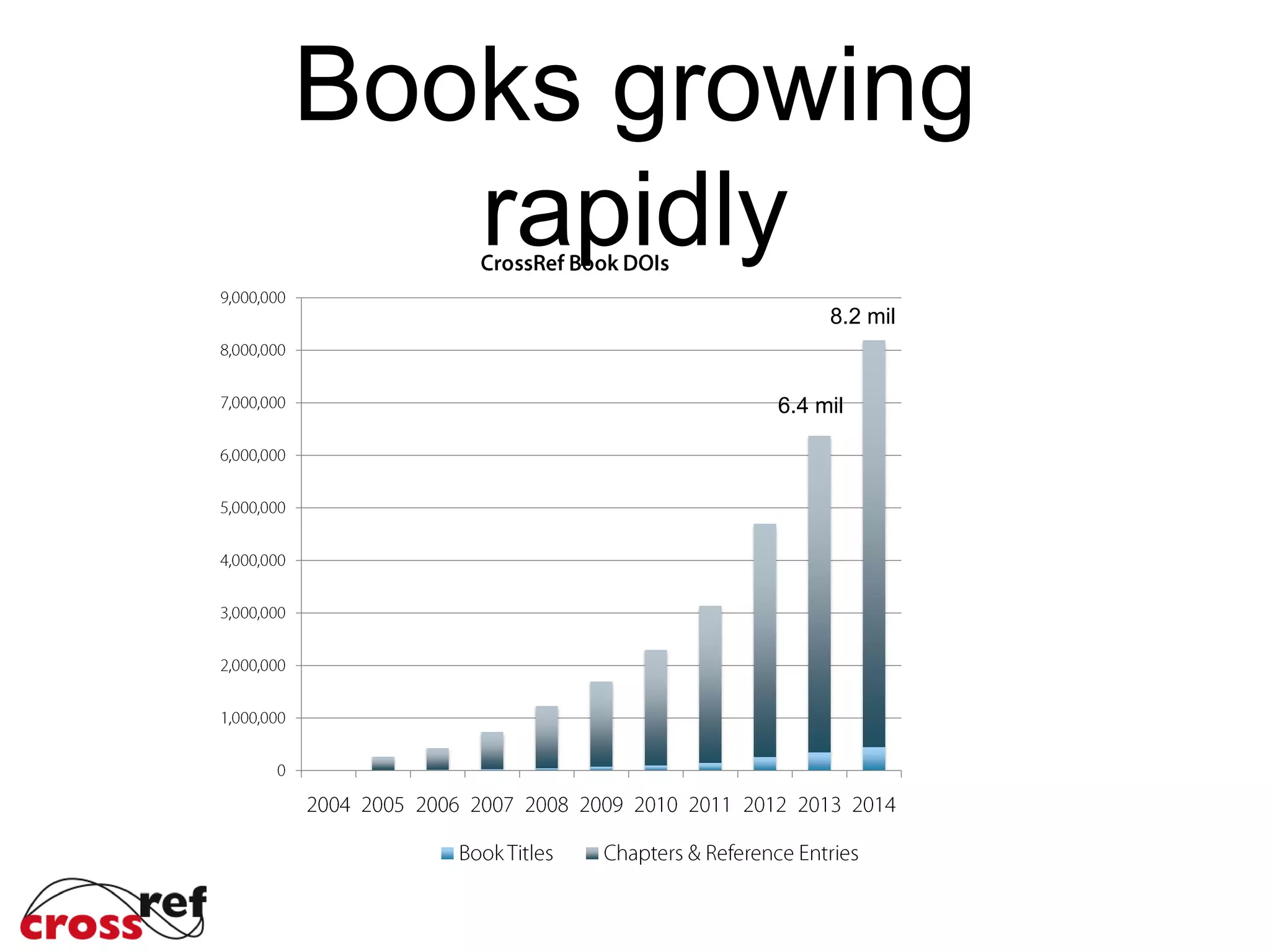
8.2 mil
6.4 mil
Books growing
rapidly
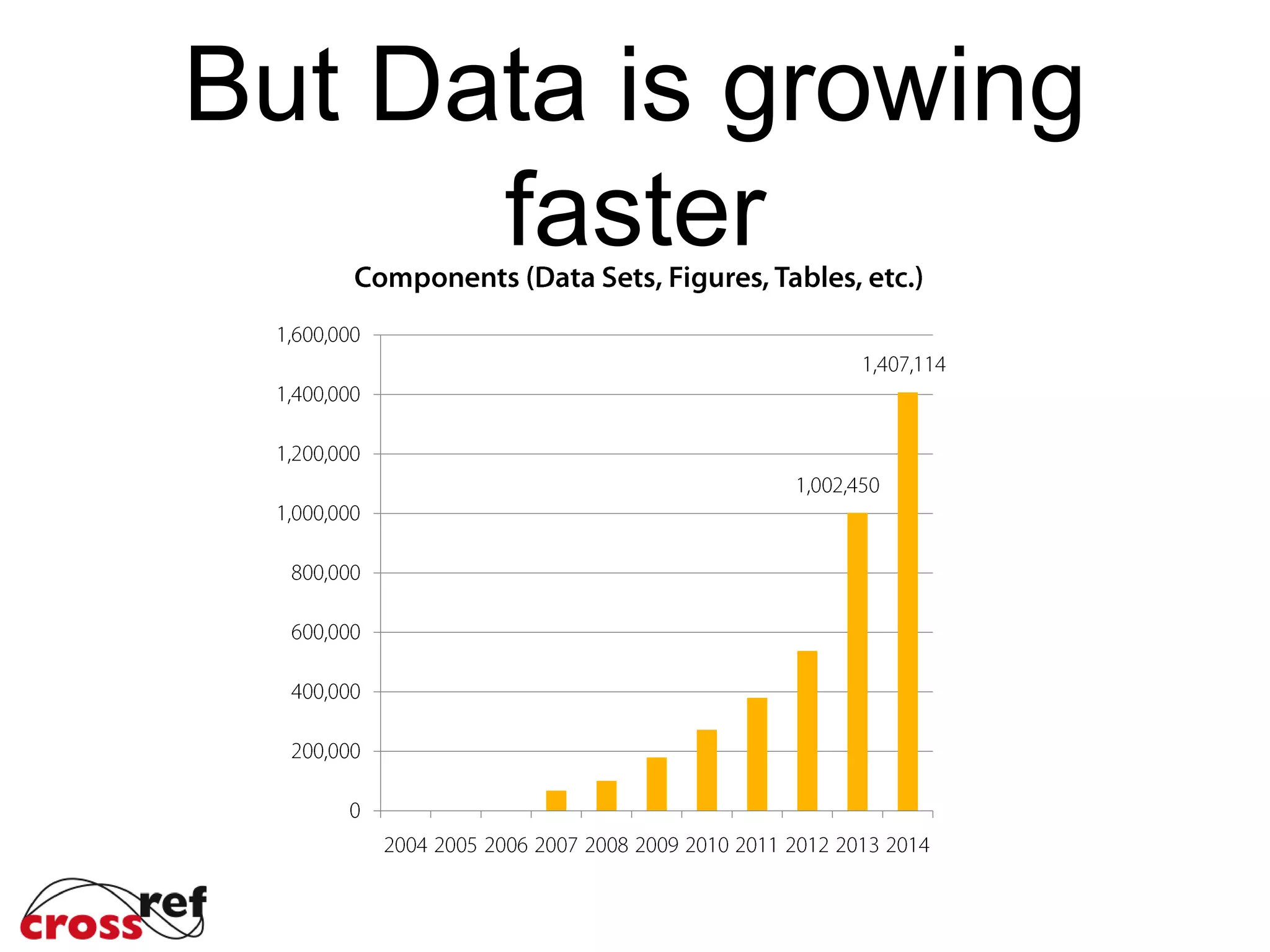
But Data is growing
faster
How can my publication cite
supplementary data and other material?
a.Assign a DOI at CrossRef
b.Cite the data in the reference section using the
DataCite or CrossRef DOI
c. Host the data at my organization
d.Have the author host the data at his or her
institution
e.All of the above
f. None of the above
If I have supplementary data, I need
to join DataCite to assign DOIs
a. True
b. False
b.
CrossRef has been assigning DOIs to
components, including data sets, figures,
tables, and graphics since 2007.
The difference between different DOI
registration agencies is one of community, not
content type.
CrossRef assigns DOIs for the scholarly
publishing community. DataCite works with the
library community and institutional repositories.
Almost 1.5 million data
items/figures/components
have CrossRef DOIs
Protein Data Bank
International Union of Crystallography (IUCR)
Organization for Economic Development (OECD)
Public Library of Science (PLoS)
How much does a DOI cost at
CrossRef?
a.$1
b.25¢
c.15¢
d..06¢
e.All of the above
f. None of the above
CrossRef doesn’t sell DOIs
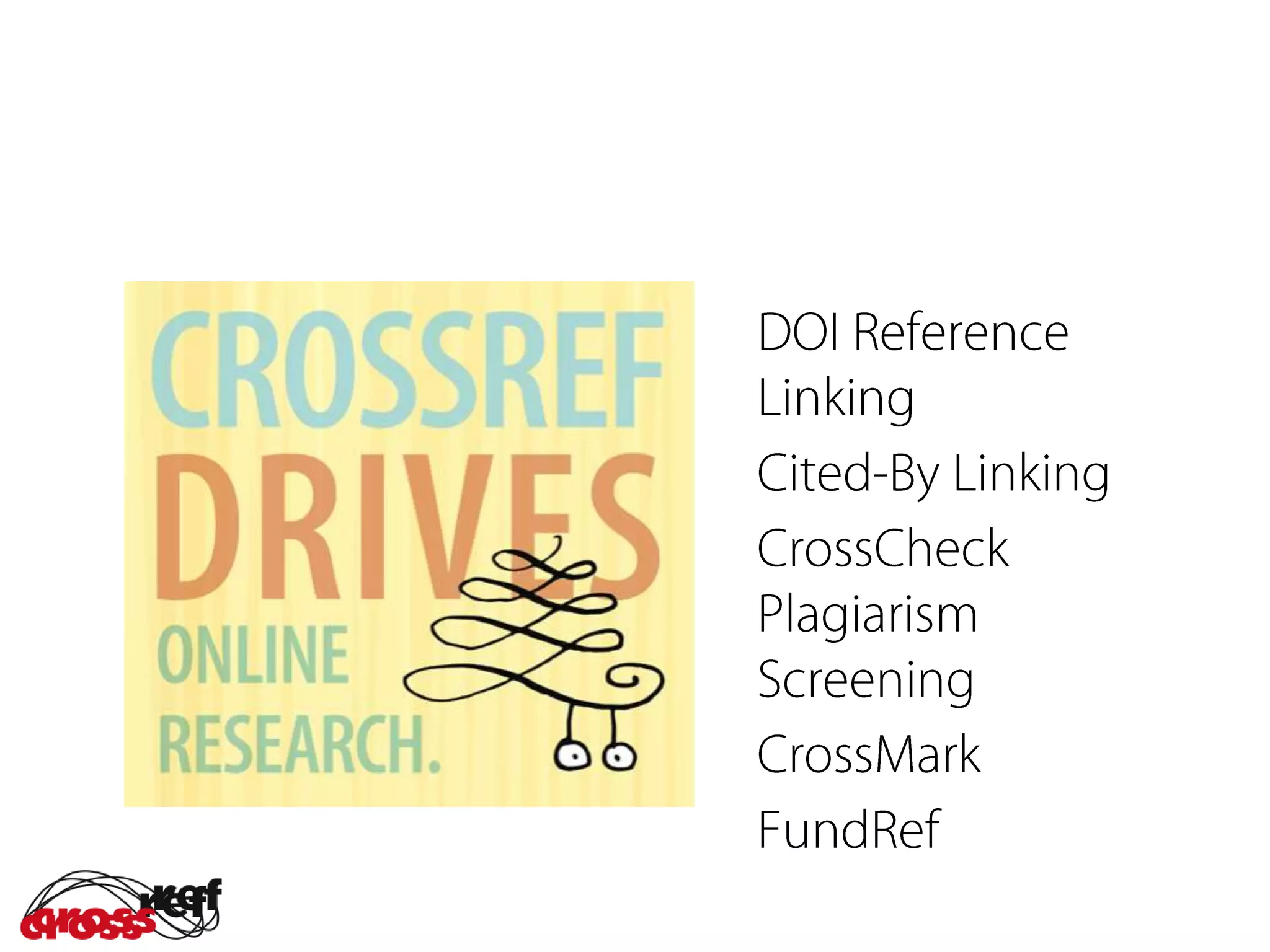
It provides services around DOIs like reference linking,
plagiarism screening, discoverability, metadata
distribution, update indicators, funding metadata.
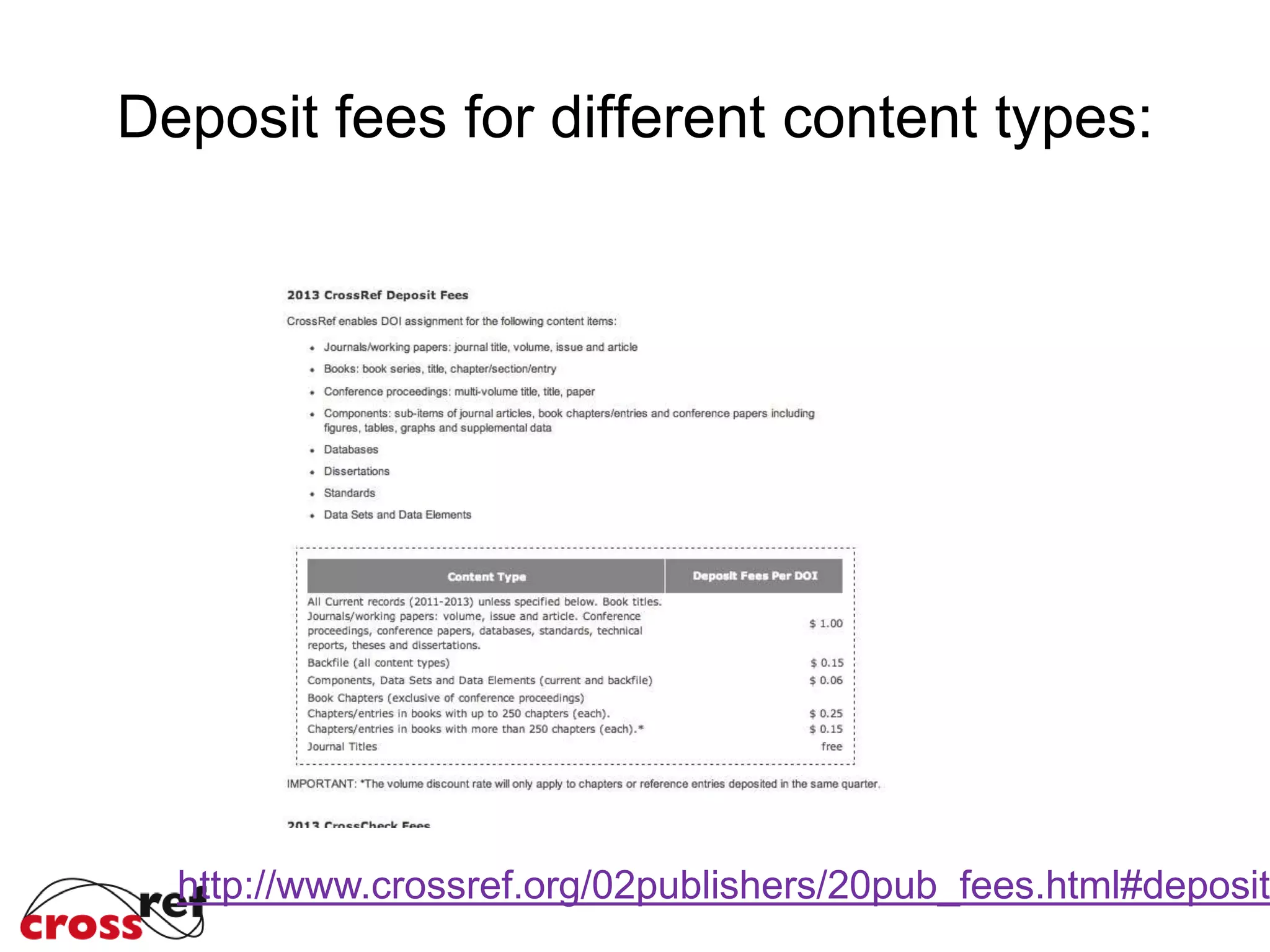
Deposit fees for different content types:
http://www.crossref.org/02publishers/20pub_fees.html#deposit
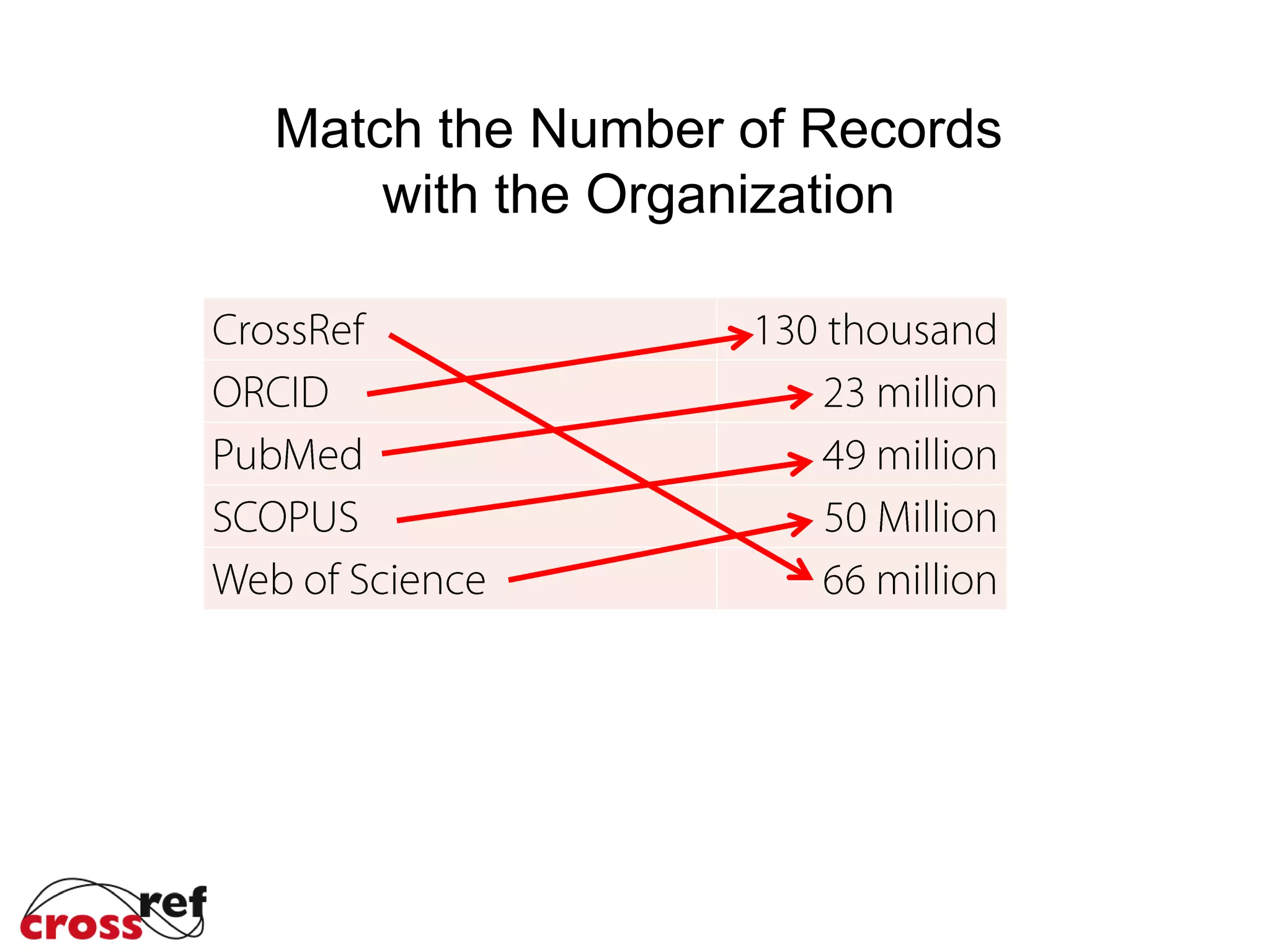
Match the Number of Records
with the Organization
How many times per month does
someone click on or resolve a CrossRef
DOI?
a. 5 million
b. 10 million
c. 100 million
d. 1 trillion
In Summary
What’s in it for
publishers?
Photo by Joi Ito
Carol Anne Meyer
cmeyer@crossref.org
Twitter: @meyercarol
Thank You!

Barcelona 2014: An Introduction to CrossRef by Carol Meyer

  • 2.
    What was thefirst service CrossRef offered? b.
  • 4.
    What does DOIstand for? g.
  • 5.
  • 6.
    DOI is atrademark of the International DOI Foundation The IDF appoints registration agencies like CrossRef www.doi.org
  • 7.
    What types ofcontent have DOIs? g.
  • 8.
  • 10.
    Which type of organizationwas not originally eligible to participate in CrossRef? a.Commercial Publishers b.Society Publishers c. Non-US Publishers d.Secondary Publishers d.
  • 11.
    CrossRef was foundedby a diverse group of publishers: commercial companies, not-for-profit societies, and publishers from North America, the UK, and Europe. Abstracting and Indexing publishers, though, not eligible for membership, quickly became able to participate as Affiliates.
  • 12.
    83 Non-Publisher Affiliates querythe CrossRef system for DOIs and metadata get bulk updates of metadata act on behalf of members Service Providers 8 Sponsors 7
  • 13.
    What do academic& research libraries have to do with CrossRef?a. They send metadata queries to discover DOIs b. They use CrossRef metadata to direct their users to the licensed copy of an article c. They assign DOIs to scholarly documents hosted in institutional repositories d. They educate students on reference skills including using DOIs in academic papers e. All of the above f. None of the above e.
  • 14.
    CrossRef has 2000 LibraryAffiliates Library Affiliates do substantial volume of querying at CrossRef Link Resolvers supplement library user metadata with CrossRef metadata and/or DOIs. The link resolver looks up institution’s holdings to direct users to a licensed copy. Libraries join CrossRef as Publisher Members to assign DOIs to content.
  • 15.
    Works with Publishers,Libraries, and others
  • 16.
    What is Forward Linking?a.A way to tell which of your article references will have content to link to in the future b. The strategic planning process at CrossRef c. Another name for CrossRef Cited-By Linking d. All of the above e. None of the Above .
  • 17.
    Cited-by Linking Forward Linkingwas the original name for Cited-By Linking, because links would be created to the article (not from the article) after subsequent articles cited it. Forward Linking should not be confused with Stored Queries, which save unmatched queries at the time of production and alert the publisher when DOIs are assigned to the non-matched references. b.
  • 18.
    • 389 CrossRefMember Publishers participate • 386 million CrossRef Cited-By links • 27 million documents have CrossRef Cited-By links • 21 million CrossRef records have references
  • 21.
    recommended format for displayingCrossRef DOIs?a. 10.5703/1288284314959 b. DOI: 10.5703/1288284314959 c. doi: 10.5703/1288284314959 d. Doi: 10.5703/1288284314959 e. doi: 10.5703/1288284314959 f. http://dx.doi.org/10.5703/12882843l4959 g. All of the above h. None of the above f.
  • 23.
    Which of thefollowing is an acceptable format for CrossRef DOIs? a. http://dx.doi.org/10.5703/1288284314959 b. http://dx.doi.org/10.12932/AP0268.31.2.2013 c. http://doi.org/jhc d. All of the above e. None of the above d.
  • 24.
    DOIs should bedisplayed as URIs (aka URLs) so they are not only unique but they resolve. Unwieldy DOIs can be shortened at shortdoi.org. Or better yet, choose a short naming scheme. CrossRef has exhausted all the “10.” prefixes with 6 digits and earlier this year began assigning 7 digit prefixes. http://shortdoi.org
  • 25.
  • 26.
    Take a lookat the following page
  • 28.
  • 29.
    Publisher response pagesmust include the DOI, ideally in URL format, even though the link resolves to the same page. Displaying the CrossRef Member logo is a best practice, but not required. CrossMark is an optional service of CrossRef, so the logo is not required for non-participating publishers Funding disclosures are good practice, but not required by CrossRef
  • 30.
  • 31.
    When did CrossRefstart allowing publishers to assign DOIs to books? a. 2000 b. 2005 c. 2010 d. Never, CrossRef doesn’t support book DOIs e. None of the above b
  • 32.
  • 33.
    Choose the answerthat best describes CrossRef a.
  • 34.
    is a not-for-profitassociation of worldwide scholarly publishers
  • 35.
    CrossRef is not-for-profit Organizedas a trade association in New York Financially independent Members include publishers with both open access and subscription models Governed by a volunteer board of directors elected by members, http://www.crossref.org/02publishers/20pub_fees.html#deposit
  • 37.
    What is thefastest growing content type at CrossRef? b.
  • 38.
    8.2 mil 6.4 mil Booksgrowing rapidly
  • 39.
    But Data isgrowing faster
  • 41.
    How can mypublication cite supplementary data and other material? a.Assign a DOI at CrossRef b.Cite the data in the reference section using the DataCite or CrossRef DOI c. Host the data at my organization d.Have the author host the data at his or her institution e.All of the above f. None of the above
  • 42.
    If I havesupplementary data, I need to join DataCite to assign DOIs a. True b. False b.
  • 43.
    CrossRef has beenassigning DOIs to components, including data sets, figures, tables, and graphics since 2007. The difference between different DOI registration agencies is one of community, not content type. CrossRef assigns DOIs for the scholarly publishing community. DataCite works with the library community and institutional repositories.
  • 44.
    Almost 1.5 milliondata items/figures/components have CrossRef DOIs Protein Data Bank International Union of Crystallography (IUCR) Organization for Economic Development (OECD) Public Library of Science (PLoS)
  • 45.
    How much doesa DOI cost at CrossRef? a.$1 b.25¢ c.15¢ d..06¢ e.All of the above f. None of the above
  • 46.
    CrossRef doesn’t sellDOIs It provides services around DOIs like reference linking, plagiarism screening, discoverability, metadata distribution, update indicators, funding metadata.
  • 47.
    Deposit fees fordifferent content types: http://www.crossref.org/02publishers/20pub_fees.html#deposit
  • 48.
    Match the Numberof Records with the Organization
  • 49.
    How many timesper month does someone click on or resolve a CrossRef DOI? a. 5 million b. 10 million c. 100 million d. 1 trillion
  • 51.
  • 52.
    What’s in itfor publishers?
  • 53.
  • 54.

Editor's Notes

  • #2 The IDF has appointed a number of registration agencies, and several of them assign DOIs to scholarly literature. For example, in Asia, Arity, CNKI, and ISTIC assign DOIs to scholarly articles written in Chinese. In Europe, mEDRA assigns DOIs to Italian language articles. DataCite works with a different community—institutions. It is quite decentralized, and authorizes member institutions to assign DOIs to data sets and other content. Bowker was a registration for a long time, but they decided not to be a registration agency any longer. In a completely different space, Movie Labs assigns DOIs to films. They call these Entertainment Industry Digital Registry? (EIDR)
  • #4 These numbers are as of Feb 28 2014Chart is January of each year.
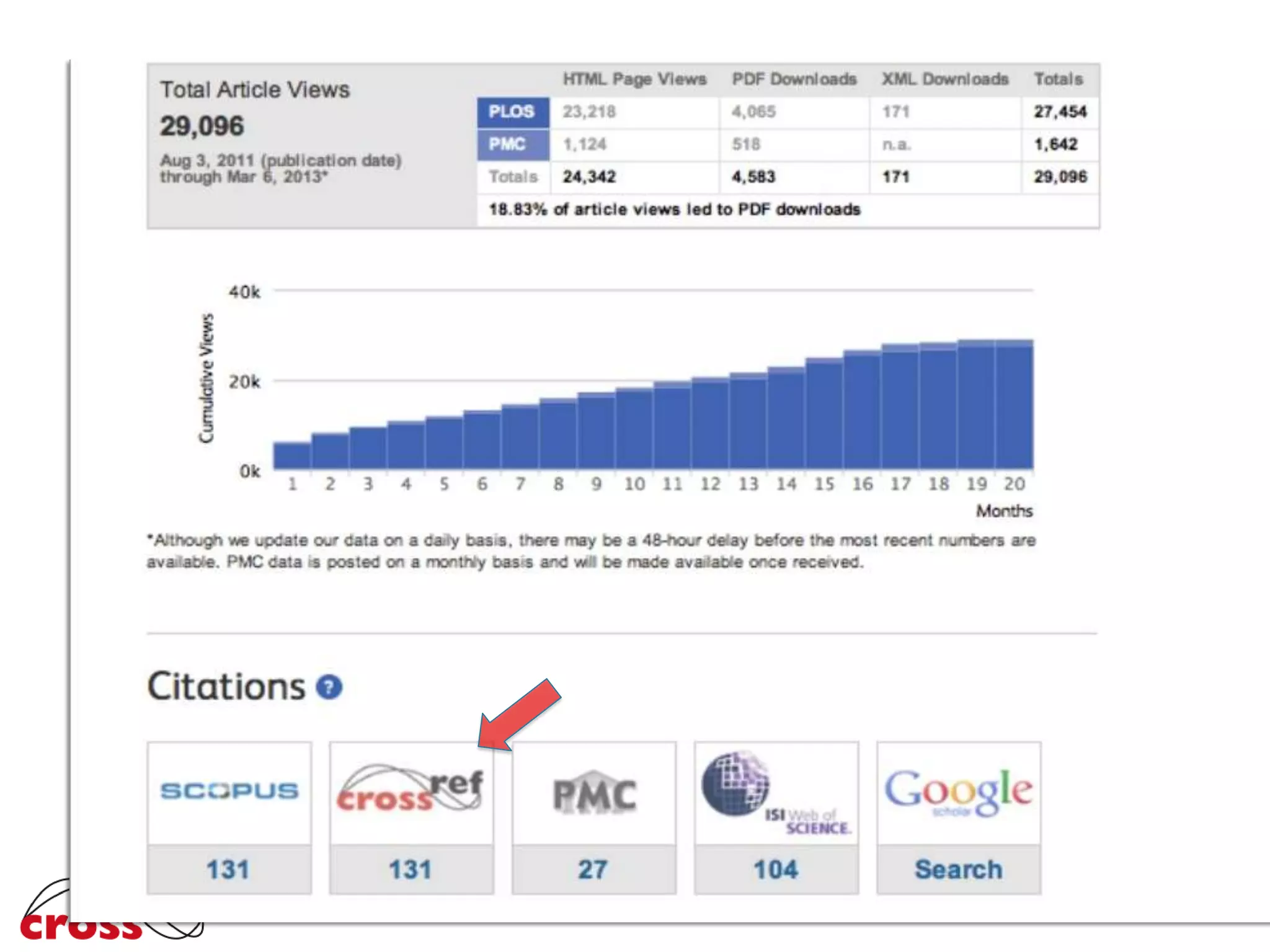
  • #5 Here’s an example of Cited by Links atPLoS featuring CrossRef Cited-by linksAdd an example from one of the Spanish attendees
  • #7 Add examples of Spanish publishers depositing something other than journals.
  • #8 Use examples of OA and subscription publishers in SpainShow geographical breakdown of board members
  • #10 Books grew 28% from 2013 to 2014: 7.7+ million chapters, reference entries, 450K titles
  • #11 Components grew 40% from 2013 to 2014