Philippines
Culture During
Pre-Hispanic
Period
Introduction
The cultural achievements of pre-
colonial Philippines include those covered
by prehistory and early history of the
Philippines archipelago and its
inhabitants, which are the indigenous
forebears of today's Filipino people.
Before the Spaniards came into the
Philippines there were existing culture of
the Filipinos which were not distinguished
by most of the filipinos especially for the
During the early period thousand years ago,
the early Filipinos were composed of
different groups that came from different
part of Asia. With different groups they
form their own community, system of
education and religious belief.
They group into different communities
composed of 50 to 2,000 individuals and
they construct their shelters in different
areas according to their lifestyle and
source of living. Usually they were situated
along the seashores, streams, rivers,
forests, fertile land areas and even in caves.
In water areas they look for fish, shells and
pearls as their source of living. They also
used boat and craft as there means of
transportation for an easier travel and
carrying their goods for trade from one
place to another. For those people located
in land areas they cultivate the land and
plant rice, bananas and crops. After the
Pre – Colonial Religion
During the pre-colonial time
there was already an
indigenous spiritual traditions
practiced by the people in the
Philippines. Generally, for lack
of better terminology
prehistoric people are
described to be animistic.
Their practice was a collection
of beliefs and cultural mores
anchored in the idea that the
world is inhabited by spirits
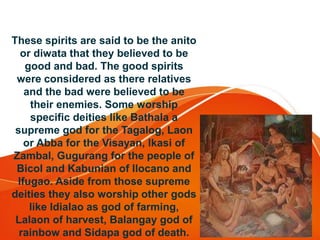
These spirits are said to be the anito
or diwata that they believed to be
good and bad. The good spirits
were considered as there relatives
and the bad were believed to be
their enemies. Some worship
specific deities like Bathala a
supreme god for the Tagalog, Laon
or Abba for the Visayan, Ikasi of
Zambal, Gugurang for the people of
Bicol and Kabunian of Ilocano and
Ifugao. Aside from those supreme
deities they also worship other gods
like Idialao as god of farming,
Lalaon of harvest, Balangay god of
rainbow and Sidapa god of death.
Others also worship the moon, stars,
caves, mountains, rivers, plants and
trees. Some creatures are being
worship too like the bird, crow,
tortoise, crocodile and other things
they believed has value and
connected to their lives.
The variation of animistic practices
occurs in different ethnic groups.
Magic, chants and prayers are often
key features. Its practitioners were
highly respected (and some feared)
in the community, as they were
healers, midwife (hilot), shamans,
witches and warlocks
(mangkukulam), babaylans, tribal
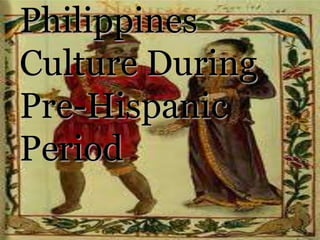
Clothing
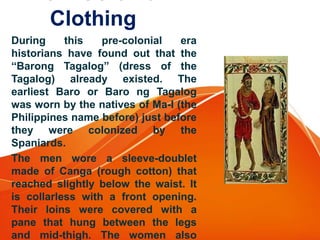
During this pre-colonial era
historians have found out that the
“Barong Tagalog” (dress of the
Tagalog) already existed. The
earliest Baro or Baro ng Tagalog
was worn by the natives of Ma-I (the
Philippines name before) just before
they were colonized by the
Spaniards.
The men wore a sleeve-doublet
made of Canga (rough cotton) that
reached slightly below the waist. It
is collarless with a front opening.
Their loins were covered with a
pane that hung between the legs
and mid-thigh. The women also
The Visayan men wore a jacket
with a Moorish style rob, that
reach down their feet and was
embroidered in beautiful
colours. Tagalog and Visayan
men bound their temples and
forehead with a “putong”
(a narrow strips of clothe).
They also wore gold jewellery
and other accessories to
beautify their bodies.
Pre – Colonial
Writing Systems
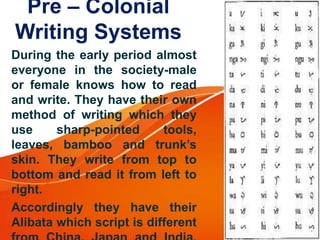
During the early period almost
everyone in the society-male
or female knows how to read
and write. They have their own
method of writing which they
use sharp-pointed tools,
leaves, bamboo and trunk’s
skin. They write from top to
bottom and read it from left to
right.
Accordingly they have their
Alibata which script is different
Government
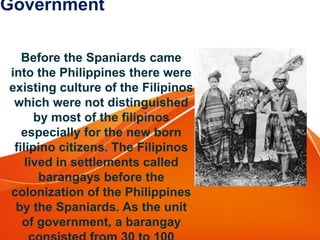
Before the Spaniards came
into the Philippines there were
existing culture of the Filipinos
which were not distinguished
by most of the filipinos
especially for the new born
filipino citizens. The Filipinos
lived in settlements called
barangays before the
colonization of the Philippines
by the Spaniards. As the unit
of government, a barangay
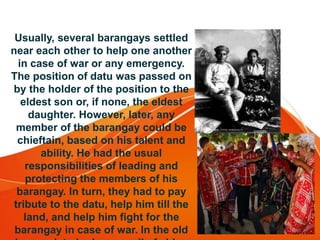
Usually, several barangays settled
near each other to help one another
in case of war or any emergency.
The position of datu was passed on
by the holder of the position to the
eldest son or, if none, the eldest
daughter. However, later, any
member of the barangay could be
chieftain, based on his talent and
ability. He had the usual
responsibilities of leading and
protecting the members of his
barangay. In turn, they had to pay
tribute to the datu, help him till the
land, and help him fight for the
barangay in case of war. In the old
Social Classes
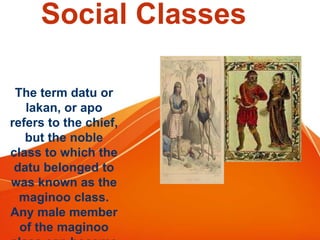
The term datu or
lakan, or apo
refers to the chief,
but the noble
class to which the
datu belonged to
was known as the
maginoo class.
Any male member
of the maginoo
The term timawa referring to freemen came
into use in the social structure of the
Tagalogs within just twenty years after the
coming of the Spaniards. The term, however,
was being incorrectly applied to former
alipin (commoner and slave class) who have
escaped bondage by payment, favor, or
flight. Moreover, the Tagalog timawa did not
have the military prominence of the Visayan
timawa. The equivalent warrior class in the
Tagalog society was present only in Laguna,
and they were known as the maharlika class.
At the bottom of the social hierarchy are the
members of the alipin class. There are two

Pre_colonial_period_130709085107_phpapp0.ppt

  • 1.
  • 2.
    Introduction The cultural achievementsof pre- colonial Philippines include those covered by prehistory and early history of the Philippines archipelago and its inhabitants, which are the indigenous forebears of today's Filipino people. Before the Spaniards came into the Philippines there were existing culture of the Filipinos which were not distinguished by most of the filipinos especially for the
  • 3.
    During the earlyperiod thousand years ago, the early Filipinos were composed of different groups that came from different part of Asia. With different groups they form their own community, system of education and religious belief. They group into different communities composed of 50 to 2,000 individuals and they construct their shelters in different areas according to their lifestyle and source of living. Usually they were situated along the seashores, streams, rivers, forests, fertile land areas and even in caves. In water areas they look for fish, shells and pearls as their source of living. They also used boat and craft as there means of transportation for an easier travel and carrying their goods for trade from one place to another. For those people located in land areas they cultivate the land and plant rice, bananas and crops. After the
  • 4.
    Pre – ColonialReligion During the pre-colonial time there was already an indigenous spiritual traditions practiced by the people in the Philippines. Generally, for lack of better terminology prehistoric people are described to be animistic. Their practice was a collection of beliefs and cultural mores anchored in the idea that the world is inhabited by spirits
  • 5.
    These spirits aresaid to be the anito or diwata that they believed to be good and bad. The good spirits were considered as there relatives and the bad were believed to be their enemies. Some worship specific deities like Bathala a supreme god for the Tagalog, Laon or Abba for the Visayan, Ikasi of Zambal, Gugurang for the people of Bicol and Kabunian of Ilocano and Ifugao. Aside from those supreme deities they also worship other gods like Idialao as god of farming, Lalaon of harvest, Balangay god of rainbow and Sidapa god of death.
  • 6.
    Others also worshipthe moon, stars, caves, mountains, rivers, plants and trees. Some creatures are being worship too like the bird, crow, tortoise, crocodile and other things they believed has value and connected to their lives. The variation of animistic practices occurs in different ethnic groups. Magic, chants and prayers are often key features. Its practitioners were highly respected (and some feared) in the community, as they were healers, midwife (hilot), shamans, witches and warlocks (mangkukulam), babaylans, tribal
  • 7.
    Clothing During this pre-colonialera historians have found out that the “Barong Tagalog” (dress of the Tagalog) already existed. The earliest Baro or Baro ng Tagalog was worn by the natives of Ma-I (the Philippines name before) just before they were colonized by the Spaniards. The men wore a sleeve-doublet made of Canga (rough cotton) that reached slightly below the waist. It is collarless with a front opening. Their loins were covered with a pane that hung between the legs and mid-thigh. The women also
  • 8.
    The Visayan menwore a jacket with a Moorish style rob, that reach down their feet and was embroidered in beautiful colours. Tagalog and Visayan men bound their temples and forehead with a “putong” (a narrow strips of clothe). They also wore gold jewellery and other accessories to beautify their bodies.
  • 9.
    Pre – Colonial WritingSystems During the early period almost everyone in the society-male or female knows how to read and write. They have their own method of writing which they use sharp-pointed tools, leaves, bamboo and trunk’s skin. They write from top to bottom and read it from left to right. Accordingly they have their Alibata which script is different
  • 10.
    Government Before the Spaniardscame into the Philippines there were existing culture of the Filipinos which were not distinguished by most of the filipinos especially for the new born filipino citizens. The Filipinos lived in settlements called barangays before the colonization of the Philippines by the Spaniards. As the unit of government, a barangay
  • 11.
    Usually, several barangayssettled near each other to help one another in case of war or any emergency. The position of datu was passed on by the holder of the position to the eldest son or, if none, the eldest daughter. However, later, any member of the barangay could be chieftain, based on his talent and ability. He had the usual responsibilities of leading and protecting the members of his barangay. In turn, they had to pay tribute to the datu, help him till the land, and help him fight for the barangay in case of war. In the old
  • 12.
    Social Classes The termdatu or lakan, or apo refers to the chief, but the noble class to which the datu belonged to was known as the maginoo class. Any male member of the maginoo
  • 13.
    The term timawareferring to freemen came into use in the social structure of the Tagalogs within just twenty years after the coming of the Spaniards. The term, however, was being incorrectly applied to former alipin (commoner and slave class) who have escaped bondage by payment, favor, or flight. Moreover, the Tagalog timawa did not have the military prominence of the Visayan timawa. The equivalent warrior class in the Tagalog society was present only in Laguna, and they were known as the maharlika class. At the bottom of the social hierarchy are the members of the alipin class. There are two