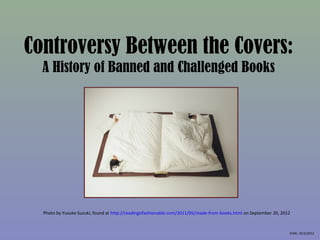
Controversy Between the Covers:
  A History of Banned and Challenged Books


  Photo by Yusuke Suzuki, found at http://readingisfashionable.com/2011/05/made-from-books.html on September 20, 2012


                                                                                                                    EHW, 10/3/2012
Ancient Roots
A source of political control
                            Before me,
                            no history!


Focused on the writers and thinkers themselves, not their
works

Church as censor
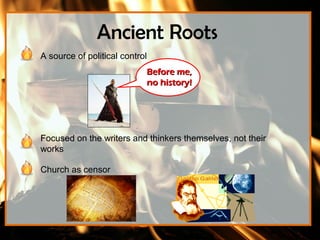
Victorian England
                         (1837-1901)
What changed?
Victorian morality

Increased literacy

Printing and public
libraries
Role of Evangelicals

“informal” censors

Legal censorship applied
only to “obscene
publications,” which
included birth control
In the United States:
             The Comstock Act (1873)
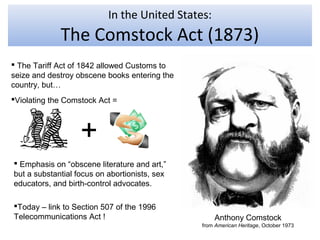
 The Tariff Act of 1842 allowed Customs to
seize and destroy obscene books entering the
country, but…
Violating the Comstock Act =


                   +
 Emphasis on “obscene literature and art,”
but a substantial focus on abortionists, sex
educators, and birth-control advocates.

Today – link to Section 507 of the 1996
Telecommunications Act !                           Anthony Comstock
                                               from American Heritage, October 1973
Court cases – “I know it when I see it!”

Textbooks
Research
  Commission on Obscenity and Pornography (1970) recommended
  loosening the legal restrictions on pornography, while the Meese
  Commission (1986) pointed to causal relationships between pornography,
  violence and organized crime!


A challenge = publicity
Libraries and Challenges
“The American Library Association promotes the freedom to choose or the freedom to
express one's opinions even if that opinion might be considered unorthodox or
unpopular and stresses the importance of ensuring the availability of those viewpoints
to all who wish to read them.”

Challenges can be initiated by anyone – most commonly by parents. Based on:

     - Offensive language         -Violence          - Age-appropriateness

               - Sexual content           - Occult references


                                   Selection
                                      vs.
                                  censorship
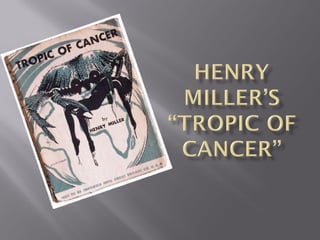
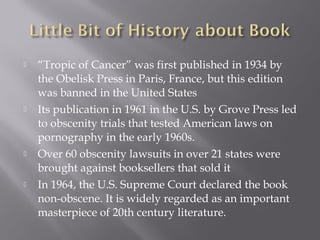
   “Tropic of Cancer” was first published in 1934 by
    the Obelisk Press in Paris, France, but this edition
    was banned in the United States
   Its publication in 1961 in the U.S. by Grove Press led
    to obscenity trials that tested American laws on
    pornography in the early 1960s.
   Over 60 obscenity lawsuits in over 21 states were
    brought against booksellers that sold it
   In 1964, the U.S. Supreme Court declared the book
    non-obscene. It is widely regarded as an important
    masterpiece of 20th century literature.
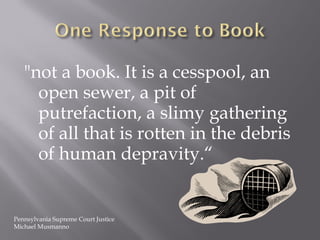
"not a book. It is a cesspool, an
     open sewer, a pit of
     putrefaction, a slimy gathering
     of all that is rotten in the debris
     of human depravity.“


Pennsylvania Supreme Court Justice
Michael Musmanno
Video by the Crash Pad Puppets, found on YouTube at http://www.youtube.com/watch?v=eLprbWMd8mM


“A truly great library has something in it
          to offend everyone.”
Sources
Altick, Richard D. Victorian People and Ideas. New York: W.W. Norton & Company, 1973.

Andrist, Ralph K. “Paladin of Purity.” American Heritage 24.6 (October 1973): 4+.

American Library Association website: http://www.ala.org, http://www.ala.org/advocacy/banned visited 26 Sept. 2012.

"Banned Books And Their Universal Availability." Journal Of Access Services 5.4 (2008): 597-609. Academic Search
   Complete. Web. 28 Sept. 2012.

Chartrand, Harry Hillman. "Christianity, Copyright, and Censorship in English-Speaking Cultures." Journal of Arts
   Management, Law & Society 22.3 (1992): 253. MasterFILE Premier. Web. 19 Sept. 2012.

LaMay, Craig L. “America’s Censor: Anthony Comstock and Free Speech.” Communications and the Law 19.3
  (Sept. 1997): 1-59. Academic OneFile. Web. 26 Sept. 2012.

Noble, William. Bookbanning in America. Middlebury, VT: Paul S. Eriksson, 1990.

“Read No Evil.” Time Magazine (May 27, 1946): 29-30.

Scales, Pat. "What Makes A Good Banned Book?." Horn Book Magazine 85.5 (2009): 533. MasterFILE Premier. Web.
   24 Sept. 2012.

Controversy Between the Covers

  • 1.
    Controversy Between theCovers: A History of Banned and Challenged Books Photo by Yusuke Suzuki, found at http://readingisfashionable.com/2011/05/made-from-books.html on September 20, 2012 EHW, 10/3/2012
  • 2.
    Ancient Roots A sourceof political control Before me, no history! Focused on the writers and thinkers themselves, not their works Church as censor
  • 3.
    Victorian England (1837-1901) What changed? Victorian morality Increased literacy Printing and public libraries Role of Evangelicals “informal” censors Legal censorship applied only to “obscene publications,” which included birth control
  • 4.
    In the UnitedStates: The Comstock Act (1873)  The Tariff Act of 1842 allowed Customs to seize and destroy obscene books entering the country, but… Violating the Comstock Act = +  Emphasis on “obscene literature and art,” but a substantial focus on abortionists, sex educators, and birth-control advocates. Today – link to Section 507 of the 1996 Telecommunications Act ! Anthony Comstock from American Heritage, October 1973
  • 5.
    Court cases –“I know it when I see it!” Textbooks Research Commission on Obscenity and Pornography (1970) recommended loosening the legal restrictions on pornography, while the Meese Commission (1986) pointed to causal relationships between pornography, violence and organized crime! A challenge = publicity
  • 6.
    Libraries and Challenges “TheAmerican Library Association promotes the freedom to choose or the freedom to express one's opinions even if that opinion might be considered unorthodox or unpopular and stresses the importance of ensuring the availability of those viewpoints to all who wish to read them.” Challenges can be initiated by anyone – most commonly by parents. Based on: - Offensive language -Violence - Age-appropriateness - Sexual content - Occult references Selection vs. censorship
  • 8.
    “Tropic of Cancer” was first published in 1934 by the Obelisk Press in Paris, France, but this edition was banned in the United States  Its publication in 1961 in the U.S. by Grove Press led to obscenity trials that tested American laws on pornography in the early 1960s.  Over 60 obscenity lawsuits in over 21 states were brought against booksellers that sold it  In 1964, the U.S. Supreme Court declared the book non-obscene. It is widely regarded as an important masterpiece of 20th century literature.
  • 9.
    "not a book.It is a cesspool, an open sewer, a pit of putrefaction, a slimy gathering of all that is rotten in the debris of human depravity.“ Pennsylvania Supreme Court Justice Michael Musmanno
  • 11.
    Video by theCrash Pad Puppets, found on YouTube at http://www.youtube.com/watch?v=eLprbWMd8mM “A truly great library has something in it to offend everyone.”
  • 12.
    Sources Altick, Richard D.Victorian People and Ideas. New York: W.W. Norton & Company, 1973. Andrist, Ralph K. “Paladin of Purity.” American Heritage 24.6 (October 1973): 4+. American Library Association website: http://www.ala.org, http://www.ala.org/advocacy/banned visited 26 Sept. 2012. "Banned Books And Their Universal Availability." Journal Of Access Services 5.4 (2008): 597-609. Academic Search Complete. Web. 28 Sept. 2012. Chartrand, Harry Hillman. "Christianity, Copyright, and Censorship in English-Speaking Cultures." Journal of Arts Management, Law & Society 22.3 (1992): 253. MasterFILE Premier. Web. 19 Sept. 2012. LaMay, Craig L. “America’s Censor: Anthony Comstock and Free Speech.” Communications and the Law 19.3 (Sept. 1997): 1-59. Academic OneFile. Web. 26 Sept. 2012. Noble, William. Bookbanning in America. Middlebury, VT: Paul S. Eriksson, 1990. “Read No Evil.” Time Magazine (May 27, 1946): 29-30. Scales, Pat. "What Makes A Good Banned Book?." Horn Book Magazine 85.5 (2009): 533. MasterFILE Premier. Web. 24 Sept. 2012.

Editor's Notes

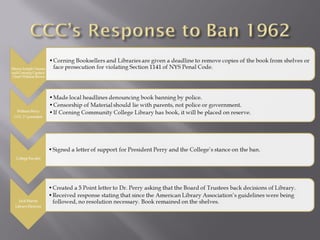
  • #11 “ Jack Martin’s obituary: In the 1960's Jack took on a battle of another type when the mayor of Corning sought to limit the freedom of local libraries and readers by banning Henry Miller's newly-published novel "Tropic of Cancer." Jack borrowed a copy of the book from a friend and announced that the College library had a copy in its collection. He was hounded by the local press and threatened with arrest, but then he received a call from Arthur Houghton, who had heard the news, and hired the lawyers of the New York Public Library to defend him. Arthur arranged for a Corning Glass plane to fly Jack to New York City for strategy discussions. When the Mayor learned of the forces that he was up against, he quickly backed down.”