Banking cooperative
PRESENTED BY: KOMAL SIKHWAL
&
ANKITA SHARMA
PRESENTED TO: PROF. MITESH PATEL
Flow of presentation
Overview and definition
Structure
Features
objectives
Importance
Functions
Principles
Products and services
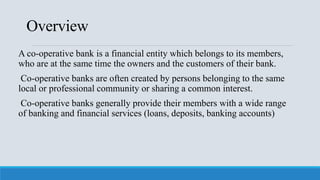
Overview
A co-operative bank is a financial entity which belongs to its members,
who are at the same time the owners and the customers of their bank.
Co-operative banks are often created by persons belonging to the same
local or professional community or sharing a common interest.
Co-operative banks generally provide their members with a wide range
of banking and financial services (loans, deposits, banking accounts)
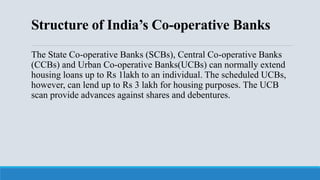
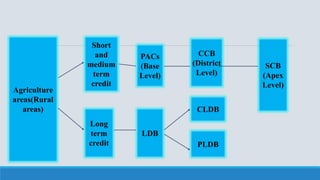
Structure of India’s Co-operative Banks
The State Co-operative Banks (SCBs), Central Co-operative Banks
(CCBs) and Urban Co-operative Banks(UCBs) can normally extend
housing loans up to Rs 1lakh to an individual. The scheduled UCBs,
however, can lend up to Rs 3 lakh for housing purposes. The UCB
scan provide advances against shares and debentures.
To support the financial requirement of people
Co-operative banks are categorized at various dimensions and at
various levels
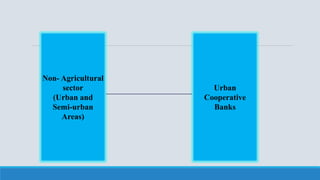
Co-operative banking structure consists of two main segment:-
(a)Agricultural Credit
(b)Non-Agricultural Credit
A
Agriculture
areas(Rural
areas)
Short
and
medium
term
credit
Long
term
credit
PACs
(Base
Level)
LDB
CLDB
PLDB
CCB
(District
Level)
SCB
(Apex
Level)
Non- Agricultural
sector
(Urban and
Semi-urban
Areas)
Urban
Cooperative
Banks
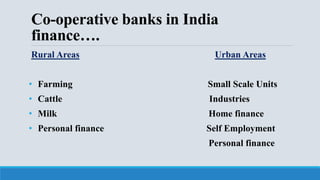
Co-operative banks in India
finance….
Rural Areas Urban Areas
• Farming Small Scale Units
• Cattle Industries
• Milk Home finance
• Personal finance Self Employment
Personal finance
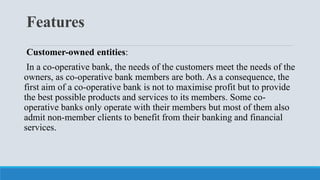
Features
Customer-owned entities:
In a co-operative bank, the needs of the customers meet the needs of the
owners, as co-operative bank members are both. As a consequence, the
first aim of a co-operative bank is not to maximise profit but to provide
the best possible products and services to its members. Some co-
operative banks only operate with their members but most of them also
admit non-member clients to benefit from their banking and financial
services.
Democratic member control:
Co-operative banks are owned and controlled by their members, who
democratically elect the board of directors. Members usually have equal
voting rights, according to the co-operative principle of “one person, one
vote”.
Profit allocation:
In a co-operative bank, a significant part of the yearly profit, benefits or
surplus is usually allocated to constitute reserves. A part of this profit
can also be distributed to the co-operative members, with legal or
statutory limitations in most cases. Profit is usually allocated to
members either through a patronage dividend, which is related to the use
of the co-operative’s products and services by each member, or through
an interest or a dividend, which is related to the number of shares
subscribed by each member.
OBJECTIVES OF
CO-OPERATIVE BANKS
Objectives
To protect the rural section from greedy money lenders
To provide easy credit facilities to the farmers
To promote and develop cooperative societies in the state
To provide training and education facilities to farmers
Overall development of rural areas
Importance
Integral Part
Credit To Agriculture
Important instrument
Small scale operation
Extensive branch network
FUNCTIONS OF
CO-OPERATIVE BANKS
Co-operative Banks are organised and managed on the principal of
co-operation, self-help, and mutual help. They function with the rule of
"one member, one vote" function on "no profit, no loss" basis. Co-
operative banks, as a principle, do not pursue the goal of profit
maximisation. Co-operative bank performs all the main banking
functions of deposit mobilisation, supply of credit and provision of
remittance facilities.
Co-operative bank do banking business mainly in the agriculture
and rural sector. However, UCBs, SCBs, and CCBs operate in semi
urban, urban, and metropolitan areas also.
The urban and non-agricultural business of these banks has grown
over the years. The co-operative banks demonstrate a shift from rural
to urban, while the commercial banks, from urban to rural.
 Co-operative Banks belong to the money market as well as to the
capital market. Primary agricultural credit societies provide short
term and medium term loans.
Co-operative Principles
Voluntary and open membership
Democratic member control
Member economic participation
Autonomy and independence
Education, training and information
Co-operation among Co-operatives
Concern for Community
PRODUCTS AND SERVICES
DEPOSITS SERVICES
Saving Bank Account Clearing
Current Account Safe Deposit Locker
Recurring Deposits ATM
Fixed Deposits Demand Draft/Pay Order
Cash Certificate
LOANS
Loans to Salaried employees
Home Needs Loan
Loan to Pensioners
Education $ Housing Loan
Anyonya Co-operative Bank Limited
Anyonya Co-operative Bank Limited (ACBL) located in the city of
Vadodara (formerly Baroda) in Gujarat, is the first co-operative bank in
India.
ACBL was established in 1889 with the name Anyonya Sahayakari
Mandali Co-operative Bank Limited, with a primary objective of
providing an alternative to exploitation by moneylenders for Baroda's
residents.
When it was started in 1889 it had just 23 members and 76 Indian rupees
(Rs) of capital, which grew to Rs 873 in the first year.By 2006, it had
grown up to more than 23,000 share holders and more than ten branches
which are mainly located within Baroda city and some small towns
surrounding it.
Introduction to The Gujarat State Co
operative Bank Ltd
The Gujarat State Cooperative Bank was established in year 1960 and
registered under the Gujarat state co-operative act, 1961.
The bank is already enjoying the status of scheduled bank and having
requisite Banking License.
Nearly 28 lacs farmers of 8100 PACs affiliated with GSCB through 17
DCCBs and a co-operative banking union are enjoying credit facilities.
It has also received the award as the Institution amongst the Best
Performing Co-operative Organisation from the National Co-operative
Union of India New Delhi.
Vision of Gujarat State Co operative Bank Ltd
To be the top most co-operative bank in the country providing able
leadership to the co-operative structure for achieving a sustained
growth and upliftment of small and marginal farmers.
GSCB aims to promote a sound, strong and vibrant co-operative
credit structure in Gujarat embedded with latest technology and
computerization, providing innovative and affordable banking
products so as to be an active partner in the progress of the state and
contribute to its social and economic development.
Banking cooperative

Banking cooperative

  • 1.
    Banking cooperative PRESENTED BY:KOMAL SIKHWAL & ANKITA SHARMA PRESENTED TO: PROF. MITESH PATEL
  • 2.
    Flow of presentation Overviewand definition Structure Features objectives Importance Functions Principles Products and services
  • 3.
    Overview A co-operative bankis a financial entity which belongs to its members, who are at the same time the owners and the customers of their bank. Co-operative banks are often created by persons belonging to the same local or professional community or sharing a common interest. Co-operative banks generally provide their members with a wide range of banking and financial services (loans, deposits, banking accounts)
  • 4.
    Structure of India’sCo-operative Banks The State Co-operative Banks (SCBs), Central Co-operative Banks (CCBs) and Urban Co-operative Banks(UCBs) can normally extend housing loans up to Rs 1lakh to an individual. The scheduled UCBs, however, can lend up to Rs 3 lakh for housing purposes. The UCB scan provide advances against shares and debentures.
  • 5.
    To support thefinancial requirement of people Co-operative banks are categorized at various dimensions and at various levels Co-operative banking structure consists of two main segment:- (a)Agricultural Credit (b)Non-Agricultural Credit
  • 6.
  • 7.
  • 8.
    Co-operative banks inIndia finance…. Rural Areas Urban Areas • Farming Small Scale Units • Cattle Industries • Milk Home finance • Personal finance Self Employment Personal finance
  • 9.
    Features Customer-owned entities: In aco-operative bank, the needs of the customers meet the needs of the owners, as co-operative bank members are both. As a consequence, the first aim of a co-operative bank is not to maximise profit but to provide the best possible products and services to its members. Some co- operative banks only operate with their members but most of them also admit non-member clients to benefit from their banking and financial services.
  • 10.
    Democratic member control: Co-operativebanks are owned and controlled by their members, who democratically elect the board of directors. Members usually have equal voting rights, according to the co-operative principle of “one person, one vote”.
  • 11.
    Profit allocation: In aco-operative bank, a significant part of the yearly profit, benefits or surplus is usually allocated to constitute reserves. A part of this profit can also be distributed to the co-operative members, with legal or statutory limitations in most cases. Profit is usually allocated to members either through a patronage dividend, which is related to the use of the co-operative’s products and services by each member, or through an interest or a dividend, which is related to the number of shares subscribed by each member.
  • 12.
  • 13.
    Objectives To protect therural section from greedy money lenders To provide easy credit facilities to the farmers To promote and develop cooperative societies in the state To provide training and education facilities to farmers Overall development of rural areas
  • 14.
    Importance Integral Part Credit ToAgriculture Important instrument Small scale operation Extensive branch network
  • 15.
  • 16.
    Co-operative Banks areorganised and managed on the principal of co-operation, self-help, and mutual help. They function with the rule of "one member, one vote" function on "no profit, no loss" basis. Co- operative banks, as a principle, do not pursue the goal of profit maximisation. Co-operative bank performs all the main banking functions of deposit mobilisation, supply of credit and provision of remittance facilities.
  • 17.
    Co-operative bank dobanking business mainly in the agriculture and rural sector. However, UCBs, SCBs, and CCBs operate in semi urban, urban, and metropolitan areas also. The urban and non-agricultural business of these banks has grown over the years. The co-operative banks demonstrate a shift from rural to urban, while the commercial banks, from urban to rural.  Co-operative Banks belong to the money market as well as to the capital market. Primary agricultural credit societies provide short term and medium term loans.
  • 18.
    Co-operative Principles Voluntary andopen membership Democratic member control Member economic participation Autonomy and independence Education, training and information Co-operation among Co-operatives Concern for Community
  • 19.
  • 20.
    DEPOSITS SERVICES Saving BankAccount Clearing Current Account Safe Deposit Locker Recurring Deposits ATM Fixed Deposits Demand Draft/Pay Order Cash Certificate LOANS Loans to Salaried employees Home Needs Loan Loan to Pensioners Education $ Housing Loan
  • 21.
    Anyonya Co-operative BankLimited Anyonya Co-operative Bank Limited (ACBL) located in the city of Vadodara (formerly Baroda) in Gujarat, is the first co-operative bank in India. ACBL was established in 1889 with the name Anyonya Sahayakari Mandali Co-operative Bank Limited, with a primary objective of providing an alternative to exploitation by moneylenders for Baroda's residents. When it was started in 1889 it had just 23 members and 76 Indian rupees (Rs) of capital, which grew to Rs 873 in the first year.By 2006, it had grown up to more than 23,000 share holders and more than ten branches which are mainly located within Baroda city and some small towns surrounding it.
  • 22.
    Introduction to TheGujarat State Co operative Bank Ltd The Gujarat State Cooperative Bank was established in year 1960 and registered under the Gujarat state co-operative act, 1961. The bank is already enjoying the status of scheduled bank and having requisite Banking License. Nearly 28 lacs farmers of 8100 PACs affiliated with GSCB through 17 DCCBs and a co-operative banking union are enjoying credit facilities. It has also received the award as the Institution amongst the Best Performing Co-operative Organisation from the National Co-operative Union of India New Delhi.
  • 23.
    Vision of GujaratState Co operative Bank Ltd To be the top most co-operative bank in the country providing able leadership to the co-operative structure for achieving a sustained growth and upliftment of small and marginal farmers. GSCB aims to promote a sound, strong and vibrant co-operative credit structure in Gujarat embedded with latest technology and computerization, providing innovative and affordable banking products so as to be an active partner in the progress of the state and contribute to its social and economic development.