WELCOME
TO
Prepared by
Bangabandhu Sheikh Mujibur Rahman science
and Technology university
The ‘ B ‘ Ark Group
Objectives of E-Banking
From banker’s point of view
 Provide retail services at reducing cost.
 Reduction of administrative expenses.
 Increase of income through different types of fees.
 Strengthening the position of in the competitive environment.
 Expanding the services in the remote areas.
From client’s point of view
 Receiving timely and instant information.
 Ability to deposit and withdraw of money within sort time & lower cost.
 Advantageously making payment for the goods and services.
 Enjoying utmost protection of the accounts maintained under E-Banking
etc.
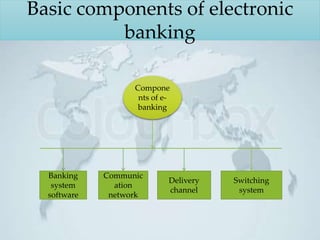
Compone
nts of e-
banking
Banking
system
software
Communic
ation
network
Delivery
channel
Switching
system
Basic components of electronic
banking
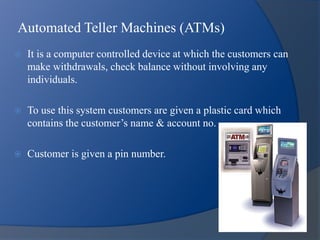
Automated Teller Machines (ATMs)
 It is a computer controlled device at which the customers can
make withdrawals, check balance without involving any
individuals.
 To use this system customers are given a plastic card which
contains the customer’s name & account no.
 Customer is given a pin number.
Functions of ATM
 24-hour access to cash
 View Account Balances & Mini-statements
 Order a Cheque Book / Account Statement
 Transfer Funds between accounts
 Refill your Prepaid card
 Pay your utility bills
 Deposit cash or cheques
 Change your PIN etc.
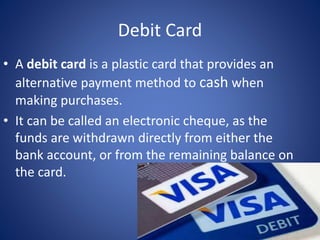
Debit Card
• A debit card is a plastic card that provides an
alternative payment method to cash when
making purchases.
• It can be called an electronic cheque, as the
funds are withdrawn directly from either the
bank account, or from the remaining balance on
the card.
Advantages of Debit Cards
 Increasing Revenue
 Reducing Expenditure
 Providing high client services
 Easy to access etc.
Credit Card
• Credit cards allow you to 'buy goods now and
pay later' - called 'buying on credit'.
• They aren't linked to your bank account.
• The rates of interest - indicated by the APR
(annual percentage rate) - is very high.
Under POS service, card owner’s accounts became debit and seller’s accounts
became credit for the amount of the purchased goods or services.
Taka can be transferred by two ways:
1. Seller is required to make a sales draft like credit card. Then this sales draft
would debit the card owner’s account and credit the seller’s account.
2. Respective clients/financial institution/sellers accounts are to be debited or
credited by transferring taka from online point of sale terminals.
Point of Sale (POS) Service
Mobile Banking
Current Mobile Banking Applications:
SMS Banking
WAP Banking
STK (Sim Toolkit) Banking
Internet Banking
 It has helped in banking at the click of a
mouse.
 In internet banking , customer of a bank
with a pc can log on to the bank website &
conduct basic functions.
Risk in E-Banking
 Operational Security Risk
 Legal Risk
 Reputation Risk
 Traditional Risk
Problems of the E-Banking
Inefficiency and inadequate knowledge.
Lack of proper strategic plan.
Lack of international standard communication channel.
High cost of establishing online banking system.
Inadequate back and front office Management.
Inefficiency clearing house facilities etc.
Recommendation to prosper E-
Banking
To implement E-banking successfully in Bangladesh
following recommendation are give below:
Hardware and software should be properly designed.
The clearing house operating Operation should be fully automated
system.
Banks should have their own strategic plans to implement the
online banking system.
The country needs to develop E-business with the help of ICT
facilities.
Public and private participation (PPP) for E-business should be
encouraged for economic development.
Any
questions???
Bank management ppt

Bank management ppt

  • 1.
  • 2.
    Prepared by Bangabandhu SheikhMujibur Rahman science and Technology university The ‘ B ‘ Ark Group
  • 4.
    Objectives of E-Banking Frombanker’s point of view  Provide retail services at reducing cost.  Reduction of administrative expenses.  Increase of income through different types of fees.  Strengthening the position of in the competitive environment.  Expanding the services in the remote areas. From client’s point of view  Receiving timely and instant information.  Ability to deposit and withdraw of money within sort time & lower cost.  Advantageously making payment for the goods and services.  Enjoying utmost protection of the accounts maintained under E-Banking etc.
  • 5.
  • 7.
    Automated Teller Machines(ATMs)  It is a computer controlled device at which the customers can make withdrawals, check balance without involving any individuals.  To use this system customers are given a plastic card which contains the customer’s name & account no.  Customer is given a pin number.
  • 8.
    Functions of ATM 24-hour access to cash  View Account Balances & Mini-statements  Order a Cheque Book / Account Statement  Transfer Funds between accounts  Refill your Prepaid card  Pay your utility bills  Deposit cash or cheques  Change your PIN etc.
  • 9.
    Debit Card • Adebit card is a plastic card that provides an alternative payment method to cash when making purchases. • It can be called an electronic cheque, as the funds are withdrawn directly from either the bank account, or from the remaining balance on the card.
  • 10.
    Advantages of DebitCards  Increasing Revenue  Reducing Expenditure  Providing high client services  Easy to access etc.
  • 11.
    Credit Card • Creditcards allow you to 'buy goods now and pay later' - called 'buying on credit'. • They aren't linked to your bank account. • The rates of interest - indicated by the APR (annual percentage rate) - is very high.
  • 12.
    Under POS service,card owner’s accounts became debit and seller’s accounts became credit for the amount of the purchased goods or services. Taka can be transferred by two ways: 1. Seller is required to make a sales draft like credit card. Then this sales draft would debit the card owner’s account and credit the seller’s account. 2. Respective clients/financial institution/sellers accounts are to be debited or credited by transferring taka from online point of sale terminals. Point of Sale (POS) Service
  • 13.
    Mobile Banking Current MobileBanking Applications: SMS Banking WAP Banking STK (Sim Toolkit) Banking
  • 14.
    Internet Banking  Ithas helped in banking at the click of a mouse.  In internet banking , customer of a bank with a pc can log on to the bank website & conduct basic functions.
  • 15.
    Risk in E-Banking Operational Security Risk  Legal Risk  Reputation Risk  Traditional Risk
  • 16.
    Problems of theE-Banking Inefficiency and inadequate knowledge. Lack of proper strategic plan. Lack of international standard communication channel. High cost of establishing online banking system. Inadequate back and front office Management. Inefficiency clearing house facilities etc.
  • 17.
    Recommendation to prosperE- Banking To implement E-banking successfully in Bangladesh following recommendation are give below: Hardware and software should be properly designed. The clearing house operating Operation should be fully automated system. Banks should have their own strategic plans to implement the online banking system. The country needs to develop E-business with the help of ICT facilities. Public and private participation (PPP) for E-business should be encouraged for economic development.
  • 18.