BANK
DATED: 3/3/2016
By
compufield
What is bank ?
A Bank is an “establishment for custody of money
which it pays out on customer’s order”
FEATURES OF BANKS
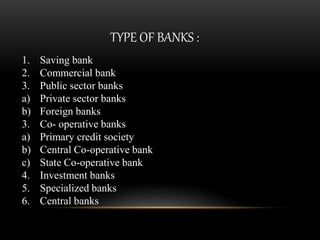
TYPE OF BANKS :
1. Saving bank
2. Commercial bank
3. Public sector banks
a) Private sector banks
b) Foreign banks
3. Co- operative banks
a) Primary credit society
b) Central Co-operative bank
c) State Co-operative bank
4. Investment banks
5. Specialized banks
6. Central banks
Savings Bank: These banks functions with the intention to culminate saving
habits among the people, especially those who belong to low income groups or those who are
salaried. The money these people deposit in the banks are invested in securities, bonds etc.
Commercial banks: These bank functions to help the entrepreneur and
businesses. They give financial services to these businessmen like debit cards, banks accounts
short term deposits, etc. with the money people deposit in such banks. They also lends money to
businessmen in the form of overdraft, credit cards, secured loans, unsecured loans and mortgage
loan to businessmen. The commercial bank in the country were nationalized in 1969. so the
various policies regarding the loans, rate of interest and loans etc are controlled by the reserve
bank. These day the commercialized banks provide some services given by investment to their
clients.
The commercial bank can be further classified as : public sector banks, private sector
banks, foreign banks and regional banks
1. Public sector banks are owned and operate by government, who has a major share in
them. The major focus of these bank is to serve the people rather earn profit. Some example
of these banks include State bank of India, Punjab national bank, bank of Maharashtra etc.
2. The private sector banks are owned and operated by private institute. They are
free to operate and are controlled by market forces. A greater share is held by private players
and not the government. For example axis bank, kotak Mahindra bank.
3. Foreign banks are those that are based on foreign country but have a several
branches in India. Some example of these bank includes HSBC, Standard chartered bank
Co-operative banks :These banks are controlled, owned, managed and
operate by cooperative societies and came into existence of Cooperative Societies Act in 1912.
these banks are located in urban as well as in rural areas. Although these bank have the same
function as the commercial bank, they provide finance to farmer, salaried people, small scale
industries, etc. and their rate of interest is lower as compared to other banks.
There are three types of cooperative bank of India, namely:
1. Primary credit societies : These are formed in small locality like small town or
village. The member using this bank usually know to each other and chance of committing
fraud is minimal.
2. Central cooperative bank : These bank have their member who belong to the same
district. They function as the other commercial banks and provide loans to their member.
They act as a link between the state cooperative bank and the primary credit societies.
3. State cooperative banks : these banks have the presence in all the state of the country
and have their presence throughout the state.
Investment banks : These are financial institution that provides financial and
advisory assistance to the customers. Their client can be individuals, businesses, or government
organization. They assist their customers to raise funds when required. These banks acts as a
underwriters for their customer when they want to raise their capital by issuing securities.
When there is merger or acquisition. They provide their customer with the necessary support like
marketing, Foreign trading, foreign exchange, sale of equities, fixed instrument etc. Apart of
raising capital. These banks render valuable advise to their customer and various kind of
businesses. Some example of these banks include bank of America, Barclays capital, Citi bank,
Deutsche bank.
Specialized bank:these provide unique service to the customers. Some such
banks include, foreign exchange bank, development banks, industrial banks, import and export
banks. These banks also provide huge financial support to businesses and various kinds projects
and tenders who have to import and export their goods or services.
Central bank :central bank is also known as bankers banks in any country. In India
Reserve bank of India is a central bank. The Federal reserve in USA and the bank of England in
UK function as a central bank. This bank makes various monetary policies, decides the rate of
interest, controlling the other bank in the country, manages the foreign exchange rate and gold
reserves and also issue paper currency in the country. The monetary control is the primary
function of a central bank in most countries and so they are considered as the lender of last resort
to various commercial banks.
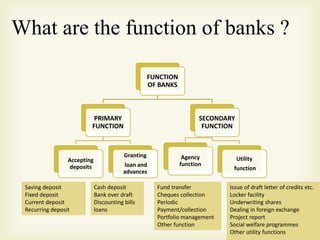
What are the function of banks ?
FUNCTION
OF BANKS
PRIMARY
FUNCTION
Accepting
deposits
Granting
loan and
advances
SECONDARY
FUNCTION
Agency
function
Utility
function
Saving deposit
Fixed deposit
Current deposit
Recurring deposit
Cash deposit
Bank over draft
Discounting bills
loans
Fund transfer
Cheques collection
Periodic
Payment/collection
Portfolio management
Other function
Issue of draft letter of credits etc.
Locker facility
Underwriting shares
Dealing in foreign exchange
Project report
Social welfare programmes
Other utility functions

Bank

  • 1.
  • 2.
    What is bank? A Bank is an “establishment for custody of money which it pays out on customer’s order”
  • 3.
  • 4.
    TYPE OF BANKS: 1. Saving bank 2. Commercial bank 3. Public sector banks a) Private sector banks b) Foreign banks 3. Co- operative banks a) Primary credit society b) Central Co-operative bank c) State Co-operative bank 4. Investment banks 5. Specialized banks 6. Central banks
  • 5.
    Savings Bank: Thesebanks functions with the intention to culminate saving habits among the people, especially those who belong to low income groups or those who are salaried. The money these people deposit in the banks are invested in securities, bonds etc. Commercial banks: These bank functions to help the entrepreneur and businesses. They give financial services to these businessmen like debit cards, banks accounts short term deposits, etc. with the money people deposit in such banks. They also lends money to businessmen in the form of overdraft, credit cards, secured loans, unsecured loans and mortgage loan to businessmen. The commercial bank in the country were nationalized in 1969. so the various policies regarding the loans, rate of interest and loans etc are controlled by the reserve bank. These day the commercialized banks provide some services given by investment to their clients. The commercial bank can be further classified as : public sector banks, private sector banks, foreign banks and regional banks 1. Public sector banks are owned and operate by government, who has a major share in them. The major focus of these bank is to serve the people rather earn profit. Some example of these banks include State bank of India, Punjab national bank, bank of Maharashtra etc.
  • 6.
    2. The privatesector banks are owned and operated by private institute. They are free to operate and are controlled by market forces. A greater share is held by private players and not the government. For example axis bank, kotak Mahindra bank. 3. Foreign banks are those that are based on foreign country but have a several branches in India. Some example of these bank includes HSBC, Standard chartered bank Co-operative banks :These banks are controlled, owned, managed and operate by cooperative societies and came into existence of Cooperative Societies Act in 1912. these banks are located in urban as well as in rural areas. Although these bank have the same function as the commercial bank, they provide finance to farmer, salaried people, small scale industries, etc. and their rate of interest is lower as compared to other banks. There are three types of cooperative bank of India, namely: 1. Primary credit societies : These are formed in small locality like small town or village. The member using this bank usually know to each other and chance of committing fraud is minimal. 2. Central cooperative bank : These bank have their member who belong to the same district. They function as the other commercial banks and provide loans to their member. They act as a link between the state cooperative bank and the primary credit societies.
  • 7.
    3. State cooperativebanks : these banks have the presence in all the state of the country and have their presence throughout the state. Investment banks : These are financial institution that provides financial and advisory assistance to the customers. Their client can be individuals, businesses, or government organization. They assist their customers to raise funds when required. These banks acts as a underwriters for their customer when they want to raise their capital by issuing securities. When there is merger or acquisition. They provide their customer with the necessary support like marketing, Foreign trading, foreign exchange, sale of equities, fixed instrument etc. Apart of raising capital. These banks render valuable advise to their customer and various kind of businesses. Some example of these banks include bank of America, Barclays capital, Citi bank, Deutsche bank. Specialized bank:these provide unique service to the customers. Some such banks include, foreign exchange bank, development banks, industrial banks, import and export banks. These banks also provide huge financial support to businesses and various kinds projects and tenders who have to import and export their goods or services.
  • 8.
    Central bank :centralbank is also known as bankers banks in any country. In India Reserve bank of India is a central bank. The Federal reserve in USA and the bank of England in UK function as a central bank. This bank makes various monetary policies, decides the rate of interest, controlling the other bank in the country, manages the foreign exchange rate and gold reserves and also issue paper currency in the country. The monetary control is the primary function of a central bank in most countries and so they are considered as the lender of last resort to various commercial banks.
  • 9.
    What are thefunction of banks ? FUNCTION OF BANKS PRIMARY FUNCTION Accepting deposits Granting loan and advances SECONDARY FUNCTION Agency function Utility function Saving deposit Fixed deposit Current deposit Recurring deposit Cash deposit Bank over draft Discounting bills loans Fund transfer Cheques collection Periodic Payment/collection Portfolio management Other function Issue of draft letter of credits etc. Locker facility Underwriting shares Dealing in foreign exchange Project report Social welfare programmes Other utility functions