INTERNET CO-REGULATION
AND CONSTITUTIONALISM


BANGKOK
20 DECEMBER 2012
PROF. CHRIS MARSDEN
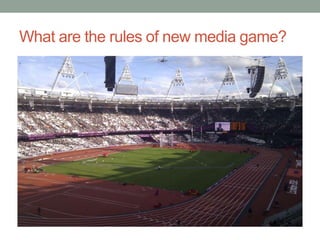
What are the rules of new media game?
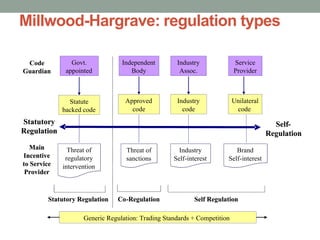
Millwood-Hargrave: regulation types

 Code           Govt.            Independent        Industry              Service
Guardian      appointed             Body             Assoc.               Provider


               Statute            Approved          Industry              Unilateral
             backed code            code              code                 code
Statutory                                                                                Self-
Regulation                                                                             Regulation
   Main        Threat of          Threat of          Industry            Brand
Incentive     regulatory          sanctions        Self-interest      Self-interest
to Service   intervention
 Provider


         Statutory Regulation   Co-Regulation              Self Regulation

                    Generic Regulation: Trading Standards + Competition
‘Soft law’ and self-regulation
• Unique role of European Commission
 • Legislative initiative
 • „Soft power‟s and industry liaison
• EC issues „Recommendations‟
 • e.g. Rec[98]460 on protection of minors & dignity
 • Which lays down ISP self-regulation via Codes
 • Forerunner to E-Commerce Dir. 2000/31/EC
• Much criticized by E. Parliament and Council
 • Legitimacy and democratic mandate?
Will competitors play fair?
Does civil society have a role?
• Obviously more interests than industry
 • Even in case of copyright holders & ISPs
• Multistakeholder-isation
 • Process not a static model
• Example: ICANN
 • Authority from Commerce
 • Government Advisory Committee
 • Driven by litigious registrars
 • Civil society ALAC – observed in the breach?
User-generated regulation or
‘self-organisation’
Governments monitoring or background view.
• users increase existing regulation
 •   Users report abuse or switch between services
 •   (e.g. social networking sites, virtual worlds)
 •   Can you leave Facebook?
 •   Can your data?
 •   Can your friends?
• Governments monitoring new developments
• while maintaining formal (de)regulation?
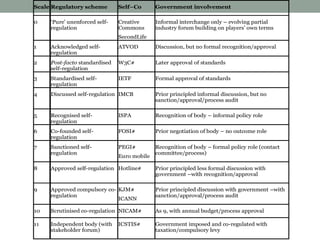
Can self-regulation be camouflaged?
Scale Regulatory scheme        Self–Co       Government involvement

0    ‘Pure’ unenforced self-   Creative      Informal interchange only – evolving partial
     regulation                Commons       industry forum building on players’ own terms
                               SecondLife
1    Acknowledged self-        ATVOD         Discussion, but no formal recognition/approval
     regulation
2    Post-facto standardised   W3C#          Later approval of standards
     self-regulation
3    Standardised self-        IETF          Formal approval of standards
     regulation
4    Discussed self-regulation IMCB          Prior principled informal discussion, but no
                                             sanction/approval/process audit

5    Recognised self-          ISPA          Recognition of body – informal policy role
     regulation
6    Co-founded self-          FOSI#         Prior negotiation of body – no outcome role
     regulation
7    Sanctioned self-          PEGI#         Recognition of body – formal policy role (contact
     regulation                              committee/process)
                               Euro mobile

8    Approved self-regulation Hotline#       Prior principled less formal discussion with
                                             government –with recognition/approval

9    Approved compulsory co- KJM#            Prior principled discussion with government –with
     regulation                              sanction/approval/process audit
                             ICANN

10   Scrutinised co-regulation NICAM#        As 9, with annual budget/process approval

11   Independent body (with    ICSTIS#       Government imposed and co-regulated with
     stakeholder forum)                      taxation/compulsory levy
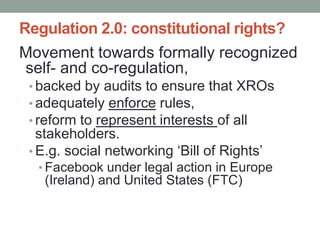
Regulation 2.0: constitutional rights?
Movement towards formally recognized
self- and co-regulation,
 • backed by audits to ensure that XROs
 • adequately enforce rules,
 • reform to represent interests of all
   stakeholders.
 • E.g. social networking „Bill of Rights‟
  • Facebook under legal action in Europe
   (Ireland) and United States (FTC)
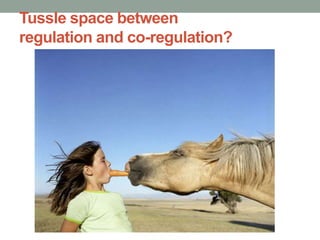
Tussle space between
regulation and co-regulation?
Legislation 2.0
• Co- or formal regulatory pattern.
• Without EU harmonisation,
• diverging national outcomes in:
 • Internet video, suicide sites,
 • social networking, copyright, privacy,
 • personal Internet security, etc.
 • Note E-Commerce Directive
Bring constitutionalism back in?
• Division of powers would audit co-
  regulation
• Audit role for communications regulator?
 • E.g. Leveson recommendation on privacy and
   right to reply in UK newspapers
 • Ofcom or judge or Parliament?
• Parliaments and Courts monitoring
 • UK Royal Charter or legislation?
Delegation of powers to XROs
• Financial and/or administrative support,
• supporting XRO membership
   • e.g. endorsing XRO-generated standards
   • standards evidence of regulatory compliance
      • Example: privacy or defamation – professional training
        for less liability
• Likely to involve
  • government officials in policy and/or
    implementation fora,
   • as with PEGI Online.
How to make regulation work better
 Explicit division of powers between XRO and government
 or separation of
            decision-making, monitoring, reporting, enforcement;
 1.        Implicit enforcement support;
      1. Affirmative criteria for supporting XRO
           1.     (with resources, information, delegated or agency enforcement power);
 2. Negative criteria for restricting, supplanting or pre-
       empting XROs
      1.        e.g. on competition policy
      2.        Or human rights
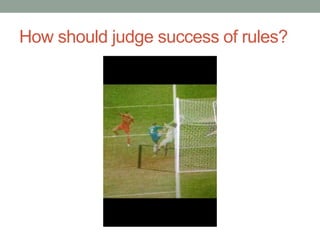
How should judge success of rules?
Leveson Inquiry:
Co-regulation for newspapers
 • Privacy invasion and telephone surveillance („hacking‟) scandal
 • Police failed to act after 2006 conviction on continued allegation
   2009
 • 2011 - Lord Justice Leveson: senior judicial inquiry
 • Reported November 2012: 2000 page report after 14 month inquiry
 • Legislative changes to political relationship with media
2014 Communications Bill?
• Leveson suggests privacy watchdog
• Backed by legislation
• Oversight role for committee
 • led by Lord Chief Justice? (Labour)
 • Or by Ofcom auditing Code of Press Standards Trust (Leveson)

• Or more self-regulation
 • newspapers and Mr Murdoch‟s Cameron
UK: Ownership key to media pluralism
• Reflected in 2011-12 News International/Sky
  • And earlier merger cases
  • Massive entry barriers
• Can successful policy simply balance BBC and Sky?
• Ofcom 2012:
  • Advising Minister on „fit and proper‟ person test
  • In connection with BSkyB/News Corporation/Murdochs
  • Decided that Murdochs were „fit and proper‟
  • But criticized corporate governance of News Corp.
Recent human rights law
• Problem of privatization of censorship
• United Nations: Rapporteur Frank LaRue
  • Declaration by regional bodies
    • Inc. Inter-American, Council of Europe etc.

• OECD: Internet governance principles?
• ITU: International Telecoms Regulations
• UNESCO: no clear principles
• OSCE: Akdeniz
• ASEAN: ?
Courts’ role in
implementing co-regulation
• Courts (esp. European Court of Justice)
  • balancing property/IP rights against fundamental rights
  • Free expression, censorship and privacy at stake
• 2012:
   • Telefonica, Scarlet Extended, Netlog and Perfect AB
   • very imperfect decisions!
• National courts‟ application will adapt –
  • E.g. UK Cleanfeed cheap and proportionate
    • Newzbin/Fox case
  • Denmark Code of Conduct as default censorship
Questions?
Email: cmars@essex.ac.uk
Extra slides
• New media: Defamation and libel
2013: Draft Defamation Bill
     • Deputy Prime Minister speech:
       http://www.guardian.co.uk/law/2011/jan/07/nick-clegg-libel-
       reform
• Draft Bill published March 2011
  • statutory public interest defence
  • clarify the law around the defences of fair
    comment, and justification.
  • Substantiality Thornton v Telegraph
  • "threshold of seriousness... exclude trivial
    claims"
Twitter posts and reposts
• Cairns v. Modi (2010)
  • Modi was head of richest cricket league
  • Cairns was a former New Zealand captain
  • Cairns had played in rival league
  • Modi claimed on Twitter that Cairns was not allowed to join his
    league due to corruption allegations – „throwing‟ games for
    gamblers
• Repeated his claims on Cricinfo (ESPN website)
• Cairns sued Modi and Cricinfo – latter settled
Cairns v. Modi: trivial Twitter?
• [2012] EWHC 756 (QB) (26 March 2012):
   • "Mr Ronald Thwaites QC for the Defendant described the case as
     an example of libel tourism.
   • The criticism is misguided.
   • Claimant went to school in England, as did his children,
    • played county cricket in England [over]15 years.
  • Defendant since mid-2010 resident in England.
  • A trial in India would have involved very long delays.
  • The case is properly before the court in England."
Cairns v. Modi: trivial Twitter?
• Court of Appeal on damages
  • [2012] EWCA Civ 1382 appeal from [2012] EWHC 483 (QB)
• Australian convenient expression
• "the grapevine effect" adopted
   • Crampton v Nugawela [1996] NSWSC 651.
Mr Caldecott QC contended that with
allegations of this scandalous nature …
• “word will "percolate" by way of the Internet
• “consequence of modern communication systems
• “capacity to "go viral" widely, quickly than ever before.
• “availability of the WWW and of social networking sites,
• “scale of this problem has been immeasurably enhanced,
  especially for libel claimants who are already in the public
  eye.
• this percolation phenomenon is a legitimate factor to be
  taken into account in the assessment of damages."
Cairns v Modi [2012] EWHC 756 (QB) (26
March 2012) per Bean J.
• 65 viewers of „Tweet‟ – but how many retweets etc.?
• "although publication was limited, that does not mean that
  damages should be reduced to trivial amounts.
• “In 1935, long before the internet was thought of,
    • “L. Atkin in Ley v Hamilton (153 L.T. 384, cited by L. Reid in Broome v
     Cassell [1972] AC 1027 at 1092G):
• "It is precisely because the 'real' damage cannot be
  ascertained and established that the damages are at
  large. It is impossible to track the scandal, to know what
  quarters the poison may reach…“
• “This remains true in the 21st century, except that
  nowadays the poison tends to spread far more rapidly.”

New media and co-regulation Bangkok TMPC

  • 1.
  • 2.
    What are therules of new media game?
  • 3.
    Millwood-Hargrave: regulation types Code Govt. Independent Industry Service Guardian appointed Body Assoc. Provider Statute Approved Industry Unilateral backed code code code code Statutory Self- Regulation Regulation Main Threat of Threat of Industry Brand Incentive regulatory sanctions Self-interest Self-interest to Service intervention Provider Statutory Regulation Co-Regulation Self Regulation Generic Regulation: Trading Standards + Competition
  • 4.
    ‘Soft law’ andself-regulation • Unique role of European Commission • Legislative initiative • „Soft power‟s and industry liaison • EC issues „Recommendations‟ • e.g. Rec[98]460 on protection of minors & dignity • Which lays down ISP self-regulation via Codes • Forerunner to E-Commerce Dir. 2000/31/EC • Much criticized by E. Parliament and Council • Legitimacy and democratic mandate?
  • 5.
  • 6.
    Does civil societyhave a role? • Obviously more interests than industry • Even in case of copyright holders & ISPs • Multistakeholder-isation • Process not a static model • Example: ICANN • Authority from Commerce • Government Advisory Committee • Driven by litigious registrars • Civil society ALAC – observed in the breach?
  • 7.
    User-generated regulation or ‘self-organisation’ Governmentsmonitoring or background view. • users increase existing regulation • Users report abuse or switch between services • (e.g. social networking sites, virtual worlds) • Can you leave Facebook? • Can your data? • Can your friends? • Governments monitoring new developments • while maintaining formal (de)regulation?
  • 8.
  • 9.
    Scale Regulatory scheme Self–Co Government involvement 0 ‘Pure’ unenforced self- Creative Informal interchange only – evolving partial regulation Commons industry forum building on players’ own terms SecondLife 1 Acknowledged self- ATVOD Discussion, but no formal recognition/approval regulation 2 Post-facto standardised W3C# Later approval of standards self-regulation 3 Standardised self- IETF Formal approval of standards regulation 4 Discussed self-regulation IMCB Prior principled informal discussion, but no sanction/approval/process audit 5 Recognised self- ISPA Recognition of body – informal policy role regulation 6 Co-founded self- FOSI# Prior negotiation of body – no outcome role regulation 7 Sanctioned self- PEGI# Recognition of body – formal policy role (contact regulation committee/process) Euro mobile 8 Approved self-regulation Hotline# Prior principled less formal discussion with government –with recognition/approval 9 Approved compulsory co- KJM# Prior principled discussion with government –with regulation sanction/approval/process audit ICANN 10 Scrutinised co-regulation NICAM# As 9, with annual budget/process approval 11 Independent body (with ICSTIS# Government imposed and co-regulated with stakeholder forum) taxation/compulsory levy
  • 10.
    Regulation 2.0: constitutionalrights? Movement towards formally recognized self- and co-regulation, • backed by audits to ensure that XROs • adequately enforce rules, • reform to represent interests of all stakeholders. • E.g. social networking „Bill of Rights‟ • Facebook under legal action in Europe (Ireland) and United States (FTC)
  • 12.
  • 13.
    Legislation 2.0 • Co-or formal regulatory pattern. • Without EU harmonisation, • diverging national outcomes in: • Internet video, suicide sites, • social networking, copyright, privacy, • personal Internet security, etc. • Note E-Commerce Directive
  • 14.
    Bring constitutionalism backin? • Division of powers would audit co- regulation • Audit role for communications regulator? • E.g. Leveson recommendation on privacy and right to reply in UK newspapers • Ofcom or judge or Parliament? • Parliaments and Courts monitoring • UK Royal Charter or legislation?
  • 15.
    Delegation of powersto XROs • Financial and/or administrative support, • supporting XRO membership • e.g. endorsing XRO-generated standards • standards evidence of regulatory compliance • Example: privacy or defamation – professional training for less liability • Likely to involve • government officials in policy and/or implementation fora, • as with PEGI Online.
  • 16.
    How to makeregulation work better Explicit division of powers between XRO and government or separation of decision-making, monitoring, reporting, enforcement; 1. Implicit enforcement support; 1. Affirmative criteria for supporting XRO 1. (with resources, information, delegated or agency enforcement power); 2. Negative criteria for restricting, supplanting or pre- empting XROs 1. e.g. on competition policy 2. Or human rights
  • 17.
    How should judgesuccess of rules?
  • 18.
    Leveson Inquiry: Co-regulation fornewspapers • Privacy invasion and telephone surveillance („hacking‟) scandal • Police failed to act after 2006 conviction on continued allegation 2009 • 2011 - Lord Justice Leveson: senior judicial inquiry • Reported November 2012: 2000 page report after 14 month inquiry • Legislative changes to political relationship with media
  • 19.
    2014 Communications Bill? •Leveson suggests privacy watchdog • Backed by legislation • Oversight role for committee • led by Lord Chief Justice? (Labour) • Or by Ofcom auditing Code of Press Standards Trust (Leveson) • Or more self-regulation • newspapers and Mr Murdoch‟s Cameron
  • 20.
    UK: Ownership keyto media pluralism • Reflected in 2011-12 News International/Sky • And earlier merger cases • Massive entry barriers • Can successful policy simply balance BBC and Sky? • Ofcom 2012: • Advising Minister on „fit and proper‟ person test • In connection with BSkyB/News Corporation/Murdochs • Decided that Murdochs were „fit and proper‟ • But criticized corporate governance of News Corp.
  • 21.
    Recent human rightslaw • Problem of privatization of censorship • United Nations: Rapporteur Frank LaRue • Declaration by regional bodies • Inc. Inter-American, Council of Europe etc. • OECD: Internet governance principles? • ITU: International Telecoms Regulations • UNESCO: no clear principles • OSCE: Akdeniz • ASEAN: ?
  • 22.
    Courts’ role in implementingco-regulation • Courts (esp. European Court of Justice) • balancing property/IP rights against fundamental rights • Free expression, censorship and privacy at stake • 2012: • Telefonica, Scarlet Extended, Netlog and Perfect AB • very imperfect decisions! • National courts‟ application will adapt – • E.g. UK Cleanfeed cheap and proportionate • Newzbin/Fox case • Denmark Code of Conduct as default censorship
  • 23.
  • 24.
    Extra slides • Newmedia: Defamation and libel
  • 25.
    2013: Draft DefamationBill • Deputy Prime Minister speech: http://www.guardian.co.uk/law/2011/jan/07/nick-clegg-libel- reform • Draft Bill published March 2011 • statutory public interest defence • clarify the law around the defences of fair comment, and justification. • Substantiality Thornton v Telegraph • "threshold of seriousness... exclude trivial claims"
  • 26.
    Twitter posts andreposts • Cairns v. Modi (2010) • Modi was head of richest cricket league • Cairns was a former New Zealand captain • Cairns had played in rival league • Modi claimed on Twitter that Cairns was not allowed to join his league due to corruption allegations – „throwing‟ games for gamblers • Repeated his claims on Cricinfo (ESPN website) • Cairns sued Modi and Cricinfo – latter settled
  • 27.
    Cairns v. Modi:trivial Twitter? • [2012] EWHC 756 (QB) (26 March 2012): • "Mr Ronald Thwaites QC for the Defendant described the case as an example of libel tourism. • The criticism is misguided. • Claimant went to school in England, as did his children, • played county cricket in England [over]15 years. • Defendant since mid-2010 resident in England. • A trial in India would have involved very long delays. • The case is properly before the court in England."
  • 28.
    Cairns v. Modi:trivial Twitter? • Court of Appeal on damages • [2012] EWCA Civ 1382 appeal from [2012] EWHC 483 (QB) • Australian convenient expression • "the grapevine effect" adopted • Crampton v Nugawela [1996] NSWSC 651.
  • 29.
    Mr Caldecott QCcontended that with allegations of this scandalous nature … • “word will "percolate" by way of the Internet • “consequence of modern communication systems • “capacity to "go viral" widely, quickly than ever before. • “availability of the WWW and of social networking sites, • “scale of this problem has been immeasurably enhanced, especially for libel claimants who are already in the public eye. • this percolation phenomenon is a legitimate factor to be taken into account in the assessment of damages."
  • 30.
    Cairns v Modi[2012] EWHC 756 (QB) (26 March 2012) per Bean J. • 65 viewers of „Tweet‟ – but how many retweets etc.? • "although publication was limited, that does not mean that damages should be reduced to trivial amounts. • “In 1935, long before the internet was thought of, • “L. Atkin in Ley v Hamilton (153 L.T. 384, cited by L. Reid in Broome v Cassell [1972] AC 1027 at 1092G): • "It is precisely because the 'real' damage cannot be ascertained and established that the damages are at large. It is impossible to track the scandal, to know what quarters the poison may reach…“ • “This remains true in the 21st century, except that nowadays the poison tends to spread far more rapidly.”