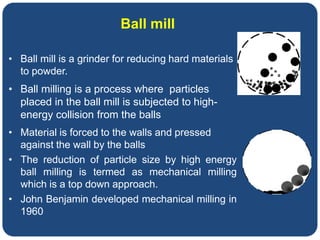
• Ball millis a grinder for reducing hard materials
to powder.
• Ball milling is a process where particles
placed in the ball mill is subjected to high-
energy collision from the balls
• Material is forced to the walls and pressed
against the wall by the balls
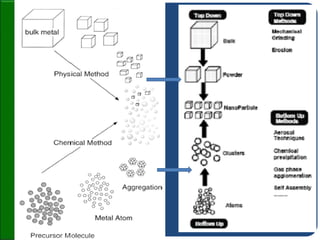
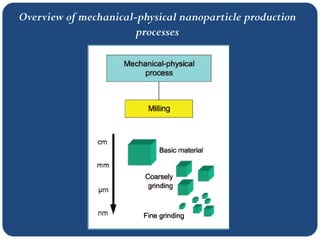
• The reduction of particle size by high energy
ball milling is termed as mechanical milling
which is a top down approach.
• John Benjamin developed mechanical milling in
1960
Ball mill
Ball milling process
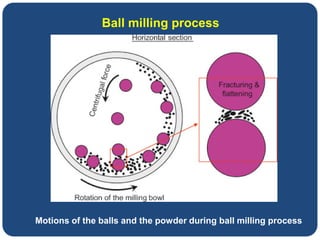
In ball milling the rotation directions of the bowl and
balls are opposite, the centrifugal forces are
alternately synchronized.
Thus, friction resulted from the hardened milling balls
and the powder mixture being ground alternately
rolling on the inner wall of the bowl and striking the
opposite wall.
The impact energy of the milling balls in the normal
direction attains a value of up to 40 times higher than
that due to gravitational acceleration. Hence, the
planetary ball mill can be used for high-speed milling
7.
High-energy ball milling
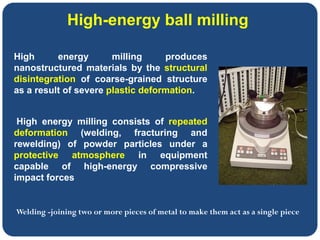
Highenergy milling produces
nanostructured materials by the structural
disintegration of coarse-grained structure
as a result of severe plastic deformation.
High energy milling consists of repeated
deformation (welding, fracturing and
rewelding) of powder particles under a
protective atmosphere in equipment
capable of high-energy compressive
impact forces
Welding -joining two or more pieces of metal to make them act as a single piece
8.
• Induce structuralchanges and chemical reactions at
room temperature.
• A complex mixture of fracturing, grinding, high-speed
plastic deformation, cold welding, thermal shock,
intimate mixing, etc.
• The structural changes and chemical reactions are
realized by mechanical energy rather than thermal
energy
• Reactions are possible at low temperatures
High-energy ball milling
9.
Mechanical Milling (MM)- Milling of uniform composition
powders, such as pure metals, intermetallics, or pre-
alloyed powders, where material transfer is not required for
homogenization
Mechanical Alloying (MA) - the process when mixtures of
powders (of different metals or alloys/compounds) are
milled together. Material transfer is involved in this process
to obtain a homogeneous alloy.
MM requires half the time required for MA to achieve the same
effect
Processing of powder particles in high-
energy ball mills
10.
Mechanical Milling: Mechanicsand Physics
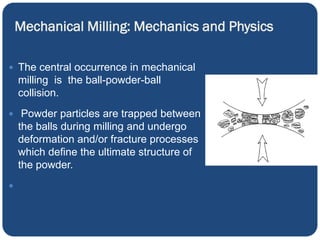
The central occurrence in mechanical
milling is the ball-powder-ball
collision.
Powder particles are trapped between
the balls during milling and undergo
deformation and/or fracture processes
which define the ultimate structure of
the powder.
11.
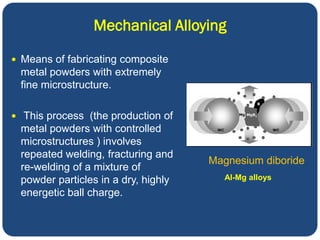
Mechanical Alloying
Meansof fabricating composite
metal powders with extremely
fine microstructure.
This process (the production of
metal powders with controlled
microstructures ) involves
repeated welding, fracturing and
re-welding of a mixture of
powder particles in a dry, highly
energetic ball charge.
Magnesium diboride
Al-Mg alloys
12.
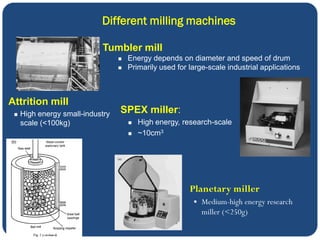
Different milling machines
Planetarymiller
Medium-high energy research
miller (<250g)
Tumbler mill
Energy depends on diameter and speed of drum
Primarily used for large-scale industrial applications
SPEX miller:
High energy, research-scale
~10cm3
Attrition mill
High energy small-industry
scale (<100kg)
13.
Ball Milling -Parameters
• Type of mill (planetary, attrition, vibratory, rod, tumbler,
etc.)
• Speed of mill: relative speeds of pot rotation to disk
revolution in a planetary mill
• Composition, size, shape and surface of pot
• Degree of filling pot
• Number, size(s), material (density, elasticity), and surface
of milling balls
• Weight, shape, size and composition of starting material
• Macroscopic temperatures of pot, ball and powder
• Microscopic Temperature at collision point
• Milling atmosphere
• Milling time
14.
Advantages of BallMills
Produces very fine powder (particle size less than
or equal to 100 nm).
It is suitable for milling toxic materials since it can
be used in a completely enclosed form.
Has a wide application.
It can be used for continuous operation.
It is used in milling highly abrasive materials.
.
15.
Disadvantages of BallMills
Contamination of product may occur as a result
of wear and tear which occurs principally from
the balls and partially from the casing.
High machine noise level
It is difficult to clean the machine after use.