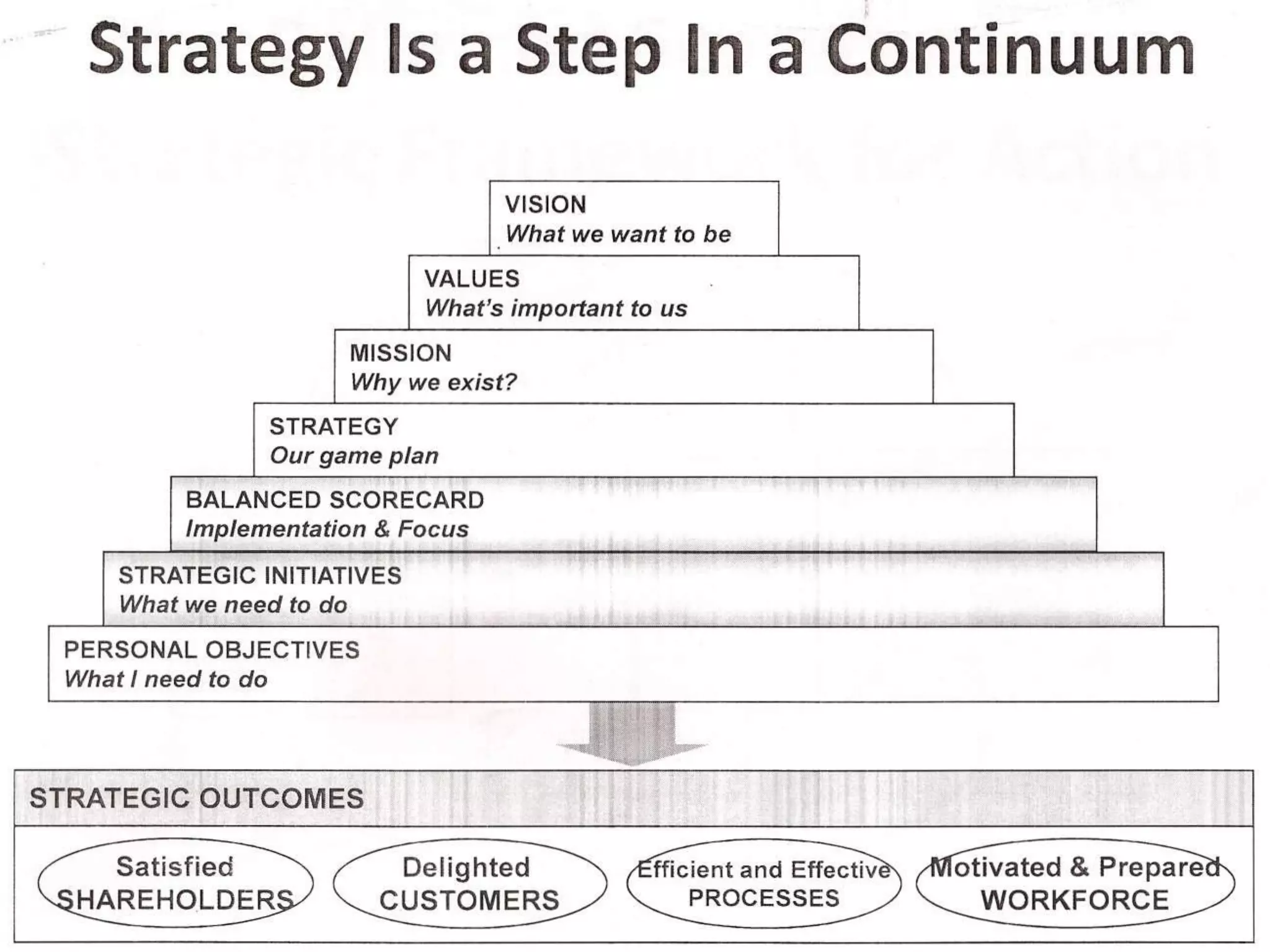
Balanced Scorecard (Part 1)Shantonu DasmahapatraNHRDN, Mumbai                                                   26th March 2011
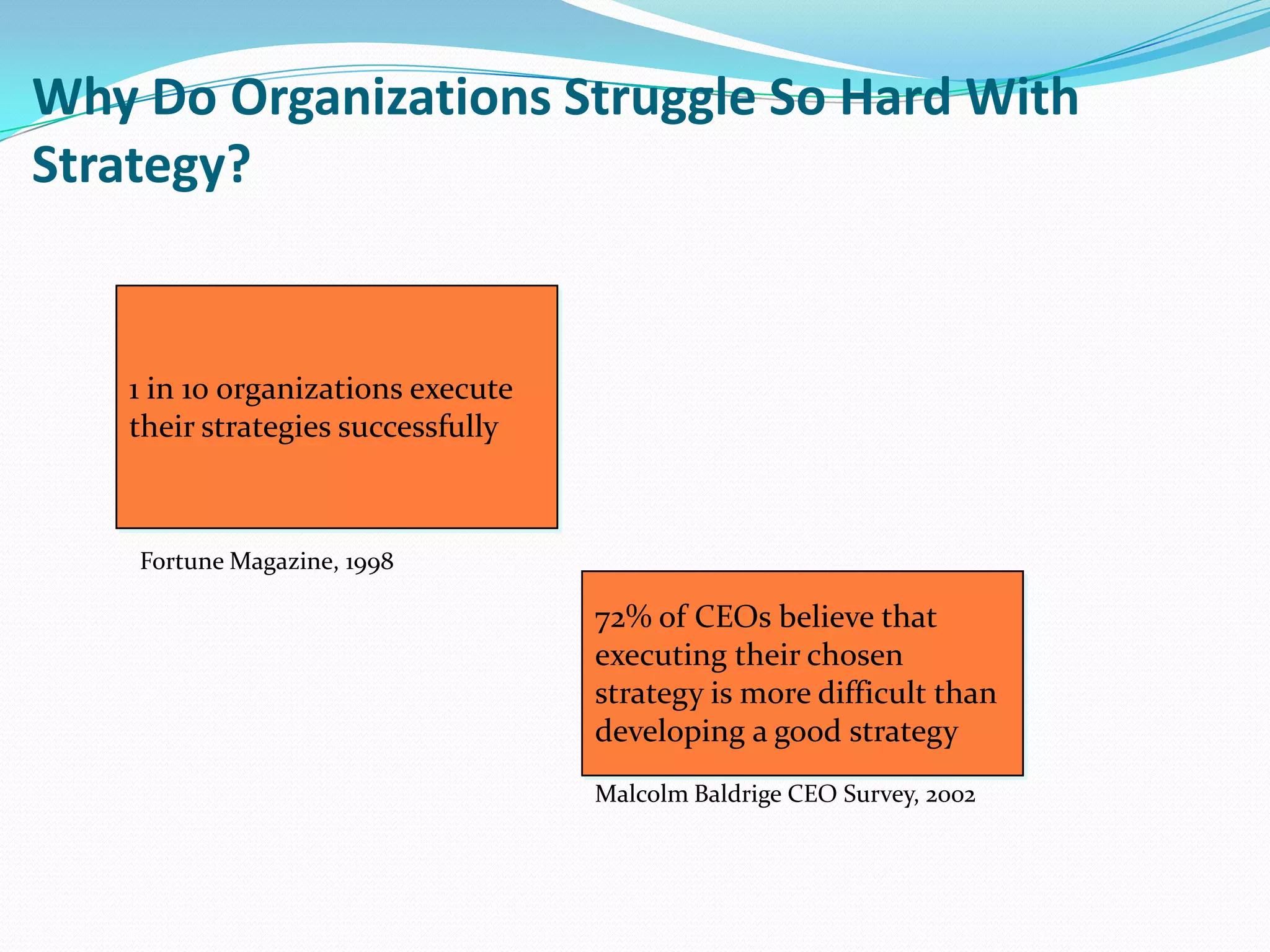
Why Do Organizations Struggle So Hard With Strategy?1 in 10 organizations execute their strategies successfullyFortune Magazine, 199872% of CEOs believe that executing their chosen strategy is more difficult than developing a good strategyMalcolm Baldrige CEO Survey, 2002
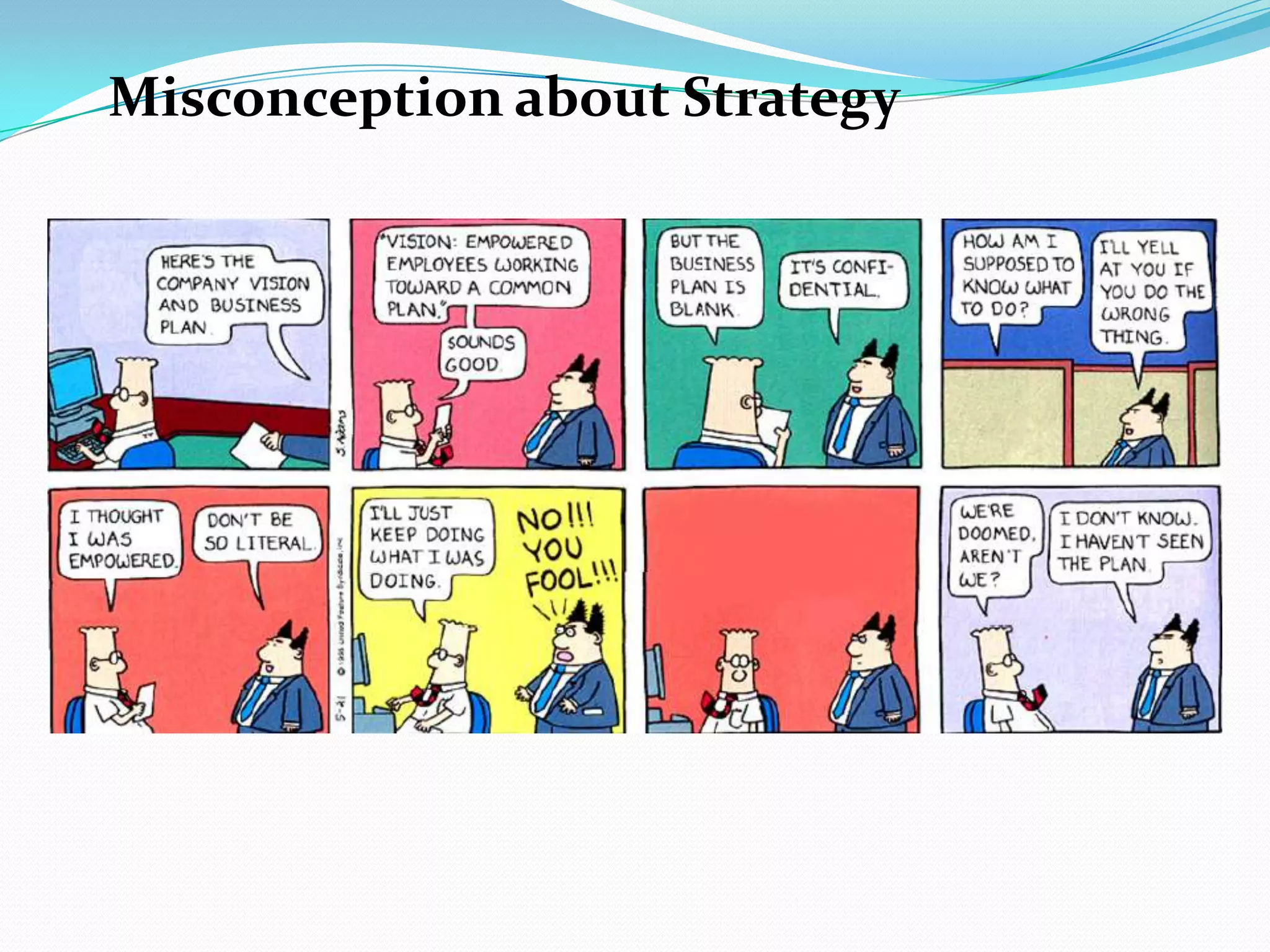
Misconception about Strategy
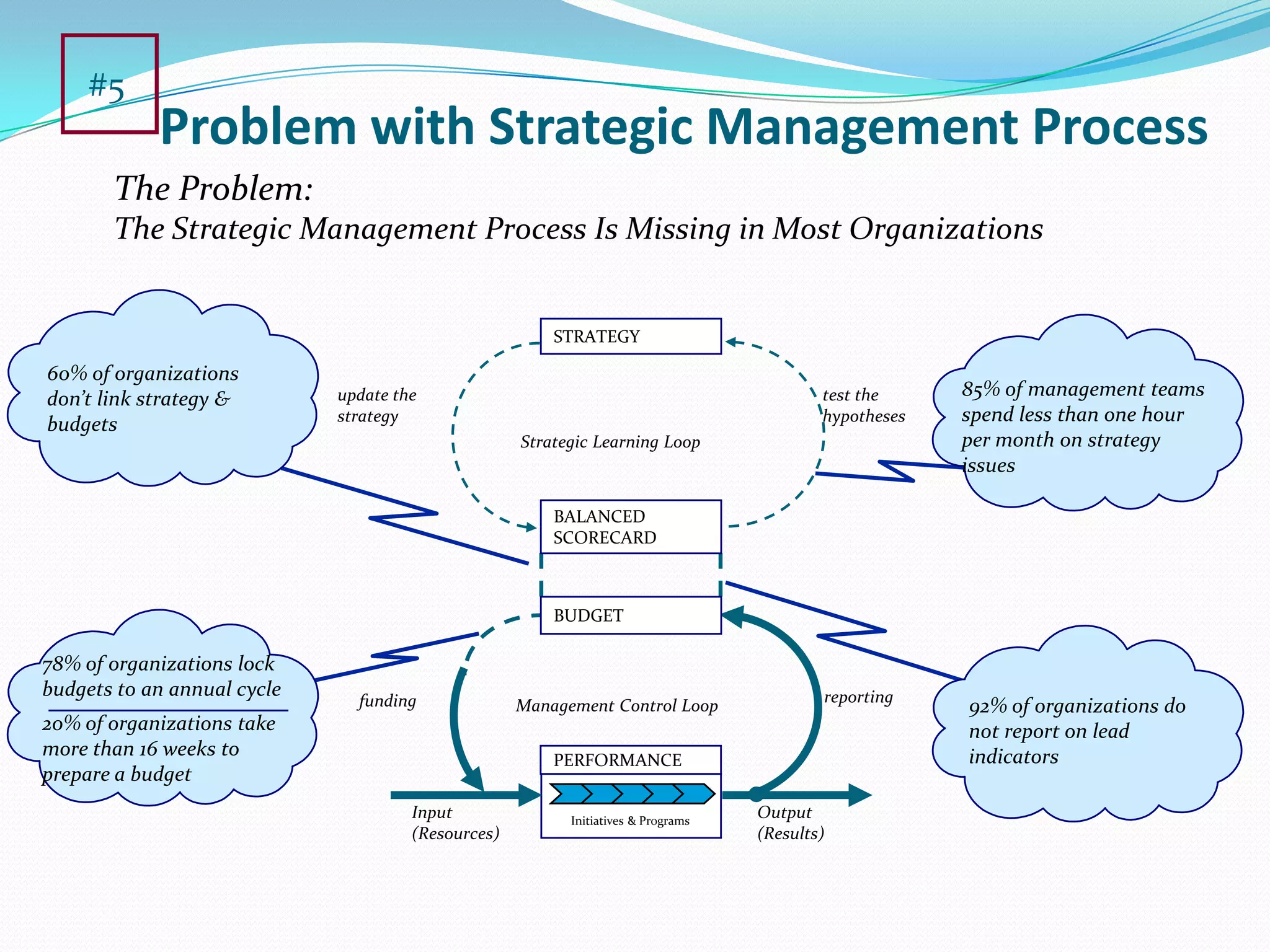
Problem with Strategic Management Process#5The Problem:  The Strategic Management Process Is Missing in Most OrganizationsSTRATEGY60% of organizations don’t link strategy & budgets85% of management teams spend less than one hour per month on strategy issuestest the hypothesesupdate the strategyStrategic Learning LoopBALANCED SCORECARDBUDGET78% of organizations lock budgets to an annual cycle20% of organizations take more than 16 weeks to prepare a budgetreportingfundingManagement Control Loop92% of organizations do not report on lead indicatorsPERFORMANCEOutput(Results)Input(Resources)Initiatives & Programs
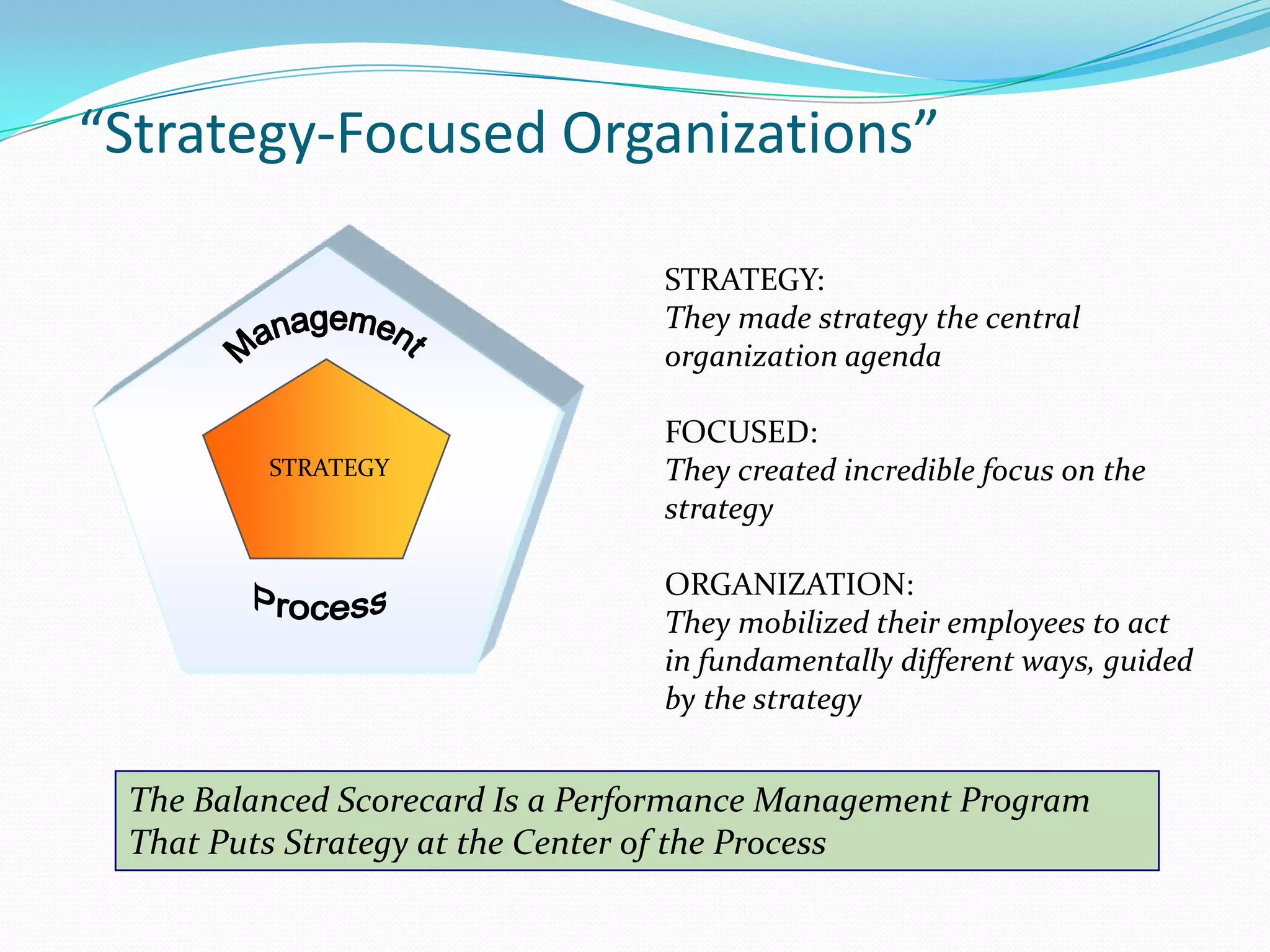
 “Strategy-Focused Organizations”STRATEGY:They made strategy the central organization agendaFOCUSED:They created incredible focus on the strategyORGANIZATION:They mobilized their employees to act in fundamentally different ways, guided by the strategyManagementSTRATEGYProcessThe Balanced Scorecard Is a Performance Management Program That Puts Strategy at the Center of the Process
A brief background of Balanced ScorecardThe Nolan Norton Institute sponsored one year multi-company study in 1990 on measuring performance in the organization of the future.The study was motivated by a belief that existing performance measurement approaches, primarily relying on financial accounting measures were becoming obsolete.
A brief background of Balanced Scorecard (Contd..)The findings of the study was summarized in article in Harvard Business Review (Jan to Feb 1992) in an article – ‘The Balanced Scorecard – measures that drive performance.Today, about 70% of the Fortune 1000 companies utilize the Balanced Scorecard to help manage organizational performance.
New Operating Environment in Information age organizationsInformation age environment for both manufacturing and service organizations require new capabilities for competitive success.The ability of a company to mobilize and exploit its intangible assets has become far more decisive than investing and managing tangible assets.Some of the typical characteristics of information age organizations are :Operates with integrated business processes that cuts across traditional business functions.Enables all organizational units along with value chain to realize enormous improvements in cost, quality and response time.Are able to offer customize products and services to its diverse customer segments.
Comparison of Balanced Scorecard with Airline CockpitA pilot will require information on all the following for the task of navigating and flying an airplaneInformation on fuelInformation on air specsInformation on altitudesInformation on environmentInformation on destination etc.Balanced Scorecard can be compared with the dials and indications in airplane cockpit.Reliance on only one indicator/ information can be fatal.Similarly the complexity of managing an organization today requires that Managers be able to view performance in several areas simultaneously. Managers like pilots need instruments about many aspects of their environment and performances to monitor the journey towards excellent future outcomes.
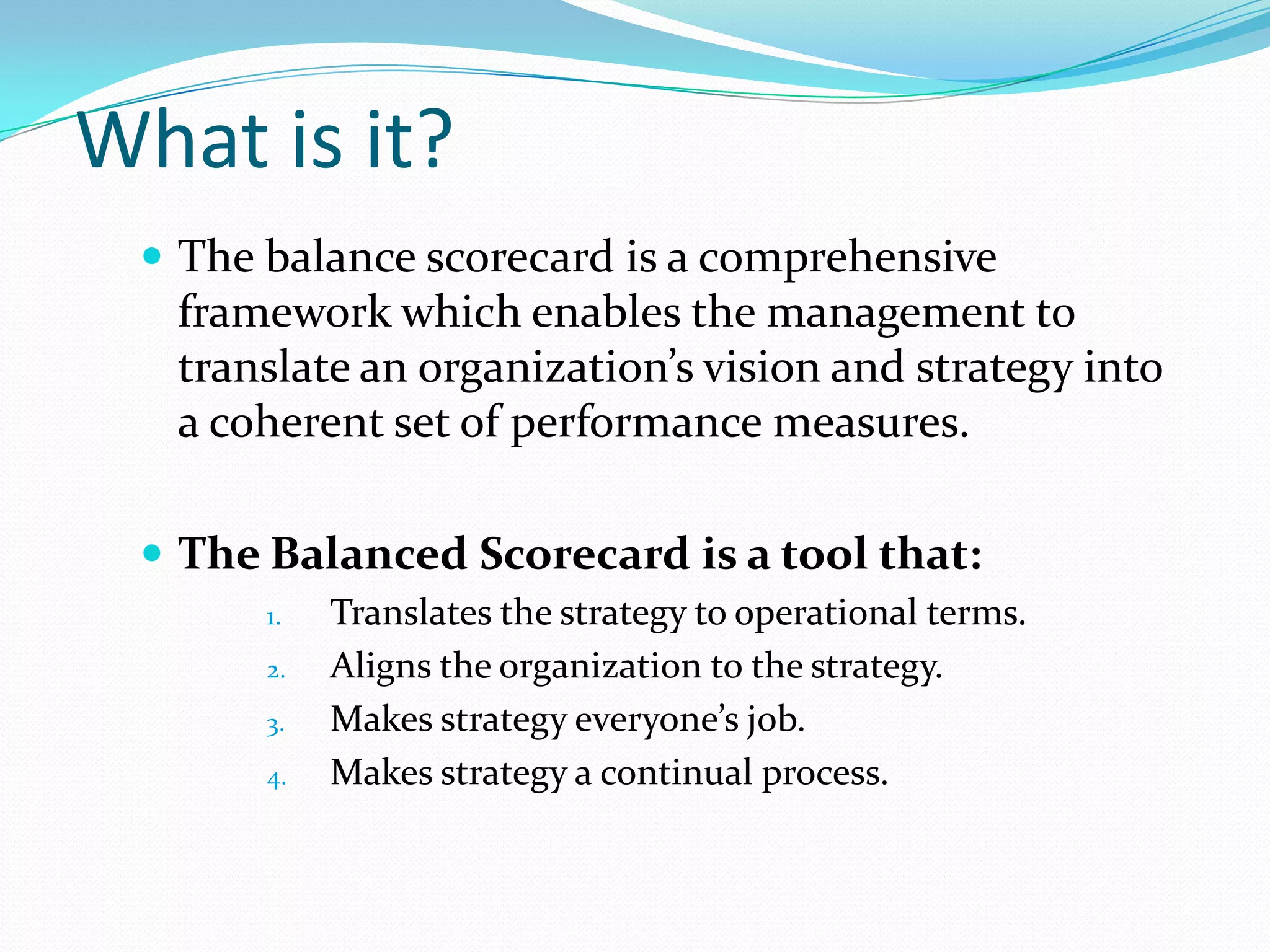
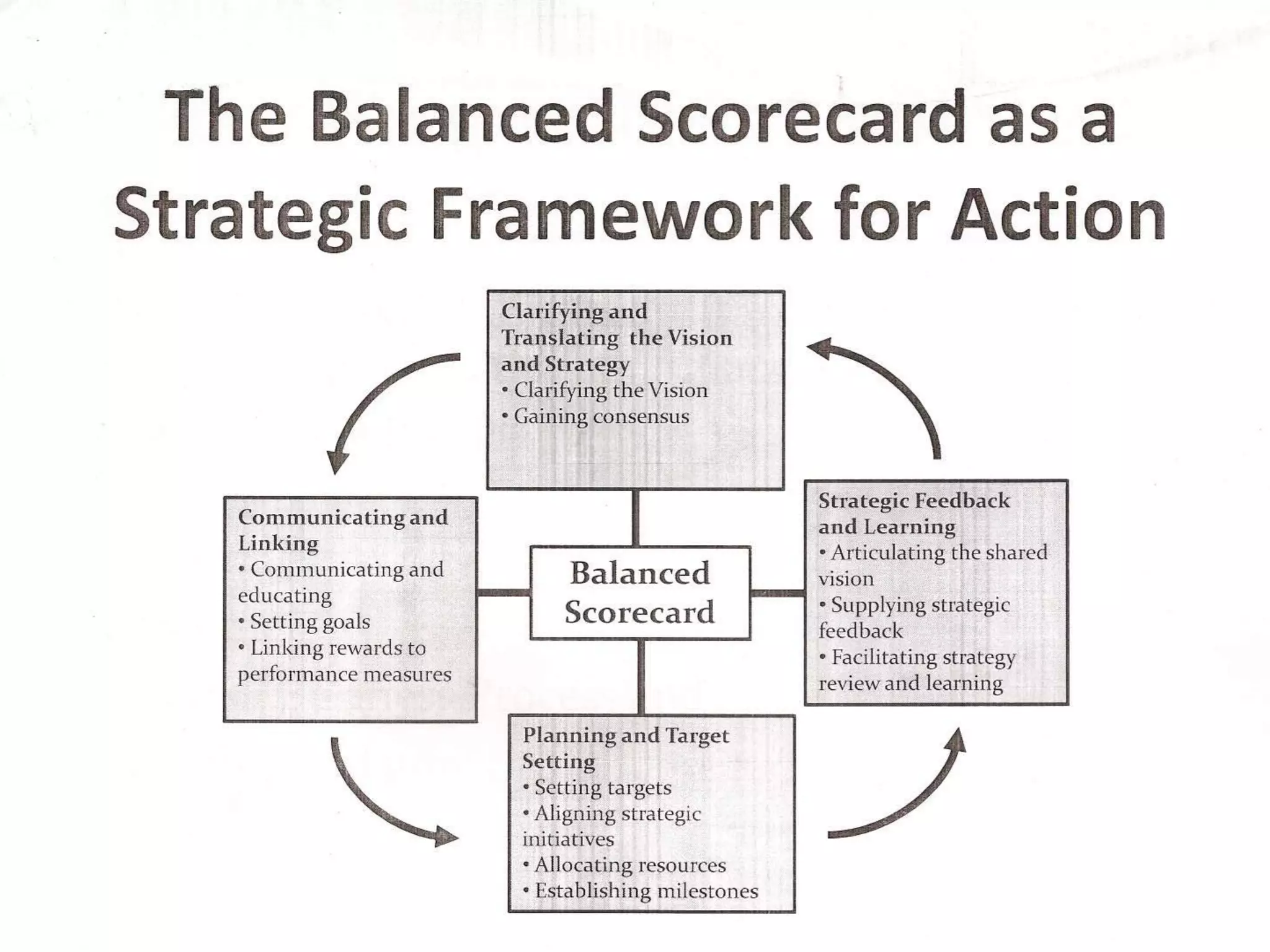
What is it?The balance scorecard is a comprehensive framework which enables the management to translate an organization’s vision and strategy into a coherent set of performance measures.The Balanced Scorecard is a tool that:Translates the strategy to operational terms.Aligns the organization to the strategy.Makes strategy everyone’s job.Makes strategy a continual process.
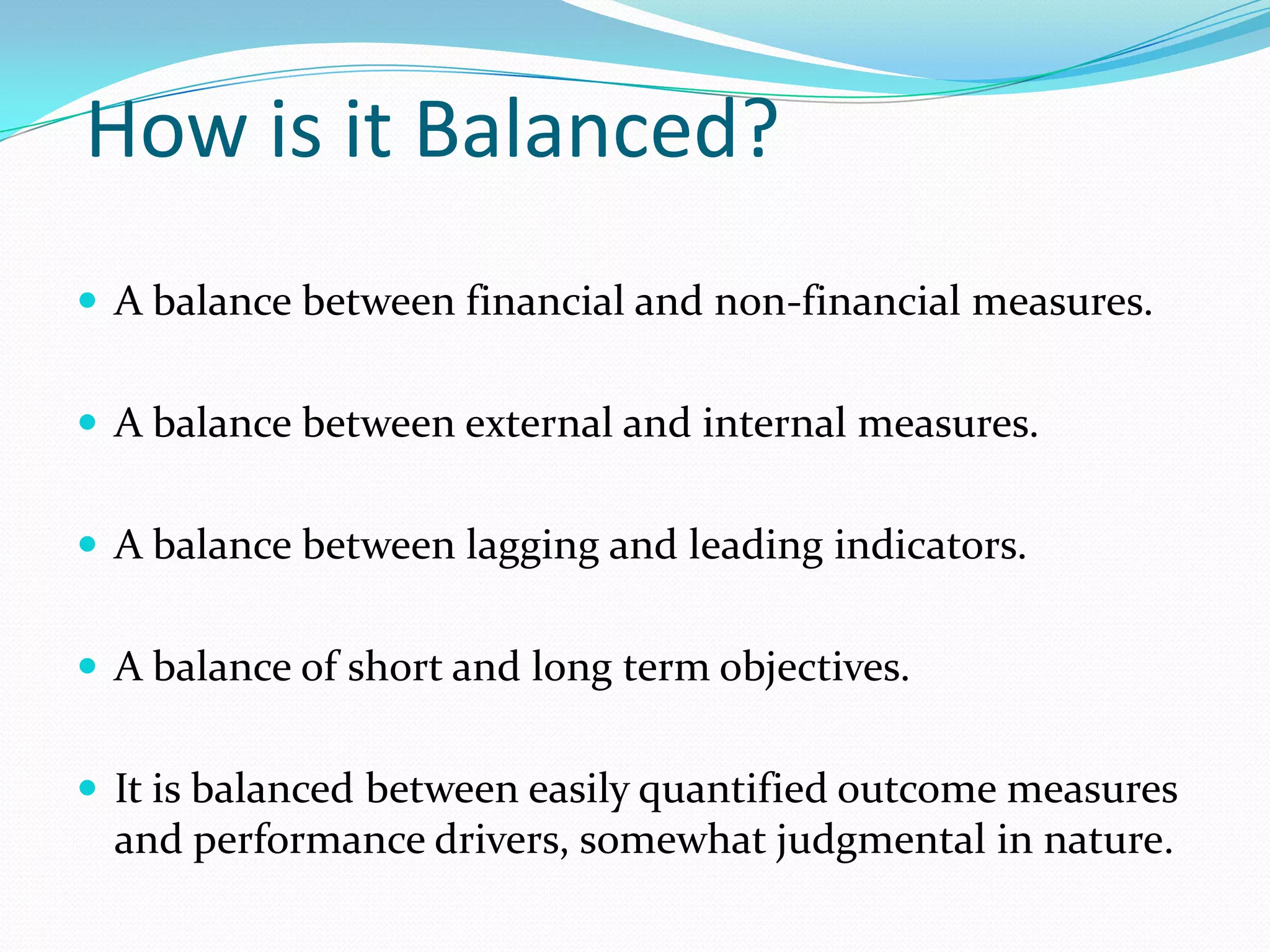
How is it Balanced?A balance between financial and non-financial measures.A balance between external and internal measures.A balance between lagging and leading indicators.A balance of short and long term objectives.It is balanced between easily quantified outcome measures and performance drivers, somewhat judgmental in nature.
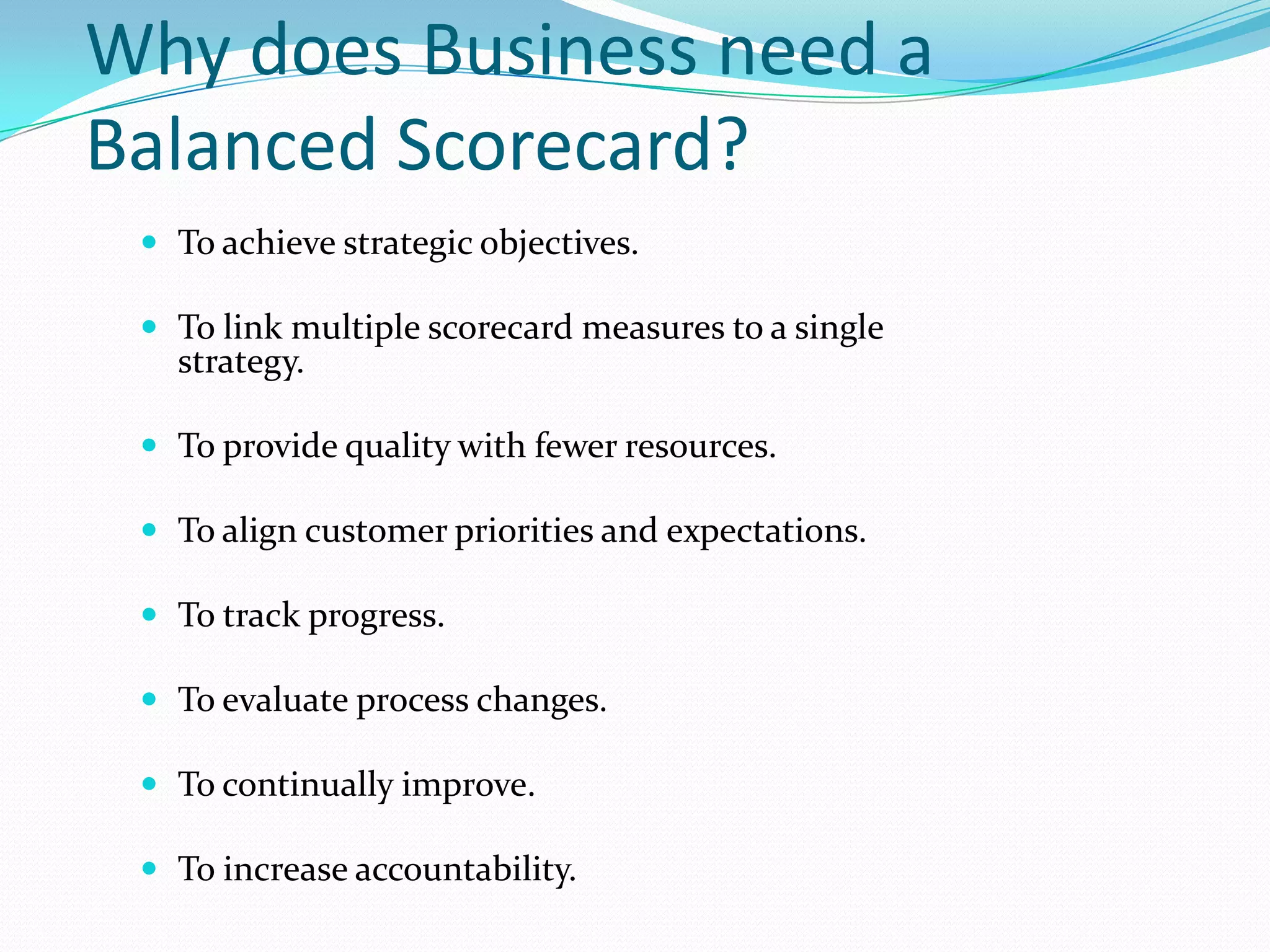
Why does Business need a Balanced Scorecard?To achieve strategic objectives.To link multiple scorecard measures to a single strategy.To provide quality with fewer resources.To align customer priorities and expectations.To track progress.To evaluate process changes.To continually improve.To increase accountability.
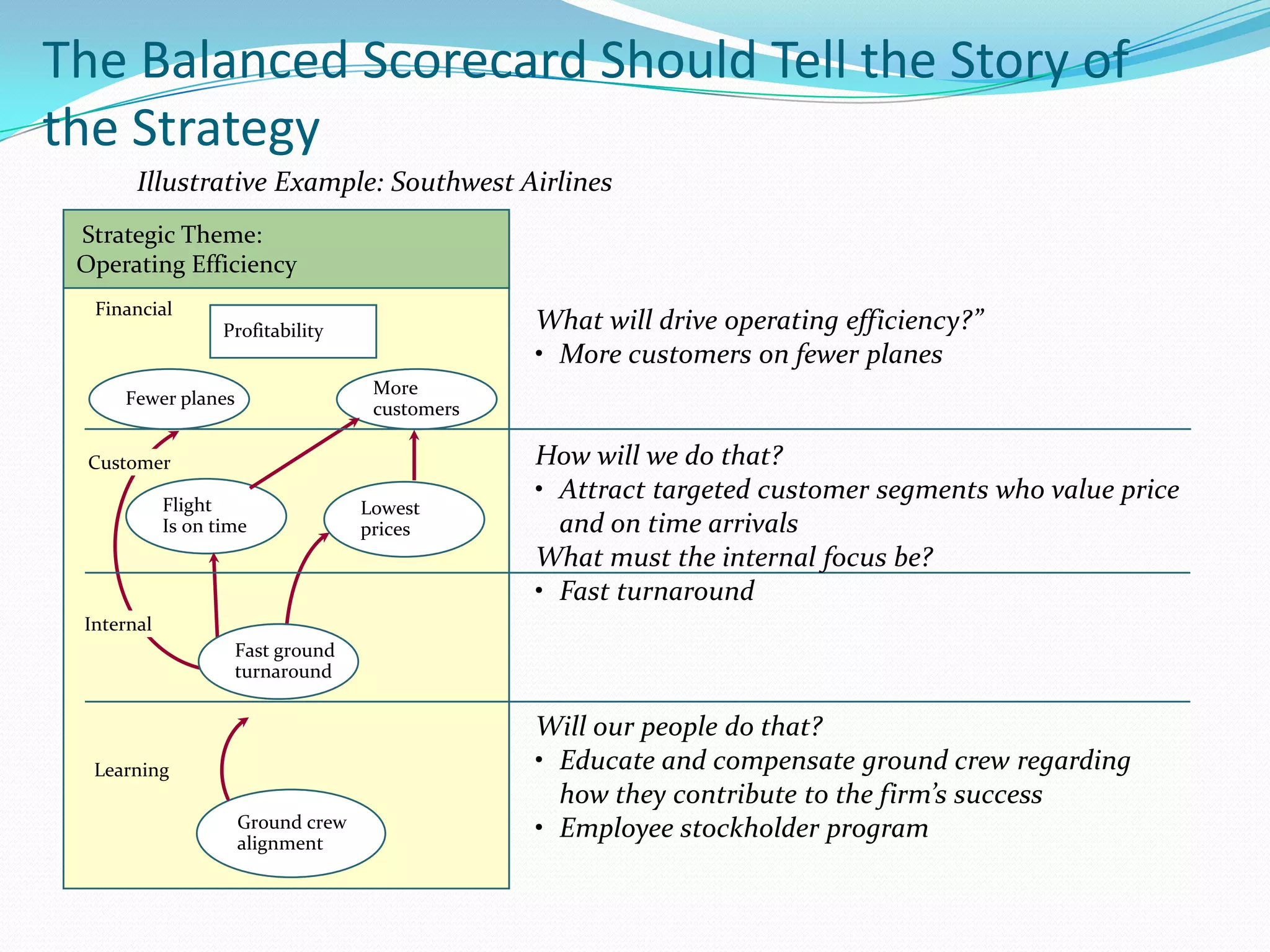
Strategic Theme: Operating EfficiencyWhat will drive operating efficiency?”More customers on fewer planesHow will we do that?Attract targeted customer segments who value price and on time arrivalsWhat must the internal focus be?Fast turnaroundWill our people do that?Educate and compensate ground crew regarding how they contribute to the firm’s success
Employee stockholder programFinancialProfitabilityMorecustomersFewer planesCustomerFlight Is on timeLowest pricesInternalFast ground turnaroundLearning Ground crew alignmentThe Balanced Scorecard Should Tell the Story of the Strategy Illustrative Example: Southwest Airlines
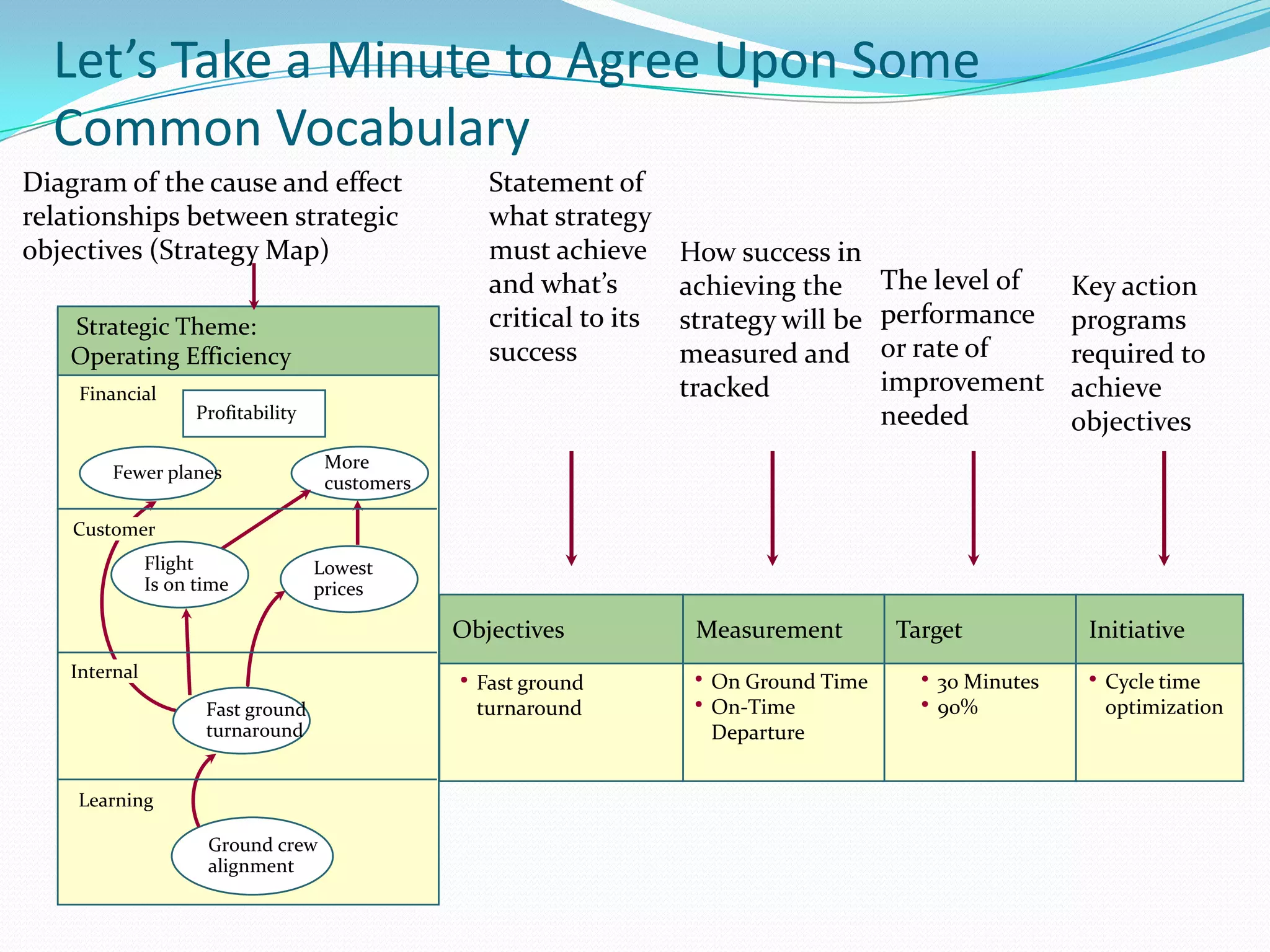
Statement of what strategy must achieve and what’s critical to its successDiagram of the cause and effect relationships between strategic objectives (Strategy Map)How success in achieving the strategy will be measured and trackedThe level of performance or rate of improvement neededKey action programs required to achieve objectivesStrategic Theme: Operating EfficiencyFinancialProfitabilityMorecustomersFewer planesCustomerFlight Is on timeLowest pricesObjectivesTargetInitiativeMeasurementInternal30 Minutes
90%
Cycle time optimization
On Ground Time
On-Time Departure
Fast ground turnaroundFast ground turnaroundLearning Ground crew alignmentLet’s Take a Minute to Agree Upon Some Common Vocabulary
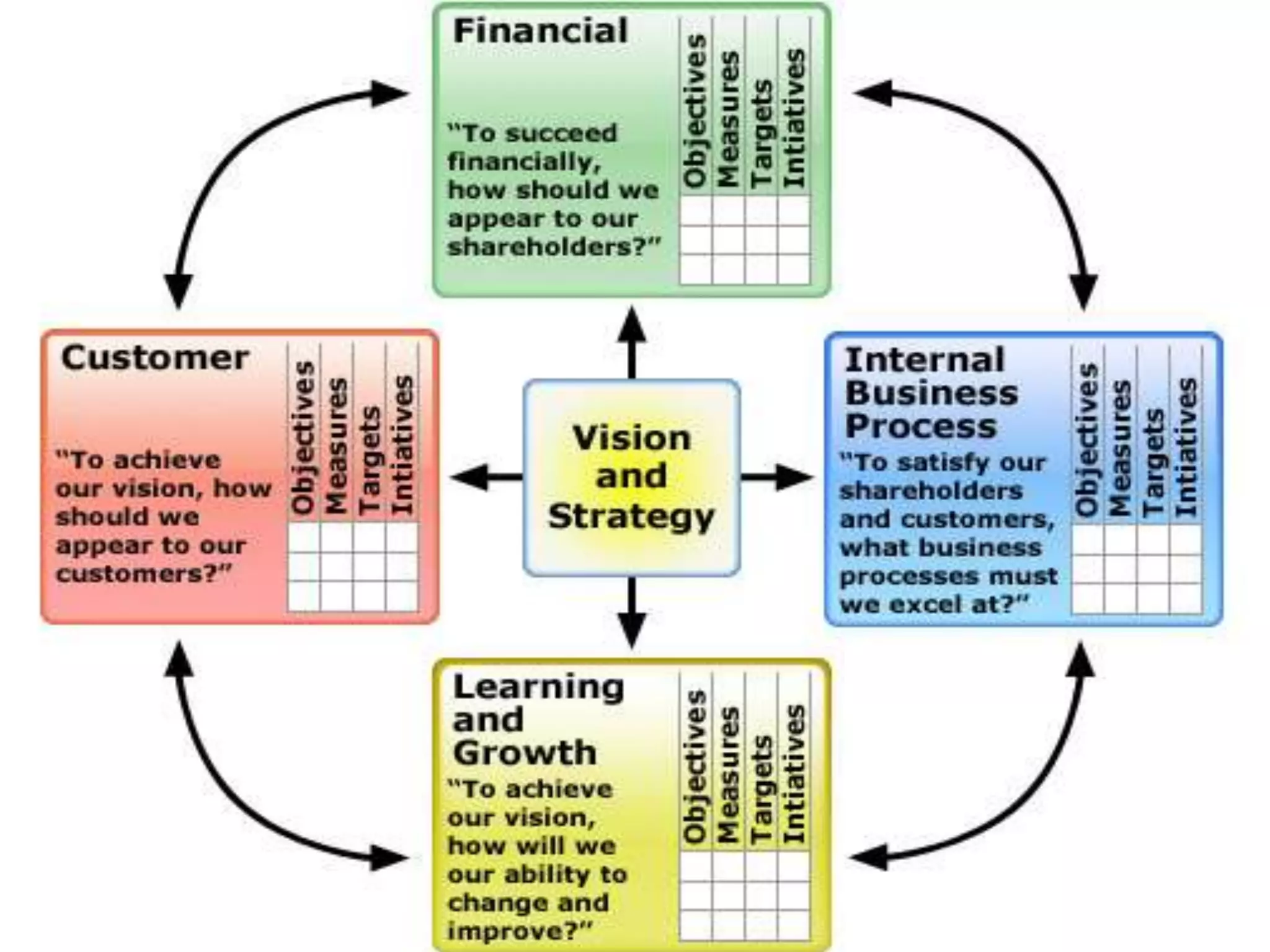
Four Perspective of Balanced ScorecardThe Balanced Scorecard translates mission and strategy into objectives and measures, organized into four different perspectives:Financial
Customer
Internal Business Process
Learning and growth
Linking multiple Scorecard measures to a single strategyMultiple measures on a properly constructed Balanced Scorecard should consist of a linked services of objectives and measures that are both consistent and mutually reinforcing.The metaphor should be a flight simulator  and not a dashboard of instrument dials.The linkage should incorporate both cause and effect relationship and a mixture of outcome measures lagging indications and performance drivers (leading indicators).
The Context of MeasurementPerformance Measurement is a process by which an agency objectively assesses and evaluates the extent to which it is accomplishing a specific objective, goal, or mission. Performance measurement alone is incomplete.  Performance Management is a systematic link between company strategy, Investments, and processes.  Performance Management is a comprehensive management process.
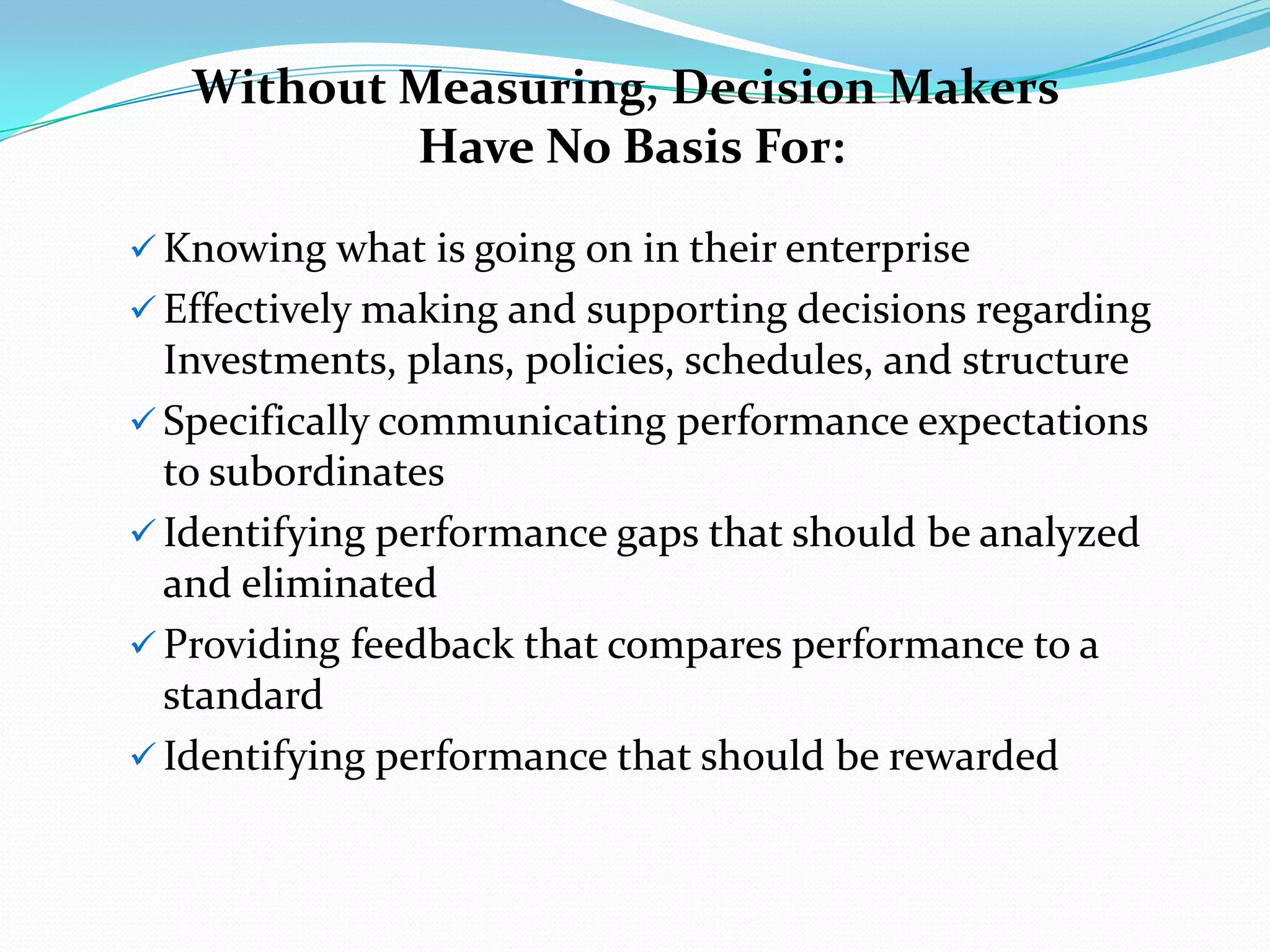
Why Measure Performance?Enables decision makingManage by resultsPromote accountabilityDistinguish between program success and failureAllow for organizational learning and improvementJustify budget requestsOptimize InvestmentsProvide means of performance comparisonFulfill mandatesEstablish catalysts for changeAnd so on…
Without Measuring, Decision Makers Have No Basis For:Knowing what is going on in their enterprise
Effectively making and supporting decisions regarding Investments, plans, policies, schedules, and structure
Specifically communicating performance expectations to subordinates
Identifying performance gaps that should be analyzed and eliminated
Providing feedback that compares performance to a standard
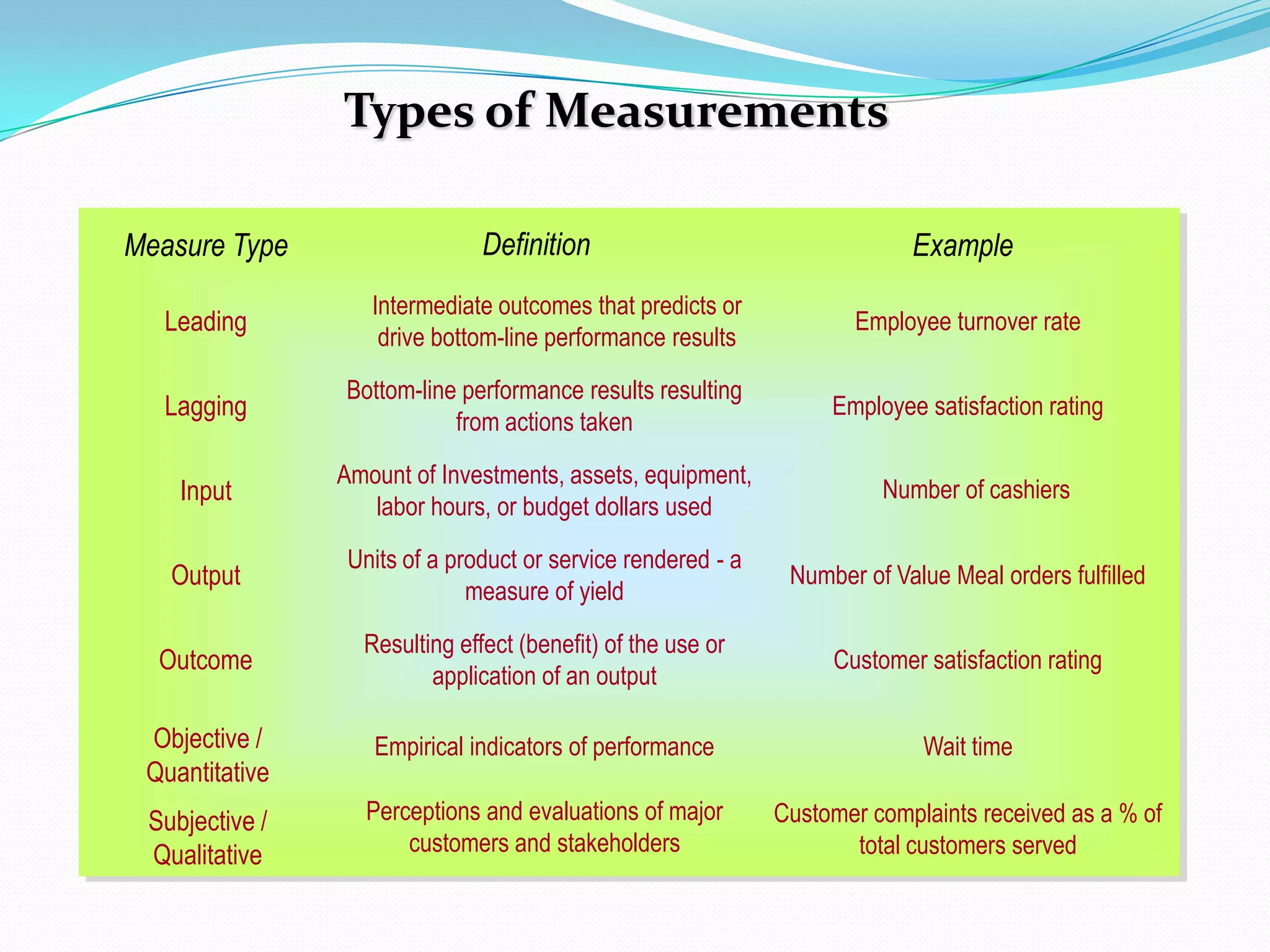
Identifying performance that should be rewardedTypes of MeasurementsDefinitionExampleMeasure TypeIntermediate outcomes that predicts or drive bottom-line performance resultsLeadingEmployee turnover rateBottom-line performance results resulting from actions takenLaggingEmployee satisfaction ratingAmount of Investments, assets, equipment, labor hours, or budget dollars usedInputNumber of cashiersUnits of a product or service rendered - a measure of yieldOutputNumber of Value Meal orders fulfilledResulting effect (benefit) of the use or application of an outputOutcomeCustomer satisfaction ratingObjective / QuantitativeEmpirical indicators of performanceWait timePerceptions and evaluations of major customers and stakeholdersCustomer complaints received as a % of total customers servedSubjective / Qualitative
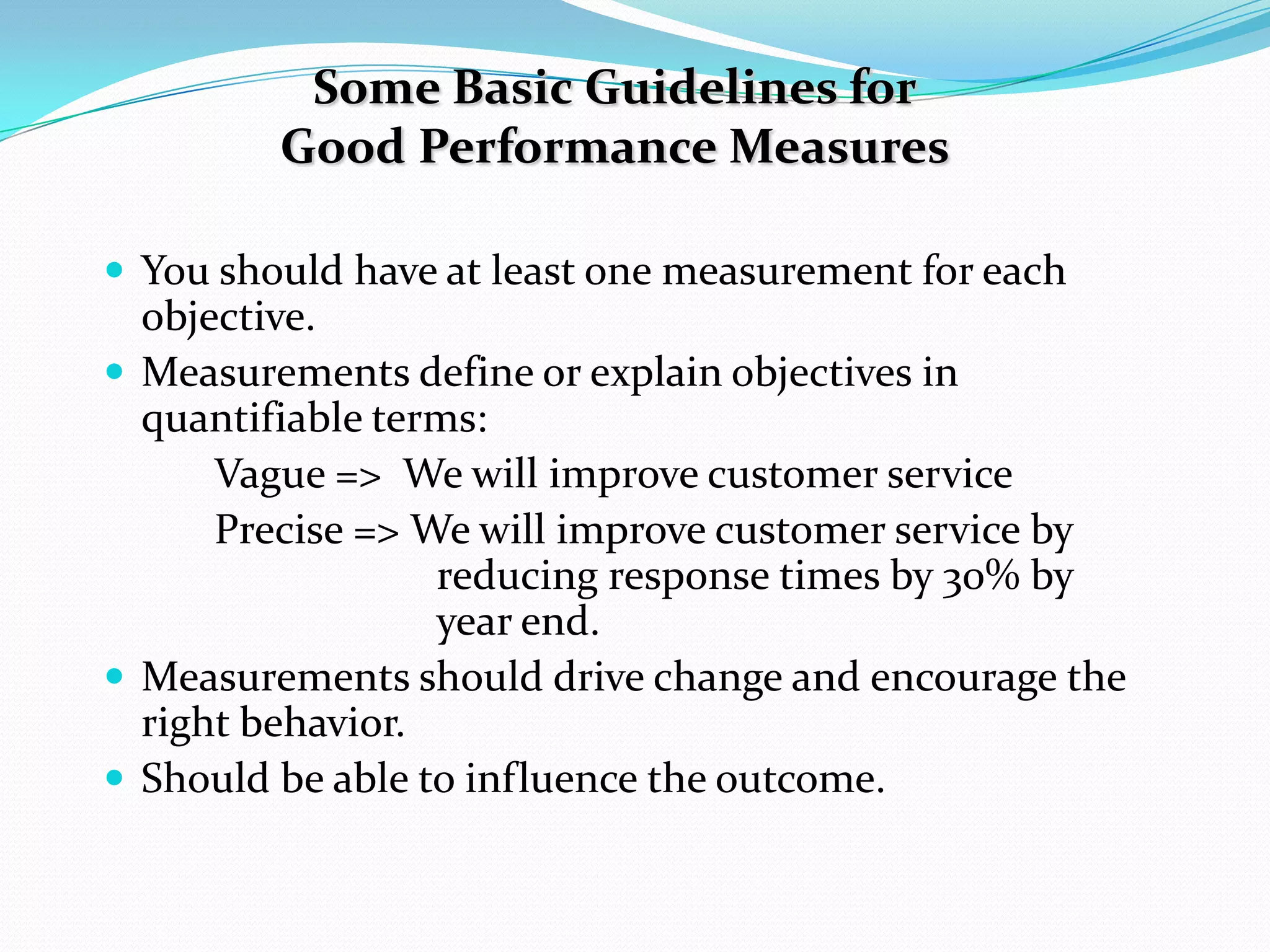
Some Basic Guidelines forGood Performance MeasuresYou should have at least one measurement for each objective. Measurements define or explain objectives in quantifiable terms:	Vague =>  We will improve customer service	Precise => We will improve customer service by reducing response times by 30% by year end.  Measurements should drive change and encourage the right behavior.Should be able to influence the outcome.
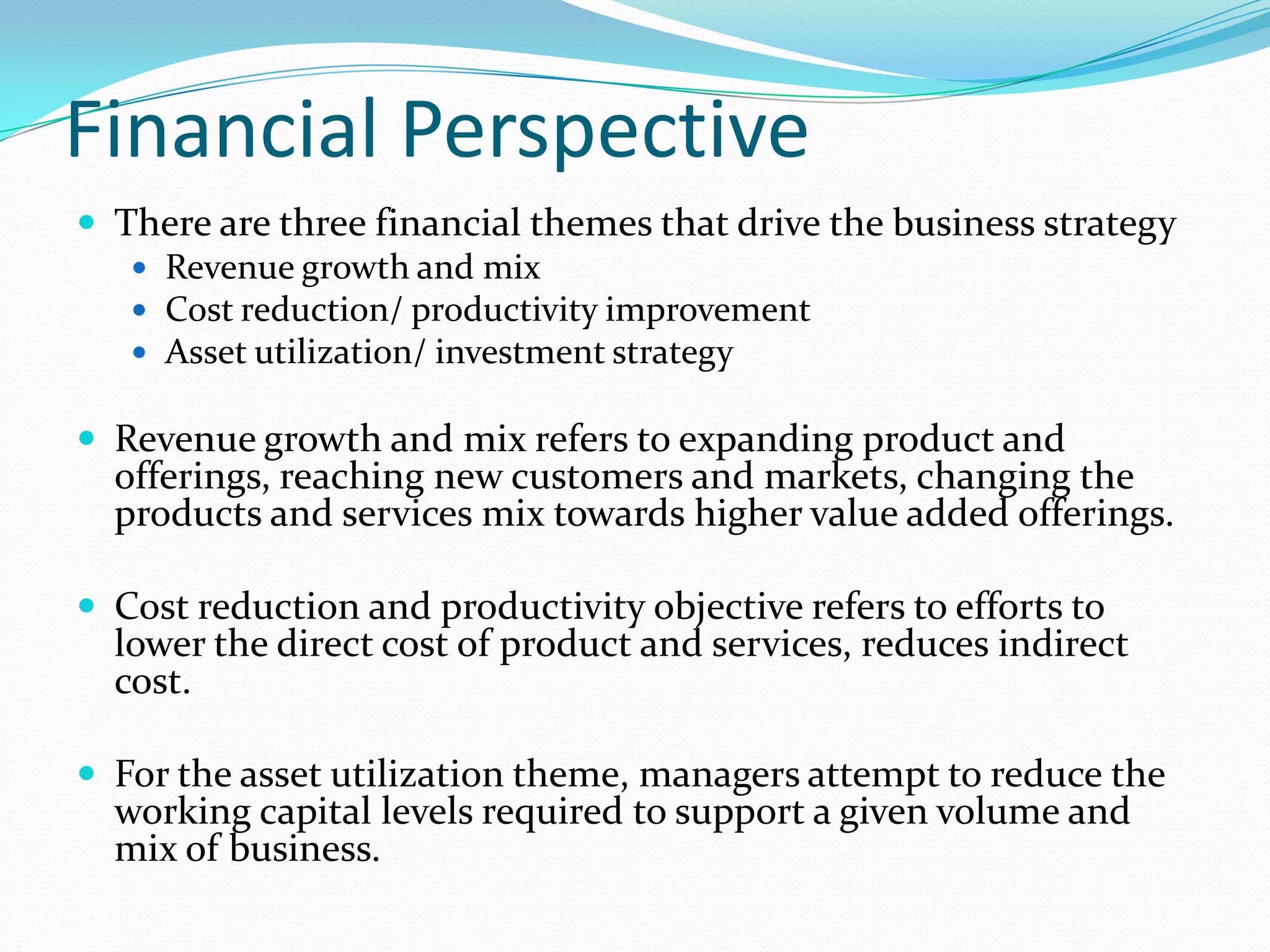
Selection Criteria for Performance MeasurementsMEANINGFUL - related significantly and directly to organizations mission and goal
VALUABLE – measure the most important activities of the organization
BALANCED – inclusive of several types of measures (i.e. quality, efficiency)
LINKED - matched to a unit responsible for achieving the measure
PRACTICAL – affordable price to retrieve and/or capture data
COMPARABLE – used to make comparisons with other data over time
CREDIBLE - based on accurate and reliable data
TIMELY - use and report data in a usable timeframe
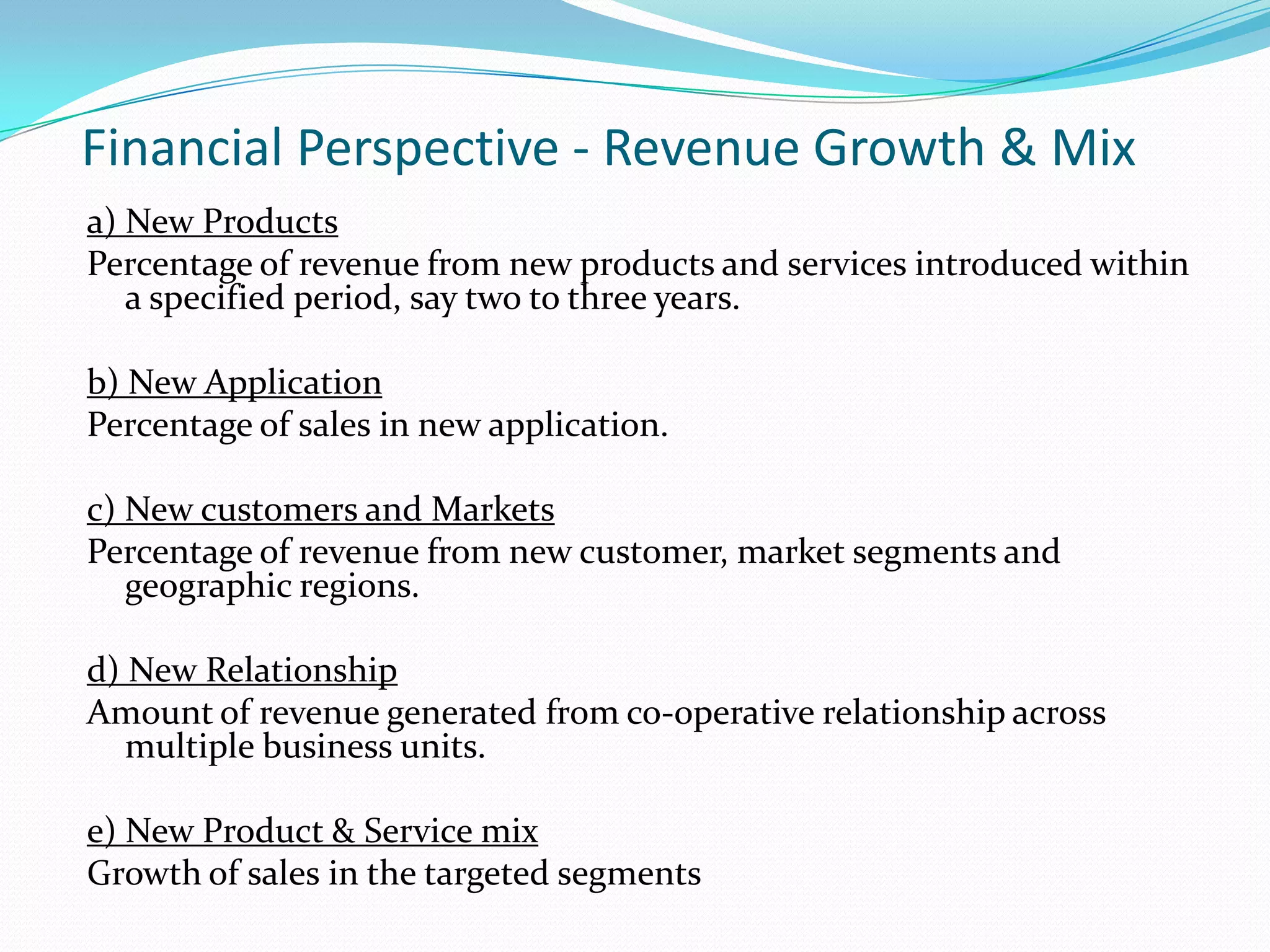
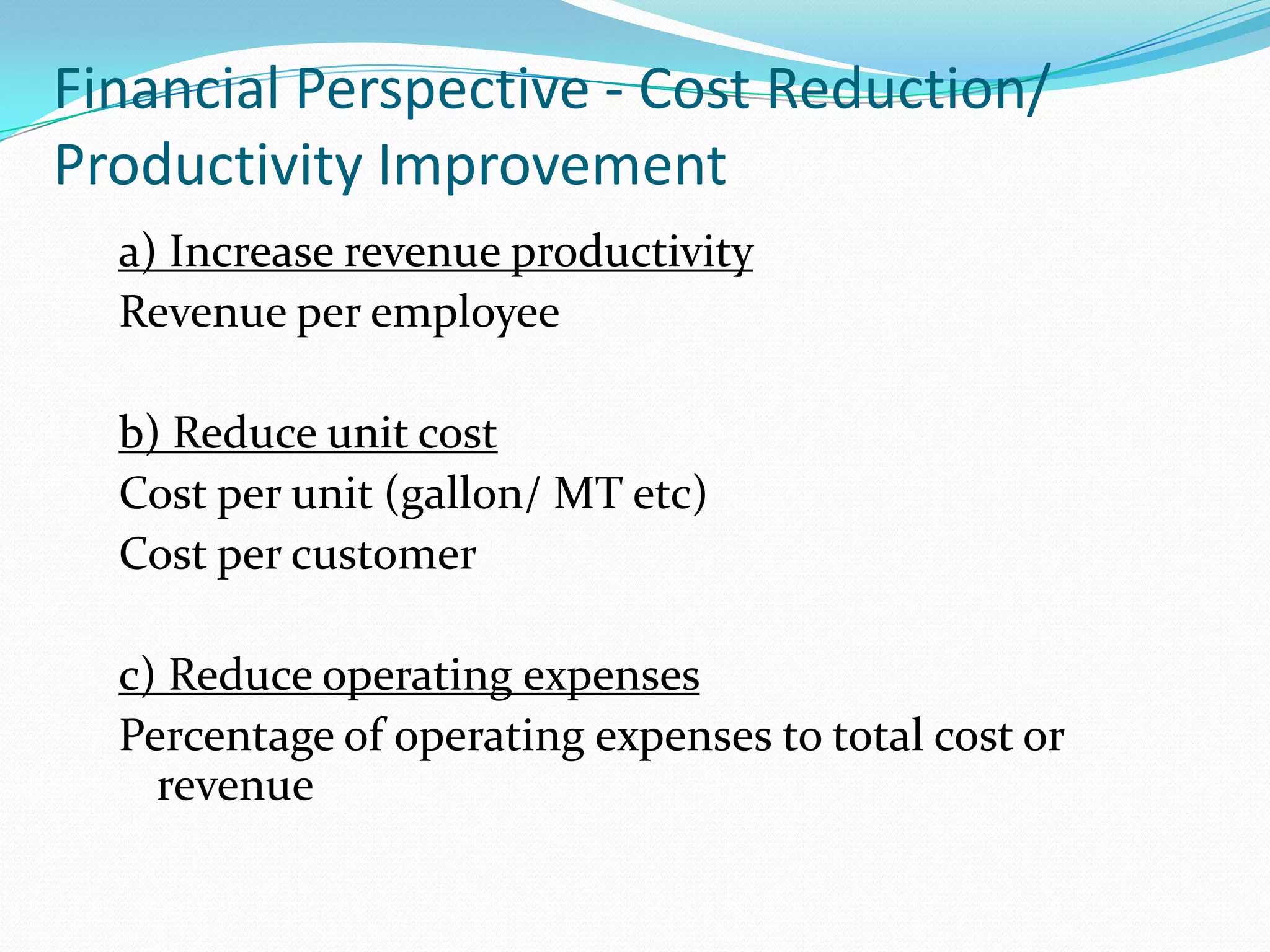
SIMPLE -- easy to calculate and understandFinancial PerspectiveThere are three financial themes that drive the business strategyRevenue growth and mixCost reduction/ productivity improvementAsset utilization/ investment strategyRevenue growth and mix refers to expanding product and offerings, reaching new customers and markets, changing the products and services mix towards higher value added offerings.Cost reduction and productivity objective refers to efforts to lower the direct cost of product and services, reduces indirect cost.For the asset utilization theme, managers attempt to reduce the working capital levels required to support a given volume and mix of business.

Balanced Scorecard (part 1) by Shantonu Dasmahapatra

  • 1.
    Balanced Scorecard (Part1)Shantonu DasmahapatraNHRDN, Mumbai 26th March 2011
  • 2.
    Why Do OrganizationsStruggle So Hard With Strategy?1 in 10 organizations execute their strategies successfullyFortune Magazine, 199872% of CEOs believe that executing their chosen strategy is more difficult than developing a good strategyMalcolm Baldrige CEO Survey, 2002
  • 3.
  • 4.
    Problem with StrategicManagement Process#5The Problem: The Strategic Management Process Is Missing in Most OrganizationsSTRATEGY60% of organizations don’t link strategy & budgets85% of management teams spend less than one hour per month on strategy issuestest the hypothesesupdate the strategyStrategic Learning LoopBALANCED SCORECARDBUDGET78% of organizations lock budgets to an annual cycle20% of organizations take more than 16 weeks to prepare a budgetreportingfundingManagement Control Loop92% of organizations do not report on lead indicatorsPERFORMANCEOutput(Results)Input(Resources)Initiatives & Programs
  • 5.
    “Strategy-Focused Organizations”STRATEGY:Theymade strategy the central organization agendaFOCUSED:They created incredible focus on the strategyORGANIZATION:They mobilized their employees to act in fundamentally different ways, guided by the strategyManagementSTRATEGYProcessThe Balanced Scorecard Is a Performance Management Program That Puts Strategy at the Center of the Process
  • 6.
    A brief backgroundof Balanced ScorecardThe Nolan Norton Institute sponsored one year multi-company study in 1990 on measuring performance in the organization of the future.The study was motivated by a belief that existing performance measurement approaches, primarily relying on financial accounting measures were becoming obsolete.
  • 7.
    A brief backgroundof Balanced Scorecard (Contd..)The findings of the study was summarized in article in Harvard Business Review (Jan to Feb 1992) in an article – ‘The Balanced Scorecard – measures that drive performance.Today, about 70% of the Fortune 1000 companies utilize the Balanced Scorecard to help manage organizational performance.
  • 8.
    New Operating Environmentin Information age organizationsInformation age environment for both manufacturing and service organizations require new capabilities for competitive success.The ability of a company to mobilize and exploit its intangible assets has become far more decisive than investing and managing tangible assets.Some of the typical characteristics of information age organizations are :Operates with integrated business processes that cuts across traditional business functions.Enables all organizational units along with value chain to realize enormous improvements in cost, quality and response time.Are able to offer customize products and services to its diverse customer segments.
  • 9.
    Comparison of BalancedScorecard with Airline CockpitA pilot will require information on all the following for the task of navigating and flying an airplaneInformation on fuelInformation on air specsInformation on altitudesInformation on environmentInformation on destination etc.Balanced Scorecard can be compared with the dials and indications in airplane cockpit.Reliance on only one indicator/ information can be fatal.Similarly the complexity of managing an organization today requires that Managers be able to view performance in several areas simultaneously. Managers like pilots need instruments about many aspects of their environment and performances to monitor the journey towards excellent future outcomes.
  • 10.
    What is it?Thebalance scorecard is a comprehensive framework which enables the management to translate an organization’s vision and strategy into a coherent set of performance measures.The Balanced Scorecard is a tool that:Translates the strategy to operational terms.Aligns the organization to the strategy.Makes strategy everyone’s job.Makes strategy a continual process.
  • 11.
    How is itBalanced?A balance between financial and non-financial measures.A balance between external and internal measures.A balance between lagging and leading indicators.A balance of short and long term objectives.It is balanced between easily quantified outcome measures and performance drivers, somewhat judgmental in nature.
  • 12.
    Why does Businessneed a Balanced Scorecard?To achieve strategic objectives.To link multiple scorecard measures to a single strategy.To provide quality with fewer resources.To align customer priorities and expectations.To track progress.To evaluate process changes.To continually improve.To increase accountability.
  • 15.
    Strategic Theme: OperatingEfficiencyWhat will drive operating efficiency?”More customers on fewer planesHow will we do that?Attract targeted customer segments who value price and on time arrivalsWhat must the internal focus be?Fast turnaroundWill our people do that?Educate and compensate ground crew regarding how they contribute to the firm’s success
  • 16.
    Employee stockholder programFinancialProfitabilityMorecustomersFewerplanesCustomerFlight Is on timeLowest pricesInternalFast ground turnaroundLearning Ground crew alignmentThe Balanced Scorecard Should Tell the Story of the Strategy Illustrative Example: Southwest Airlines
  • 17.
    Statement of whatstrategy must achieve and what’s critical to its successDiagram of the cause and effect relationships between strategic objectives (Strategy Map)How success in achieving the strategy will be measured and trackedThe level of performance or rate of improvement neededKey action programs required to achieve objectivesStrategic Theme: Operating EfficiencyFinancialProfitabilityMorecustomersFewer planesCustomerFlight Is on timeLowest pricesObjectivesTargetInitiativeMeasurementInternal30 Minutes
  • 18.
  • 19.
  • 20.
  • 21.
  • 22.
    Fast ground turnaroundFastground turnaroundLearning Ground crew alignmentLet’s Take a Minute to Agree Upon Some Common Vocabulary
  • 23.
    Four Perspective ofBalanced ScorecardThe Balanced Scorecard translates mission and strategy into objectives and measures, organized into four different perspectives:Financial
  • 24.
  • 25.
  • 26.
  • 27.
    Linking multiple Scorecardmeasures to a single strategyMultiple measures on a properly constructed Balanced Scorecard should consist of a linked services of objectives and measures that are both consistent and mutually reinforcing.The metaphor should be a flight simulator and not a dashboard of instrument dials.The linkage should incorporate both cause and effect relationship and a mixture of outcome measures lagging indications and performance drivers (leading indicators).
  • 28.
    The Context ofMeasurementPerformance Measurement is a process by which an agency objectively assesses and evaluates the extent to which it is accomplishing a specific objective, goal, or mission. Performance measurement alone is incomplete. Performance Management is a systematic link between company strategy, Investments, and processes. Performance Management is a comprehensive management process.
  • 29.
    Why Measure Performance?Enablesdecision makingManage by resultsPromote accountabilityDistinguish between program success and failureAllow for organizational learning and improvementJustify budget requestsOptimize InvestmentsProvide means of performance comparisonFulfill mandatesEstablish catalysts for changeAnd so on…
  • 30.
    Without Measuring, DecisionMakers Have No Basis For:Knowing what is going on in their enterprise
  • 31.
    Effectively making andsupporting decisions regarding Investments, plans, policies, schedules, and structure
  • 32.
    Specifically communicating performanceexpectations to subordinates
  • 33.
    Identifying performance gapsthat should be analyzed and eliminated
  • 34.
    Providing feedback thatcompares performance to a standard
  • 35.
    Identifying performance thatshould be rewardedTypes of MeasurementsDefinitionExampleMeasure TypeIntermediate outcomes that predicts or drive bottom-line performance resultsLeadingEmployee turnover rateBottom-line performance results resulting from actions takenLaggingEmployee satisfaction ratingAmount of Investments, assets, equipment, labor hours, or budget dollars usedInputNumber of cashiersUnits of a product or service rendered - a measure of yieldOutputNumber of Value Meal orders fulfilledResulting effect (benefit) of the use or application of an outputOutcomeCustomer satisfaction ratingObjective / QuantitativeEmpirical indicators of performanceWait timePerceptions and evaluations of major customers and stakeholdersCustomer complaints received as a % of total customers servedSubjective / Qualitative
  • 36.
    Some Basic GuidelinesforGood Performance MeasuresYou should have at least one measurement for each objective. Measurements define or explain objectives in quantifiable terms: Vague => We will improve customer service Precise => We will improve customer service by reducing response times by 30% by year end. Measurements should drive change and encourage the right behavior.Should be able to influence the outcome.
  • 37.
    Selection Criteria forPerformance MeasurementsMEANINGFUL - related significantly and directly to organizations mission and goal
  • 38.
    VALUABLE – measurethe most important activities of the organization
  • 39.
    BALANCED – inclusiveof several types of measures (i.e. quality, efficiency)
  • 40.
    LINKED - matchedto a unit responsible for achieving the measure
  • 41.
    PRACTICAL – affordableprice to retrieve and/or capture data
  • 42.
    COMPARABLE – usedto make comparisons with other data over time
  • 43.
    CREDIBLE - basedon accurate and reliable data
  • 44.
    TIMELY - useand report data in a usable timeframe
  • 45.
    SIMPLE -- easyto calculate and understandFinancial PerspectiveThere are three financial themes that drive the business strategyRevenue growth and mixCost reduction/ productivity improvementAsset utilization/ investment strategyRevenue growth and mix refers to expanding product and offerings, reaching new customers and markets, changing the products and services mix towards higher value added offerings.Cost reduction and productivity objective refers to efforts to lower the direct cost of product and services, reduces indirect cost.For the asset utilization theme, managers attempt to reduce the working capital levels required to support a given volume and mix of business.
  • 46.
    Financial Perspective -Revenue Growth & Mixa) New ProductsPercentage of revenue from new products and services introduced within a specified period, say two to three years.b) New ApplicationPercentage of sales in new application.c) New customers and MarketsPercentage of revenue from new customer, market segments and geographic regions.d) New RelationshipAmount of revenue generated from co-operative relationship across multiple business units.e) New Product & Service mixGrowth of sales in the targeted segments
  • 47.
    Financial Perspective -Cost Reduction/ Productivity Improvementa) Increase revenue productivityRevenue per employeeb) Reduce unit costCost per unit (gallon/ MT etc)Cost per customerc) Reduce operating expensesPercentage of operating expenses to total cost or revenue
  • 48.
    Customer perspectiveEnables companiesto align their core customer outcome measures – satisfaction, loyalty, retention, acquisition and profitability to targeted customers and market segments.It enables to identify and measure the value proposition they will deliver to targeted customers and market segments.If business units are to achieve long term superior financial performance, they must create and deliver products and services that are valued by customers.
  • 49.
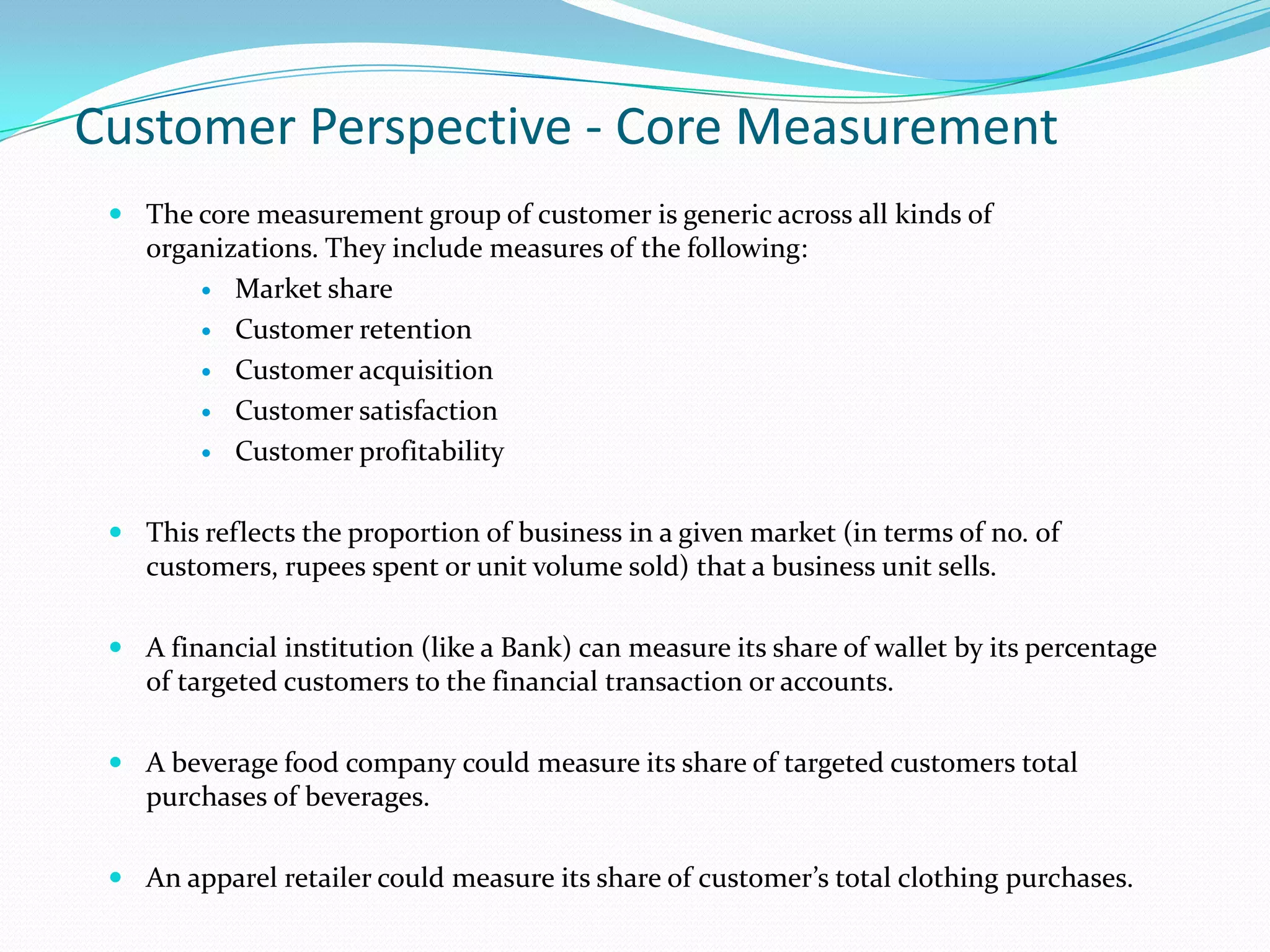
    Customer Perspective -Core MeasurementThe core measurement group of customer is generic across all kinds of organizations. They include measures of the following:Market shareCustomer retentionCustomer acquisitionCustomer satisfactionCustomer profitabilityThis reflects the proportion of business in a given market (in terms of no. of customers, rupees spent or unit volume sold) that a business unit sells.A financial institution (like a Bank) can measure its share of wallet by its percentage of targeted customers to the financial transaction or accounts.A beverage food company could measure its share of targeted customers total purchases of beverages.An apparel retailer could measure its share of customer’s total clothing purchases.
  • 50.
    Customer Perspective -Core MeasurementCustomer RetentionTracks in absolute or relative terms, the rate at which a business unit attracts or wins new customers or business.Companies that can readily identify all of their customers – industrial product companies, banks, credit card companies, telephone companies etc can readily measure customer retention.
  • 51.
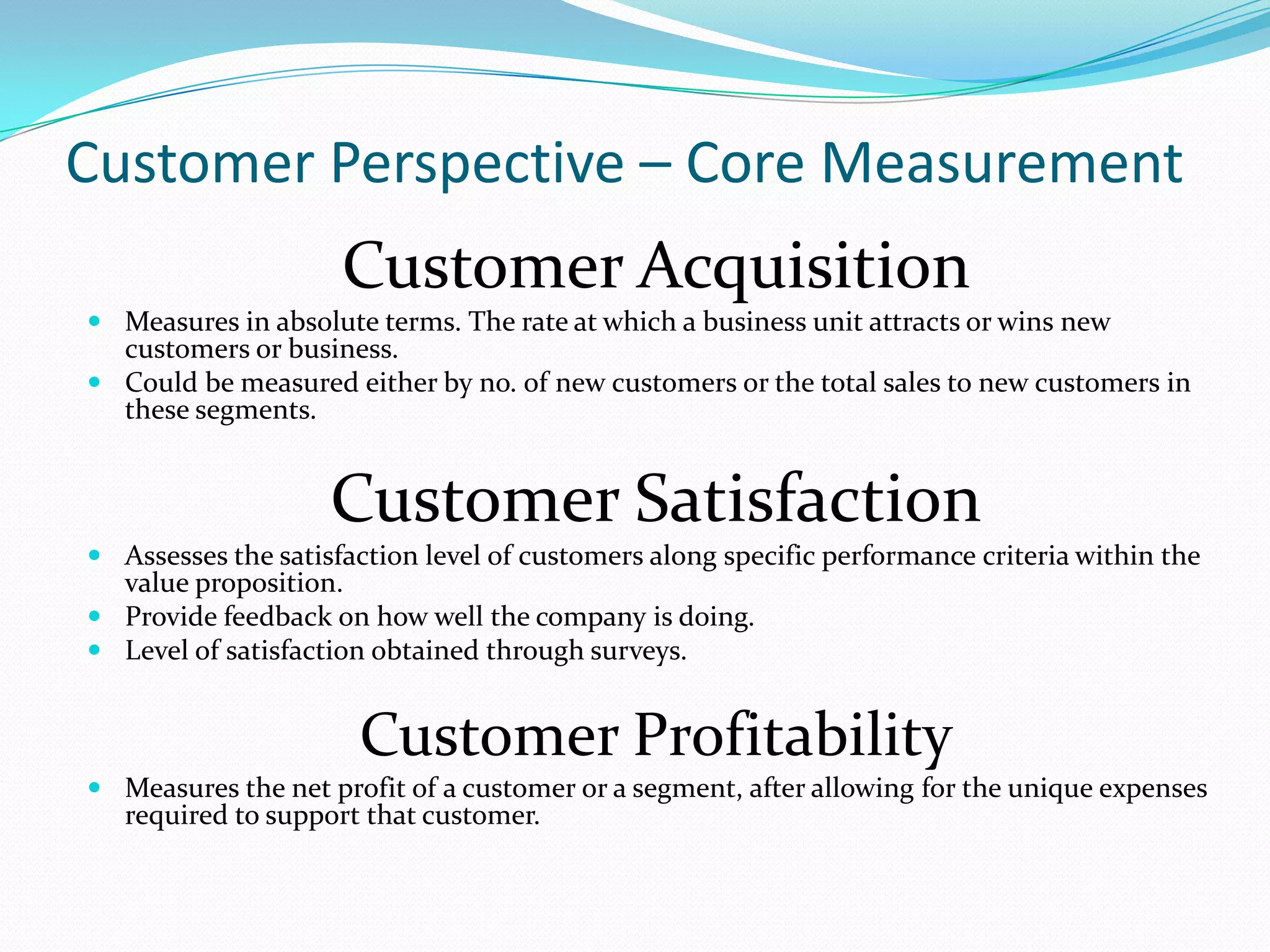
    Customer Perspective –Core MeasurementCustomer AcquisitionMeasures in absolute terms. The rate at which a business unit attracts or wins new customers or business.Could be measured either by no. of new customers or the total sales to new customers in these segments.Customer SatisfactionAssesses the satisfaction level of customers along specific performance criteria within the value proposition.Provide feedback on how well the company is doing.Level of satisfaction obtained through surveys.Customer ProfitabilityMeasures the net profit of a customer or a segment, after allowing for the unique expenses required to support that customer.
  • 52.
    Customer Perspective -Measuring customer value propositionCustomer Value propositions represent the attributes that supplying companies provide, through their products and services, to create loyalty and satisfaction in targeted customer segments throughProduct/service attributesCustomer relationshipsImage and reputation.Product and service attributes encompass the functionality of the product/service, its price and quality – choice between customers – reliable low cost producer vs differentiated supplier.The customer relationship dimension includes the delivery of the product/ service to the customer including the response and delivery time dimension e.g knowledgeable people, convenient access, responsiveness.Image and reputation dimension reflects the intangible factors that attracts a customer to a company. Some companies are able to generate customer loyalty well beyond tangible aspects of the product and service. Eg. Theme park (Disneyland), Cigarettes (Marlboro), Soft drink (Coca-Cola / Pepsi)
  • 53.
    Internal Business ProcessPerspectiveIn this perspective, executives identify the critical internal processes in which the organization must excel. These processes enable the business unit toDeliver the value propositions that will attract and retain customers in targeted market segments.Satisfy shareholder expectations and excellent financial returns.A generic model would be:InnovationOperationsPostsale service
  • 54.
    Internal Business ProcessPerspectiveThe Innovation ProcessIn the Innovation process, the business unit researches the emerging or latent needs of customers and then creates the product or services that will meet these needs.Two crucial questions – What range of benefits will customers value in tomorrow’s products?How might we, through innovation pre-empt competitors in delivering those benefits to the marketplace?Advanced Micro services, a leading semiconductor manufacturer had following measures: 1. Percentage of sale from new product, 2. Percentage of sales from proprietary products, 3. New product introduction vs competitors 4. Time to develop next generation product.
  • 55.
    Internal Business ProcessPerspectiveThe Operation ProcessIn this process the existing products and services are produced and delivered to customers.It starts with receipt of a customer order and finishes with delivery of the product or service to the customer.This process stresses efficient, consistent timely delivery of existing products and services to existing customers.Some of the areas of measurement - Operating processes qualityOperating process cycle timeOperating process costCompanies that can identify differentiating characteristics of the products and services (measured by accuracy, size, speed, clarity or energy consumption) will certainly want the focus and attention that measurement on the Balance Scorecard can commence.
  • 56.
    Internal Business ProcessPerspectiveThe Postsale ServiceThis is the service to the customer after the original sale or delivery of a product or service.Postsale Service includes warranty, repair, treatment of defects and returns, processing of payments such as credit card administration.Companies attempting to meet their targeted customer’s expectations for superior postsale service can measure their performance by applying some of the same time, quality and cost metrics.Cycle time – from customer request to ultimate resolution of the problem can measure the speed of the response time.Cost metrics can evaluate the efficiency – the cost of resource used.The first Pass yields can measure what percentage of customer request are handled with a single service call rather than requiring multiple calls.
  • 57.
    Learning & growthperspectiveThis perspective identifies the infrastructure that the organization must build to create long term growth and improvement.The objectives in the first three perspective will reveal large gaps between the existing capabilities of people, systems and procedures.To close these gaps, businesses will have to invest in reskilling employees, enchanting information technology and systems aligning organizational procedures.Organizations must also invest in their infrastructure other than equipment, plant and machinery and R&D.There are three principal categories under Learning & Growth: 1. Employee capabilities, 2. Information system capabilities, 3. Motivation, empowerment and alignment.
  • 58.
    L&G -Core EmployeeMeasurementEmployee satisfaction.Employee retention.Employee productivityMeasuring employee satisfaction Satisfied employees are a precondition for increasing productivity, responsiveness, quality and customer service. This is measured with an annual survey or a rolling survey in which a specified percentage of randomly chosen employer is surveyed.2. Measuring employee retention The theory underlying this measure is that the organization is making long term investments in its employees so that any unwanted departures represent in the intellectual capital of the business. Employee retention is generally measured by percentage of key staff turnover.
  • 59.
    L&G - MeasuringEmployee ProductivityEmployee productivity is an outcome measure of the aggregate impact from enhancing employee skills and morale, innovation, improving internal processes and satisfying customers. The objective is to relate the output produced by employees to the number of employees used to produce that output.The simplest productivity measure is revenue per employee. This measure represents how much output can be generated per employee.L&G - Information system capabilitiesIf employees are to be effective in today’s competitive environment, they need excellent information – on customers, or internal processes and of the financial consequence of their decisions.Measures of strategic information availability could be: a) percentage of processes with real time quality and cycle time. b) percentage of customer facing employees having online access to information about customers.
  • 60.
    L&G - Motivation,Empowerment and alignmentEven skilled employees provided with superb access to information will not contribute to organizational success if they are not motivated to get in the best interest of an organization or if they are not given freedom to make decisions and take actions.L&G - Measures of suggestions made and implementedThis measure captures the ongoing participation of employees in improving the organization’s performance. Such a measure can be reinforced by a complementary measure, number of suggestions implemented, which tracks the quality of the suggestions being made as well as communicating to the workforce that its suggestions are valued and taken seriously.
  • 61.
    L&G - Measuresof ImprovementOrganizations can also look for improvements in quality, time or performance for specific interval and customer processes.The rest of improvement actually occurring in critical processes are good outcome measures indicating employee participation in improvement activities.
  • 62.
    L&G - Measuresof Individual and organizational alignmentThe performance drivers for individual and organizational alignment focus on whether department individuals have their goals aligned with the company objective articulated in the Balanced Scorecard. Some measures that can be tracked :No. of major activities of the business unit aligned to the scorecard.No. of employees covered by the BSC communication cascading process.Alignment of individual performance goals to the scorecard.
  • 63.
    L&G - HRperformance driver measuresAverage change in performance-appraisal rating over time.Employee competency growth.Extent of cross-functional teamwork.Extent to which employees have ready access to the information and knowledge that they need.Extent to which employees are clear about the firm’s goals and objectives.Extent to which employees are clear about their own goals.Extent to which HR is helping to develop necessary leadership competencies.Extent to which HR measurement systems are seen as credible.Extent to which firm has turned its strategy into specific goals/objectives that employees can act on in the short and long run.Extent to which the firm has turned its strategy into specific goals/objectives that employees can act on in the short and long run.Extent to which top management shows commitment and leadership around knowledge sharing issues throughout the firm.Percentage of employees making suggestions.Percentage of intern conversion to hires.Percentage of workforce that is promotable.Percentage of retention of high-performing key employees..
  • 64.
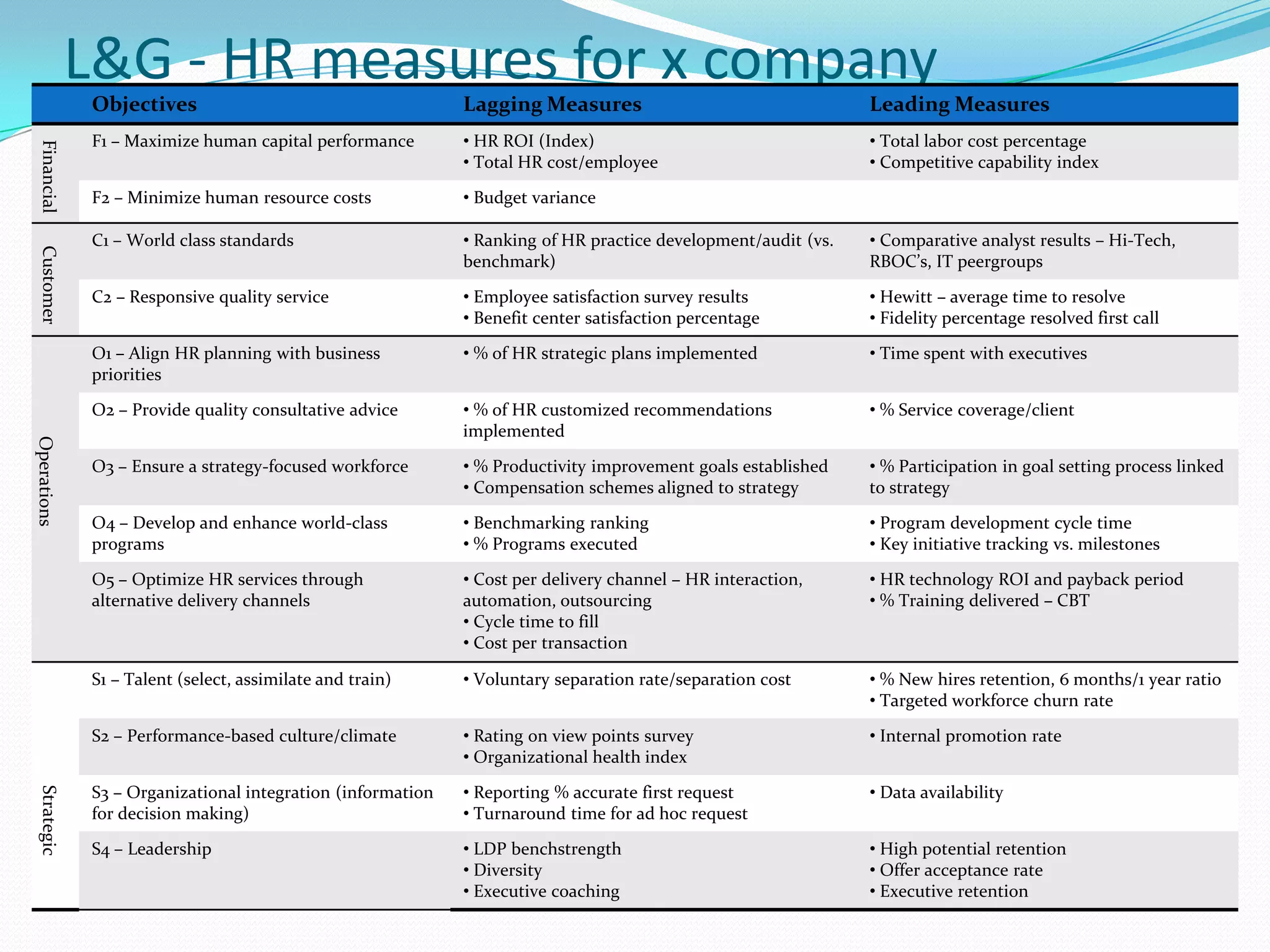
    L&G - HRmeasures for x companyFinancialCustomerOperationsStrategic