Balance Sheet &
Income Statement
Dr. Devyanee K. Nemade
Assistant Professor
Department of Agricultural
Economics & Statistics
Dr. PDKV, Akola
• Balance sheet:
It is a statement of financial
position of a firm at a particular point of
time.
It indicates an account of total assets
and total liabilities of the farm business
revealing the financial solvency of the
business.
More specifically it is a statement of
the financial position.
Assets:
Assets are those which are owned
by the farmer.
Examples:
The assets of a company are its
cash, lands, buildings, and real estates,
equipment, machinery, furniture, patents
and trademarks, and money owed by
certain individuals or/and other
businesses.
1. Current Assets :
They are very liquid or short term assets. They
can be converted into cash, within a short term assets.
For example: Cash on hand, agricultural produce ready for
disposal, i.e. Stocks of paddy, black gram, jowar, wheat,
etc.
2. Intermediate or working assets:
These assets take two to five years to convert in
to cash form.
Example : Machinery, equipment, livestock, tractors,
trucks, etc.
3. Long term assets or Fixed Assets :
An asset that is permanent or will be used
continuously for several years is called a long-term asset.
Examples: Land, Farm buildings etc.
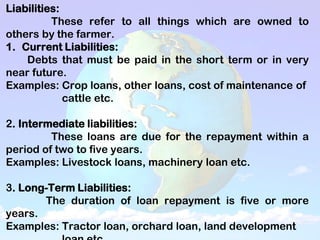
Liabilities:
These refer to all things which are owned to
others by the farmer.
1. Current Liabilities:
Debts that must be paid in the short term or in very
near future.
Examples: Crop loans, other loans, cost of maintenance of
cattle etc.
2. Intermediate liabilities:
These loans are due for the repayment within a
period of two to five years.
Examples: Livestock loans, machinery loan etc.
3. Long-Term Liabilities:
The duration of loan repayment is five or more
years.
Examples: Tractor loan, orchard loan, land development
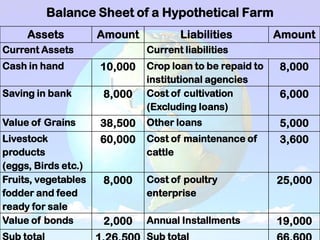
Balance Sheet of a Hypothetical Farm
Assets Amount Liabilities Amount
Current Assets Current liabilities
Cash in hand 10,000 Crop loan to be repaid to
institutional agencies
8,000
Saving in bank 8,000 Cost of cultivation
(Excluding loans)
6,000
Value of Grains 38,500 Other loans 5,000
Livestock
products
(eggs, Birds etc.)
60,000 Cost of maintenance of
cattle
3,600
Fruits, vegetables
fodder and feed
ready for sale
8,000 Cost of poultry
enterprise
25,000
Value of bonds 2,000 Annual Installments 19,000
Sub total Sub total
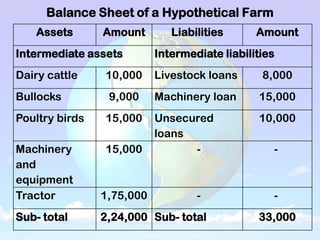
Balance Sheet of a Hypothetical Farm
Assets Amount Liabilities Amount
Intermediate assets Intermediate liabilities
Dairy cattle 10,000 Livestock loans 8,000
Bullocks 9,000 Machinery loan 15,000
Poultry birds 15,000 Unsecured
loans
10,000
Machinery
and
equipment
15,000 - -
Tractor 1,75,000 - -
Sub- total 2,24,000 Sub- total 33,000
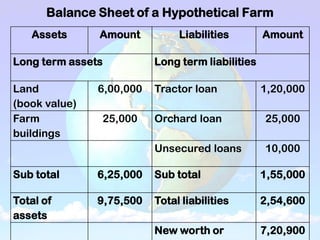
Balance Sheet of a Hypothetical Farm
Assets Amount Liabilities Amount
Long term assets Long term liabilities
Land
(book value)
6,00,000 Tractor loan 1,20,000
Farm
buildings
25,000 Orchard loan 25,000
Unsecured loans 10,000
Sub total 6,25,000 Sub total 1,55,000
Total of
assets
9,75,500 Total liabilities 2,54,600
New worth or 7,20,900
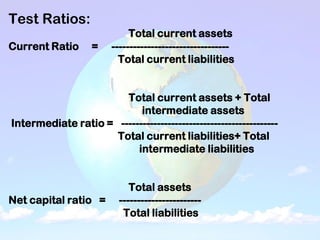
Test Ratios:
Total current assets
Current Ratio = ---------------------------------
Total current liabilities
Total current assets + Total
intermediate assets
Intermediate ratio = --------------------------------------------
Total current liabilities+ Total
intermediate liabilities
Total assets
Net capital ratio = -----------------------
Total liabilities
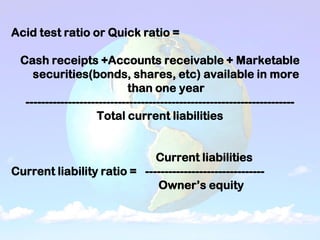
Acid test ratio or Quick ratio =
Cash receipts +Accounts receivable + Marketable
securities(bonds, shares, etc) available in more
than one year
----------------------------------------------------------------------
Total current liabilities
Current liabilities
Current liability ratio = -------------------------------
Owner’s equity
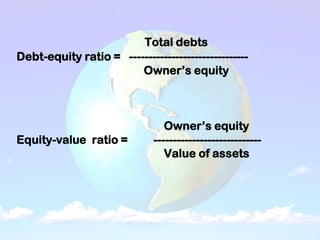
Total debts
Debt-equity ratio = -------------------------------
Owner’s equity
Owner’s equity
Equity-value ratio = ----------------------------
Value of assets
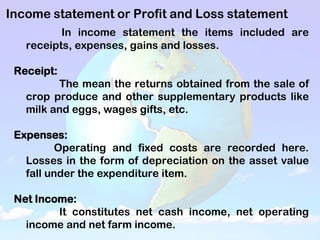
Income statement or Profit and Loss statement
In income statement the items included are
receipts, expenses, gains and losses.
Receipt:
The mean the returns obtained from the sale of
crop produce and other supplementary products like
milk and eggs, wages gifts, etc.
Expenses:
Operating and fixed costs are recorded here.
Losses in the form of depreciation on the asset value
fall under the expenditure item.
Net Income:
It constitutes net cash income, net operating
income and net farm income.
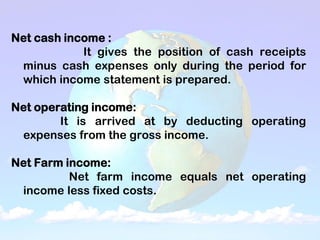
Net cash income :
It gives the position of cash receipts
minus cash expenses only during the period for
which income statement is prepared.
Net operating income:
It is arrived at by deducting operating
expenses from the gross income.
Net Farm income:
Net farm income equals net operating
income less fixed costs.
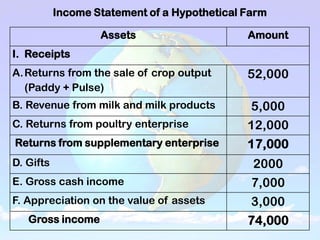
Income Statement of a Hypothetical Farm
Assets Amount
I. Receipts
A.Returns from the sale of crop output
(Paddy + Pulse)
52,000
B. Revenue from milk and milk products 5,000
C. Returns from poultry enterprise 12,000
Returns from supplementary enterprise 17,000
D. Gifts 2000
E. Gross cash income 7,000
F. Appreciation on the value of assets 3,000
Gross income 74,000
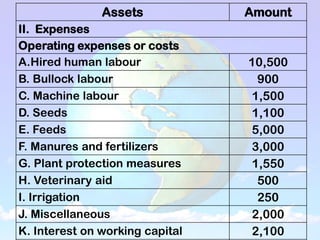
Assets Amount
II. Expenses
Operating expenses or costs
A.Hired human labour 10,500
B. Bullock labour 900
C. Machine labour 1,500
D. Seeds 1,100
E. Feeds 5,000
F. Manures and fertilizers 3,000
G. Plant protection measures 1,550
H. Veterinary aid 500
I. Irrigation 250
J. Miscellaneous 2,000
K. Interest on working capital 2,100
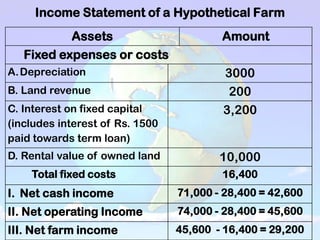
Income Statement of a Hypothetical Farm
Assets Amount
Fixed expenses or costs
A.Depreciation 3000
B. Land revenue 200
C. Interest on fixed capital
(includes interest of Rs. 1500
paid towards term loan)
3,200
D. Rental value of owned land 10,000
Total fixed costs 16,400
I. Net cash income 71,000 - 28,400 = 42,600
II. Net operating Income 74,000 - 28,400 = 45,600
III. Net farm income 45,600 - 16,400 = 29,200
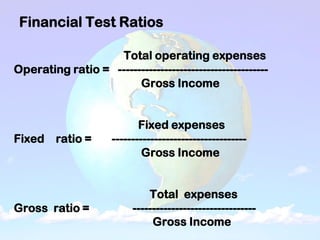
Financial Test Ratios
Total operating expenses
Operating ratio = ---------------------------------------
Gross Income
Fixed expenses
Fixed ratio = -----------------------------------
Gross Income
Total expenses
Gross ratio = --------------------------------
Gross Income
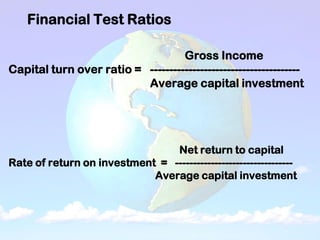
Financial Test Ratios
Gross Income
Capital turn over ratio = ---------------------------------------
Average capital investment
Net return to capital
Rate of return on investment = ---------------------------------
Average capital investment
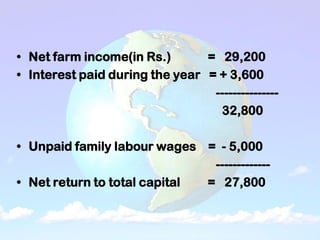
• Net farm income(in Rs.) = 29,200
• Interest paid during the year = + 3,600
---------------
32,800
• Unpaid family labour wages = - 5,000
-------------
• Net return to total capital = 27,800
Balance sheet & income statement

Balance sheet & income statement

  • 1.
    Balance Sheet & IncomeStatement Dr. Devyanee K. Nemade Assistant Professor Department of Agricultural Economics & Statistics Dr. PDKV, Akola
  • 2.
    • Balance sheet: Itis a statement of financial position of a firm at a particular point of time. It indicates an account of total assets and total liabilities of the farm business revealing the financial solvency of the business. More specifically it is a statement of the financial position.
  • 3.
    Assets: Assets are thosewhich are owned by the farmer. Examples: The assets of a company are its cash, lands, buildings, and real estates, equipment, machinery, furniture, patents and trademarks, and money owed by certain individuals or/and other businesses.
  • 4.
    1. Current Assets: They are very liquid or short term assets. They can be converted into cash, within a short term assets. For example: Cash on hand, agricultural produce ready for disposal, i.e. Stocks of paddy, black gram, jowar, wheat, etc. 2. Intermediate or working assets: These assets take two to five years to convert in to cash form. Example : Machinery, equipment, livestock, tractors, trucks, etc. 3. Long term assets or Fixed Assets : An asset that is permanent or will be used continuously for several years is called a long-term asset. Examples: Land, Farm buildings etc.
  • 5.
    Liabilities: These refer toall things which are owned to others by the farmer. 1. Current Liabilities: Debts that must be paid in the short term or in very near future. Examples: Crop loans, other loans, cost of maintenance of cattle etc. 2. Intermediate liabilities: These loans are due for the repayment within a period of two to five years. Examples: Livestock loans, machinery loan etc. 3. Long-Term Liabilities: The duration of loan repayment is five or more years. Examples: Tractor loan, orchard loan, land development
  • 6.
    Balance Sheet ofa Hypothetical Farm Assets Amount Liabilities Amount Current Assets Current liabilities Cash in hand 10,000 Crop loan to be repaid to institutional agencies 8,000 Saving in bank 8,000 Cost of cultivation (Excluding loans) 6,000 Value of Grains 38,500 Other loans 5,000 Livestock products (eggs, Birds etc.) 60,000 Cost of maintenance of cattle 3,600 Fruits, vegetables fodder and feed ready for sale 8,000 Cost of poultry enterprise 25,000 Value of bonds 2,000 Annual Installments 19,000 Sub total Sub total
  • 7.
    Balance Sheet ofa Hypothetical Farm Assets Amount Liabilities Amount Intermediate assets Intermediate liabilities Dairy cattle 10,000 Livestock loans 8,000 Bullocks 9,000 Machinery loan 15,000 Poultry birds 15,000 Unsecured loans 10,000 Machinery and equipment 15,000 - - Tractor 1,75,000 - - Sub- total 2,24,000 Sub- total 33,000
  • 8.
    Balance Sheet ofa Hypothetical Farm Assets Amount Liabilities Amount Long term assets Long term liabilities Land (book value) 6,00,000 Tractor loan 1,20,000 Farm buildings 25,000 Orchard loan 25,000 Unsecured loans 10,000 Sub total 6,25,000 Sub total 1,55,000 Total of assets 9,75,500 Total liabilities 2,54,600 New worth or 7,20,900
  • 9.
    Test Ratios: Total currentassets Current Ratio = --------------------------------- Total current liabilities Total current assets + Total intermediate assets Intermediate ratio = -------------------------------------------- Total current liabilities+ Total intermediate liabilities Total assets Net capital ratio = ----------------------- Total liabilities
  • 10.
    Acid test ratioor Quick ratio = Cash receipts +Accounts receivable + Marketable securities(bonds, shares, etc) available in more than one year ---------------------------------------------------------------------- Total current liabilities Current liabilities Current liability ratio = ------------------------------- Owner’s equity
  • 11.
    Total debts Debt-equity ratio= ------------------------------- Owner’s equity Owner’s equity Equity-value ratio = ---------------------------- Value of assets
  • 12.
    Income statement orProfit and Loss statement In income statement the items included are receipts, expenses, gains and losses. Receipt: The mean the returns obtained from the sale of crop produce and other supplementary products like milk and eggs, wages gifts, etc. Expenses: Operating and fixed costs are recorded here. Losses in the form of depreciation on the asset value fall under the expenditure item. Net Income: It constitutes net cash income, net operating income and net farm income.
  • 13.
    Net cash income: It gives the position of cash receipts minus cash expenses only during the period for which income statement is prepared. Net operating income: It is arrived at by deducting operating expenses from the gross income. Net Farm income: Net farm income equals net operating income less fixed costs.
  • 14.
    Income Statement ofa Hypothetical Farm Assets Amount I. Receipts A.Returns from the sale of crop output (Paddy + Pulse) 52,000 B. Revenue from milk and milk products 5,000 C. Returns from poultry enterprise 12,000 Returns from supplementary enterprise 17,000 D. Gifts 2000 E. Gross cash income 7,000 F. Appreciation on the value of assets 3,000 Gross income 74,000
  • 15.
    Assets Amount II. Expenses Operatingexpenses or costs A.Hired human labour 10,500 B. Bullock labour 900 C. Machine labour 1,500 D. Seeds 1,100 E. Feeds 5,000 F. Manures and fertilizers 3,000 G. Plant protection measures 1,550 H. Veterinary aid 500 I. Irrigation 250 J. Miscellaneous 2,000 K. Interest on working capital 2,100
  • 16.
    Income Statement ofa Hypothetical Farm Assets Amount Fixed expenses or costs A.Depreciation 3000 B. Land revenue 200 C. Interest on fixed capital (includes interest of Rs. 1500 paid towards term loan) 3,200 D. Rental value of owned land 10,000 Total fixed costs 16,400 I. Net cash income 71,000 - 28,400 = 42,600 II. Net operating Income 74,000 - 28,400 = 45,600 III. Net farm income 45,600 - 16,400 = 29,200
  • 17.
    Financial Test Ratios Totaloperating expenses Operating ratio = --------------------------------------- Gross Income Fixed expenses Fixed ratio = ----------------------------------- Gross Income Total expenses Gross ratio = -------------------------------- Gross Income
  • 18.
    Financial Test Ratios GrossIncome Capital turn over ratio = --------------------------------------- Average capital investment Net return to capital Rate of return on investment = --------------------------------- Average capital investment
  • 19.
    • Net farmincome(in Rs.) = 29,200 • Interest paid during the year = + 3,600 --------------- 32,800 • Unpaid family labour wages = - 5,000 ------------- • Net return to total capital = 27,800