Chapter 1

BALANCE

These notes are basic and a guideline to understand concepts.

WHAT IS BALANCE?
Balance is a State of tension. When two forces pull in opposite direction, you achieve a state of
balance.
The brain always looks for balance.
Opposite of Balance : Stress/tension
Arnheim talks about opoosites forces - positive and negative forces that create Synergy
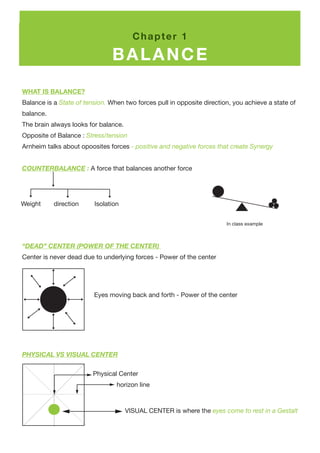
COUNTERBALANCE : A force that balances another force

Weight

direction

Isolation
In class example

“DEAD” CENTER (POWER OF THE CENTER)
Center is never dead due to underlying forces - Power of the center

Eyes moving back and forth - Power of the center

PHYSICAL VS VISUAL CENTER
VISUAL CENTER is where the eyes come to rest in a Gestalt
horizon line
Physical Center
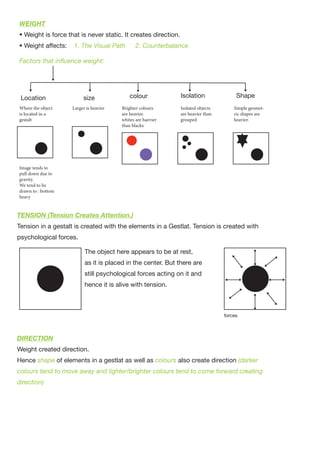
WEIGHT
§ Weight is force that is never static. It creates direction.
§ Weight affects:

1. The Visual Path	

2. Counterbalance

Factors that influence weight:

size

colour

Larger is heavier

Brighter colours
are heavier.
whites are haevier
than blacks

Location
Where the object
is located in a
gestalt

Isolation
Isolated objects
are heavier than
grouped

Shape
Simple geometric shapes are
heavier.

Image tends to
pull down due to
gravity.
We tend to be
drawn to : bottom
heavy

TENSION (Tension Creates Attention.)
Tension in a gestalt is created with the elements in a Gestlat. Tension is created with
psychological forces.
The object here appears to be at rest,
as it is placed in the center. But there are
still psychological forces acting on it and
hence it is alive with tension.

forces

DIRECTION
Weight created direction.
Hence shape of elements in a gestlat as well as colours also create direction (darker
colours tend to move away and lighter/brighter colours tend to come forward creating
direction)
SYMMETRY VS ASSYMETRY
SYMMETRY

ASYMMETRY

Balanced
(Vertical, horizontal or radial balance)

Counter balance
more Visual Tension

Equillibrium is achieved

(You can have balance in Assymetry too)

VISUAL FIELD
Is what the eye sees clearly. Our visual field is a 45 degree angle.
VISUAL PATH
Is where the eye moves in a Gestlat.
Weight, direction and tension are factors that affect the visual path.

Balance notes

  • 1.
    Chapter 1 BALANCE These notesare basic and a guideline to understand concepts. WHAT IS BALANCE? Balance is a State of tension. When two forces pull in opposite direction, you achieve a state of balance. The brain always looks for balance. Opposite of Balance : Stress/tension Arnheim talks about opoosites forces - positive and negative forces that create Synergy COUNTERBALANCE : A force that balances another force Weight direction Isolation In class example “DEAD” CENTER (POWER OF THE CENTER) Center is never dead due to underlying forces - Power of the center Eyes moving back and forth - Power of the center PHYSICAL VS VISUAL CENTER VISUAL CENTER is where the eyes come to rest in a Gestalt horizon line Physical Center
  • 2.
    WEIGHT § Weight isforce that is never static. It creates direction. § Weight affects: 1. The Visual Path 2. Counterbalance Factors that influence weight: size colour Larger is heavier Brighter colours are heavier. whites are haevier than blacks Location Where the object is located in a gestalt Isolation Isolated objects are heavier than grouped Shape Simple geometric shapes are heavier. Image tends to pull down due to gravity. We tend to be drawn to : bottom heavy TENSION (Tension Creates Attention.) Tension in a gestalt is created with the elements in a Gestlat. Tension is created with psychological forces. The object here appears to be at rest, as it is placed in the center. But there are still psychological forces acting on it and hence it is alive with tension. forces DIRECTION Weight created direction. Hence shape of elements in a gestlat as well as colours also create direction (darker colours tend to move away and lighter/brighter colours tend to come forward creating direction)
  • 3.
    SYMMETRY VS ASSYMETRY SYMMETRY ASYMMETRY Balanced (Vertical,horizontal or radial balance) Counter balance more Visual Tension Equillibrium is achieved (You can have balance in Assymetry too) VISUAL FIELD Is what the eye sees clearly. Our visual field is a 45 degree angle. VISUAL PATH Is where the eye moves in a Gestlat. Weight, direction and tension are factors that affect the visual path.