Baker: Scaling OVN with
Kubernetes API Server
Han Zhou
OpenStack Summit Boston 2017
Why OVN?
OVS is GREAT.
OVN makes it GREATER!
2
OVN Challenges
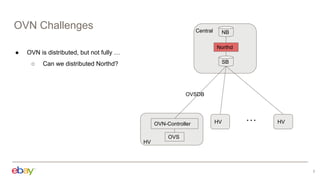
● OVN is distributed, but not fully …
○ Can we distributed Northd?
3
Northd
NB
SB
OVN-Controller
OVS
HV
HV
…
Central
OVSDB
HV
OVN Challenges
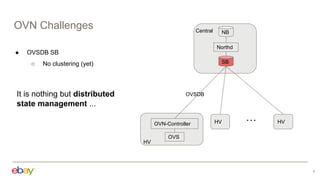
● OVSDB SB
○ No clustering (yet)
4
Northd
NB
SB
OVN-Controller
OVS
HV
HV
…
Central
OVSDB
HV
It is nothing but distributed
state management ...
Scale-out with Baker
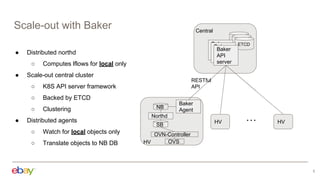
● Distributed northd
○ Computes lflows for local only
● Scale-out central cluster
○ K8S API server framework
○ Backed by ETCD
○ Clustering
● Distributed agents
○ Watch for local objects only
○ Translate objects to NB DB
5
Northd
NB
SB
OVN-Controller
OVSHV
Central
ETCD
ETCD
ETCDBaker
API
server
Baker
API
server
Baker
API
server
Baker
Agent
HV
… HV
RESTful
API
One more thing ...
6
● Northd and ovn-controller are all distributed
● They process data related to local HV only
But what does this mean?
In terms of overlay ...
7
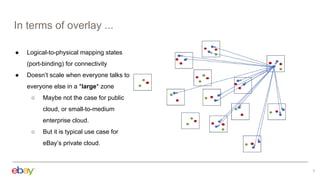
● Logical-to-physical mapping states
(port-binding) for connectivity
● Doesn’t scale when everyone talks to
everyone else in a *large* zone
○ Maybe not the case for public
cloud, or small-to-medium
enterprise cloud.
○ But it is typical use case for
eBay’s private cloud.
Are we solving the right problem?
8
● Connectivity v.s. Segmentation
● L2 Segmentation v.s. L3 segmentation
● Address sets (L3) based segmentation
○ ACL: default deny, whitelist access
○ IPAM:
■ Use ip efficiently
■ Summarized CIDRs to reduce address set size
Flat network
9
● Reuse OVN abstraction and pipeline
○ Port security
○ ARP proxy
○ ACL
○ LB
○ …
○ But NOT overlay
● Use localnet port to connect to physical
network directly
● Data to be processed by each HV
depends on size of AddressSet used by
ACLs that apply to ports on the HV
Baker Object Model
● Similar as OVN NB Schema
○ Logical Port
■ Addresses
■ Port security
○ ACL
○ Address Set
○ Load balancer (TBD)
○ ...
● Differences
○ No Logical Switch (local)
○ Port-SecGroup binding
○ ACL: SecGroup instead of
individual ports in inport/outport
10
Neutron Plugin
● Support security group, with API extensions
○ Address set - support external IPs from legacy systems
○ Security group rule packet logging
11
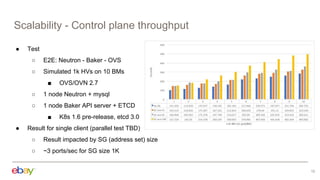
Scalability - Control plane throughput
12
● Test
○ E2E: Neutron - Baker - OVS
○ Simulated 1k HVs on 10 BMs
■ OVS/OVN 2.7
○ 1 node Neutron + mysql
○ 1 node Baker API server + ETCD
■ K8s 1.6 pre-release, etcd 3.0
● Result for single client (parallel test TBD)
○ Result impacted by SG (address set) size
○ ~3 ports/sec for SG size 1K
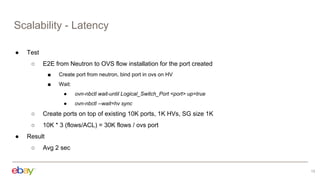
Scalability - Latency
13
● Test
○ E2E from Neutron to OVS flow installation for the port created
■ Create port from neutron, bind port in ovs on HV
■ Wait:
● ovn-nbctl wait-until Logical_Switch_Port <port> up=true
● ovn-nbctl --wait=hv sync
○ Create ports on top of existing 10K ports, 1K HVs, SG size 1K
○ 10K * 3 (flows/ACL) = 30K flows / ovs port
● Result
○ Avg 2 sec
Improvement - ovn-controller
14
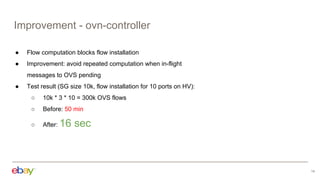
● Flow computation blocks flow installation
● Improvement: avoid repeated computation when in-flight
messages to OVS pending
● Test result (SG size 10k, flow installation for 10 ports on HV):
○ 10k * 3 * 10 = 300k OVS flows
○ Before: 50 min
○ After: 16 sec
Other Lessons learned
15
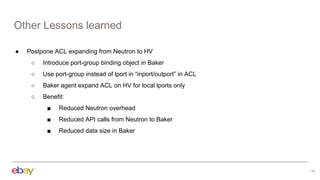
● Postpone ACL expanding from Neutron to HV
○ Introduce port-group binding object in Baker
○ Use port-group instead of lport in “inport/outport” in ACL
○ Baker agent expand ACL on HV for local lports only
○ Benefit:
■ Reduced Neutron overhead
■ Reduced API calls from Neutron to Baker
■ Reduced data size in Baker
Other Lessons learned
16
● Baker RESTful API: use Protobuf instead of JSON-RPC
○ 10 - 20 % throughput increase for SG size 1k - 10k
○ Lower CPU cost on API-server
Thanks!
Q & A

Baker: Scaling OVN with Kubernetes API Server

  • 1.
    Baker: Scaling OVNwith Kubernetes API Server Han Zhou OpenStack Summit Boston 2017
  • 2.
    Why OVN? OVS isGREAT. OVN makes it GREATER! 2
  • 3.
    OVN Challenges ● OVNis distributed, but not fully … ○ Can we distributed Northd? 3 Northd NB SB OVN-Controller OVS HV HV … Central OVSDB HV
  • 4.
    OVN Challenges ● OVSDBSB ○ No clustering (yet) 4 Northd NB SB OVN-Controller OVS HV HV … Central OVSDB HV It is nothing but distributed state management ...
  • 5.
    Scale-out with Baker ●Distributed northd ○ Computes lflows for local only ● Scale-out central cluster ○ K8S API server framework ○ Backed by ETCD ○ Clustering ● Distributed agents ○ Watch for local objects only ○ Translate objects to NB DB 5 Northd NB SB OVN-Controller OVSHV Central ETCD ETCD ETCDBaker API server Baker API server Baker API server Baker Agent HV … HV RESTful API
  • 6.
    One more thing... 6 ● Northd and ovn-controller are all distributed ● They process data related to local HV only But what does this mean?
  • 7.
    In terms ofoverlay ... 7 ● Logical-to-physical mapping states (port-binding) for connectivity ● Doesn’t scale when everyone talks to everyone else in a *large* zone ○ Maybe not the case for public cloud, or small-to-medium enterprise cloud. ○ But it is typical use case for eBay’s private cloud.
  • 8.
    Are we solvingthe right problem? 8 ● Connectivity v.s. Segmentation ● L2 Segmentation v.s. L3 segmentation ● Address sets (L3) based segmentation ○ ACL: default deny, whitelist access ○ IPAM: ■ Use ip efficiently ■ Summarized CIDRs to reduce address set size
  • 9.
    Flat network 9 ● ReuseOVN abstraction and pipeline ○ Port security ○ ARP proxy ○ ACL ○ LB ○ … ○ But NOT overlay ● Use localnet port to connect to physical network directly ● Data to be processed by each HV depends on size of AddressSet used by ACLs that apply to ports on the HV
  • 10.
    Baker Object Model ●Similar as OVN NB Schema ○ Logical Port ■ Addresses ■ Port security ○ ACL ○ Address Set ○ Load balancer (TBD) ○ ... ● Differences ○ No Logical Switch (local) ○ Port-SecGroup binding ○ ACL: SecGroup instead of individual ports in inport/outport 10
  • 11.
    Neutron Plugin ● Supportsecurity group, with API extensions ○ Address set - support external IPs from legacy systems ○ Security group rule packet logging 11
  • 12.
    Scalability - Controlplane throughput 12 ● Test ○ E2E: Neutron - Baker - OVS ○ Simulated 1k HVs on 10 BMs ■ OVS/OVN 2.7 ○ 1 node Neutron + mysql ○ 1 node Baker API server + ETCD ■ K8s 1.6 pre-release, etcd 3.0 ● Result for single client (parallel test TBD) ○ Result impacted by SG (address set) size ○ ~3 ports/sec for SG size 1K
  • 13.
    Scalability - Latency 13 ●Test ○ E2E from Neutron to OVS flow installation for the port created ■ Create port from neutron, bind port in ovs on HV ■ Wait: ● ovn-nbctl wait-until Logical_Switch_Port <port> up=true ● ovn-nbctl --wait=hv sync ○ Create ports on top of existing 10K ports, 1K HVs, SG size 1K ○ 10K * 3 (flows/ACL) = 30K flows / ovs port ● Result ○ Avg 2 sec
  • 14.
    Improvement - ovn-controller 14 ●Flow computation blocks flow installation ● Improvement: avoid repeated computation when in-flight messages to OVS pending ● Test result (SG size 10k, flow installation for 10 ports on HV): ○ 10k * 3 * 10 = 300k OVS flows ○ Before: 50 min ○ After: 16 sec
  • 15.
    Other Lessons learned 15 ●Postpone ACL expanding from Neutron to HV ○ Introduce port-group binding object in Baker ○ Use port-group instead of lport in “inport/outport” in ACL ○ Baker agent expand ACL on HV for local lports only ○ Benefit: ■ Reduced Neutron overhead ■ Reduced API calls from Neutron to Baker ■ Reduced data size in Baker
  • 16.
    Other Lessons learned 16 ●Baker RESTful API: use Protobuf instead of JSON-RPC ○ 10 - 20 % throughput increase for SG size 1k - 10k ○ Lower CPU cost on API-server
  • 17.