An ROI Zone Presentation
In a world where mass media is a part of everyday life, companies are
doing their best to integrate every form of media possible into their
advertising campaigns. Some companies succeed in making
informative, catchy, and vibrant ads that attract new customers to
their brand. Far more fail miserably at it. Have you ever seen an ad,
cringed, and wondered why a company would ever think that their
campaign was a good idea? You aren’t alone. Here are some
particularly heinous examples of what people have dubbed
“badvertising”.
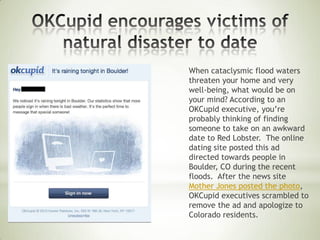
When cataclysmic flood waters
threaten your home and very
well-being, what would be on
your mind? According to an
OKCupid executive, you’re
probably thinking of finding
someone to take on an awkward
date to Red Lobster. The online
dating site posted this ad
directed towards people in
Boulder, CO during the recent
floods. After the news site
Mother Jones posted the photo,
OKCupid executives scrambled to
remove the ad and apologize to
Colorado residents.
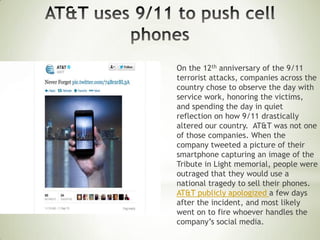
On the 12th anniversary of the 9/11
terrorist attacks, companies across the
country chose to observe the day with
service work, honoring the victims,
and spending the day in quiet
reflection on how 9/11 drastically
altered our country. AT&T was not one
of those companies. When the
company tweeted a picture of their
smartphone capturing an image of the
Tribute in Light memorial, people were
outraged that they would use a
national tragedy to sell their phones.
AT&T publicly apologized a few days
after the incident, and most likely
went on to fire whoever handles the
company’s social media.
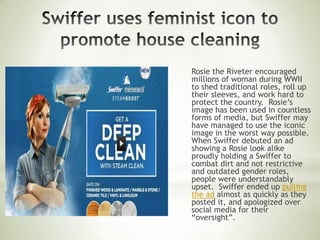
Rosie the Riveter encouraged
millions of woman during WWII
to shed traditional roles, roll up
their sleeves, and work hard to
protect the country. Rosie’s
image has been used in countless
forms of media, but Swiffer may
have managed to use the iconic
image in the worst way possible.
When Swiffer debuted an ad
showing a Rosie look alike
proudly holding a Swiffer to
combat dirt and not restrictive
and outdated gender roles,
people were understandably
upset. Swiffer ended up pulling
the ad almost as quickly as they
posted it, and apologized over
social media for their
“oversight”.
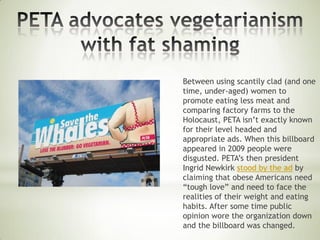
Between using scantily clad (and one
time, under-aged) women to
promote eating less meat and
comparing factory farms to the
Holocaust, PETA isn’t exactly known
for their level headed and
appropriate ads. When this billboard
appeared in 2009 people were
disgusted. PETA’s then president
Ingrid Newkirk stood by the ad by
claiming that obese Americans need
“tough love” and need to face the
realities of their weight and eating
habits. After some time public
opinion wore the organization down
and the billboard was changed.
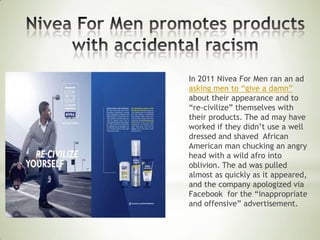
In 2011 Nivea For Men ran an ad
asking men to “give a damn”
about their appearance and to
“re-civilize” themselves with
their products. The ad may have
worked if they didn’t use a well
dressed and shaved African
American man chucking an angry
head with a wild afro into
oblivion. The ad was pulled
almost as quickly as it appeared,
and the company apologized via
Facebook for the “inappropriate
and offensive” advertisement.
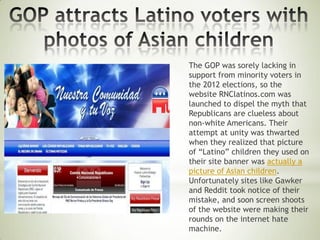
The GOP was sorely lacking in
support from minority voters in
the 2012 elections, so the
website RNClatinos.com was
launched to dispel the myth that
Republicans are clueless about
non-white Americans. Their
attempt at unity was thwarted
when they realized that picture
of “Latino” children they used on
their site banner was actually a
picture of Asian children.
Unfortunately sites like Gawker
and Reddit took notice of their
mistake, and soon screen shoots
of the website were making their
rounds on the internet hate
machine.
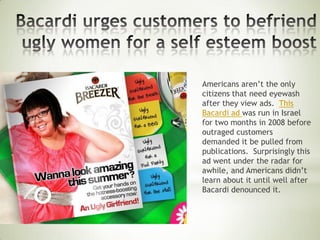
Americans aren’t the only
citizens that need eyewash
after they view ads. This
Bacardi ad was run in Israel
for two months in 2008 before
outraged customers
demanded it be pulled from
publications. Surprisingly this
ad went under the radar for
awhile, and Americans didn’t
learn about it until well after
Bacardi denounced it.
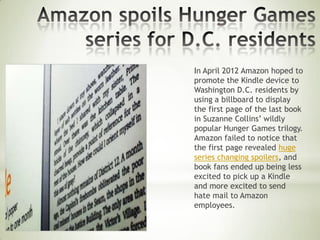
In April 2012 Amazon hoped to
promote the Kindle device to
Washington D.C. residents by
using a billboard to display
the first page of the last book
in Suzanne Collins’ wildly
popular Hunger Games trilogy.
Amazon failed to notice that
the first page revealed huge
series changing spoilers, and
book fans ended up being less
excited to pick up a Kindle
and more excited to send
hate mail to Amazon
employees.
When Huggies made their “Dad
Test” ad, they probably thought
that consumers would nod
knowingly, and laugh when their
commercial showed dads comically
unable to provide basic care for
their babies. They weren’t
prepared when outraged single
fathers, parents of both genders,
and even children blasted the ad
for assuming that men are
incapable of caring for their own
children. They dropped the
campaign after only a few days or
airtime, and spent months trying to
rebrand themselves as a dad
friendly brand.

Badvertising: The World of Poorly Chosen Ad Campaigns

  • 1.
    An ROI ZonePresentation
  • 2.
    In a worldwhere mass media is a part of everyday life, companies are doing their best to integrate every form of media possible into their advertising campaigns. Some companies succeed in making informative, catchy, and vibrant ads that attract new customers to their brand. Far more fail miserably at it. Have you ever seen an ad, cringed, and wondered why a company would ever think that their campaign was a good idea? You aren’t alone. Here are some particularly heinous examples of what people have dubbed “badvertising”.
  • 3.
    When cataclysmic floodwaters threaten your home and very well-being, what would be on your mind? According to an OKCupid executive, you’re probably thinking of finding someone to take on an awkward date to Red Lobster. The online dating site posted this ad directed towards people in Boulder, CO during the recent floods. After the news site Mother Jones posted the photo, OKCupid executives scrambled to remove the ad and apologize to Colorado residents.
  • 4.
    On the 12thanniversary of the 9/11 terrorist attacks, companies across the country chose to observe the day with service work, honoring the victims, and spending the day in quiet reflection on how 9/11 drastically altered our country. AT&T was not one of those companies. When the company tweeted a picture of their smartphone capturing an image of the Tribute in Light memorial, people were outraged that they would use a national tragedy to sell their phones. AT&T publicly apologized a few days after the incident, and most likely went on to fire whoever handles the company’s social media.
  • 5.
    Rosie the Riveterencouraged millions of woman during WWII to shed traditional roles, roll up their sleeves, and work hard to protect the country. Rosie’s image has been used in countless forms of media, but Swiffer may have managed to use the iconic image in the worst way possible. When Swiffer debuted an ad showing a Rosie look alike proudly holding a Swiffer to combat dirt and not restrictive and outdated gender roles, people were understandably upset. Swiffer ended up pulling the ad almost as quickly as they posted it, and apologized over social media for their “oversight”.
  • 6.
    Between using scantilyclad (and one time, under-aged) women to promote eating less meat and comparing factory farms to the Holocaust, PETA isn’t exactly known for their level headed and appropriate ads. When this billboard appeared in 2009 people were disgusted. PETA’s then president Ingrid Newkirk stood by the ad by claiming that obese Americans need “tough love” and need to face the realities of their weight and eating habits. After some time public opinion wore the organization down and the billboard was changed.
  • 7.
    In 2011 NiveaFor Men ran an ad asking men to “give a damn” about their appearance and to “re-civilize” themselves with their products. The ad may have worked if they didn’t use a well dressed and shaved African American man chucking an angry head with a wild afro into oblivion. The ad was pulled almost as quickly as it appeared, and the company apologized via Facebook for the “inappropriate and offensive” advertisement.
  • 8.
    The GOP wassorely lacking in support from minority voters in the 2012 elections, so the website RNClatinos.com was launched to dispel the myth that Republicans are clueless about non-white Americans. Their attempt at unity was thwarted when they realized that picture of “Latino” children they used on their site banner was actually a picture of Asian children. Unfortunately sites like Gawker and Reddit took notice of their mistake, and soon screen shoots of the website were making their rounds on the internet hate machine.
  • 9.
    Americans aren’t theonly citizens that need eyewash after they view ads. This Bacardi ad was run in Israel for two months in 2008 before outraged customers demanded it be pulled from publications. Surprisingly this ad went under the radar for awhile, and Americans didn’t learn about it until well after Bacardi denounced it.
  • 10.
    In April 2012Amazon hoped to promote the Kindle device to Washington D.C. residents by using a billboard to display the first page of the last book in Suzanne Collins’ wildly popular Hunger Games trilogy. Amazon failed to notice that the first page revealed huge series changing spoilers, and book fans ended up being less excited to pick up a Kindle and more excited to send hate mail to Amazon employees.
  • 11.
    When Huggies madetheir “Dad Test” ad, they probably thought that consumers would nod knowingly, and laugh when their commercial showed dads comically unable to provide basic care for their babies. They weren’t prepared when outraged single fathers, parents of both genders, and even children blasted the ad for assuming that men are incapable of caring for their own children. They dropped the campaign after only a few days or airtime, and spent months trying to rebrand themselves as a dad friendly brand.