Badge System Design
 An introduction to badge system design
through multi-criteria performance driven
                  design

                              created by Peter Rawsthorne
                       http://criticaltechnology.blogspot.ca
Introduction - A rubric built as a guide
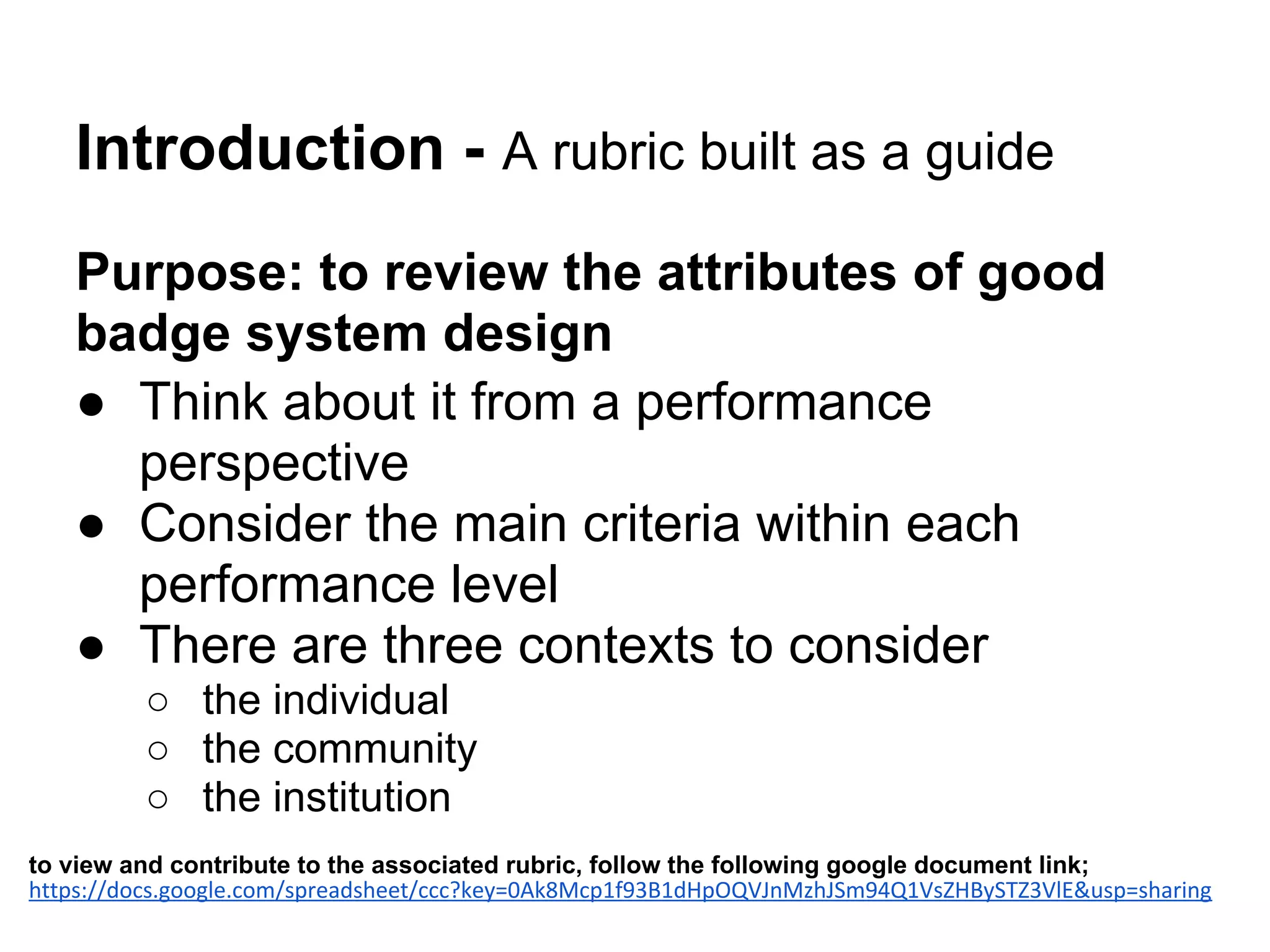
   Purpose: to review the attributes of good
   badge system design
   ● Think about it from a performance
     perspective
   ● Consider the main criteria within each
     performance level
   ● There are three contexts to consider
         ○ the individual
         ○ the community
         ○ the institution
to view and contribute to the associated rubric, follow the following google document link;
https://docs.google.com/spreadsheet/ccc?key=0Ak8Mcp1f93B1dHpOQVJnMzhJSm94Q1VsZHBySTZ3VlE&usp=sharing
The performance levels
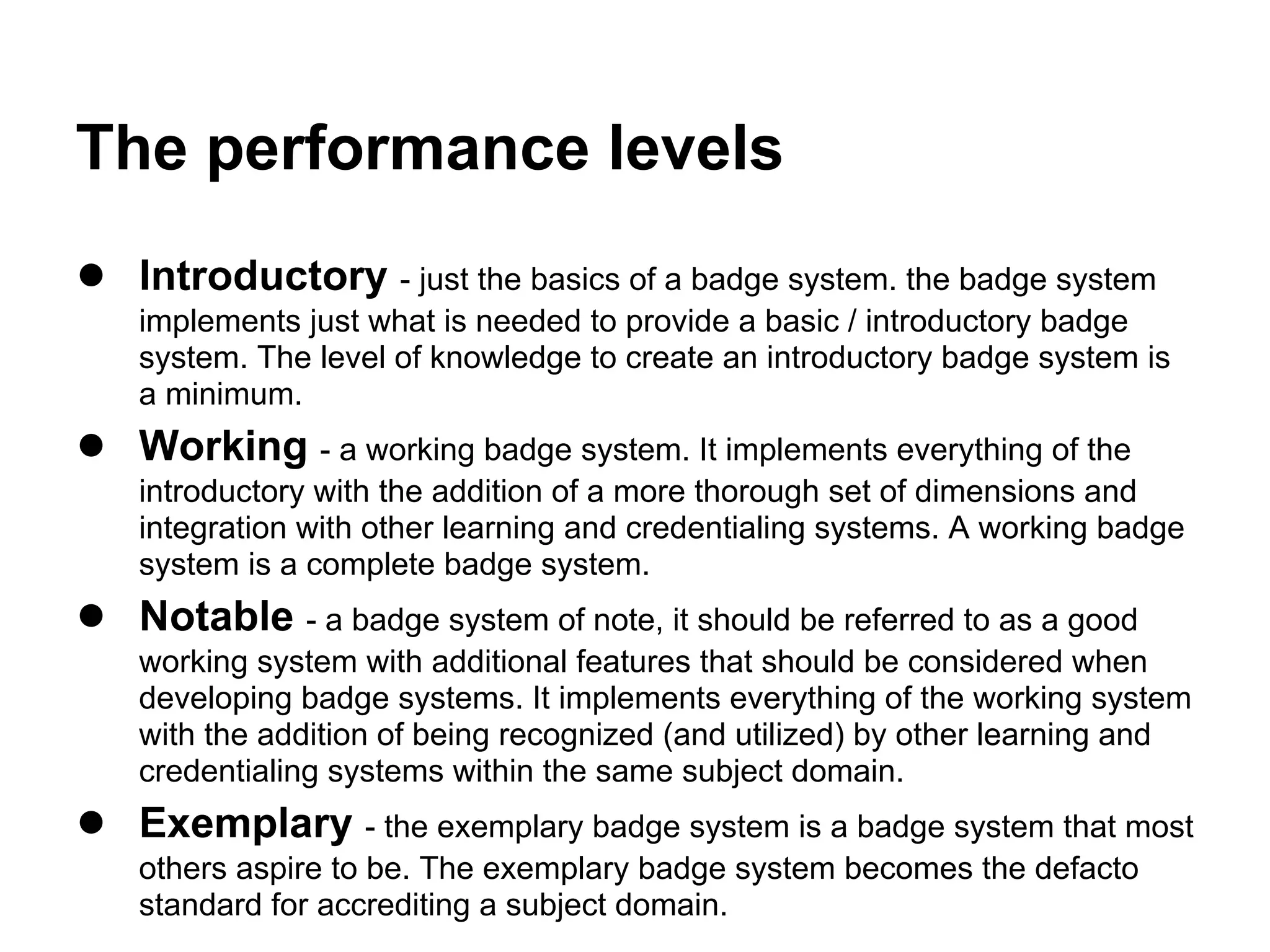
● Introductory - just the basics of a badge system. the badge system
    implements just what is needed to provide a basic / introductory badge
    system. The level of knowledge to create an introductory badge system is
    a minimum.
● Working - a working badge system. It implements everything of the
    introductory with the addition of a more thorough set of dimensions and
    integration with other learning and credentialing systems. A working badge
    system is a complete badge system.
● Notable - a badge system of note, it should be referred to as a good
    working system with additional features that should be considered when
    developing badge systems. It implements everything of the working system
    with the addition of being recognized (and utilized) by other learning and
    credentialing systems within the same subject domain.
● Exemplary - the exemplary badge system is a badge system that most
    others aspire to be. The exemplary badge system becomes the defacto
    standard for accrediting a subject domain.
The three contexts
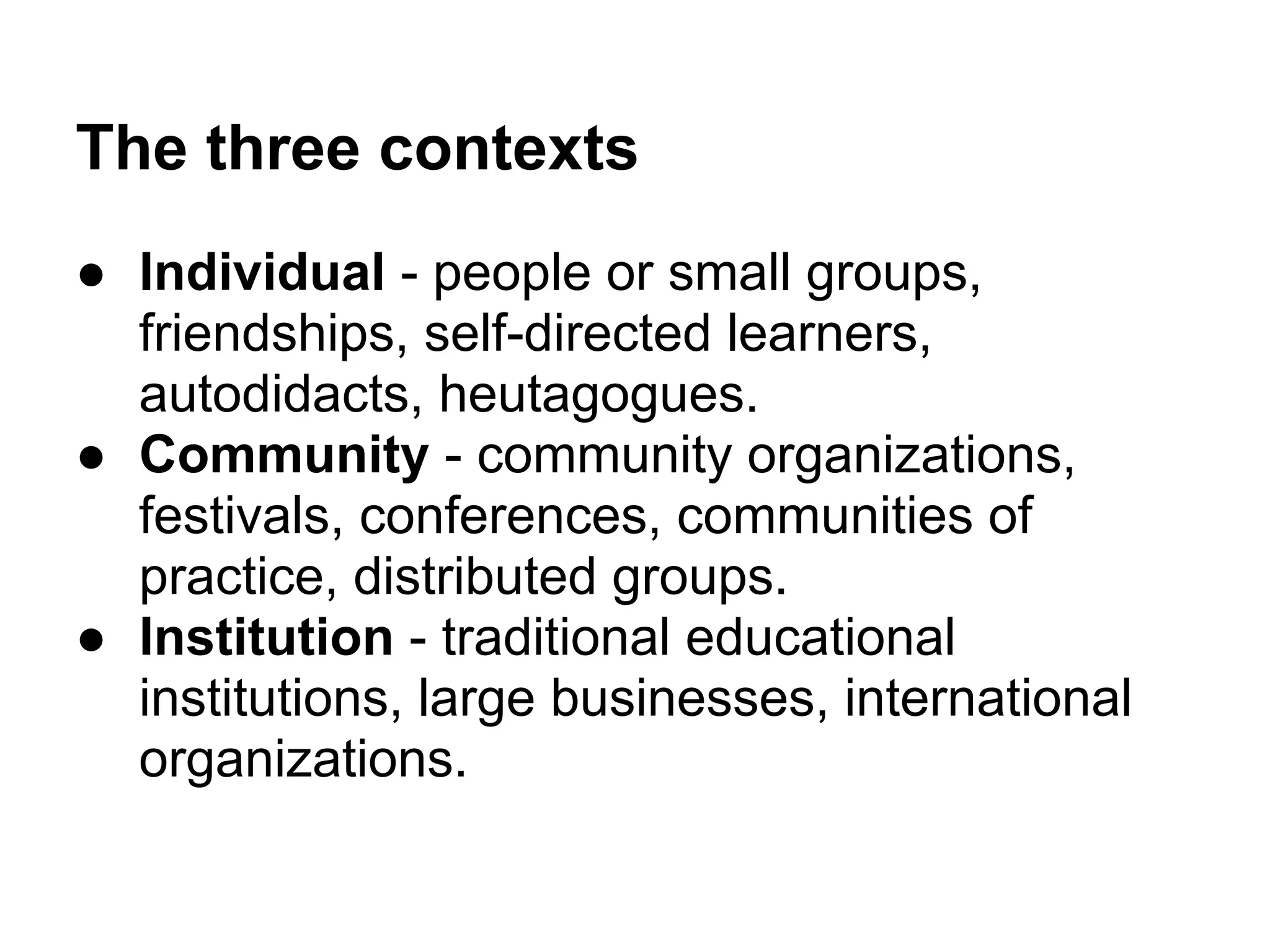
● Individual - people or small groups,
  friendships, self-directed learners,
  autodidacts, heutagogues.
● Community - community organizations,
  festivals, conferences, communities of
  practice, distributed groups.
● Institution - traditional educational
  institutions, large businesses, international
  organizations.
The criteria
 1.   Purpose
 2.   Graphical Design
 3.   Organization
 4.   Criteria
 5.   Technical Integration
 6.   System Integration
 7.   Assertion
 8.   Endorsement
 9.   Validity
10.   Development Team
11.   tbd
Deepening understanding
● Badge system design is an emerging
  domain
● With badge systems being designed for;
  ○ many different contexts
  ○ many different audiences
  ○ many different achievements
● If you want deepen your understanding, join
   in our peer developed course on P2Pu;
https://p2pu.org/en/groups/badge-system-design/

Badge system design (intro)

  • 1.
    Badge System Design An introduction to badge system design through multi-criteria performance driven design created by Peter Rawsthorne http://criticaltechnology.blogspot.ca
  • 2.
    Introduction - Arubric built as a guide Purpose: to review the attributes of good badge system design ● Think about it from a performance perspective ● Consider the main criteria within each performance level ● There are three contexts to consider ○ the individual ○ the community ○ the institution to view and contribute to the associated rubric, follow the following google document link; https://docs.google.com/spreadsheet/ccc?key=0Ak8Mcp1f93B1dHpOQVJnMzhJSm94Q1VsZHBySTZ3VlE&usp=sharing
  • 3.
    The performance levels ●Introductory - just the basics of a badge system. the badge system implements just what is needed to provide a basic / introductory badge system. The level of knowledge to create an introductory badge system is a minimum. ● Working - a working badge system. It implements everything of the introductory with the addition of a more thorough set of dimensions and integration with other learning and credentialing systems. A working badge system is a complete badge system. ● Notable - a badge system of note, it should be referred to as a good working system with additional features that should be considered when developing badge systems. It implements everything of the working system with the addition of being recognized (and utilized) by other learning and credentialing systems within the same subject domain. ● Exemplary - the exemplary badge system is a badge system that most others aspire to be. The exemplary badge system becomes the defacto standard for accrediting a subject domain.
  • 4.
    The three contexts ●Individual - people or small groups, friendships, self-directed learners, autodidacts, heutagogues. ● Community - community organizations, festivals, conferences, communities of practice, distributed groups. ● Institution - traditional educational institutions, large businesses, international organizations.
  • 5.
    The criteria 1. Purpose 2. Graphical Design 3. Organization 4. Criteria 5. Technical Integration 6. System Integration 7. Assertion 8. Endorsement 9. Validity 10. Development Team 11. tbd
  • 6.
    Deepening understanding ● Badgesystem design is an emerging domain ● With badge systems being designed for; ○ many different contexts ○ many different audiences ○ many different achievements ● If you want deepen your understanding, join in our peer developed course on P2Pu; https://p2pu.org/en/groups/badge-system-design/