Tsunami Facts in Wake of Japan EarthquakeA tsunami spawned by the Japan earthquake washed away houses and cars in Miyagai Prefecture.
It  spawned by the magnitude-8.9 quake—one of the largest    ever recorded—rocked Japan's eastern coast, killing hundreds of people, according to the Associated Press.
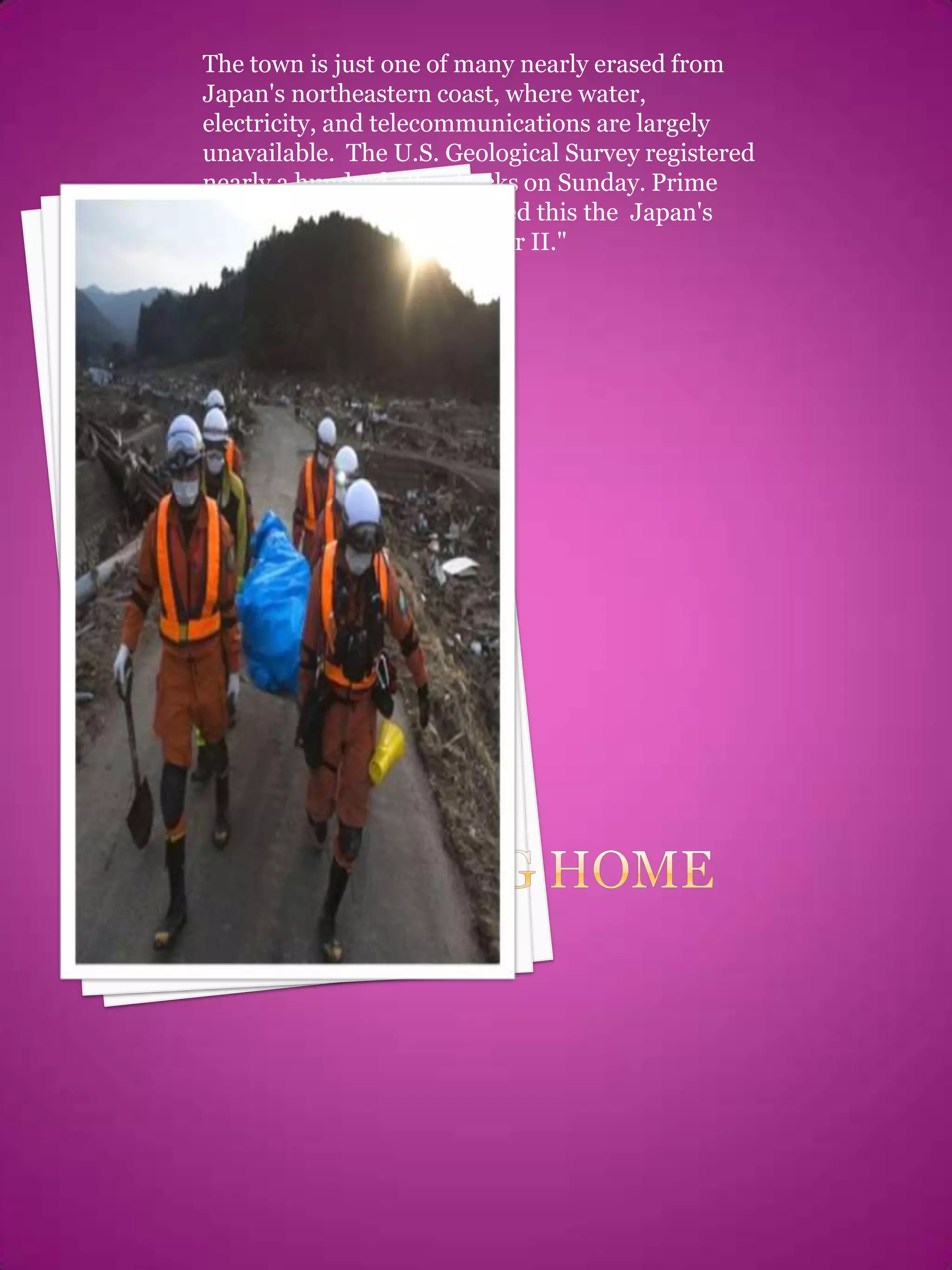
Within hours, the tsunami hit Hawaii and set off warnings throughout the Pacific, including South America, Canada, Alaska, and the U.S., such as the Oregon coast, the AP reported.The town is just one of many nearly erased from Japan's northeastern coast, where water, electricity, and telecommunications are largely unavailable.The U.S. Geological Survey registered nearly a hundred aftershocks on Sunday. Prime Minister Naoto Kan has called this the  Japan's "worst crisis since World War II."Leaving Home
Path Through DestructionA survivor walks his bicycle through the remains of the devastated Japanese town of Otsuchi on March 14.
Wave of DestructionA tsunami wave crashes over a street in Miyako City, Iwate Prefecture, in northeastern Japan on March 11.
Houses DestroyedRescue workers search for Japan earthquake victims amid shattered houses in Nodamura, Iwate Prefecture, on March 14.
Japan Earthquake Shortened Days, Increased Earth's WobbleThe magnitude 9.0 earthquake that struck Japan last Friday was powerful enough to shorten Earth's day by 1.8 microseconds and throw an extra 6.7 inches (17 centimeters) into the planet's wobble, scientists say.
The quake shifted what's called Earth's figure axis, an imaginary line around which the world's mass is balanced, about 33 feet (10 meters) from the north-south axis.
Data from high-precision GPS instruments show that parts of Japan shifted by as much as 13 feet (4 meters) as the fault plates lurched due to the earthquake. 
The shifting mass also affected the planet's spin rate.
For the Japan earthquake, the change in Earth's wobble was more than twice as large as those calculated for the 2004 and 2010 events.Japan Battles to Avert Nuclear Power Plant DisasterThe nuclear crisis at Fukushima Daiichi power plant comes four years after another earthquake delivered a warning to Tokyo Electric Power Company that seismic risks at its atomic reactors could be far greater than plant engineers had reckoned.

Bad work, Tsunami in Japan

  • 1.
    Tsunami Facts inWake of Japan EarthquakeA tsunami spawned by the Japan earthquake washed away houses and cars in Miyagai Prefecture.
  • 2.
    It spawnedby the magnitude-8.9 quake—one of the largest ever recorded—rocked Japan's eastern coast, killing hundreds of people, according to the Associated Press.
  • 3.
    Within hours, thetsunami hit Hawaii and set off warnings throughout the Pacific, including South America, Canada, Alaska, and the U.S., such as the Oregon coast, the AP reported.The town is just one of many nearly erased from Japan's northeastern coast, where water, electricity, and telecommunications are largely unavailable.The U.S. Geological Survey registered nearly a hundred aftershocks on Sunday. Prime Minister Naoto Kan has called this the Japan's "worst crisis since World War II."Leaving Home
  • 4.
    Path Through DestructionAsurvivor walks his bicycle through the remains of the devastated Japanese town of Otsuchi on March 14.
  • 5.
    Wave of DestructionAtsunami wave crashes over a street in Miyako City, Iwate Prefecture, in northeastern Japan on March 11.
  • 6.
    Houses DestroyedRescue workerssearch for Japan earthquake victims amid shattered houses in Nodamura, Iwate Prefecture, on March 14.
  • 7.
    Japan Earthquake ShortenedDays, Increased Earth's WobbleThe magnitude 9.0 earthquake that struck Japan last Friday was powerful enough to shorten Earth's day by 1.8 microseconds and throw an extra 6.7 inches (17 centimeters) into the planet's wobble, scientists say.
  • 8.
    The quake shiftedwhat's called Earth's figure axis, an imaginary line around which the world's mass is balanced, about 33 feet (10 meters) from the north-south axis.
  • 9.
    Data from high-precisionGPS instruments show that parts of Japan shifted by as much as 13 feet (4 meters) as the fault plates lurched due to the earthquake. 
  • 10.
    The shifting massalso affected the planet's spin rate.
  • 11.
    For the Japanearthquake, the change in Earth's wobble was more than twice as large as those calculated for the 2004 and 2010 events.Japan Battles to Avert Nuclear Power Plant DisasterThe nuclear crisis at Fukushima Daiichi power plant comes four years after another earthquake delivered a warning to Tokyo Electric Power Company that seismic risks at its atomic reactors could be far greater than plant engineers had reckoned.
  • 12.
    TEPCO is nowbattling to avert a catastrophic meltdown at three of the six reactors at the Fukushima facility­, with a second hydrogen explosion early Monday morning signaling the difficulty of that effort.
  • 13.
    But in 2007,the company escaped such peril at its Kashiwazaki-Kariwa plant, the largest nuclear power station in the world, when it was damaged by a 6.8-magnitude earthquake that was up to three times larger than the plant’s design was built t­o withstand.
  • 14.
    That underestimate touchedoff concern and study throughout the global nuclear industry, but officials have pointed to the incident as a demonstration of nuclear plant resilience, because no critical safety structures or systems were impairedNuclear ReactionSmoke billows from Japan's Fukushima I nuclear reactor as a man watches the scene unfold on TV Saturday—the result of damage to the reactor's cooling system during yesterday's earthqu.ake and tsunami.
  • 15.
    At the plant,an explosion blew the roof off a building and destroyed exterior walls, Japan's Kyodo News reported. The steel container housing the reactor, however, was reportedly not damaged.
  • 16.
    The explosion hasheightened fears of radiation exposure in Japan, which has declared a precautionary nuclear emergency for the country.How Is Japan's Nuclear Disaster Different?1. Japan's Fukushima Daiichi nuclear power complex, which began operating in the 1970s, is made up of six boiling-water reactors, or BWRs—a type of "Light Water Reactor. Both of these reactors use water for two purposes. It acts as a coolant, carrying heat away from the nuclear fuel, and as a "moderator," slowing down the release of neutrons during fission reactions Chernobyl's reactors were a type called RBMK (for the Russian, "reaktorbolshoymoshchnostykanalny"), which also used water for the coolant. But unlike the Light Water Reactors, the RMBK used graphite as a moderator.
  • 17.
    Japan Tsunami, Before& After: AfterBefore
  • 18.