


삶이 편해지는 쉬운 리팩토링(Refactoring)
유석문
http://xaxor.com/bizarre/23678-dangerou
s-work-part-4-construction-workers.html
Refactoring?!?!!
What is Refactoring?
A change made to the internal structure of software to make it
easier to understand and cheaper to modify without changing its
observable behavior. — Refactoring, Martin Fowler, page 53.
Refactoring typically involves
• Removing duplicated or dead code
• Simplifying complex code
• Clarifying unclear code
Refactoring is revision
All good writing is based upon revision.
— Jacques Barzun, Simple & Direct, 4th Edition
Revision means to re-see or see again.
How to Refactor
The secret to successful refactoring is to
take baby steps.
When refactoring, your ultimate goal is not to:
• break anything
• make things worse
• introduce new behavior
How to Refactor
• Verify that all automated tests (unit tests) pass
• Decide what code to change
• Implement one or more refactorings carefully
• Run the unit tests whenever you wish to confirm that changes ha
ve not altered system behavior
• Repeat until the refactoring is complete or revert to an earlier
state
Refactoring?!?!!
http://daily-pins.com/there-was-a-spider-its-gone-now/
A Chicken and Egg Problem?
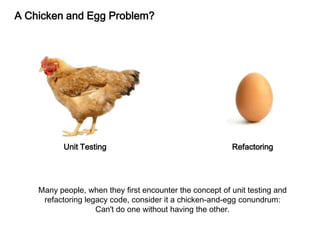
Many people, when they first encounter the concept of unit testing and
refactoring legacy code, consider it a chicken-and-egg conundrum:
Can't do one without having the other.
Unit Testing Refactoring
Start with the Universals
Always start refactoring work with the three universals.
1. Reformat and Commit. Establish a baseline for later diffs.
2. Eliminate the Noise. A refactored file always minimizes noise and m
aximizes signal.
3. Get To Testability. We're going to need some tests. Can we even st
art to test our class?
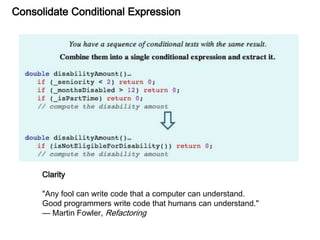
Consolidate Conditional Expression
Clarity
"Any fool can write code that a computer can understand.
Good programmers write code that humans can understand."
— Martin Fowler, Refactoring
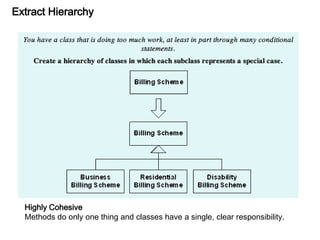
Extract Hierarchy
Highly Cohesive
Methods do only one thing and classes have a single, clear responsibility.
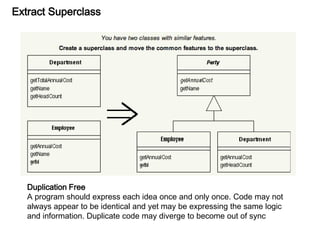
Extract Superclass
Duplication Free
A program should express each idea once and only once. Code may not
always appear to be identical and yet may be expressing the same logic
and information. Duplicate code may diverge to become out of sync
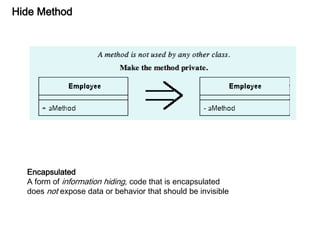
Hide Method
Encapsulated
A form of information hiding, code that is encapsulated
does not expose data or behavior that should be invisible
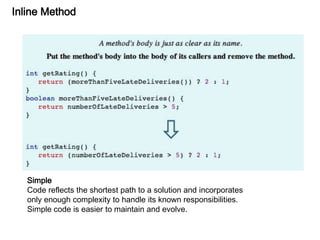
Inline Method
Simple
Code reflects the shortest path to a solution and incorporates
only enough complexity to handle its known responsibilities.
Simple code is easier to maintain and evolve.
Caller Creates
When you need to create a new class or method that will be invoked by a
caller, don't perform the creation where the new code will reside (e.g. in a
new file or within the class that will contain the new method).
Instead, declare the to-be-created class/method where it will be used, i.e.
in the caller code.
This will allow you to use IDE tools to automatically generate the exact co
de needed by the client, instead of retrofitting client code to the new class/
method after creation.
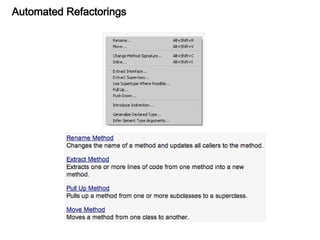
Automated Refactorings
Rejected Parameter
To avoid passing a parameter to code you want to extract, you must first rej
ect the parameter from the extraction.
The video on the next page presents three different ways to reject a
parameter:
1. Inline the unwanted parameter.
2. Move the unwanted parameter out of the extraction block.
3. Turn the unwanted parameter into a field so it can be referenced from t
he extracted method instead of being passed as a parameter.
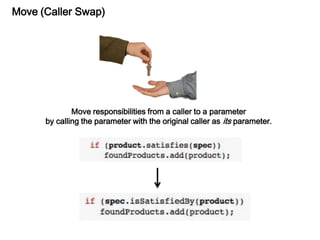
Move (Caller Swap)
Move responsibilities from a caller to a parameter
by calling the parameter with the original caller as its parameter.
Encapsulated Dependency
Before moving code to a new class, first encapsulate
dependencies, like fields.
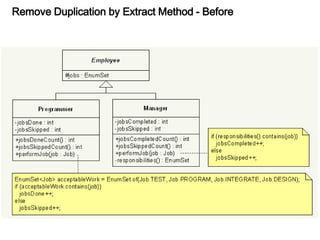
Remove Duplication by Extract Method - Before
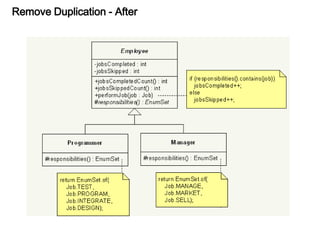
Remove Duplication - After
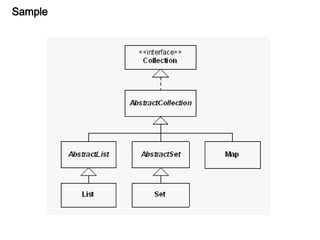
Sample
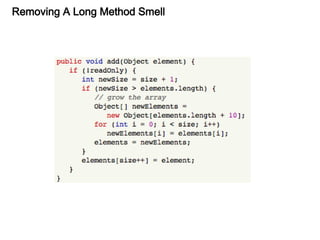
Removing A Long Method Smell
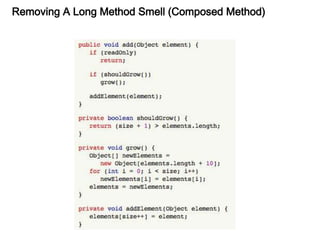
Removing A Long Method Smell (Composed Method)
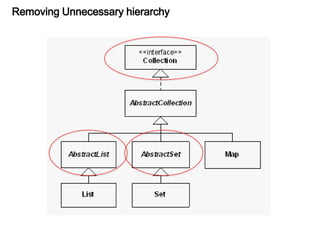
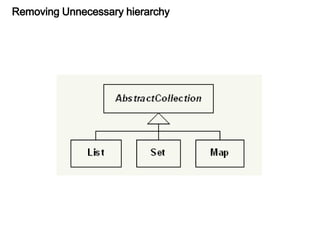
Removing Unnecessary hierarchy
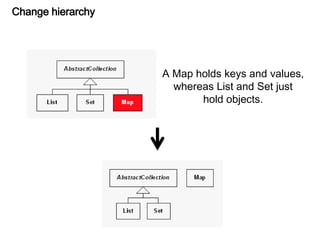
Change hierarchy
A Map holds keys and values,
whereas List and Set just
hold objects.
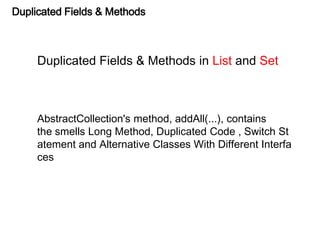
Duplicated Fields & Methods
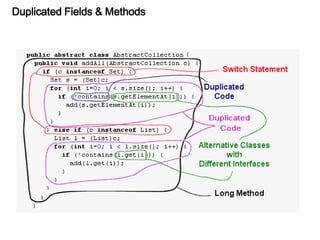
Duplicated Fields & Methods in List and Set
AbstractCollection's method, addAll(...), contains
the smells Long Method, Duplicated Code , Switch St
atement and Alternative Classes With Different Interfa
ces
Duplicated Fields & Methods
Don’t Fix Bugs during Refactoring
A List should allow duplicates, yet in
AbstractCollection your addAll(...) method is
checking whether the element is already
contained before adding it.
There is a time and place to fix bugs and it is
not during refactoring.
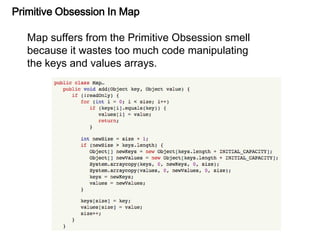
Primitive Obsession In Map
Map suffers from the Primitive Obsession smell
because it wastes too much code manipulating
the keys and values arrays.
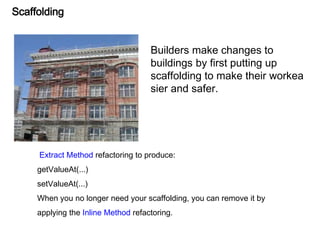
Scaffolding
Builders make changes to
buildings by first putting up
scaffolding to make their workea
sier and safer.
Extract Method refactoring to produce:
getValueAt(...)
setValueAt(...)
When you no longer need your scaffolding, you can remove it by
applying the Inline Method refactoring.
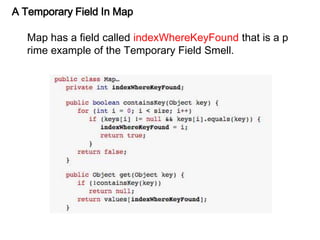
A Temporary Field In Map
Map has a field called indexWhereKeyFound that is a p
rime example of the Temporary Field Smell.
Thank you.

Agile korea 2013 유석문

  • 1.
    삶이 편해지는 쉬운리팩토링(Refactoring) 유석문
  • 2.
  • 3.
    What is Refactoring? Achange made to the internal structure of software to make it easier to understand and cheaper to modify without changing its observable behavior. — Refactoring, Martin Fowler, page 53. Refactoring typically involves • Removing duplicated or dead code • Simplifying complex code • Clarifying unclear code
  • 4.
    Refactoring is revision Allgood writing is based upon revision. — Jacques Barzun, Simple & Direct, 4th Edition Revision means to re-see or see again.
  • 5.
    How to Refactor Thesecret to successful refactoring is to take baby steps. When refactoring, your ultimate goal is not to: • break anything • make things worse • introduce new behavior
  • 6.
    How to Refactor •Verify that all automated tests (unit tests) pass • Decide what code to change • Implement one or more refactorings carefully • Run the unit tests whenever you wish to confirm that changes ha ve not altered system behavior • Repeat until the refactoring is complete or revert to an earlier state
  • 7.
  • 8.
    A Chicken andEgg Problem? Many people, when they first encounter the concept of unit testing and refactoring legacy code, consider it a chicken-and-egg conundrum: Can't do one without having the other. Unit Testing Refactoring
  • 9.
    Start with theUniversals Always start refactoring work with the three universals. 1. Reformat and Commit. Establish a baseline for later diffs. 2. Eliminate the Noise. A refactored file always minimizes noise and m aximizes signal. 3. Get To Testability. We're going to need some tests. Can we even st art to test our class?
  • 10.
    Consolidate Conditional Expression Clarity "Anyfool can write code that a computer can understand. Good programmers write code that humans can understand." — Martin Fowler, Refactoring
  • 11.
    Extract Hierarchy Highly Cohesive Methodsdo only one thing and classes have a single, clear responsibility.
  • 12.
    Extract Superclass Duplication Free Aprogram should express each idea once and only once. Code may not always appear to be identical and yet may be expressing the same logic and information. Duplicate code may diverge to become out of sync
  • 13.
    Hide Method Encapsulated A formof information hiding, code that is encapsulated does not expose data or behavior that should be invisible
  • 14.
    Inline Method Simple Code reflectsthe shortest path to a solution and incorporates only enough complexity to handle its known responsibilities. Simple code is easier to maintain and evolve.
  • 15.
    Caller Creates When youneed to create a new class or method that will be invoked by a caller, don't perform the creation where the new code will reside (e.g. in a new file or within the class that will contain the new method). Instead, declare the to-be-created class/method where it will be used, i.e. in the caller code. This will allow you to use IDE tools to automatically generate the exact co de needed by the client, instead of retrofitting client code to the new class/ method after creation.
  • 16.
  • 17.
    Rejected Parameter To avoidpassing a parameter to code you want to extract, you must first rej ect the parameter from the extraction. The video on the next page presents three different ways to reject a parameter: 1. Inline the unwanted parameter. 2. Move the unwanted parameter out of the extraction block. 3. Turn the unwanted parameter into a field so it can be referenced from t he extracted method instead of being passed as a parameter.
  • 18.
    Move (Caller Swap) Moveresponsibilities from a caller to a parameter by calling the parameter with the original caller as its parameter.
  • 19.
    Encapsulated Dependency Before movingcode to a new class, first encapsulate dependencies, like fields.
  • 20.
    Remove Duplication byExtract Method - Before
  • 21.
  • 22.
  • 23.
    Removing A LongMethod Smell
  • 24.
    Removing A LongMethod Smell (Composed Method)
  • 25.
  • 26.
  • 27.
    Change hierarchy A Mapholds keys and values, whereas List and Set just hold objects.
  • 28.
    Duplicated Fields &Methods Duplicated Fields & Methods in List and Set AbstractCollection's method, addAll(...), contains the smells Long Method, Duplicated Code , Switch St atement and Alternative Classes With Different Interfa ces
  • 29.
  • 30.
    Don’t Fix Bugsduring Refactoring A List should allow duplicates, yet in AbstractCollection your addAll(...) method is checking whether the element is already contained before adding it. There is a time and place to fix bugs and it is not during refactoring.
  • 31.
    Primitive Obsession InMap Map suffers from the Primitive Obsession smell because it wastes too much code manipulating the keys and values arrays.
  • 32.
    Scaffolding Builders make changesto buildings by first putting up scaffolding to make their workea sier and safer. Extract Method refactoring to produce: getValueAt(...) setValueAt(...) When you no longer need your scaffolding, you can remove it by applying the Inline Method refactoring.
  • 33.
    A Temporary FieldIn Map Map has a field called indexWhereKeyFound that is a p rime example of the Temporary Field Smell.
  • 34.