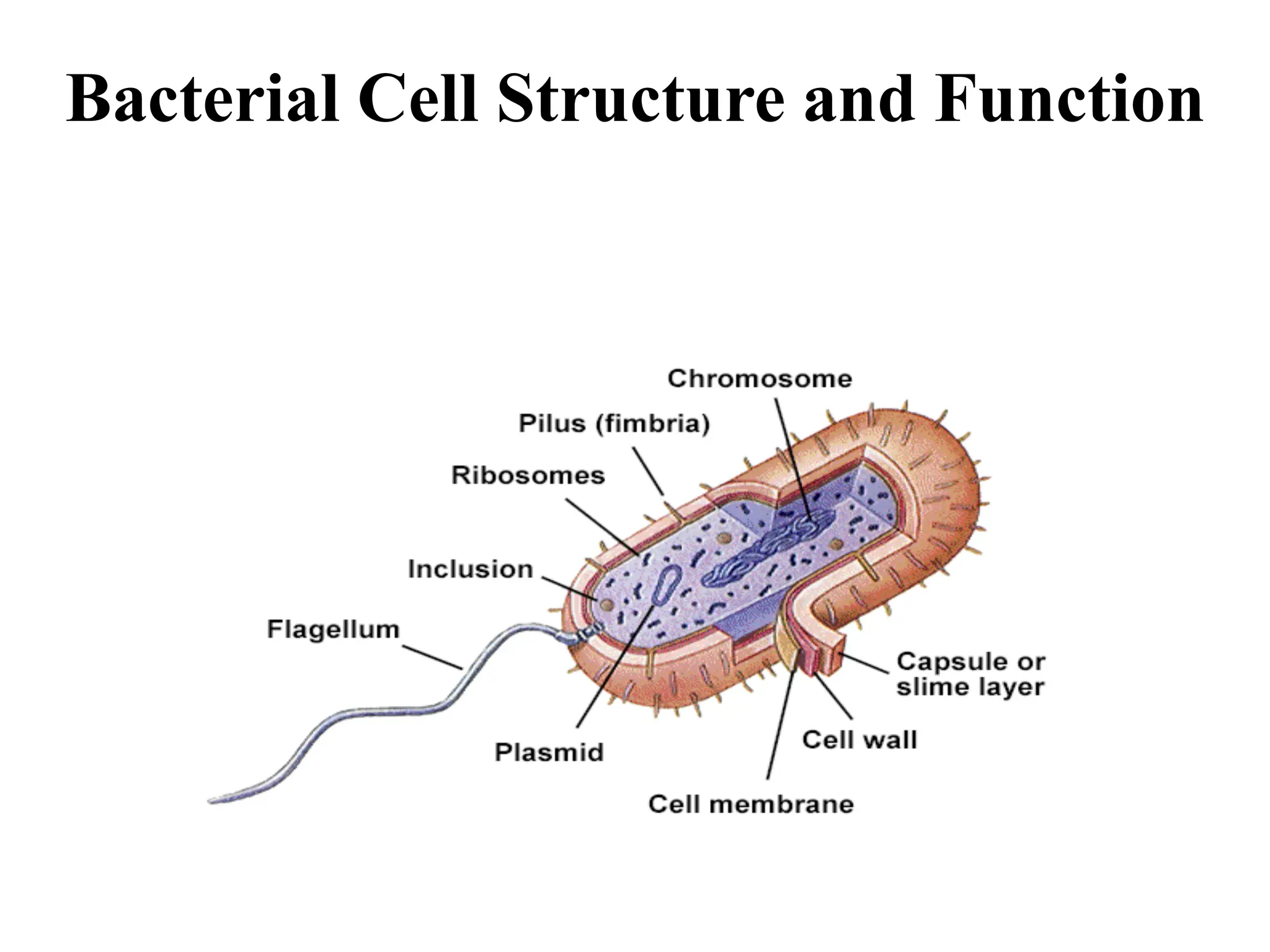
Bacterial Cell Structure and Function
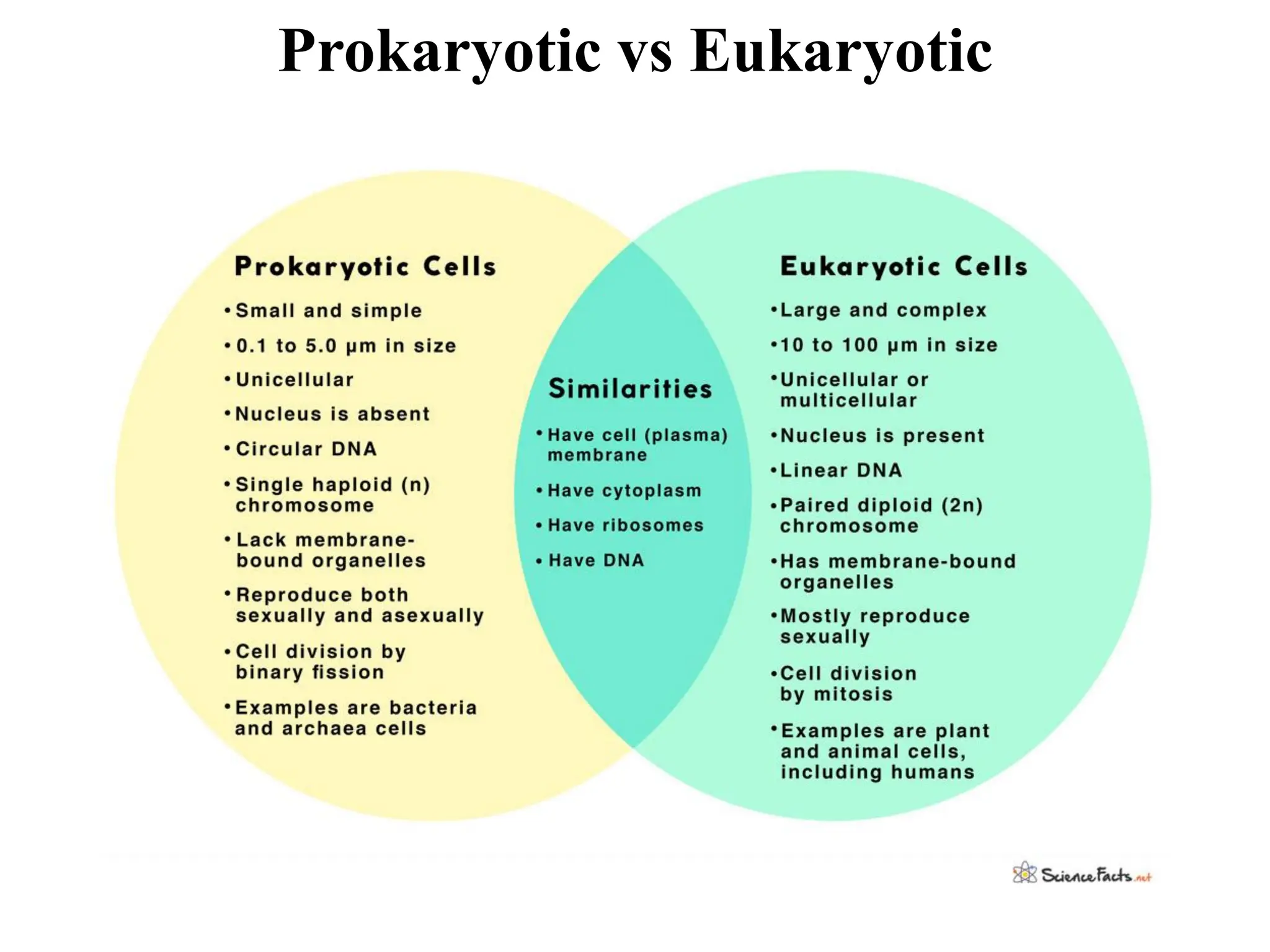
Prokaryotic vs Eukaryotic
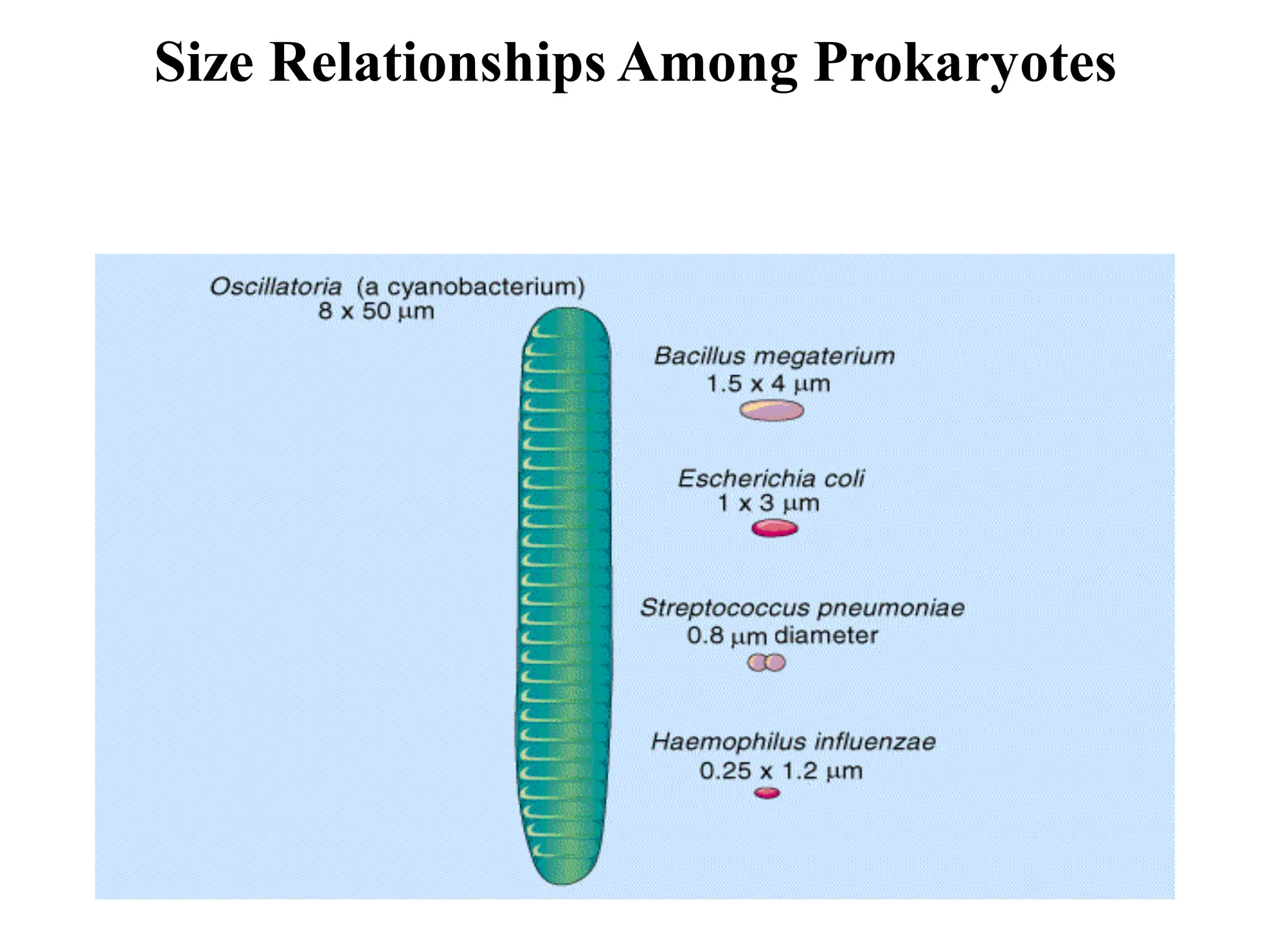
Size Relationships Among Prokaryotes
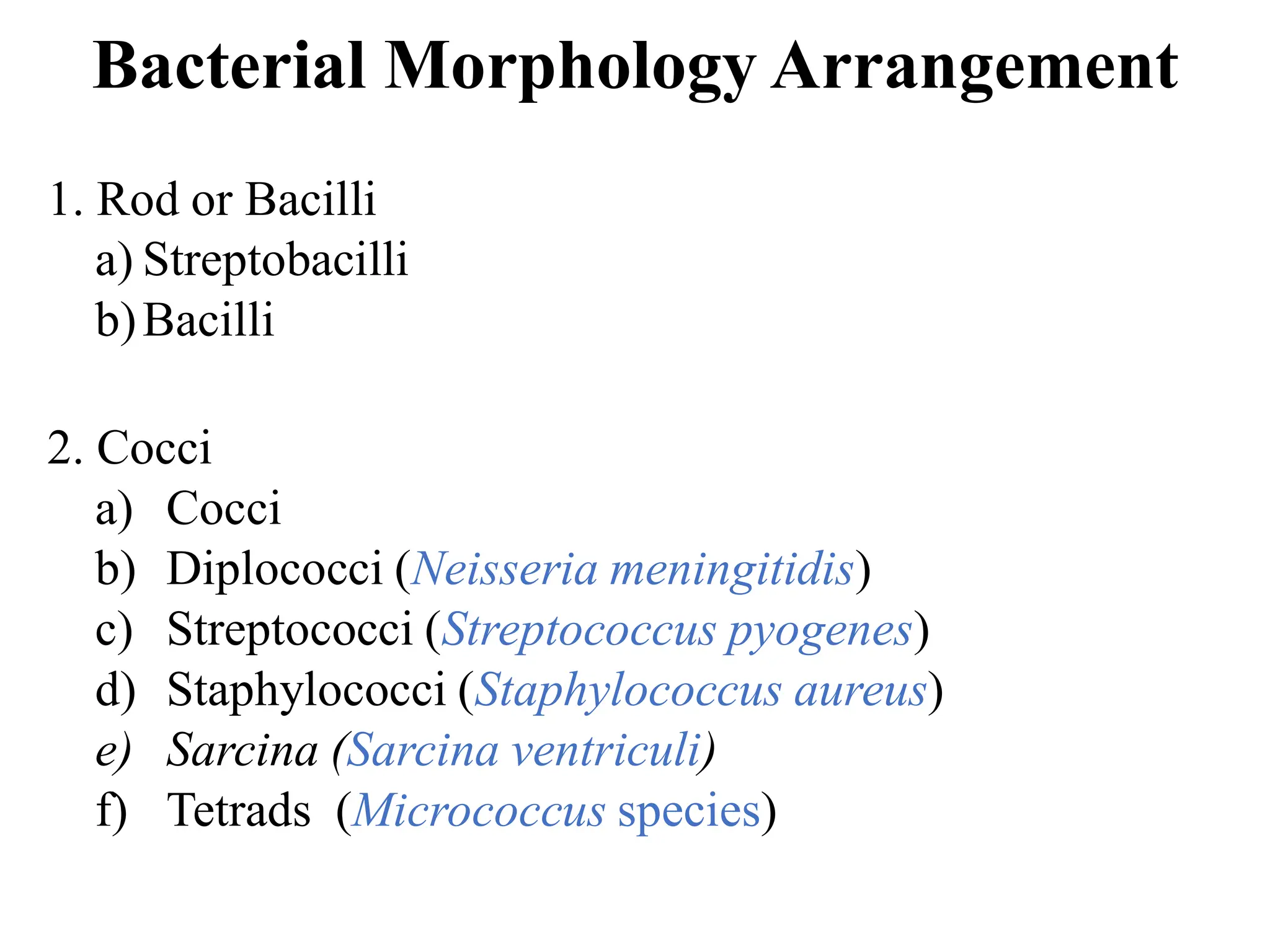
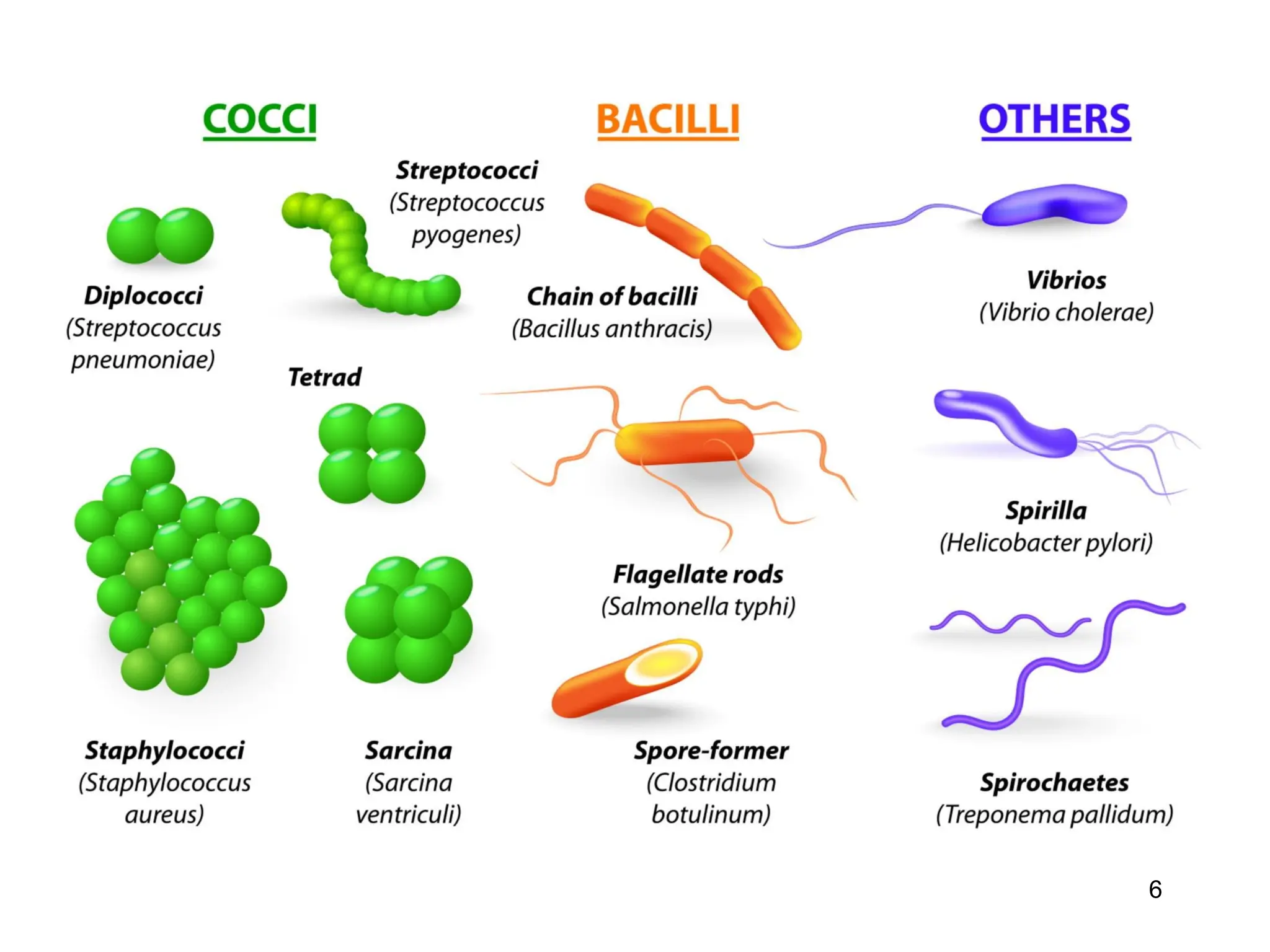
Bacterial Morphology Arrangement
1. Rod or Bacilli
a) Streptobacilli
b)Bacilli
2. Cocci
a) Cocci
b) Diplococci (Neisseria meningitidis)
c) Streptococci (Streptococcus pyogenes)
d) Staphylococci (Staphylococcus aureus)
e) Sarcina (Sarcina ventriculi)
f) Tetrads (Micrococcus species)
5
Bacterial Shapes, Arrangements, and Sizes
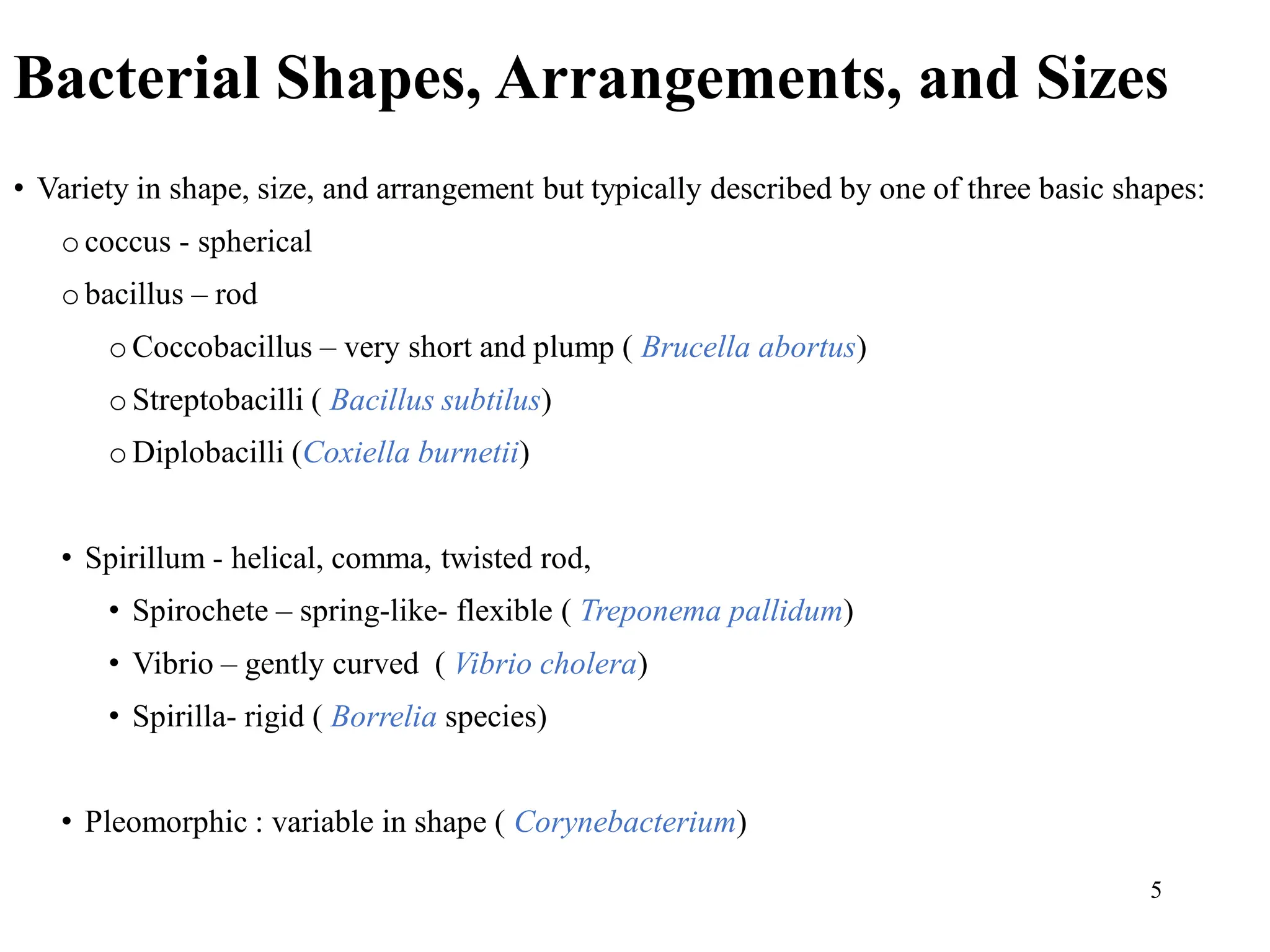
• Variety in shape, size, and arrangement but typically described by one of three basic shapes:
ococcus - spherical
obacillus – rod
oCoccobacillus – very short and plump ( Brucella abortus)
oStreptobacilli ( Bacillus subtilus)
oDiplobacilli (Coxiella burnetii)
• Spirillum - helical, comma, twisted rod,
• Spirochete – spring-like- flexible ( Treponema pallidum)
• Vibrio – gently curved ( Vibrio cholera)
• Spirilla- rigid ( Borrelia species)
• Pleomorphic : variable in shape ( Corynebacterium)
6
7
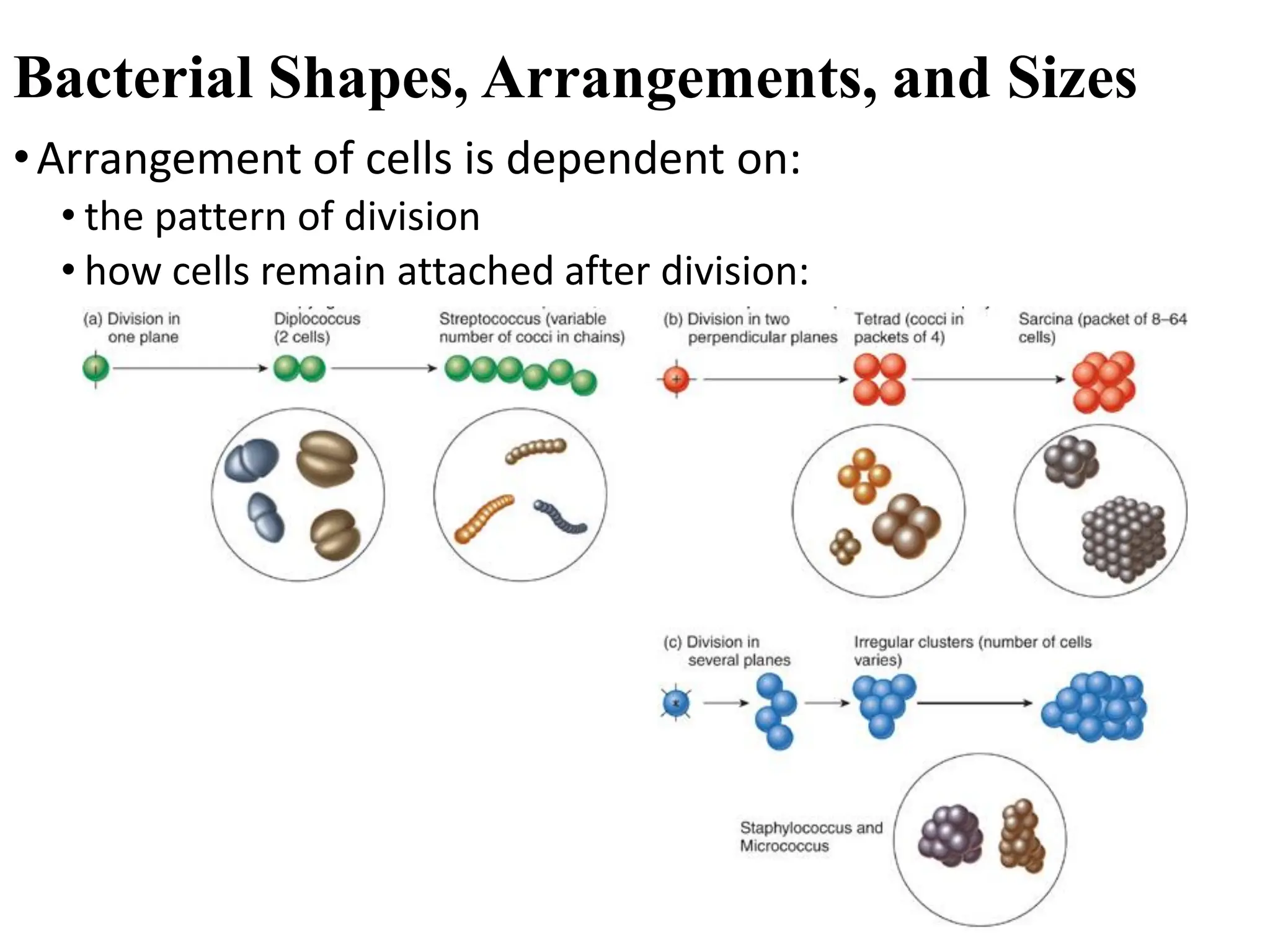
•Arrangement of cells is dependent on:
• the pattern of division
• how cells remain attached after division:
Bacterial Shapes, Arrangements, and Sizes
8
Bacterial Shapes, Arrangements, and Sizes
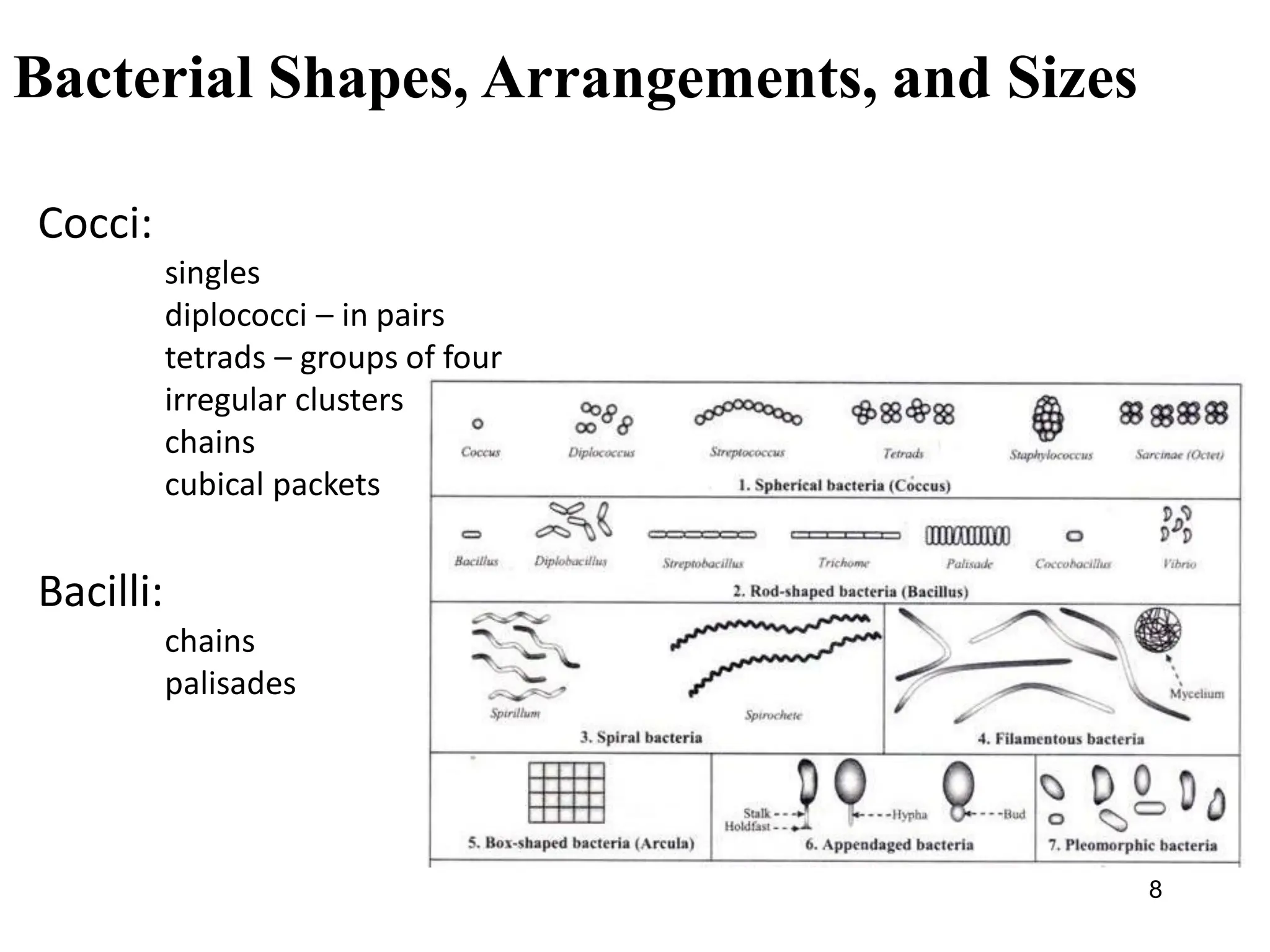
Cocci:
singles
diplococci – in pairs
tetrads – groups of four
irregular clusters
chains
cubical packets
Bacilli:
chains
palisades
Bacterial Cell Structure
•Appendages → flagella, pili or fimbriae
•Surface layers → capsule, cell wall, cell membrane
•Cytoplasm → nuclear material, ribosome, mesosome, etc.
•Special structure → endospore
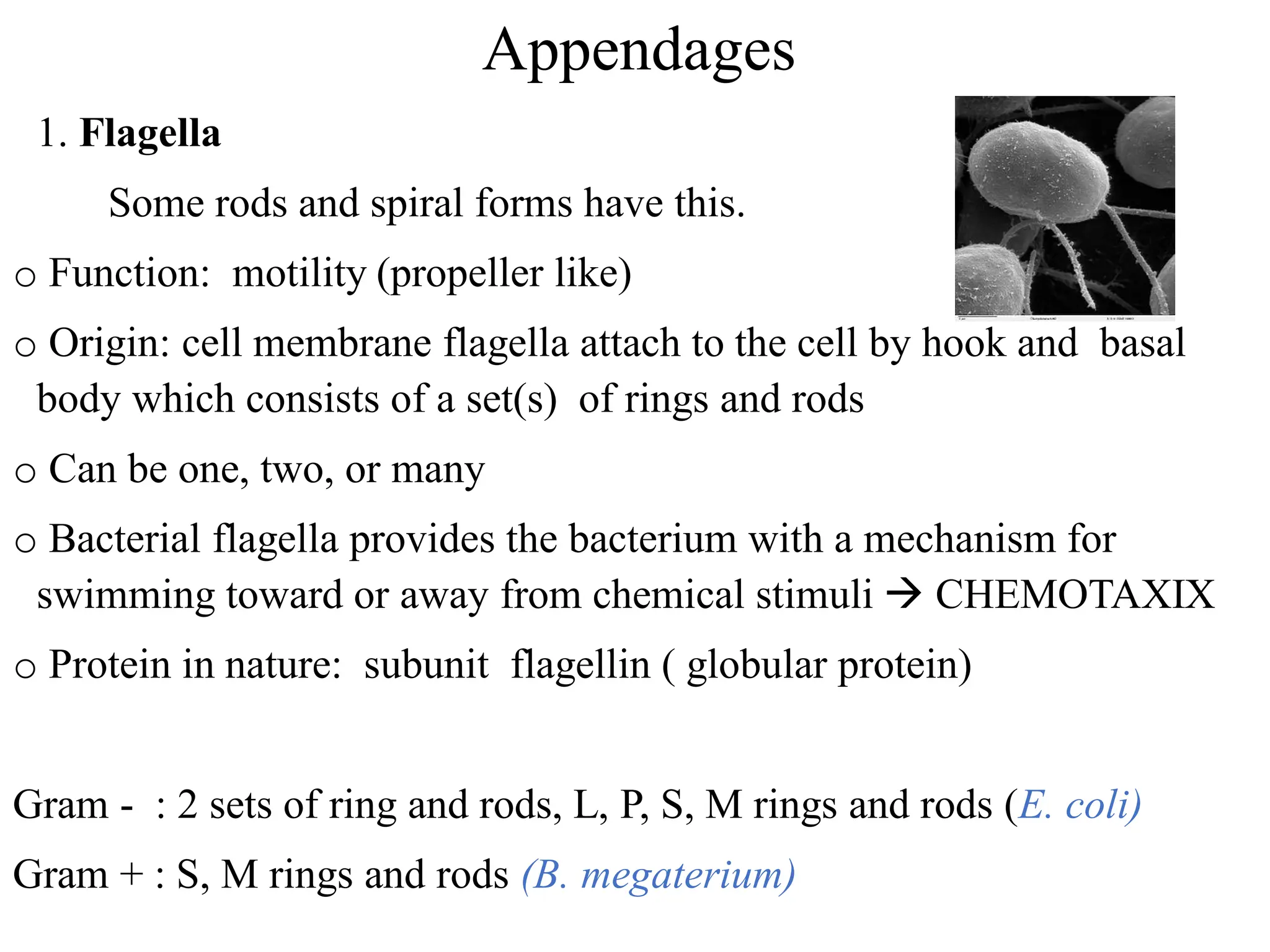
Appendages
1. Flagella
Some rods and spiral forms have this.
o Function: motility (propeller like)
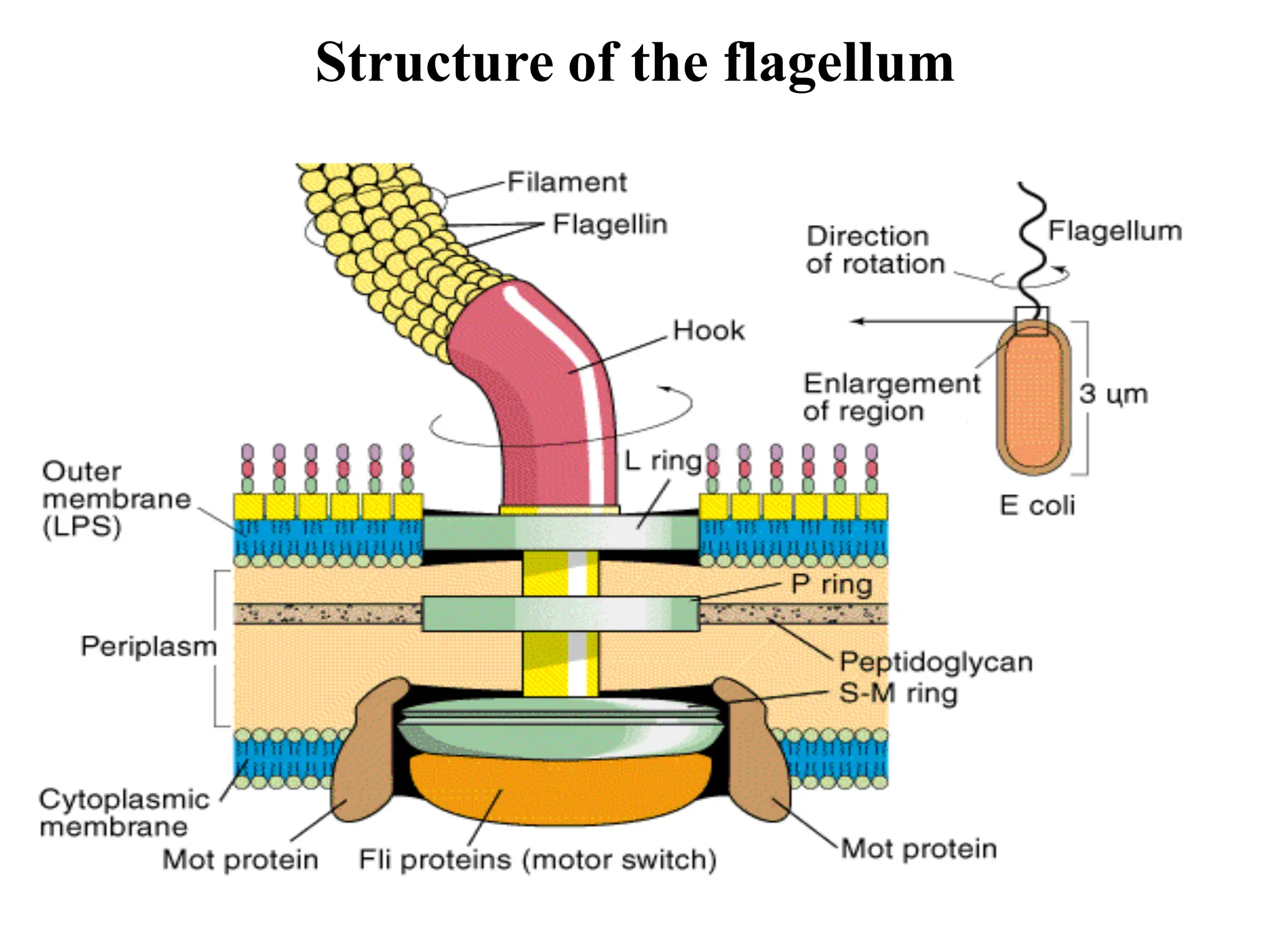
o Origin: cell membrane flagella attach to the cell by hook and basal
body which consists of a set(s) of rings and rods
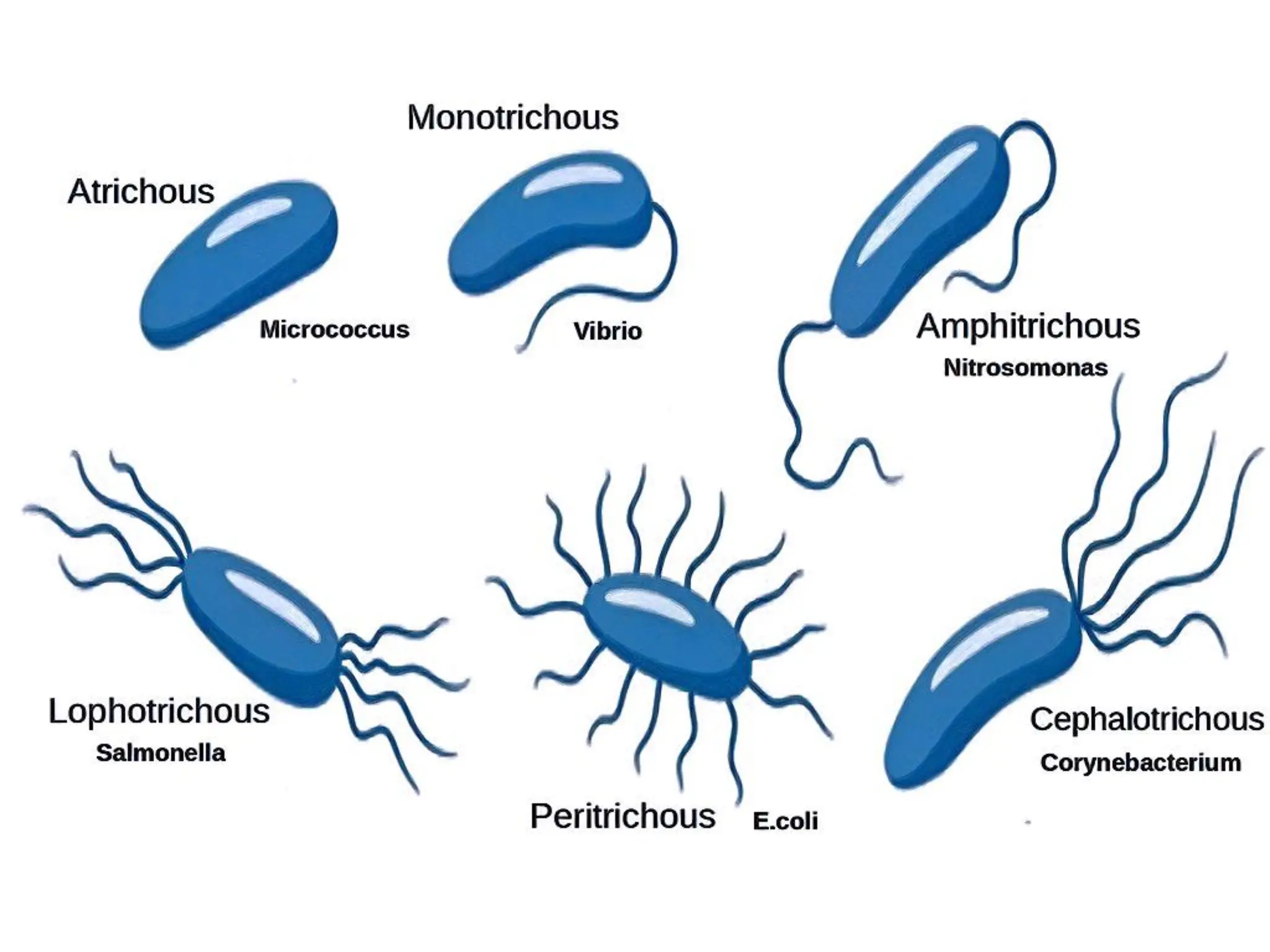
o Can be one, two, or many
o Bacterial flagella provides the bacterium with a mechanism for
swimming toward or away from chemical stimuli → CHEMOTAXIX
o Protein in nature: subunit flagellin ( globular protein)
Gram - : 2 sets of ring and rods, L, P, S, M rings and rods (E. coli)
Gram + : S, M rings and rods (B. megaterium)
Structure of the flagellum
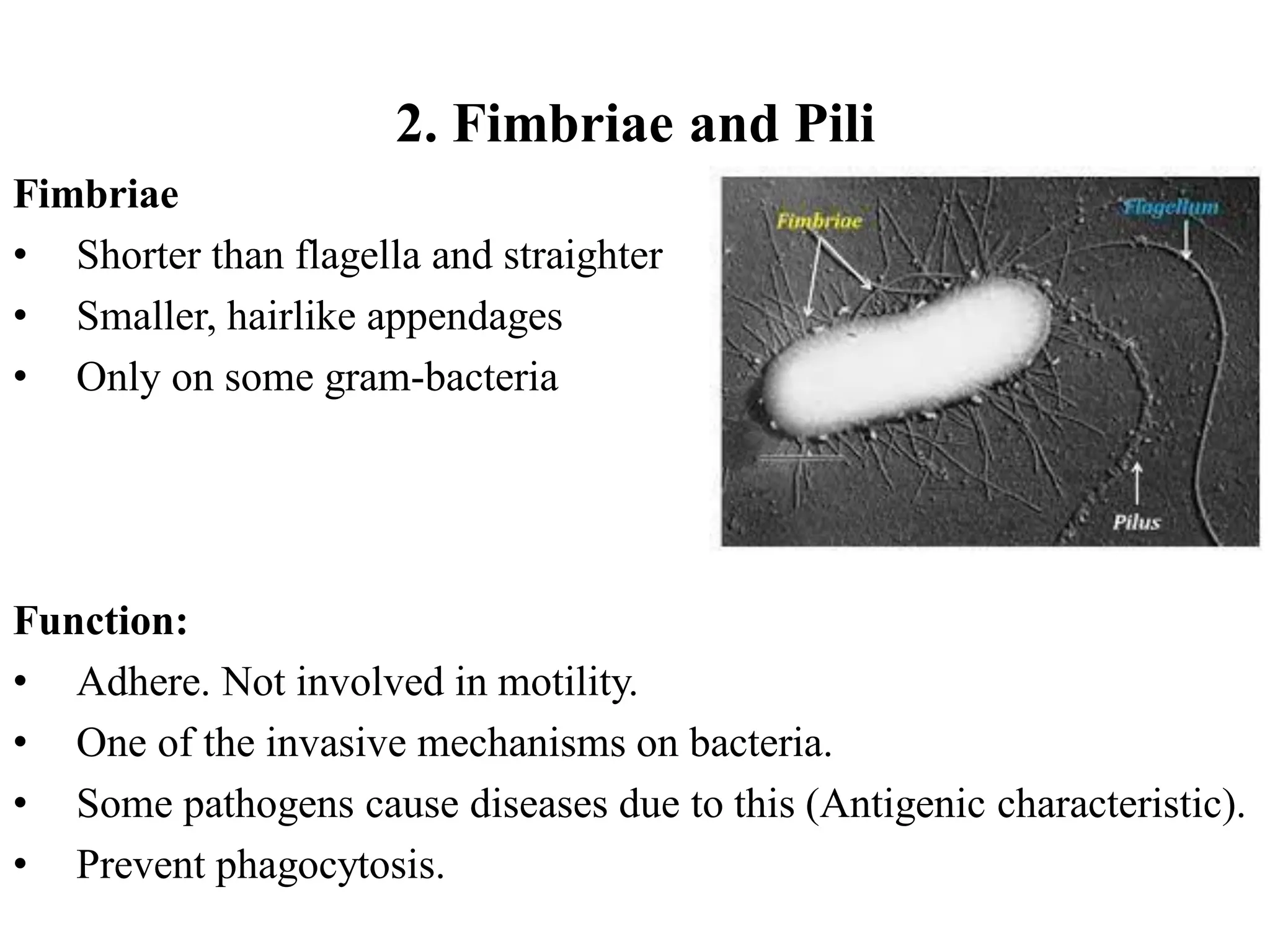
2. Fimbriae and Pili
Fimbriae
• Shorter than flagella and straighter
• Smaller, hairlike appendages
• Only on some gram-bacteria
Function:
• Adhere. Not involved in motility.
• One of the invasive mechanisms on bacteria.
• Some pathogens cause diseases due to this (Antigenic characteristic).
• Prevent phagocytosis.
Pili - sex factor
• If they make pili, they are + or donors of F factor
• F-factor (plasmid): allows genes to be transferred from one
bacterium carrying the factor to another bacterium lacking
the factor
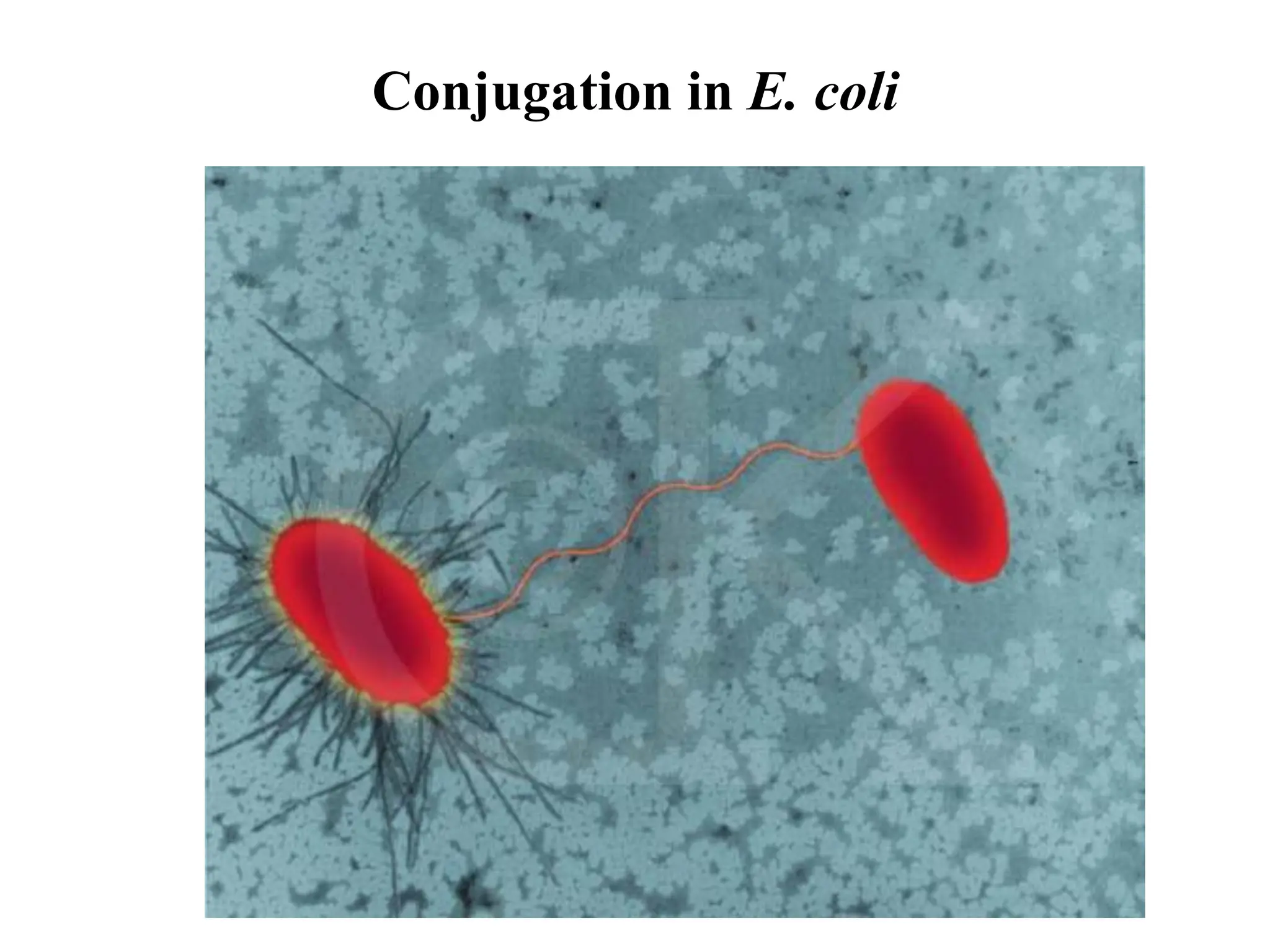
• It is necessary for bacterial conjugation → transfer of DNA
from one cell to another
• It has been implicated in the ability of bacteria to recognize
specific receptor sites (ompA) on the host cell membrane
• Origin: Cell membrane
• Position: common pili → numerous over the cell →
attachment
• Sex pili → 1-4/cell
•Structure: composed of proteins that can be dissociated into
smaller units Pilin
•Pilin → class of protein Lectin which bond to cell surface
polysaccharide.
Conjugation in E. coli
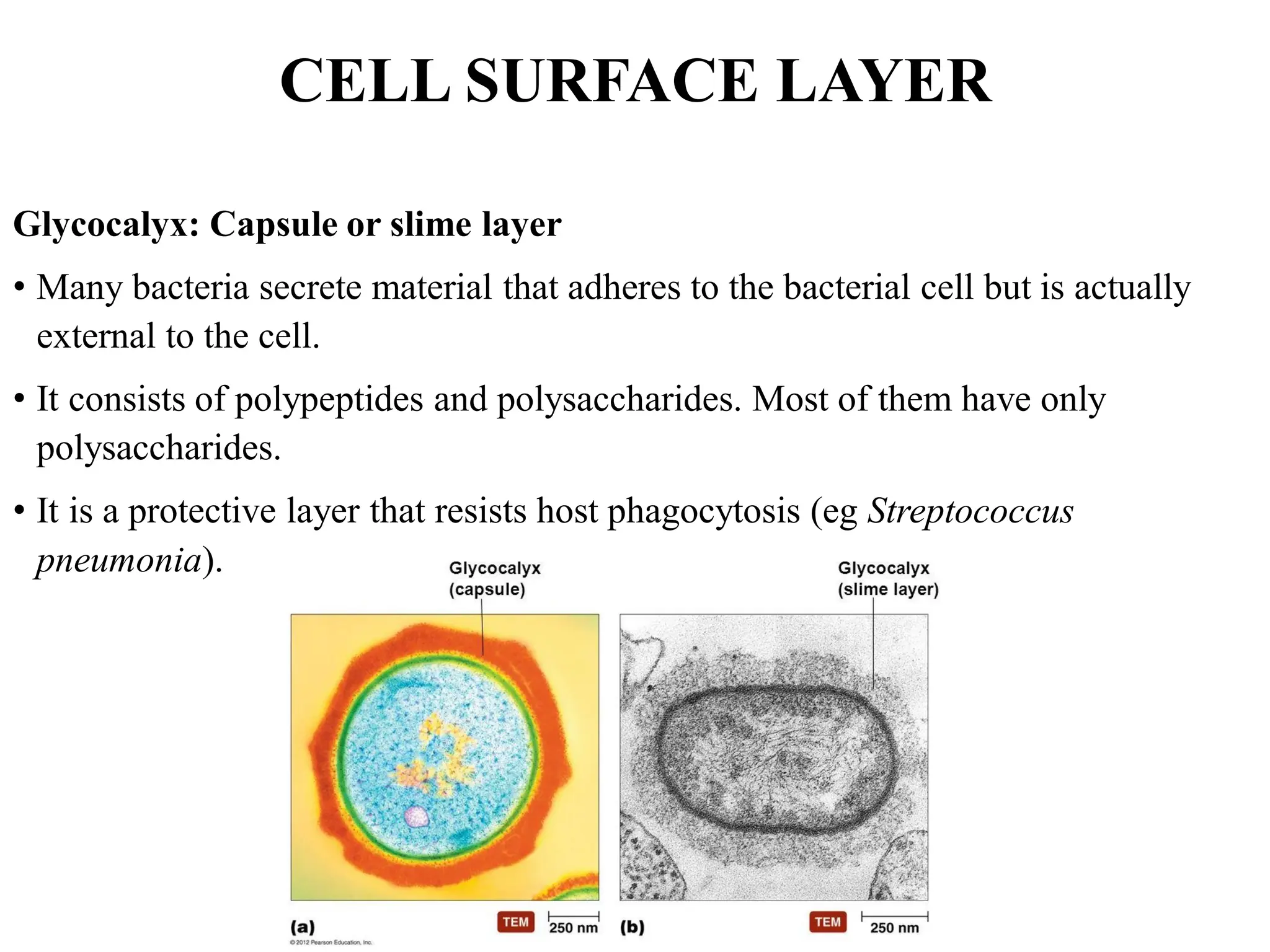
CELL SURFACE LAYER
Glycocalyx: Capsule or slime layer
• Many bacteria secrete material that adheres to the bacterial cell but is actually
external to the cell.
• It consists of polypeptides and polysaccharides. Most of them have only
polysaccharides.
• It is a protective layer that resists host phagocytosis (eg Streptococcus
pneumonia).
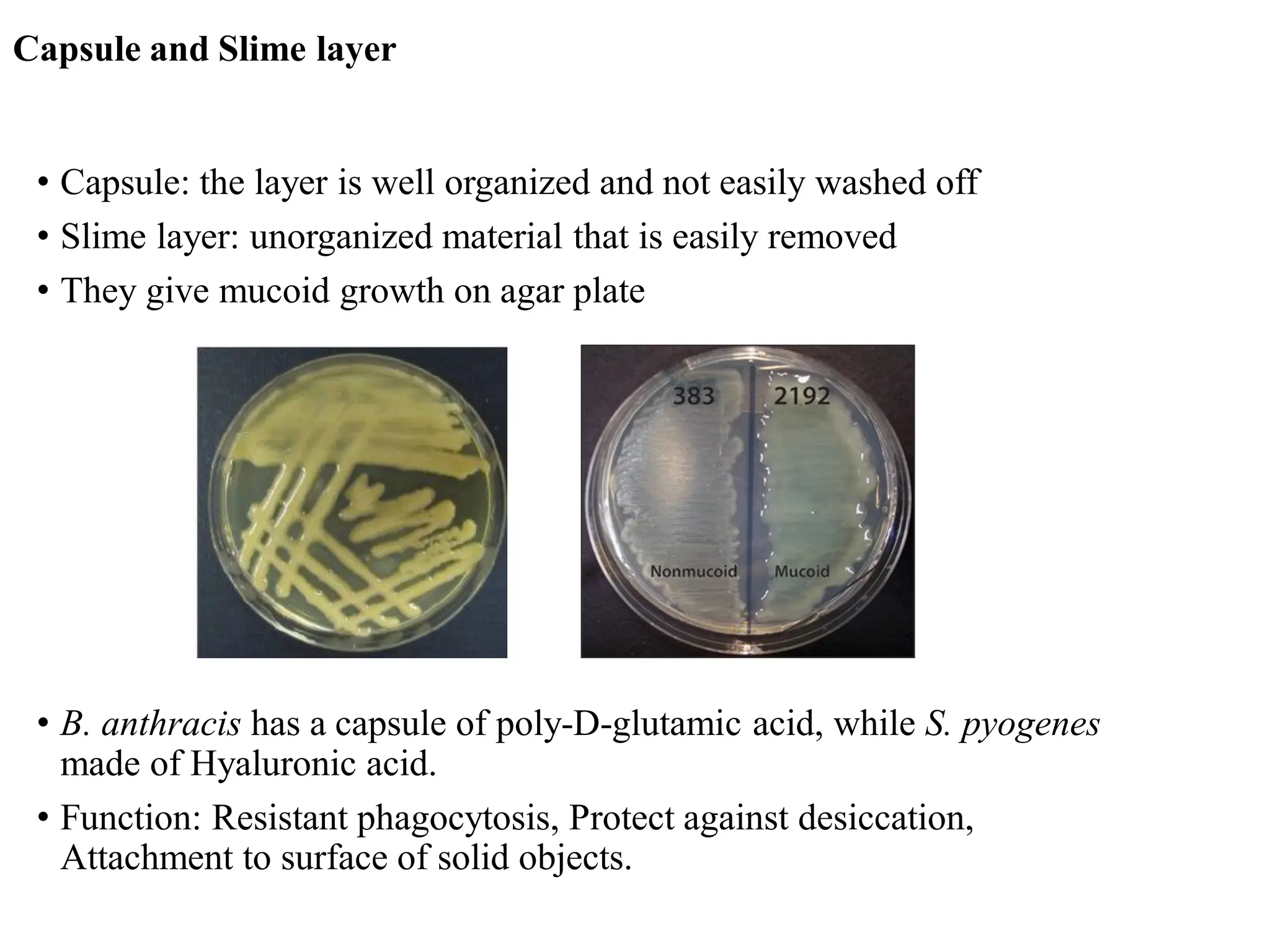
Capsule and Slime layer
• Capsule: the layer is well organized and not easily washed off
• Slime layer: unorganized material that is easily removed
• They give mucoid growth on agar plate
• B. anthracis has a capsule of poly-D-glutamic acid, while S. pyogenes
made of Hyaluronic acid.
• Function: Resistant phagocytosis, Protect against desiccation,
Attachment to surface of solid objects.
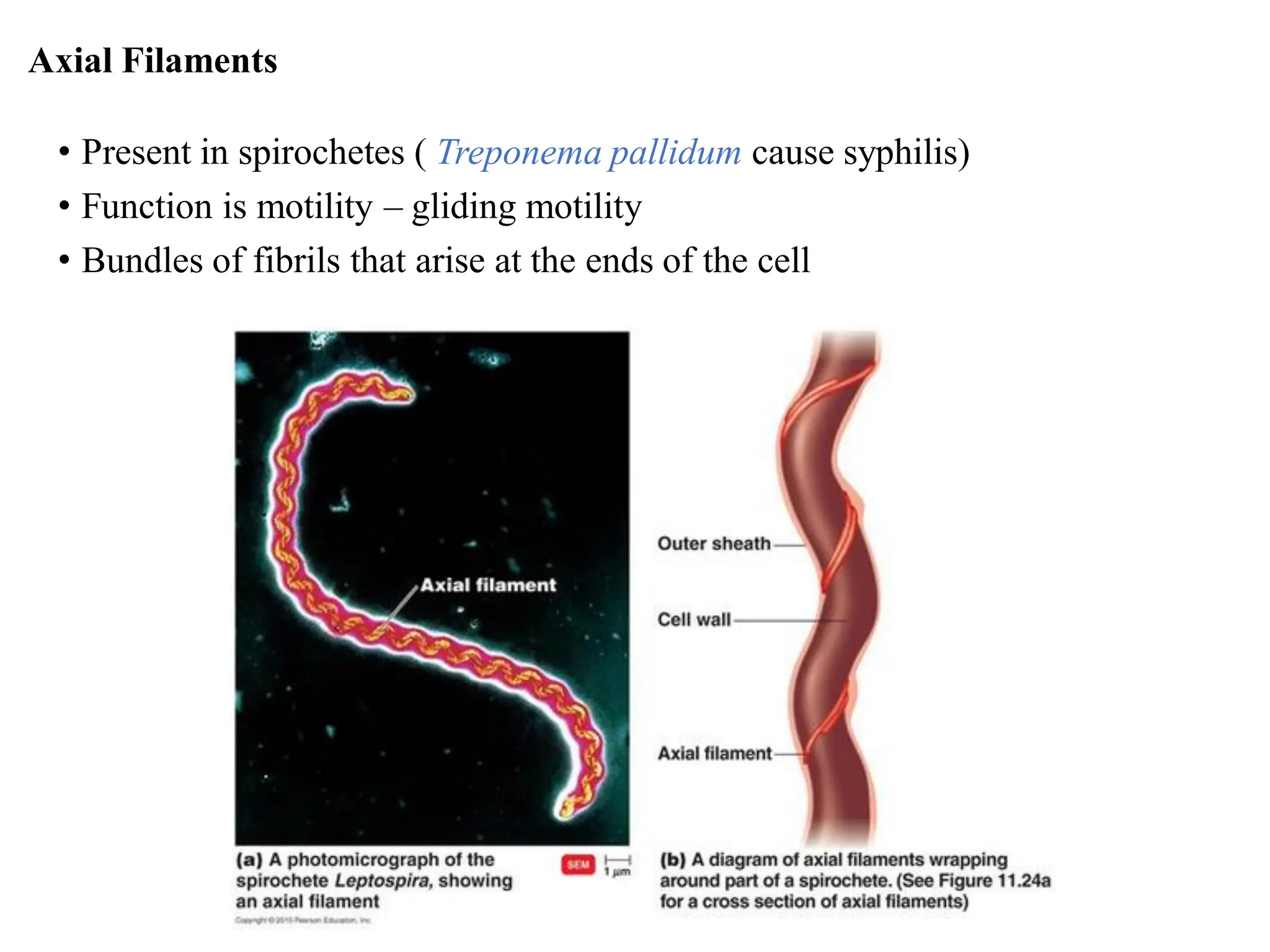
Axial Filaments
• Present in spirochetes ( Treponema pallidum cause syphilis)
• Function is motility – gliding motility
• Bundles of fibrils that arise at the ends of the cell
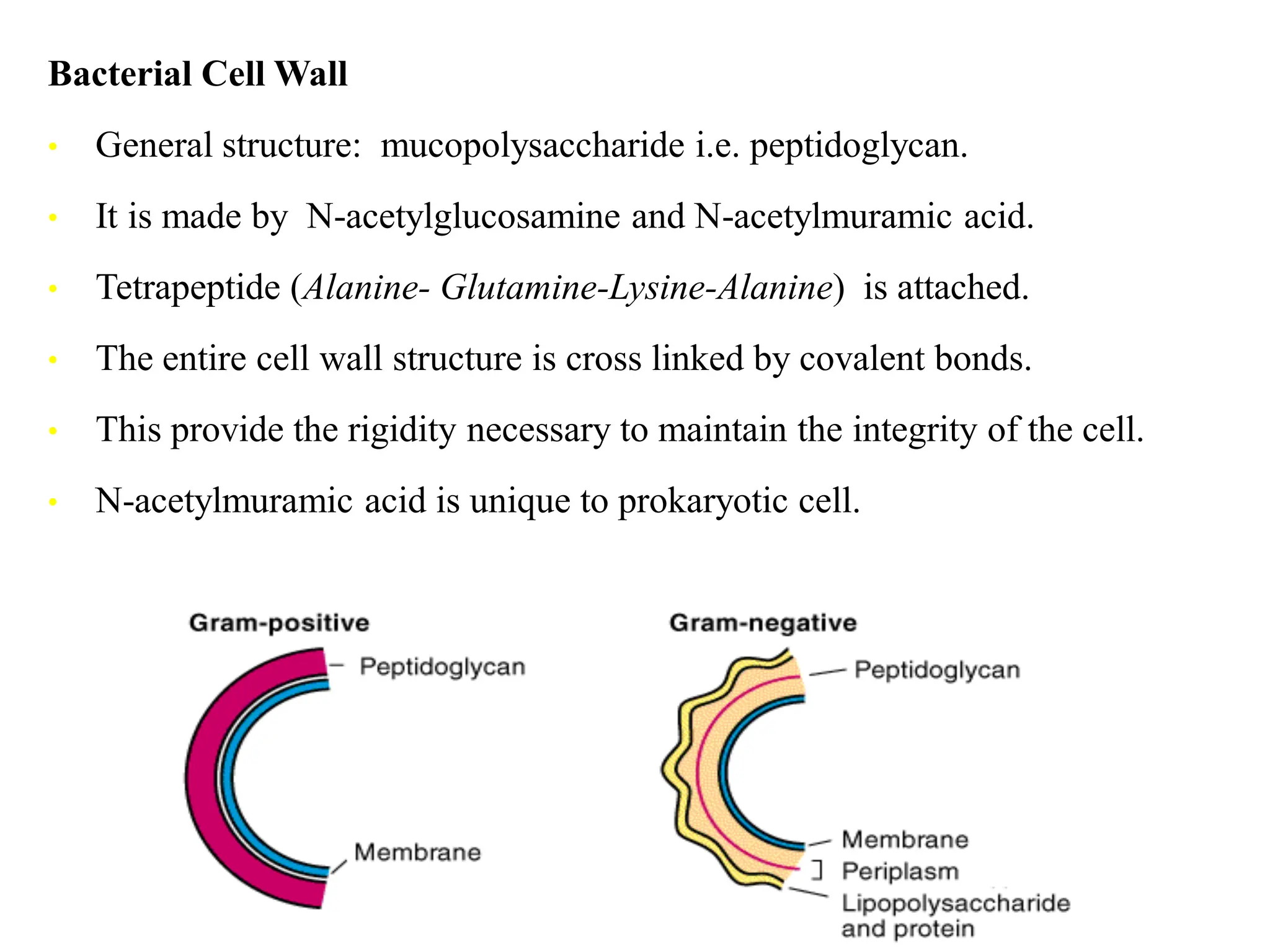
Bacterial Cell Wall
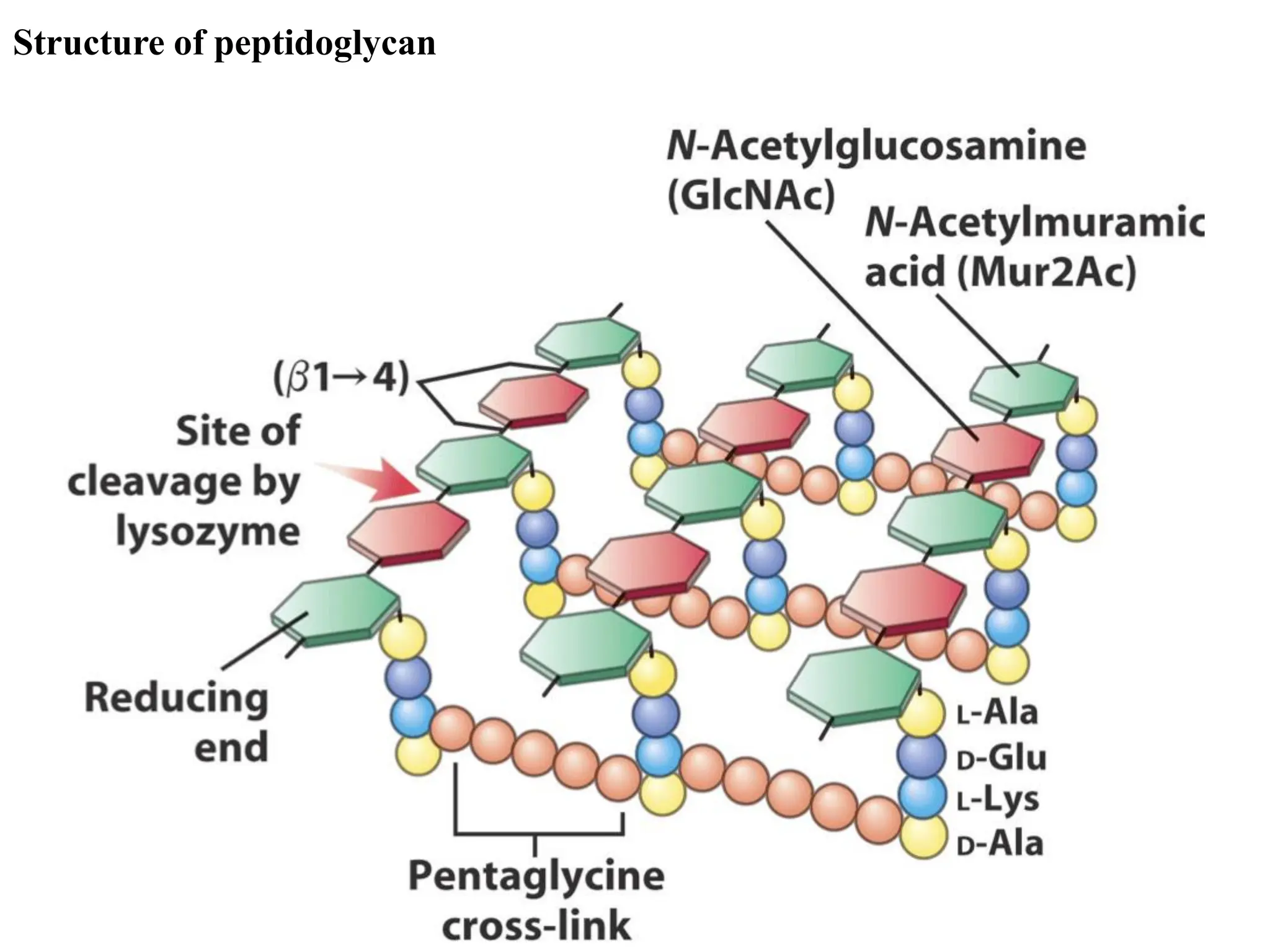
• General structure: mucopolysaccharide i.e. peptidoglycan.
• It is made by N-acetylglucosamine and N-acetylmuramic acid.
• Tetrapeptide (Alanine- Glutamine-Lysine-Alanine) is attached.
• The entire cell wall structure is cross linked by covalent bonds.
• This provide the rigidity necessary to maintain the integrity of the cell.
• N-acetylmuramic acid is unique to prokaryotic cell.
Structure of peptidoglycan

Bacterial Cell structure and Function I.pdf

  • 1.
  • 2.
  • 3.
  • 4.
    Bacterial Morphology Arrangement 1.Rod or Bacilli a) Streptobacilli b)Bacilli 2. Cocci a) Cocci b) Diplococci (Neisseria meningitidis) c) Streptococci (Streptococcus pyogenes) d) Staphylococci (Staphylococcus aureus) e) Sarcina (Sarcina ventriculi) f) Tetrads (Micrococcus species)
  • 5.
    5 Bacterial Shapes, Arrangements,and Sizes • Variety in shape, size, and arrangement but typically described by one of three basic shapes: ococcus - spherical obacillus – rod oCoccobacillus – very short and plump ( Brucella abortus) oStreptobacilli ( Bacillus subtilus) oDiplobacilli (Coxiella burnetii) • Spirillum - helical, comma, twisted rod, • Spirochete – spring-like- flexible ( Treponema pallidum) • Vibrio – gently curved ( Vibrio cholera) • Spirilla- rigid ( Borrelia species) • Pleomorphic : variable in shape ( Corynebacterium)
  • 6.
  • 7.
    7 •Arrangement of cellsis dependent on: • the pattern of division • how cells remain attached after division: Bacterial Shapes, Arrangements, and Sizes
  • 8.
    8 Bacterial Shapes, Arrangements,and Sizes Cocci: singles diplococci – in pairs tetrads – groups of four irregular clusters chains cubical packets Bacilli: chains palisades
  • 9.
    Bacterial Cell Structure •Appendages→ flagella, pili or fimbriae •Surface layers → capsule, cell wall, cell membrane •Cytoplasm → nuclear material, ribosome, mesosome, etc. •Special structure → endospore
  • 10.
    Appendages 1. Flagella Some rodsand spiral forms have this. o Function: motility (propeller like) o Origin: cell membrane flagella attach to the cell by hook and basal body which consists of a set(s) of rings and rods o Can be one, two, or many o Bacterial flagella provides the bacterium with a mechanism for swimming toward or away from chemical stimuli → CHEMOTAXIX o Protein in nature: subunit flagellin ( globular protein) Gram - : 2 sets of ring and rods, L, P, S, M rings and rods (E. coli) Gram + : S, M rings and rods (B. megaterium)
  • 12.
  • 13.
    2. Fimbriae andPili Fimbriae • Shorter than flagella and straighter • Smaller, hairlike appendages • Only on some gram-bacteria Function: • Adhere. Not involved in motility. • One of the invasive mechanisms on bacteria. • Some pathogens cause diseases due to this (Antigenic characteristic). • Prevent phagocytosis.
  • 14.
    Pili - sexfactor • If they make pili, they are + or donors of F factor • F-factor (plasmid): allows genes to be transferred from one bacterium carrying the factor to another bacterium lacking the factor • It is necessary for bacterial conjugation → transfer of DNA from one cell to another • It has been implicated in the ability of bacteria to recognize specific receptor sites (ompA) on the host cell membrane
  • 15.
    • Origin: Cellmembrane • Position: common pili → numerous over the cell → attachment • Sex pili → 1-4/cell •Structure: composed of proteins that can be dissociated into smaller units Pilin •Pilin → class of protein Lectin which bond to cell surface polysaccharide.
  • 16.
  • 17.
    CELL SURFACE LAYER Glycocalyx:Capsule or slime layer • Many bacteria secrete material that adheres to the bacterial cell but is actually external to the cell. • It consists of polypeptides and polysaccharides. Most of them have only polysaccharides. • It is a protective layer that resists host phagocytosis (eg Streptococcus pneumonia).
  • 18.
    Capsule and Slimelayer • Capsule: the layer is well organized and not easily washed off • Slime layer: unorganized material that is easily removed • They give mucoid growth on agar plate • B. anthracis has a capsule of poly-D-glutamic acid, while S. pyogenes made of Hyaluronic acid. • Function: Resistant phagocytosis, Protect against desiccation, Attachment to surface of solid objects.
  • 19.
    Axial Filaments • Presentin spirochetes ( Treponema pallidum cause syphilis) • Function is motility – gliding motility • Bundles of fibrils that arise at the ends of the cell
  • 20.
    Bacterial Cell Wall •General structure: mucopolysaccharide i.e. peptidoglycan. • It is made by N-acetylglucosamine and N-acetylmuramic acid. • Tetrapeptide (Alanine- Glutamine-Lysine-Alanine) is attached. • The entire cell wall structure is cross linked by covalent bonds. • This provide the rigidity necessary to maintain the integrity of the cell. • N-acetylmuramic acid is unique to prokaryotic cell.
  • 21.