ENUGU STATE UNIVERSITY OF SCIENCE AND TECHNOLOGY
FACULTYOF APPLIED NATURAL SCIENCES
DEPARTMENTOF APPLIED MICROBIOLOGY AND BREWING
SEMINAR PRESENTEDBY
Onyekwere Uchenna Samuel
REGISTRATION NUMBER: 2020030194715
SEMINAR TOPIC: Bacteria colonizationon human skin.
COURSE CODE: AMB 481
COURSE TITLE: SEMINAR
SUPERVISOR: MR. J.E. ILOPUTAIFE
DATE: FEBRUARY2024
TABLE OF CONTENT
• Abstract
• Introduction
• Bacteria that colonizes the skin
• Factors influencing Bacteria colonization
• The role of Bacteria in maintaining skin health
• Implications of imbalanced bacteria on the skin
• Conclusion
• References
ABSTRACT
Our skin is home to a diverse community of bacteria, collectively known as
the skin microbiome. Some bacteria found on the skin includes
staphylococcus which are the major skin colonizers, propionibacterium and
corynebacterium.These bacteria play crucial roles in maintaining skin health,
including protection against harmful pathogens and regulation of skin pH.
There are some factors that influence bacteria colonization thereby affecting
how they establish on our skin. These factors includes environmental factors,
PH levels, moisture levels, sebum production, etc. However, imbalances in
the skin microbiome can lead to various skin conditions and infections.
Understanding the dynamics of bacterial colonization on the skin can provide
insights into maintaining a healthy skin microbiome and developing targeted
interventions.
INTRODUCTION
The skin is the largest human organ and it’s colonized by a wide variety
of microorganisms. During colonization, bacteria need to make sure
that attachment is established. Bacteria have special structures on their
surface such as Pili or firmbriae, that allow them to adhere or attach to
the skin cells. Additionally, our skin has natural oils and sweat that can
create a nourishing environment for bacteria. Once they find a spot,
they start forming communities and become part of our skin
microbiome.
CHART 1:BACTERIATHAT COLONIZES THE SKIN
1. Staphylococcus:They are widelyregarded as the most importantcolonizers ofthe human skin, there are certain species of
staphylococcus that colonizes the skin, there are:
• Staphylococcus epidermis:They are the main specie colonizingvarious areas ofthe skin.
• staphylococcus aureus:Theyare commonlyregarded as the major and dangerous human pathogenfoundon the skin, it can lead to
skin infections such as boils or impetigo.
2. Propionibacterium:They are commonlyfound on the skin, one of the main specie is calledpropionibacterium acnes.It can be
found on the skin of most individuals. It is well known as a contributor to the developmentofskin disease called acne. Other species
includes,Propionibacterium avidum,Propionibacterium propionicum, etc.
3. Corynebacterium:Theyare commonlyfound on human skin,theyare part of the skin’s natural microbiota.There are various
species of Corynebacteriumsuch as corynebacterium diphtheroids,Corynebacterium minutissimum,etc.
Sources: Rogers et al.(2008).
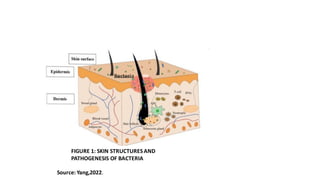
Source: Yang,2022.
FIGURE 1: SKIN STRUCTURES AND
PATHOGENESIS OF BACTERIA
Bacteria
CHART 2: FACTORS INFLUENCING BACTERIA
COLONIZATION
1. Sebum production: Sebum is an oily substance produced by the sebaceous
glands in the skin, it provides a comfortable environment for certain bacteria
to grow and colonize.
2. moisture levels: The level of moisture on the skin can impact bacterial
colonization.
3. PH levels: The PH level of the skin plays a role in determining which
bacteria can thrive. Differentbacteria have different PH preferences, so the
skin’s PH can influence their colonization.
4. Environmental factors: Environmental conditions such as temperature and
humidity can impact bacterial colonization.
Sources: Chilleret al.(2001).
CHART 3: THE ROLE OF BACTERIA IN
MAINTAINING SKIN HEALTH.
1. Bacteria promote wound healing: Bacteria like staphylococcus
epidermis plays a role in promoting wound healing by producing a
molecule that prevents inflammatorycytokine release from skin cells
2. protecting against harmful bacteria: The commensal bacteria can help
prevent harmful bacteria from taking over.
3. Supporting the immune system:certain bacteria can stimulateour
immune system,they help to strengthen our body against infections and
diseases.
4. Skin hydration: some bacteria produce substancesthat helps to
moisturize the skin, keeping it hydrated and preventing dryness.
Source: Lai,(2009).
CHART 4: IMPLICATIONS OF IMBALANCED
BACTERIA ON THE SKIN
1. Imbalances can cause skin Infections
2. Inflammation
3. Skin conditions such as eczema.
4. Body Odor
5.Imbalances can delay the healing process.
6.Acne
Sources: Daniele et al.(2019).
CONCLUSION
Our skin is home to a diverse community of bacteria, forming the skin
microbiome. This microbiome plays a crucial role in maintaining skin
health and protection against harmful pathogens. However, imbalances
in the skin microbiome can lead to various skin conditions and
infections. Understanding the dynamics of bacteria colonization can
provide insights into promoting a healthy skin microbiome and overall
skin well-being.
REFERENCES
• Chiller,K., Selkin,B. and Murakawa,G. (2001). Skin microflora and bacterial infections of the skin.
Journalof InvestigativeDermatologySymposiumProceedings,6(3):170-4
• Dagnelie,M.A., Montassier,E., Khammari,A., Mounier,C., Corvec S., Dreno,B.(2019). Inflammatory
skin is associated with changes in the skin microbiota composition on the back of severe acne
patients. Journal Of Dermatologyand Skin Science, 28:961–967
• Lai,Y.(2009). Commensalbacteria regulate toll-like receptor 3-dependent inflammationafter skin
injury. JournalOf Nature Medicine, 15(12):1377–1382
• Mak,T.N., Schmid,M., Brzuszkiewicz,E.,Zeng,G., Meyer,R., Sfanos,K.S., Brinkmann,V., Meyer,T.F.,
Bruggemann,H.(2013).Comparative genomics reveals distinct host-interacting traits of three
major human-associatedpropionibacteria. JournalOf Biomed Central Genomics,14:640
• Nakatsuji,T.(2017). Antimicrobials from human skin commensal bacteria protect against
Staphylococcus aureus and are deficient in atopic dermatitis. JournalOf Science Translational
Medicine,9:378
• Rogers,K.L., Rupp,M.E. and Fey,P.D.(2008). The presence of icaADBC is detrimental to the
colonization of human skin by Staphylococcus epidermidis. Research journal of Applied and
EnvironmentalMicrobiology, 74:6155–6157

Bacteria colonization on human skinghhhhhhhhhhhhhhhhhhhhhh

  • 1.
    ENUGU STATE UNIVERSITYOF SCIENCE AND TECHNOLOGY FACULTYOF APPLIED NATURAL SCIENCES DEPARTMENTOF APPLIED MICROBIOLOGY AND BREWING SEMINAR PRESENTEDBY Onyekwere Uchenna Samuel REGISTRATION NUMBER: 2020030194715 SEMINAR TOPIC: Bacteria colonizationon human skin. COURSE CODE: AMB 481 COURSE TITLE: SEMINAR SUPERVISOR: MR. J.E. ILOPUTAIFE DATE: FEBRUARY2024
  • 2.
    TABLE OF CONTENT •Abstract • Introduction • Bacteria that colonizes the skin • Factors influencing Bacteria colonization • The role of Bacteria in maintaining skin health • Implications of imbalanced bacteria on the skin • Conclusion • References
  • 3.
    ABSTRACT Our skin ishome to a diverse community of bacteria, collectively known as the skin microbiome. Some bacteria found on the skin includes staphylococcus which are the major skin colonizers, propionibacterium and corynebacterium.These bacteria play crucial roles in maintaining skin health, including protection against harmful pathogens and regulation of skin pH. There are some factors that influence bacteria colonization thereby affecting how they establish on our skin. These factors includes environmental factors, PH levels, moisture levels, sebum production, etc. However, imbalances in the skin microbiome can lead to various skin conditions and infections. Understanding the dynamics of bacterial colonization on the skin can provide insights into maintaining a healthy skin microbiome and developing targeted interventions.
  • 4.
    INTRODUCTION The skin isthe largest human organ and it’s colonized by a wide variety of microorganisms. During colonization, bacteria need to make sure that attachment is established. Bacteria have special structures on their surface such as Pili or firmbriae, that allow them to adhere or attach to the skin cells. Additionally, our skin has natural oils and sweat that can create a nourishing environment for bacteria. Once they find a spot, they start forming communities and become part of our skin microbiome.
  • 5.
    CHART 1:BACTERIATHAT COLONIZESTHE SKIN 1. Staphylococcus:They are widelyregarded as the most importantcolonizers ofthe human skin, there are certain species of staphylococcus that colonizes the skin, there are: • Staphylococcus epidermis:They are the main specie colonizingvarious areas ofthe skin. • staphylococcus aureus:Theyare commonlyregarded as the major and dangerous human pathogenfoundon the skin, it can lead to skin infections such as boils or impetigo. 2. Propionibacterium:They are commonlyfound on the skin, one of the main specie is calledpropionibacterium acnes.It can be found on the skin of most individuals. It is well known as a contributor to the developmentofskin disease called acne. Other species includes,Propionibacterium avidum,Propionibacterium propionicum, etc. 3. Corynebacterium:Theyare commonlyfound on human skin,theyare part of the skin’s natural microbiota.There are various species of Corynebacteriumsuch as corynebacterium diphtheroids,Corynebacterium minutissimum,etc. Sources: Rogers et al.(2008).
  • 6.
    Source: Yang,2022. FIGURE 1:SKIN STRUCTURES AND PATHOGENESIS OF BACTERIA Bacteria
  • 7.
    CHART 2: FACTORSINFLUENCING BACTERIA COLONIZATION 1. Sebum production: Sebum is an oily substance produced by the sebaceous glands in the skin, it provides a comfortable environment for certain bacteria to grow and colonize. 2. moisture levels: The level of moisture on the skin can impact bacterial colonization. 3. PH levels: The PH level of the skin plays a role in determining which bacteria can thrive. Differentbacteria have different PH preferences, so the skin’s PH can influence their colonization. 4. Environmental factors: Environmental conditions such as temperature and humidity can impact bacterial colonization. Sources: Chilleret al.(2001).
  • 8.
    CHART 3: THEROLE OF BACTERIA IN MAINTAINING SKIN HEALTH. 1. Bacteria promote wound healing: Bacteria like staphylococcus epidermis plays a role in promoting wound healing by producing a molecule that prevents inflammatorycytokine release from skin cells 2. protecting against harmful bacteria: The commensal bacteria can help prevent harmful bacteria from taking over. 3. Supporting the immune system:certain bacteria can stimulateour immune system,they help to strengthen our body against infections and diseases. 4. Skin hydration: some bacteria produce substancesthat helps to moisturize the skin, keeping it hydrated and preventing dryness. Source: Lai,(2009).
  • 9.
    CHART 4: IMPLICATIONSOF IMBALANCED BACTERIA ON THE SKIN 1. Imbalances can cause skin Infections 2. Inflammation 3. Skin conditions such as eczema. 4. Body Odor 5.Imbalances can delay the healing process. 6.Acne Sources: Daniele et al.(2019).
  • 10.
    CONCLUSION Our skin ishome to a diverse community of bacteria, forming the skin microbiome. This microbiome plays a crucial role in maintaining skin health and protection against harmful pathogens. However, imbalances in the skin microbiome can lead to various skin conditions and infections. Understanding the dynamics of bacteria colonization can provide insights into promoting a healthy skin microbiome and overall skin well-being.
  • 11.
    REFERENCES • Chiller,K., Selkin,B.and Murakawa,G. (2001). Skin microflora and bacterial infections of the skin. Journalof InvestigativeDermatologySymposiumProceedings,6(3):170-4 • Dagnelie,M.A., Montassier,E., Khammari,A., Mounier,C., Corvec S., Dreno,B.(2019). Inflammatory skin is associated with changes in the skin microbiota composition on the back of severe acne patients. Journal Of Dermatologyand Skin Science, 28:961–967 • Lai,Y.(2009). Commensalbacteria regulate toll-like receptor 3-dependent inflammationafter skin injury. JournalOf Nature Medicine, 15(12):1377–1382 • Mak,T.N., Schmid,M., Brzuszkiewicz,E.,Zeng,G., Meyer,R., Sfanos,K.S., Brinkmann,V., Meyer,T.F., Bruggemann,H.(2013).Comparative genomics reveals distinct host-interacting traits of three major human-associatedpropionibacteria. JournalOf Biomed Central Genomics,14:640 • Nakatsuji,T.(2017). Antimicrobials from human skin commensal bacteria protect against Staphylococcus aureus and are deficient in atopic dermatitis. JournalOf Science Translational Medicine,9:378 • Rogers,K.L., Rupp,M.E. and Fey,P.D.(2008). The presence of icaADBC is detrimental to the colonization of human skin by Staphylococcus epidermidis. Research journal of Applied and EnvironmentalMicrobiology, 74:6155–6157