Backpacking
               Tourism


                                       Juan Archanco Galíndez
English for Tourism IV, January 2012   Laura López - Cifuentes Ortiz
                                       Inmaculada Cano Abellán
                                       Roberto Rodriguez Garrote
THE HISTORY OF BACKPACKING


• 1968    National Scenic Trail Act

• Giovani Careri    traveled around the world during 5
  years.

• The Grand Tour   trip around Europe undertaken by
  european young men.
The term “Backpacker”
  The term 'backpacker' is extensively used by this market in
 Australia and New Zealand. In recent years, it has begun to be
used overseas, primarily by people setting up hostels and tours.
However, it might be misunderstood in some regions like the US
  where it is used to describe a bushwalker. 'Budget travel' or
         'independent travelers’ are alternative phrases.

Backpackers spend more, travel further and stay longer than other
  travellers. The backpacking sector in NSW is about attracting
  more adventurous and independent international travellers into
regional areas, through the development of more 'must see and do
                           experiences'.
Backpacker’s profile (I)
        Age: mostly in their late
       teens, twenties and early
thirties, usually during holidays or in
a gap year between high school and
                college.

  Studies: usually upper studies, at
           least high school.
Backpacker’s profile (II)
 Income: broad range, usually students do not have much money
and depend on their families; therefore we can say low to medium
   income. However more and more people that have joined the
backpacker’s community are older people with more money. They
     have created the latest trend: flashpacking, which is a more
            expensive and higher standard backpacking.
  Lifestyle and personality: open minded with hunger for meeting
 new cultures and discovering new places. Independent, problem
              solvers, flexible, easy going and romantic.
  Motivation: anthropologic, documentary interest, the search for
 new experiences, self-actualization, hunt of authenticity, getting
                    the best from each place, etc.
Personal Experiences (I)

As there is an almost
   infinite possible
    combination of
  places, dates and
prices, we are going
to do this part based
 on an actual 22 day
 interrail around 11
different countries in
Europe (June 2010).
Personal Experiences
Personal Experiences (III)
           Day 1:
Flight Madrid > Charleroi
     Train to Brussels
   Nights in hotel (**)
  Stroll around Brussels


                            Day 2: Train and visit to
                               Gant and Bruges
Personal Experiences (IV)
  Day 3: Train to Maastricht
  Night in a friend’s house.

Day 4: Train to London, under
the English Channel. Arrival to
   London and CS’er place.
Personal Experiences (V)
Day 4, 5, 6 & 7: Visit to
London Stayed at polish
  CSer’s place and at
    David’s place.


                               Day 7, & 8: Train to
                            Edinburgh (via York) Long
                              way, train driver sick.
                             Stayed at Inma’s hostel.
Personal Experiences (VI)
Day 8 & 9: Train to Inverness
 (Loch Ness Lake) Night at
 Inverness Bed & Breakfast


                                Day 9 & 10: Train to Aberdeen
                                Night at CSer’s place (german
                                 girl) Train back to Edinburgh
                                     Night at Inma’s Hostel
Personal Experiences (VII)
  Day 11 & 12: Missed the
 plane to Dublin: change of
plans. Trip to Stranraer Ferry
    to Belfast Late night
arrival, night at Holiday Inn
            (****)
Personal Experiences (VIII)
 Day 12, 13 & 14:
  Train to Dublin
 Night at 2 hostels
Free tour Pub-crawl


                           Day 14: Flight to
                        Oslo, Train to Göteborg
                       (broken). Night at hostel.
Personal Experiences (IX)
              Day 15 & 16: Visit to Liseberg
            (Scandinavia’s biggest amusement
           park). Night Train from Göteborg to
            Stockholm, Sundsvall and Storlien
Personal Experiences (X)
           Day 17 & 18: Storlien, Ǻre cable-
           car, train to Trondheim, met CSer
             there, night train back to Oslo.
Personal Experiences (XI)
                                    Day 18: Amusement park:
                                   Tusenfryd. Plane to Gdansk
                                delayed (no taxi nor bus, no local
                                currency). Night train to Katowice

    Day 19: Visit to Katowice
Train to Salzburg (night @ Prague)
Personal Experiences (XII)
            Day 20, 21 & 22: Visit to Salzburg
             Cable car “The Sound of Music”
Personal Experiences (XIII)
                        Day 22:
           Train to Milano (via Verona) Flight
                     back to Madrid
           TOTAL: 9,800 Km (straight line)
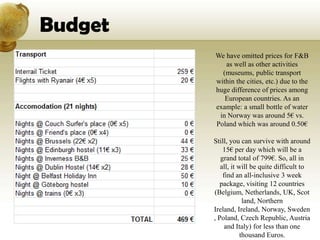
Budget
         We have omitted prices for F&B
            as well as other activities
           (museums, public transport
         within the cities, etc.) due to the
         huge difference of prices among
            European countries. As an
         example: a small bottle of water
          in Norway was around 5€ vs.
         Poland which was around 0.50€

         Still, you can survive with around
             15€ per day which will be a
            grand total of 799€. So, all in
            all, it will be quite difficult to
             find an all-inclusive 3 week
            package, visiting 12 countries
         (Belgium, Netherlands, UK, Scot
                      land, Northern
         Ireland, Ireland, Norway, Sweden
         , Poland, Czech Republic, Austria
              and Italy) for less than one
                     thousand Euros.
SWOT Analysis
    Is a strategic planning method use to evaluate the
  strengths, weaknesses/limitations, opportunities and
 threats involved in a project or in a business venture.
Strengths


• 1) More money is spent due to the duration of the trip
• 2) It focuses on a wider geographical area
• 3) More money is spent on locally produced goods and
  services
• 4) Significant multiplier effects
• 5) Revitalization of traditional culture
• 6) Backpackers are more environmentally friendly
• 7) Local tourism competes with foreign domination
Strengths
• 1) More money is spent due to the duration of the
  trip. Backpackers spend more money than other
  tourists because they stay longer in a place (Europe)
  (between two weeks and one month)
Strengths
• 2) It focuses on a wider geographical area, more
  money is spent, including remote, economically
  depressed or isolated regions
Strengths
• 3) More money is spent on locally produced
  goods and services. Backpacking tourists do not
  demand luxury therefore; they spend more on locally
  produced goods (such as food) and services
  (transport, homestay accommodation)
Strengths
• 4) There are significant multiplier effects from
  drawing on local skills and resources. In this way
  local people gain self-fulfillment through running their
  own tourism enterprises rather than filling in menial
  positions in enterprises run by outside operators
Strengths
• 5) Revitalization of traditional culture. The interest
  of backpackers in meeting and learning from local
  people can lead to a revitalization of traditional
  culture, respect for the knowledge of elders and
  pride in traditional aspects of one’s culture.
Strengths
• 6) Backpackers are more environmentally friendly.
  Backpackers use fewer resources (like cold showers
  and fans rather than hot baths and air
  conditioning), therefore, kinder to the environment
  than other tourists.
Strengths
• 7) Local tourism competes with foreign
  domination.
Weaknesses/limitations
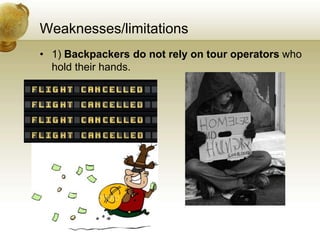
•   1) Backpackers do not rely on tour operators
•   2) Enterprises catering for backpackers are small
•   3) Interaction with locals is of secondary importance
•   4) Backpackers spend less money
•   5) Prejudices and stereotypes on backpackers by
    locals
Weaknesses/limitations
• 1) Backpackers do not rely on tour operators who
  hold their hands.
Weaknesses/limitations
• 2) Enterprises catering for backpackers are small
Weaknesses/limitations
• 3) Interaction with locals is of secondary
  importance. The majority of backpackers spend
  most of the time interacting with other backpackers.
Weaknesses/limitations
• 4) Backpackers spend less money, in terms of
  stay, they spend less money than other tourists
Weaknesses/limitations
• 5) Prejudices on backpackers by locals due to
  some locals have prejudices and fixed stereotypes
  towards backpackers.
Opportunities

• 1) No frontier controls at the borders between 22 EU
  countries.
• 2) The power of Internet in order to organize their
  own backpacking experience
• 3) Globalization
Opportunities
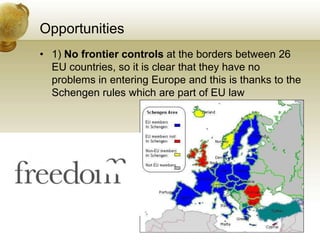
• 1) No frontier controls at the borders between 26
  EU countries, so it is clear that they have no
  problems in entering Europe and this is thanks to the
  Schengen rules which are part of EU law
Opportunities
• 2) The power of Internet in order to organize their
  own backpacking experience
Opportunities
• 3) Globalization refers to the increasingly global
  relationships of culture, people and economic
  activity.
• Environmental challenges such as climate
  change, cross-boundary water and air pollution and
  over-fishing of the ocean, require trans-
  national/global solutions
Threats

• 1) Some governments don’t recognize enough the
  economic benefits backpackers can bring
• 2) The increase of the travel’s costs
• 3) Money exchange
Threats
• 1) Some governments don’t recognize enough the
  economic benefits backpackers can bring
Threats
• 2) The increase of the travel’s costs, fuel prices
  have increased significantly in recent years and are
  likely to stay high in the future. Between 2003 and
  2008 average U.S. gasoline retail prices more than
  doubled.
Threats
• 3) Money exchange, Nineteen European countries
  — and more than 330 million people — use the
  same currency. Using euros, tourists and locals can
  easily compare prices of goods between countries.
  And we no longer lose money or time changing
  money at borders.
Conclusions
• Backpacking is a type of tourism that has been going
  on for over 200 years
• Very liberal type of tourism, not planned and it
  adjusts to a low budget
• Flashpacking: more luxurious type of tourism, not
  only for young people
• Backpacking is possible thanks to the increasing
  emergence of low cost air companies, improvements
  in the railway system, internet and a wide range of
  accommodation.
FUTURE TENDENCIES


•   Flashpacking     travel with luxury accomodation and
    transport.

•   Gap-packing       young europeans who leave after
    finishing high school and return back in time for college
    or a new job.
Sources & Bibliography
http://internationaldevelopmentstudies.artsandsocialsciences.dal.ca/Files/Gula_H
                                onours_Thesis_07.pdf
 http://www.coloradomesa.edu/op/documents/backpackertourismthirdworld.pdf
        http://archive.tourism.nsw.gov.au/Backpacker_Tourism_p726.aspx
                             http://www.mochileros.org/
        http://archive.tourism.nsw.gov.au/Backpacker_Tourism_p726.aspx
http://internationaldevelopmentstudies.artsandsocialsciences.dal.ca/Files/Gula_H
                                onours_Thesis_07.pdf
      http://ezinearticles.com/?Backpacking-History-and-Help&id=3659832
              http://camping.lovetoknow.com/History_of_Backpacking
                 http://www.infohostels.com/notizia.php?chiave=200
             http://espanol.interrailnet.com/enes/planning/railway-map
                                    Google Images
                                    WordReference
Backpacking tourism

Backpacking tourism

  • 1.
    Backpacking Tourism Juan Archanco Galíndez English for Tourism IV, January 2012 Laura López - Cifuentes Ortiz Inmaculada Cano Abellán Roberto Rodriguez Garrote
  • 2.
    THE HISTORY OFBACKPACKING • 1968 National Scenic Trail Act • Giovani Careri traveled around the world during 5 years. • The Grand Tour trip around Europe undertaken by european young men.
  • 3.
    The term “Backpacker” The term 'backpacker' is extensively used by this market in Australia and New Zealand. In recent years, it has begun to be used overseas, primarily by people setting up hostels and tours. However, it might be misunderstood in some regions like the US where it is used to describe a bushwalker. 'Budget travel' or 'independent travelers’ are alternative phrases. Backpackers spend more, travel further and stay longer than other travellers. The backpacking sector in NSW is about attracting more adventurous and independent international travellers into regional areas, through the development of more 'must see and do experiences'.
  • 4.
    Backpacker’s profile (I) Age: mostly in their late teens, twenties and early thirties, usually during holidays or in a gap year between high school and college. Studies: usually upper studies, at least high school.
  • 5.
    Backpacker’s profile (II) Income: broad range, usually students do not have much money and depend on their families; therefore we can say low to medium income. However more and more people that have joined the backpacker’s community are older people with more money. They have created the latest trend: flashpacking, which is a more expensive and higher standard backpacking. Lifestyle and personality: open minded with hunger for meeting new cultures and discovering new places. Independent, problem solvers, flexible, easy going and romantic. Motivation: anthropologic, documentary interest, the search for new experiences, self-actualization, hunt of authenticity, getting the best from each place, etc.
  • 6.
    Personal Experiences (I) Asthere is an almost infinite possible combination of places, dates and prices, we are going to do this part based on an actual 22 day interrail around 11 different countries in Europe (June 2010).
  • 7.
  • 8.
    Personal Experiences (III) Day 1: Flight Madrid > Charleroi Train to Brussels Nights in hotel (**) Stroll around Brussels Day 2: Train and visit to Gant and Bruges
  • 9.
    Personal Experiences (IV) Day 3: Train to Maastricht Night in a friend’s house. Day 4: Train to London, under the English Channel. Arrival to London and CS’er place.
  • 10.
    Personal Experiences (V) Day4, 5, 6 & 7: Visit to London Stayed at polish CSer’s place and at David’s place. Day 7, & 8: Train to Edinburgh (via York) Long way, train driver sick. Stayed at Inma’s hostel.
  • 11.
    Personal Experiences (VI) Day8 & 9: Train to Inverness (Loch Ness Lake) Night at Inverness Bed & Breakfast Day 9 & 10: Train to Aberdeen Night at CSer’s place (german girl) Train back to Edinburgh Night at Inma’s Hostel
  • 12.
    Personal Experiences (VII) Day 11 & 12: Missed the plane to Dublin: change of plans. Trip to Stranraer Ferry to Belfast Late night arrival, night at Holiday Inn (****)
  • 13.
    Personal Experiences (VIII) Day 12, 13 & 14: Train to Dublin Night at 2 hostels Free tour Pub-crawl Day 14: Flight to Oslo, Train to Göteborg (broken). Night at hostel.
  • 14.
    Personal Experiences (IX) Day 15 & 16: Visit to Liseberg (Scandinavia’s biggest amusement park). Night Train from Göteborg to Stockholm, Sundsvall and Storlien
  • 15.
    Personal Experiences (X) Day 17 & 18: Storlien, Ǻre cable- car, train to Trondheim, met CSer there, night train back to Oslo.
  • 16.
    Personal Experiences (XI) Day 18: Amusement park: Tusenfryd. Plane to Gdansk delayed (no taxi nor bus, no local currency). Night train to Katowice Day 19: Visit to Katowice Train to Salzburg (night @ Prague)
  • 17.
    Personal Experiences (XII) Day 20, 21 & 22: Visit to Salzburg Cable car “The Sound of Music”
  • 18.
    Personal Experiences (XIII) Day 22: Train to Milano (via Verona) Flight back to Madrid TOTAL: 9,800 Km (straight line)
  • 19.
    Budget We have omitted prices for F&B as well as other activities (museums, public transport within the cities, etc.) due to the huge difference of prices among European countries. As an example: a small bottle of water in Norway was around 5€ vs. Poland which was around 0.50€ Still, you can survive with around 15€ per day which will be a grand total of 799€. So, all in all, it will be quite difficult to find an all-inclusive 3 week package, visiting 12 countries (Belgium, Netherlands, UK, Scot land, Northern Ireland, Ireland, Norway, Sweden , Poland, Czech Republic, Austria and Italy) for less than one thousand Euros.
  • 20.
    SWOT Analysis Is a strategic planning method use to evaluate the strengths, weaknesses/limitations, opportunities and threats involved in a project or in a business venture.
  • 21.
    Strengths • 1) Moremoney is spent due to the duration of the trip • 2) It focuses on a wider geographical area • 3) More money is spent on locally produced goods and services • 4) Significant multiplier effects • 5) Revitalization of traditional culture • 6) Backpackers are more environmentally friendly • 7) Local tourism competes with foreign domination
  • 22.
    Strengths • 1) Moremoney is spent due to the duration of the trip. Backpackers spend more money than other tourists because they stay longer in a place (Europe) (between two weeks and one month)
  • 23.
    Strengths • 2) Itfocuses on a wider geographical area, more money is spent, including remote, economically depressed or isolated regions
  • 24.
    Strengths • 3) Moremoney is spent on locally produced goods and services. Backpacking tourists do not demand luxury therefore; they spend more on locally produced goods (such as food) and services (transport, homestay accommodation)
  • 25.
    Strengths • 4) Thereare significant multiplier effects from drawing on local skills and resources. In this way local people gain self-fulfillment through running their own tourism enterprises rather than filling in menial positions in enterprises run by outside operators
  • 26.
    Strengths • 5) Revitalizationof traditional culture. The interest of backpackers in meeting and learning from local people can lead to a revitalization of traditional culture, respect for the knowledge of elders and pride in traditional aspects of one’s culture.
  • 27.
    Strengths • 6) Backpackersare more environmentally friendly. Backpackers use fewer resources (like cold showers and fans rather than hot baths and air conditioning), therefore, kinder to the environment than other tourists.
  • 28.
    Strengths • 7) Localtourism competes with foreign domination.
  • 29.
    Weaknesses/limitations • 1) Backpackers do not rely on tour operators • 2) Enterprises catering for backpackers are small • 3) Interaction with locals is of secondary importance • 4) Backpackers spend less money • 5) Prejudices and stereotypes on backpackers by locals
  • 30.
    Weaknesses/limitations • 1) Backpackersdo not rely on tour operators who hold their hands.
  • 31.
    Weaknesses/limitations • 2) Enterprisescatering for backpackers are small
  • 32.
    Weaknesses/limitations • 3) Interactionwith locals is of secondary importance. The majority of backpackers spend most of the time interacting with other backpackers.
  • 33.
    Weaknesses/limitations • 4) Backpackersspend less money, in terms of stay, they spend less money than other tourists
  • 34.
    Weaknesses/limitations • 5) Prejudiceson backpackers by locals due to some locals have prejudices and fixed stereotypes towards backpackers.
  • 35.
    Opportunities • 1) Nofrontier controls at the borders between 22 EU countries. • 2) The power of Internet in order to organize their own backpacking experience • 3) Globalization
  • 36.
    Opportunities • 1) Nofrontier controls at the borders between 26 EU countries, so it is clear that they have no problems in entering Europe and this is thanks to the Schengen rules which are part of EU law
  • 37.
    Opportunities • 2) Thepower of Internet in order to organize their own backpacking experience
  • 38.
    Opportunities • 3) Globalizationrefers to the increasingly global relationships of culture, people and economic activity. • Environmental challenges such as climate change, cross-boundary water and air pollution and over-fishing of the ocean, require trans- national/global solutions
  • 39.
    Threats • 1) Somegovernments don’t recognize enough the economic benefits backpackers can bring • 2) The increase of the travel’s costs • 3) Money exchange
  • 40.
    Threats • 1) Somegovernments don’t recognize enough the economic benefits backpackers can bring
  • 41.
    Threats • 2) Theincrease of the travel’s costs, fuel prices have increased significantly in recent years and are likely to stay high in the future. Between 2003 and 2008 average U.S. gasoline retail prices more than doubled.
  • 42.
    Threats • 3) Moneyexchange, Nineteen European countries — and more than 330 million people — use the same currency. Using euros, tourists and locals can easily compare prices of goods between countries. And we no longer lose money or time changing money at borders.
  • 43.
    Conclusions • Backpacking isa type of tourism that has been going on for over 200 years • Very liberal type of tourism, not planned and it adjusts to a low budget • Flashpacking: more luxurious type of tourism, not only for young people • Backpacking is possible thanks to the increasing emergence of low cost air companies, improvements in the railway system, internet and a wide range of accommodation.
  • 44.
    FUTURE TENDENCIES • Flashpacking travel with luxury accomodation and transport. • Gap-packing young europeans who leave after finishing high school and return back in time for college or a new job.
  • 45.
    Sources & Bibliography http://internationaldevelopmentstudies.artsandsocialsciences.dal.ca/Files/Gula_H onours_Thesis_07.pdf http://www.coloradomesa.edu/op/documents/backpackertourismthirdworld.pdf http://archive.tourism.nsw.gov.au/Backpacker_Tourism_p726.aspx http://www.mochileros.org/ http://archive.tourism.nsw.gov.au/Backpacker_Tourism_p726.aspx http://internationaldevelopmentstudies.artsandsocialsciences.dal.ca/Files/Gula_H onours_Thesis_07.pdf http://ezinearticles.com/?Backpacking-History-and-Help&id=3659832 http://camping.lovetoknow.com/History_of_Backpacking http://www.infohostels.com/notizia.php?chiave=200 http://espanol.interrailnet.com/enes/planning/railway-map Google Images WordReference