By Derek Larsen By Derek Larsen Manpower Wellness Placement Student
‘ To put sitting into perspective, when you are standing up, each disc in your back is under 100 per cent of pressure. When you’re sitting, each disc is under 140 per cent of pressure. If you’re sitting and leaning forward, it’s 185 per cent,’ Kylie explains. ‘Lying on your back is only 25 per cent of pressure and on the side is 75 per cent. Lifting is 220 per cent.’  (http://nz.lifestyle.yahoo.com/b/new-idea-nz/1162/beat-back-pain-forever/) -healthy body can only tolerate staying in one position for about 20 minutes. -Holding the same position slowly diminishes elasticity in the soft tissues (muscles ligaments and tendons in the back Keep your head directly over the shoulders (i.e. “chest out, head back”) * Keep the shoulders directly over the pelvis Health Canada states that employees’ work performance can be improved by 4 -15 % through participation in regular physical activity.
Seminar successes understand the factors contributing to low back pain become more aware of your body and relate this information to your situation learn some techniques to both stretch and strengthen the underlying muscles to help alleviate the causal pain and stress that develops into back pain
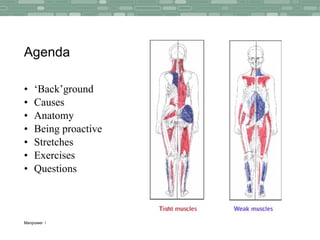
Agenda ‘ Back’ground Causes Anatomy Being proactive Stretches Exercises Questions
Did you know? The back is a well-designed structure made up of bone, ligaments, muscles, spongy material and nerves. You rely on your back for nearly every move you make. The lower portion of you back experiences more physical stress than any other part of your body. As opposed to historical beliefs, the key to feeling recovering sooner following a back injury is to stay active
‘ Back’ground  Back disorders are the  most common  form of ill health at work More than  80%   of adults experience back pain at some point in their lives  [1] In Canada, back injuries account for  44%  of work-related injuries that require time away from work. Occurrence is most often between the ages of 30-50 years [2] No specific cause can be identified in approximately  85% to 90%  of individuals with back pain. [3]
Causes 2 categories Accidental Unexpected event triggers injury Muscle or ligament strain, Spinal disc  injury, Vertebral damage Non Accidental   Poor body mechanics (such as slouching  in an office chair)  Prolonged activity, repetitive motions, and  fatigue are major contributors to these injuries)
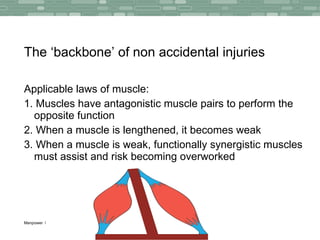
The ‘backbone’ of non accidental injuries Applicable laws of muscle: 1. Muscles have antagonistic muscle pairs to perform the opposite function 2. When a muscle is lengthened, it becomes weak 3. When a muscle is weak, functionally synergistic muscles must assist and risk becoming overworked
Anatomy of the usual suspects The 4 abdominal core muscles Transverse Internal and External obliques Rectus Abdominus -Synergistically provide Lower back  stability  in  addition to flexion of the  lumbar spine
Psoas Major Hip flexion, straightens  the spine, turns pelvis down Iliacus Flexes, laterally rotates the hip, turns pelvis down
Glutes/Hamstrings both function as powerful hip flexors and are attached to  the hip bone
Postural vs Phasic muscles Vastus Lateralis Vastus Medialis Gluteal Muscles Hamstrings Iliopsoas Rectus Femoris Adductors Piriformis Tensor Fasciae Latae Thoracic Erector Spinae Rectus Abdominis Lumbar Erector Spinae Cervical Erector Spinae Quadratus Lumborum Prone to inhibition Fatigue-early Faulty loading-weakening Prone to hyperactivity Fatigue-late Faulty loading-shortening Phasic (movement) Postural (static)
Abdominals weaken due to lack of activation Hip flexors, including the psoas and rectus femoris assist in maintaining upright posture Psoas and rectus femoris become hyperactive and tighten Pelvic muscles tighten, become dominant and pull on the lumbar spine The increased lumbar curve causes PAIN The typical chain of events
Stretches for a limber Lumbar Psoas stretch -rest your knee on an elevated  surface, shift weight to front leg  and lunge the hips forward,  holding for 15-30s Piriformis stretch -Rest lower leg on top of other Knee, pull bottom leg towards chest, holding for 15-30s
Exercises to end back pain Glute bridge Lie flact, knees bent, exhale while  engaging core, push hips off the ground  slowly.  Inhale and bring hips back to floor.  Perform 12-15 repetitions Foot lift Lie flat, knees bent, exhale while engaging  core and keeping the back stable, raise one foot a few inches off the  floor, keeping the knee bent.  Inhale and bring your foot back to the floor.  Perform 12-15 repetitions
Resources http://www.spine-health.com/wellness/ergonomics/ergonomics-workplace-overview http://www. medicalnewstoday .com/articles/10002. php http://www. healthyalberta .com/HealthyPlaces/738. htm http://www.statcan.gc.ca/pub/82-619-m/2006003/4053542-eng.htm 1. Hicks GS, Duddleston DN, Russell LD, Holman HE, Shepherd JM, Brown A. Low back pain. The American Journal of the Medical Sciences 2002; 324 (4): 207–211. Wheeler AH, Stubbart JR, Hicks B. Pathophysiology of chronic back pain. eMedicine [Online]. Available at: http://www.emedicine.com/neuro/topic516. Accessed December 2004. 2. National Institute for Neurological Disorders and Stroke. Low back pain fact sheet [Online]. Available at: http://www.ninds.nih.gov/disorders/backpain/detail_backpain.htm. Accessed December 2004. 3. van Tulder M, Koes B. Low back pain and sciatica: Chronic. Clin Evid 2002; 7: 1032–1048.

Back Pain

  • 1.
    By Derek LarsenBy Derek Larsen Manpower Wellness Placement Student
  • 2.
    ‘ To putsitting into perspective, when you are standing up, each disc in your back is under 100 per cent of pressure. When you’re sitting, each disc is under 140 per cent of pressure. If you’re sitting and leaning forward, it’s 185 per cent,’ Kylie explains. ‘Lying on your back is only 25 per cent of pressure and on the side is 75 per cent. Lifting is 220 per cent.’ (http://nz.lifestyle.yahoo.com/b/new-idea-nz/1162/beat-back-pain-forever/) -healthy body can only tolerate staying in one position for about 20 minutes. -Holding the same position slowly diminishes elasticity in the soft tissues (muscles ligaments and tendons in the back Keep your head directly over the shoulders (i.e. “chest out, head back”) * Keep the shoulders directly over the pelvis Health Canada states that employees’ work performance can be improved by 4 -15 % through participation in regular physical activity.
  • 3.
    Seminar successes understandthe factors contributing to low back pain become more aware of your body and relate this information to your situation learn some techniques to both stretch and strengthen the underlying muscles to help alleviate the causal pain and stress that develops into back pain
  • 4.
    Agenda ‘ Back’groundCauses Anatomy Being proactive Stretches Exercises Questions
  • 5.
    Did you know?The back is a well-designed structure made up of bone, ligaments, muscles, spongy material and nerves. You rely on your back for nearly every move you make. The lower portion of you back experiences more physical stress than any other part of your body. As opposed to historical beliefs, the key to feeling recovering sooner following a back injury is to stay active
  • 6.
    ‘ Back’ground Back disorders are the most common form of ill health at work More than 80% of adults experience back pain at some point in their lives [1] In Canada, back injuries account for 44% of work-related injuries that require time away from work. Occurrence is most often between the ages of 30-50 years [2] No specific cause can be identified in approximately 85% to 90% of individuals with back pain. [3]
  • 7.
    Causes 2 categoriesAccidental Unexpected event triggers injury Muscle or ligament strain, Spinal disc injury, Vertebral damage Non Accidental Poor body mechanics (such as slouching in an office chair) Prolonged activity, repetitive motions, and fatigue are major contributors to these injuries)
  • 8.
    The ‘backbone’ ofnon accidental injuries Applicable laws of muscle: 1. Muscles have antagonistic muscle pairs to perform the opposite function 2. When a muscle is lengthened, it becomes weak 3. When a muscle is weak, functionally synergistic muscles must assist and risk becoming overworked
  • 9.
    Anatomy of theusual suspects The 4 abdominal core muscles Transverse Internal and External obliques Rectus Abdominus -Synergistically provide Lower back stability in addition to flexion of the lumbar spine
  • 10.
    Psoas Major Hipflexion, straightens the spine, turns pelvis down Iliacus Flexes, laterally rotates the hip, turns pelvis down
  • 11.
    Glutes/Hamstrings both functionas powerful hip flexors and are attached to the hip bone
  • 12.
    Postural vs Phasicmuscles Vastus Lateralis Vastus Medialis Gluteal Muscles Hamstrings Iliopsoas Rectus Femoris Adductors Piriformis Tensor Fasciae Latae Thoracic Erector Spinae Rectus Abdominis Lumbar Erector Spinae Cervical Erector Spinae Quadratus Lumborum Prone to inhibition Fatigue-early Faulty loading-weakening Prone to hyperactivity Fatigue-late Faulty loading-shortening Phasic (movement) Postural (static)
  • 13.
    Abdominals weaken dueto lack of activation Hip flexors, including the psoas and rectus femoris assist in maintaining upright posture Psoas and rectus femoris become hyperactive and tighten Pelvic muscles tighten, become dominant and pull on the lumbar spine The increased lumbar curve causes PAIN The typical chain of events
  • 14.
    Stretches for alimber Lumbar Psoas stretch -rest your knee on an elevated surface, shift weight to front leg and lunge the hips forward, holding for 15-30s Piriformis stretch -Rest lower leg on top of other Knee, pull bottom leg towards chest, holding for 15-30s
  • 15.
    Exercises to endback pain Glute bridge Lie flact, knees bent, exhale while engaging core, push hips off the ground slowly. Inhale and bring hips back to floor. Perform 12-15 repetitions Foot lift Lie flat, knees bent, exhale while engaging core and keeping the back stable, raise one foot a few inches off the floor, keeping the knee bent. Inhale and bring your foot back to the floor. Perform 12-15 repetitions
  • 16.
    Resources http://www.spine-health.com/wellness/ergonomics/ergonomics-workplace-overview http://www.medicalnewstoday .com/articles/10002. php http://www. healthyalberta .com/HealthyPlaces/738. htm http://www.statcan.gc.ca/pub/82-619-m/2006003/4053542-eng.htm 1. Hicks GS, Duddleston DN, Russell LD, Holman HE, Shepherd JM, Brown A. Low back pain. The American Journal of the Medical Sciences 2002; 324 (4): 207–211. Wheeler AH, Stubbart JR, Hicks B. Pathophysiology of chronic back pain. eMedicine [Online]. Available at: http://www.emedicine.com/neuro/topic516. Accessed December 2004. 2. National Institute for Neurological Disorders and Stroke. Low back pain fact sheet [Online]. Available at: http://www.ninds.nih.gov/disorders/backpain/detail_backpain.htm. Accessed December 2004. 3. van Tulder M, Koes B. Low back pain and sciatica: Chronic. Clin Evid 2002; 7: 1032–1048.