COLOMBIA AND LATIN 
AMERICA 
THE NEXT CHALLENGES 
Alvaro Uribe Velez 
April 2013
TOPICS FOR DISCUSSION 
1. The trends that will define our future 
2. Latin America in a multi-polar world 
3. The 2013 outlook 
4. The Colombian case
1. THE TRENDS THAT WILL DEFINE OUR FUTURE 
There are 4 trends that will shape the global future in the next 20 years… 
The global middle class expansion 
The rise and flight of the emerging powers 
Demography will determine destiny 
The pressure for natural resources
1. THE TRENDS THAT WILL DEFINE OUR FUTURE 
The global 
middle class 
expansion 
By 2030 a majority of 
the world’s population 
will not be 
impoverished, and the 
growing middle class 
will determine global 
consumption patterns 
The rise and 
flight of the 
emerging 
powers 
Asia will have 
surpassed North 
America and Europe 
combined in terms of 
global power, based 
upon GDP, population 
size, military spending, 
and technological 
investment 
China alone will 
probably have the 
largest economy, 
surpassing that of the 
United States a few 
years before 2030 
Source: U.S National Intelligence Council 
Demography 
will 
determine 
destiny 
In 2013 the world will 
have reached 8.1 
billion habitants 
Aging population, 
shrinking young 
population, migration 
and urbanization will 
impact world social 
and economic 
performance 
The 
pressure for 
natural 
resources 
Demand for food, 
water, and energy 
will grow by 
approximately 35, 40, 
and 50 percent 
respectively owing to 
an increase in the 
global population 
and the consumption 
patterns of an 
expanding middle 
class
1. THE TRENDS THAT WILL DEFINE OUR FUTURE 
By 2050 19 of the top 30 
economies by GDP will be 
countries that we currently 
describe as ‘emerging’ 
China and India will be the 
largest and third-largest 
economies in the world 
Eight countries – India, 
China, Brazil, Russia, 
Indonesia, Korea, Mexico 
and Turkey – will be 
responsible for most of 
global growth up to 2025 
Emerging economies will 
account for 68% of global 
growth by 2030 
In 1980, 5% of goods were 
sourced globally. By 2000, 
this was 20%. By 2025, it 
will be 50% 
In 1980, world exports 
accounted for one-sixth of 
global GDP. Today it is a 
quarter. By 2030, it will have 
risen to a third 
By 2030 the urban middle 
class will rise to 42% of the 
global population. The 
number of people with daily 
income of $10 to $100 a day 
will rise from 1.8 billion 
today to 4.9 billion by 2030
1. THE TRENDS THAT WILL DEFINE OUR FUTURE 
Global energy demand rises 
by over one-third in the period 
to 2035, underpinned by rising 
living standards in China, India 
& the Middle East 
Iraq accounts for 45% of the 
growth in global production to 
2035; by the 2030s it becomes 
the second-largest global oil 
exporter, overtaking Russia 
By 2035, almost 90% of 
Middle Eastern oil exports go 
to Asia; North America’s 
emergence as a net exporter 
accelerates the eastward shift 
in trade 
The energy sector’s water 
needs are set to grow, making 
water an increasingly 
important criterion for 
assessing the viability of 
energy projects 
Electricity prices are set to 
increase with the highest 
prices persisting in the 
European Union & Japan, well 
above those in China & the 
United States 
The need for electricity in 
emerging economies drives 
a 70% increase in worldwide 
demand, with renewable 
accounting for half of new 
global capacity 
Two-thirds of the economic 
potential to improve energy 
efficiency remains untapped in 
the period to 2035 
Global energy trends in the next 25 years… 
Source: International Energy Agency
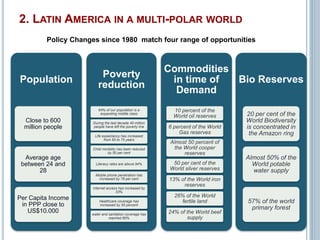
2. LATIN AMERICA IN A MULTI-POLAR WORLD 
Policy Changes since 1980 match four range of opportunities 
Population 
Close to 600 
million people 
Average age 
between 24 and 
28 
Per Capita Income 
in PPP close to 
US$10.000 
Poverty 
reduction 
64% of our population is a 
expanding middle class 
During the last decade 40 million 
people have left the poverty line 
Life expectancy has increased 
from 65 to 75 years 
Child mortality has been reduced 
by 50 per cent 
Literacy rates are above 94% 
Mobile phone penetration has 
increased by 78 per cent 
Internet access has increased by 
33% 
Healthcare coverage has 
increased by 50 percent 
water and sanitation coverage has 
reached 80% 
Commodities 
in time of 
Demand 
10 percent of the 
World oil reserves 
6 percent of the World 
Gas reserves 
Almost 50 percent of 
the World cooper 
reserves 
50 per cent of the 
World silver reserves 
13% of the World iron 
reserves 
26% of the World 
fertile land 
24% of the World beef 
supply 
Bio Reserves 
20 per cent of the 
World Biodiversity 
is concentrated in 
the Amazon ring 
Almost 50% of the 
World potable 
water supply 
57% of the world 
primary forest
2. LATIN AMERICA IN A MULTI-POLAR WORLD 
The change process is a consequence of the consistency, congruence and sense of urgency that a group of 
countries have adopted as their policy cornerstone. Brazil, Mexico, Colombia, Chile, Peru and Uruguay 
represent 70 per cent of the region’s population and 75% of the regional GDP. 
The strengthening of 
Liberal Democracy 
The adoption of an 
institutional Framework 
in favor of foreign and 
national investment 
The construction of a 
sound and sustainable 
social safety net 
The expansion of 
export markets and the 
commercial integration 
with the World (FTA’s) 
Construction of 
strategic infrastructure 
Better regulatory 
environment 
A sound 
Macroeconomic 
Administration driven 
by fiscal and 
monetary prudence 
A public administration 
driven by results 
The consolidation of an 
innovation agenda 
leaded by an 
improvement in 
education 
A well capitalized 
financial sector and the 
constant expansion of 
financial services 
Today countries like Panama, 
Dominican Republic, Costa 
Rica, Salvador, Guatemala, 
Honduras, Paraguay, as well as 
most of the Caribbean States, 
are following that line of 
behavior
2. LATIN AMERICA IN A MULTI-POLAR WORLD 
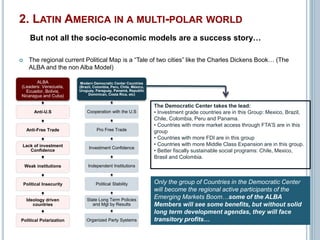
But not all the socio-economic models are a success story… 
 The regional current Political Map is a “Tale of two cities” like the Charles Dickens Book… (The 
ALBA and the non Alba Model) 
ALBA 
(Leaders: Venezuela, 
Ecuador, Bolivia, 
Nicaragua and Cuba) 
Anti-U.S 
Anti-Free Trade 
Lack of investment 
Confidence 
Weak institutions 
Political Insecurity 
Ideology driven 
countries 
Political Polarization 
Modern Democratic Center Countries 
(Brazil, Colombia, Peru, Chile, México, 
Uruguay, Paraguay, Panamá, Republic 
Dominican, Costa Rica, etc) 
Cooperation with the U.S 
Pro Free Trade 
Investment Confidence 
Independent Institutions 
Political Stability 
State Long Term Policies 
and Mgt by Results 
Organized Party Systems 
The Democratic Center takes the lead: 
• Investment grade countries are in this Group: Mexico, Brazil, 
Chile, Colombia, Peru and Panama. 
• Countries with more market access through FTA’S are in this 
group 
• Countries with more FDI are in this group 
• Countries with more Middle Class Expansion are in this group. 
• Better fiscally sustainable social programs: Chile, Mexico, 
Brasil and Colombia. 
Only the group of Countries in the Democratic Center 
will become the regional active participants of the 
Emerging Markets Boom…some of the ALBA 
Members will see some benefits, but without solid 
long term development agendas, they will face 
transitory profits…
3. THE 2013 OUTLOOK 
After decelerating for two 
consecutive years, Latin 
American economies 
accelerated growth again at 
the end of 2012. Brazil’s 
recovery was an engine of 
performance 
The 2012 experience…. 
The region’s growth 
averaged around 3.2% in 
2012 after 4.3% in 2011 and 
6% in 2010 
Latin America will approach 
its potential rate in 2013, 
remaining the world's 
second best performing 
region after Asia 
Chile reported lower annual 
growth, although the 
economy reaccelerated to 
rates higher than its long-term 
trend because of 
expansionary monetary 
conditions 
Colombia’s growth was 
below government 
expectations reaching a 
3.5% level 
Due to the political transition, 
which generates temporary 
contractions the Mexican 
economy began decelerating 
in the second half of the year 
Brazil became the main 
contributor to Latin 
America’s growth reduction 
in the past two years 
Inflation was maintained on 
target with the excepctions 
of Mexico and Brazil, that 
experienced marginal 
increases
3. THE 2013 OUTLOOK 
Argentina 
The country will face risks in 2013, 
although growth will improve in 
comparison with 2012 
Uncertainty will increase 
Inflation will be around 25% 
Public expenditure will be the driver of 
economic growth 
Central Bank will continue to be the main 
source of funding for the Central 
Government 
Economy will grow 3.4% in 2013 
Brazil 
The economy experienced a small scale 
recovery at the end of 2012 
The recovery will strengthen in 2013, 
boosted by investment for the 2014 World 
Cup, as well as the fiscal and monetary 
stimulus package in place 
The economy will grow 5% in 2013 
Chile 
Monetary conditions need to be stabilized 
before excess demand threatens 
economic stability 
Growth in 2013 will be around 4.3% 
Inflation will remain on target 
Source: World Bank
3. THE 2013 OUTLOOK 
Mexico 
The deceleration initiated at the end of 2012 will extend 
over the first half of 2013, as a change in political 
administration usually introduces a delay in the federal 
budget and private decisions on investment 
The economy will grow only 3.5% in 2013 after 3.8% in 
2012 
Inflation is rising 
Monetary tightening could affect growth performance 
Great expectations are based on the new government 
reform agenda 
Peru 
The best performer with strong fundamentals and a 
well managed mining boom 
Growth will reach 5.8% in 2013 
Inflation will be between 1% and 3% 
Venezuela 
The fiscal deficit in 2012 reached troublesome levels, 
that will require cuts in 2013 
Growth will be around 1.5% and 2% 
Declines in the oil price could trigger a recession 
Inflation will reach 30% 
Source: World Bank
3. THE 2013 OUTLOOK 
Regional Financial Flows 
2009 2010 2011 2012e 2013f 2014f 2015f 
Financial Flows 
Capital Inflows 179.6 328.5 303.9 322.4 326.2 327.1 342.3 
Private inflows, net 161.6 306.1 299.1 320.5 327.1 327.8 344.7 
Equity Inflows, net 126.5 166.6 165.6 179.5 198.0 200.8 214.5 
FDI inflows 84.9 125.3 158.3 167.3 182.4 176.3 184.2 
Portfolio equity inflows 41.6 41.3 7.4 12.2 15.6 24.5 30.3 
Private creditors, net 35.1 139.5 133.4 141.0 129.1 127.0 130.2 
Bonds 45.9 72.9 85.2 95.1 72.2 57.7 60.2 
Banks -1.7 21.7 51.7 41.4 42.7 45.2 51.4 
Short-term debt flows -8.6 43.8 -3.0 4.3 12.7 23.4 16.5 
Other private -0.5 1.1 -0.4 0.2 1.5 0.7 2.1 
Offical inflows, net 18.0 22.5 4.8 1.9 -0.9 -0.7 -2.4 
World Bank 6.6 8.3 -2.9 0.4 .. .. .. 
IMF 0.4 1.3 0.2 0.1 .. .. .. 
Other official 11.0 12.9 7.5 1.4 .. .. ..
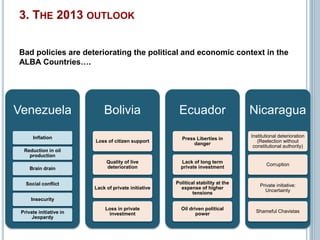
Bad policies are deteriorating the political and economic context in the 
ALBA Countries…. 
Venezuela 
Inflation 
Reduction in oil 
production 
Brain drain 
Social conflict 
Insecurity 
Private initiative in 
Jeopardy 
Bolivia 
Loss of citizen support 
Quality of live 
deterioration 
Lack of private initiative 
Loss in private 
investment 
Ecuador 
Press Liberties in 
danger 
Lack of long term 
private investment 
Political stability at the 
expense of higher 
tensions 
Oil driven political 
power 
Nicaragua 
Institutional deterioration 
(Reelection without 
constitutional authority) 
Corruption 
Private initiative: 
Uncertainty 
Shameful Chavistas 
3. THE 2013 OUTLOOK
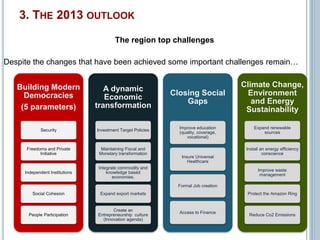
Despite the changes that have been achieved some important challenges remain… 
Building Modern 
Democracies 
(5 parameters) 
Security 
Freedoms and Private 
Initiative 
Independent Institutions 
Social Cohesion 
People Participation 
A dynamic 
Economic 
transformation 
Investment Target Policies 
Maintaining Fiscal and 
Monetary transformation 
Integrate commodity and 
knowledge based 
economies. 
Expand export markets 
Create an 
Entrepreneurship culture 
(Innovation agenda) 
Closing Social 
Gaps 
Improve education 
(quality, coverage, 
vocational) 
Insure Universal 
Healthcare 
Formal Job creation 
Access to Finance 
Climate Change, 
Environment 
and Energy 
Sustainability 
Expand renewable 
sources 
Install an energy efficiency 
conscience 
Improve waste 
management 
Protect the Amazon Ring 
Reduce Co2 Emissions 
3. THE 2013 OUTLOOK 
The region top challenges
4. THE COLOMBIAN CASE: NO LOST CAUSES 
Security 
28.837 homicides 
2.882 kidnappings 
69 homicides per 100.000 habitants 
1.645 terrorist attacks 
350 mayors out of their 
municipalities 
158 municipalities without police 
Economy 
Average Economic Growth 1994- 
2001: 2.1% 
GDP per Capita: US$2.377 
Investment as % of GDP: 16.5% 
Exports: US$11.975 million 
FDI: US$2.100 million 
Inflation: 6.99% 
Fiscal balance: -3.2% 
Social 
Unemployment: 16.2% 
Health Coverage: 25 million 
Colombians. 
Pension affiliates: 4.5 million 
Poverty: 57% 
Education Coverage: Primary 97%, 
High school: 57%, University: 24% 
Mobil Phone Lines: 4.6 million 
Internet coverage: 1.9 million 
Eleven years ago Colombia was a fragile state… 
The Colombian Paradox: a long and stable democracy in a permanent threat from terrorist groups, 
drug dealers and organized crime…
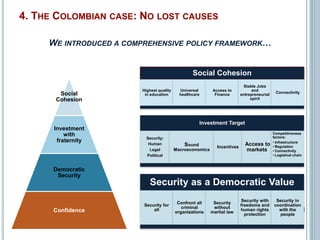
WE INTRODUCED A COMPREHENSIVE POLICY FRAMEWORK… 
Social 
Cohesion 
Investment 
with 
fraternity 
Democratic 
Security 
Confidence 
Security as a Democratic Value 
Security for 
all 
Confront all 
criminal 
organizations 
Security 
without 
martial law 
Security with 
freedoms and 
human rights 
protection 
Security in 
coordination 
with the 
people 
Investment Target 
Security: 
Human 
Legal 
Political 
Sound 
Macroeconomics 
Incentives 
Access to 
markets 
Competitiveness 
factors: 
• Infrastructure 
• Regulation 
• Connectivity 
• Logistical chain 
Social Cohesion 
Highest quality 
in education 
Universal 
healthcare 
Access to 
Finance 
Stable Jobs 
and 
entrepreneurial 
spirit 
Connectivity 
4. THE COLOMBIAN CASE: NO LOST CAUSES
4. THE COLOMBIAN CASE: NO LOST CAUSES 
OUR POLICY ACHIEVEMENTS GENERATED A TURNING POINT 
Indicator 2002 2010 
Homicides 28.838 7400 
Kidnappings 2,882 123 
Homicides per 
100K Habitants 
69 16.3 
Terrorist attacks 1.645 250 
Municipalities 
without mayors 
presence 
350 0 
Municipalities 
without police 
158 0 
Indicator 2002 2010 
Average 
Economic 
Growth 
2.1% 4.3% 
GDP per Capita 2377 5.300 
Invest % GDP 16.5% 24.6% 
Exports US$11. 
000 
US$ 
39.000 
FDI US$2.1 
00 
US$ 7.000 
Inflation 6.9% 2.5% 
Indicator 2002 2010 
Unemployment 16.2% 11.6% 
Health Coverage 25.1 million 43.1 
million 
Pension affiliates 4.5 million 7.1 
million 
Poverty 57% 38% 
Education coverage 
(Primary, Hs, 
University) 
97% 
57% 
24% 
100% 
79.4% 
35.5% 
Mobile phone users 4.6 million 
lines 
41 
million 
lines 
• Reached the highest economic growth in 
more than 20 years 
• The largest education, health and 
connectivity coverage in its history 
• The largest poverty reduction in Colombian 
history 
• The biggest FDI rates in history 
• The lowest violence records in 30 years 
• Expanded the middle class 
• Highest exports in Colombian 
History 
• Paramilitary groups dismantled 
• FARC structure severely 
dismantled 
• Per Capita income more than 
doubled
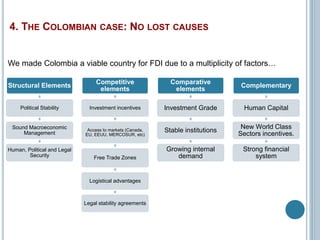
We made Colombia a viable country for FDI due to a multiplicity of factors… 
Structural Elements 
Political Stability 
Sound Macroeconomic 
Management 
Human, Political and Legal 
Security 
Competitive 
elements 
Investment incentives 
Access to markets (Canada, 
EU, EEUU, MERCOSUR, etc) 
Free Trade Zones 
Logistical advantages 
Legal stability agreements 
Comparative 
elements 
Investment Grade 
Stable institutions 
Growing internal 
demand 
Complementary 
Human Capital 
New World Class 
Sectors incentives. 
Strong financial 
system 
4. THE COLOMBIAN CASE: NO LOST CAUSES
The case of the oil sector in Colombia: Change is possible 
In 2002 it was believed that 
by 2009 Colombia oil 
production will not be able 
to attend national demand 
In 2003 the oil and gas 
sector restructuring was 
designed 
ECOPETROL undertook a 
strategy shift to become a 
more competitive and 
professional corporation 
The National Hydrocarbon 
Agency was created 
From 2002 to 2010 
successful exploration 
passed from 40% to 61.4% 
Between 2002 and May 
2010 447 new fields were 
explored 
In 2007 ECOPETROL was 
capitalized by 10% through 
local capital markets. 
486.000 Colombians 
bought shares 
Between 2002 and 2010 
341 exploration and 
production contracts were 
signed 
Seismic exploration in the 
country (Onshore, Offshore 
and 2 dimensions) 
increased by more than 
250% 
Colombia is currently close 
to produce 1 million oil 
barrels per day 
Success triggers 
Security: Investment, 
exploration 
Government Reform: New 
ECOPETROL and ANH 
Investment target policies: 
New players and new 
exploration and production 
contracts 
4. THE COLOMBIAN CASE: NO LOST CAUSES
Security 
Maintain Macro-Vision and 
Micro-Management 
Continue dismantling all 
terrorist organizations 
Continue dismantling drug 
cartels apparatus 
Strengthen Citizen Security 
agendas with local 
authorities 
Economic 
Face new trends of 
currency appreciation 
Maintain and increase FDI 
flows (Security, incentives 
and stability rules) 
Fiscal Policy to face new 
countercyclical challenges 
Increase tax collections 
Expand new trade markets 
through FTA’s 
Social 
Cohesion 
Fight labor informality and 
create quality jobs 
Insure education and health 
quality 
Expand vocational training 
coverage 
Create Entrepreneurial 
Family Transfers program 
Political 
Judicial reform 
Strengthen Democratic 
Center 
Improve local institutional 
capacity 
New law implementation 
(Victims and land) 
Prevent the emergence of 
populist movements 
4. THE COLOMBIAN CASE: NO LOST CAUSES 
Colombia current challenges
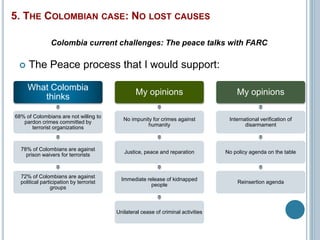
 The Peace process that I would support: 
What Colombia 
thinks 
68% of Colombians are not willing to 
pardon crimes committed by 
terrorist organizations 
78% of Colombians are against 
prison waivers for terrorists 
72% of Colombians are against 
political participation by terrorist 
groups 
My opinions 
No impunity for crimes against 
humanity 
Justice, peace and reparation 
Immediate release of kidnapped 
people 
Unilateral cease of criminal activities 
My opinions 
International verification of 
disarmament 
No policy agenda on the table 
Reinsertion agenda 
5. THE COLOMBIAN CASE: NO LOST CAUSES 
Colombia current challenges: The peace talks with FARC
WWW.ALVAROURIBEVELEZ.COM

Colombia and latin america - The next challenges

  • 1.
    COLOMBIA AND LATIN AMERICA THE NEXT CHALLENGES Alvaro Uribe Velez April 2013
  • 2.
    TOPICS FOR DISCUSSION 1. The trends that will define our future 2. Latin America in a multi-polar world 3. The 2013 outlook 4. The Colombian case
  • 3.
    1. THE TRENDSTHAT WILL DEFINE OUR FUTURE There are 4 trends that will shape the global future in the next 20 years… The global middle class expansion The rise and flight of the emerging powers Demography will determine destiny The pressure for natural resources
  • 4.
    1. THE TRENDSTHAT WILL DEFINE OUR FUTURE The global middle class expansion By 2030 a majority of the world’s population will not be impoverished, and the growing middle class will determine global consumption patterns The rise and flight of the emerging powers Asia will have surpassed North America and Europe combined in terms of global power, based upon GDP, population size, military spending, and technological investment China alone will probably have the largest economy, surpassing that of the United States a few years before 2030 Source: U.S National Intelligence Council Demography will determine destiny In 2013 the world will have reached 8.1 billion habitants Aging population, shrinking young population, migration and urbanization will impact world social and economic performance The pressure for natural resources Demand for food, water, and energy will grow by approximately 35, 40, and 50 percent respectively owing to an increase in the global population and the consumption patterns of an expanding middle class
  • 5.
    1. THE TRENDSTHAT WILL DEFINE OUR FUTURE By 2050 19 of the top 30 economies by GDP will be countries that we currently describe as ‘emerging’ China and India will be the largest and third-largest economies in the world Eight countries – India, China, Brazil, Russia, Indonesia, Korea, Mexico and Turkey – will be responsible for most of global growth up to 2025 Emerging economies will account for 68% of global growth by 2030 In 1980, 5% of goods were sourced globally. By 2000, this was 20%. By 2025, it will be 50% In 1980, world exports accounted for one-sixth of global GDP. Today it is a quarter. By 2030, it will have risen to a third By 2030 the urban middle class will rise to 42% of the global population. The number of people with daily income of $10 to $100 a day will rise from 1.8 billion today to 4.9 billion by 2030
  • 6.
    1. THE TRENDSTHAT WILL DEFINE OUR FUTURE Global energy demand rises by over one-third in the period to 2035, underpinned by rising living standards in China, India & the Middle East Iraq accounts for 45% of the growth in global production to 2035; by the 2030s it becomes the second-largest global oil exporter, overtaking Russia By 2035, almost 90% of Middle Eastern oil exports go to Asia; North America’s emergence as a net exporter accelerates the eastward shift in trade The energy sector’s water needs are set to grow, making water an increasingly important criterion for assessing the viability of energy projects Electricity prices are set to increase with the highest prices persisting in the European Union & Japan, well above those in China & the United States The need for electricity in emerging economies drives a 70% increase in worldwide demand, with renewable accounting for half of new global capacity Two-thirds of the economic potential to improve energy efficiency remains untapped in the period to 2035 Global energy trends in the next 25 years… Source: International Energy Agency
  • 7.
    2. LATIN AMERICAIN A MULTI-POLAR WORLD Policy Changes since 1980 match four range of opportunities Population Close to 600 million people Average age between 24 and 28 Per Capita Income in PPP close to US$10.000 Poverty reduction 64% of our population is a expanding middle class During the last decade 40 million people have left the poverty line Life expectancy has increased from 65 to 75 years Child mortality has been reduced by 50 per cent Literacy rates are above 94% Mobile phone penetration has increased by 78 per cent Internet access has increased by 33% Healthcare coverage has increased by 50 percent water and sanitation coverage has reached 80% Commodities in time of Demand 10 percent of the World oil reserves 6 percent of the World Gas reserves Almost 50 percent of the World cooper reserves 50 per cent of the World silver reserves 13% of the World iron reserves 26% of the World fertile land 24% of the World beef supply Bio Reserves 20 per cent of the World Biodiversity is concentrated in the Amazon ring Almost 50% of the World potable water supply 57% of the world primary forest
  • 8.
    2. LATIN AMERICAIN A MULTI-POLAR WORLD The change process is a consequence of the consistency, congruence and sense of urgency that a group of countries have adopted as their policy cornerstone. Brazil, Mexico, Colombia, Chile, Peru and Uruguay represent 70 per cent of the region’s population and 75% of the regional GDP. The strengthening of Liberal Democracy The adoption of an institutional Framework in favor of foreign and national investment The construction of a sound and sustainable social safety net The expansion of export markets and the commercial integration with the World (FTA’s) Construction of strategic infrastructure Better regulatory environment A sound Macroeconomic Administration driven by fiscal and monetary prudence A public administration driven by results The consolidation of an innovation agenda leaded by an improvement in education A well capitalized financial sector and the constant expansion of financial services Today countries like Panama, Dominican Republic, Costa Rica, Salvador, Guatemala, Honduras, Paraguay, as well as most of the Caribbean States, are following that line of behavior
  • 9.
    2. LATIN AMERICAIN A MULTI-POLAR WORLD But not all the socio-economic models are a success story…  The regional current Political Map is a “Tale of two cities” like the Charles Dickens Book… (The ALBA and the non Alba Model) ALBA (Leaders: Venezuela, Ecuador, Bolivia, Nicaragua and Cuba) Anti-U.S Anti-Free Trade Lack of investment Confidence Weak institutions Political Insecurity Ideology driven countries Political Polarization Modern Democratic Center Countries (Brazil, Colombia, Peru, Chile, México, Uruguay, Paraguay, Panamá, Republic Dominican, Costa Rica, etc) Cooperation with the U.S Pro Free Trade Investment Confidence Independent Institutions Political Stability State Long Term Policies and Mgt by Results Organized Party Systems The Democratic Center takes the lead: • Investment grade countries are in this Group: Mexico, Brazil, Chile, Colombia, Peru and Panama. • Countries with more market access through FTA’S are in this group • Countries with more FDI are in this group • Countries with more Middle Class Expansion are in this group. • Better fiscally sustainable social programs: Chile, Mexico, Brasil and Colombia. Only the group of Countries in the Democratic Center will become the regional active participants of the Emerging Markets Boom…some of the ALBA Members will see some benefits, but without solid long term development agendas, they will face transitory profits…
  • 10.
    3. THE 2013OUTLOOK After decelerating for two consecutive years, Latin American economies accelerated growth again at the end of 2012. Brazil’s recovery was an engine of performance The 2012 experience…. The region’s growth averaged around 3.2% in 2012 after 4.3% in 2011 and 6% in 2010 Latin America will approach its potential rate in 2013, remaining the world's second best performing region after Asia Chile reported lower annual growth, although the economy reaccelerated to rates higher than its long-term trend because of expansionary monetary conditions Colombia’s growth was below government expectations reaching a 3.5% level Due to the political transition, which generates temporary contractions the Mexican economy began decelerating in the second half of the year Brazil became the main contributor to Latin America’s growth reduction in the past two years Inflation was maintained on target with the excepctions of Mexico and Brazil, that experienced marginal increases
  • 11.
    3. THE 2013OUTLOOK Argentina The country will face risks in 2013, although growth will improve in comparison with 2012 Uncertainty will increase Inflation will be around 25% Public expenditure will be the driver of economic growth Central Bank will continue to be the main source of funding for the Central Government Economy will grow 3.4% in 2013 Brazil The economy experienced a small scale recovery at the end of 2012 The recovery will strengthen in 2013, boosted by investment for the 2014 World Cup, as well as the fiscal and monetary stimulus package in place The economy will grow 5% in 2013 Chile Monetary conditions need to be stabilized before excess demand threatens economic stability Growth in 2013 will be around 4.3% Inflation will remain on target Source: World Bank
  • 12.
    3. THE 2013OUTLOOK Mexico The deceleration initiated at the end of 2012 will extend over the first half of 2013, as a change in political administration usually introduces a delay in the federal budget and private decisions on investment The economy will grow only 3.5% in 2013 after 3.8% in 2012 Inflation is rising Monetary tightening could affect growth performance Great expectations are based on the new government reform agenda Peru The best performer with strong fundamentals and a well managed mining boom Growth will reach 5.8% in 2013 Inflation will be between 1% and 3% Venezuela The fiscal deficit in 2012 reached troublesome levels, that will require cuts in 2013 Growth will be around 1.5% and 2% Declines in the oil price could trigger a recession Inflation will reach 30% Source: World Bank
  • 13.
    3. THE 2013OUTLOOK Regional Financial Flows 2009 2010 2011 2012e 2013f 2014f 2015f Financial Flows Capital Inflows 179.6 328.5 303.9 322.4 326.2 327.1 342.3 Private inflows, net 161.6 306.1 299.1 320.5 327.1 327.8 344.7 Equity Inflows, net 126.5 166.6 165.6 179.5 198.0 200.8 214.5 FDI inflows 84.9 125.3 158.3 167.3 182.4 176.3 184.2 Portfolio equity inflows 41.6 41.3 7.4 12.2 15.6 24.5 30.3 Private creditors, net 35.1 139.5 133.4 141.0 129.1 127.0 130.2 Bonds 45.9 72.9 85.2 95.1 72.2 57.7 60.2 Banks -1.7 21.7 51.7 41.4 42.7 45.2 51.4 Short-term debt flows -8.6 43.8 -3.0 4.3 12.7 23.4 16.5 Other private -0.5 1.1 -0.4 0.2 1.5 0.7 2.1 Offical inflows, net 18.0 22.5 4.8 1.9 -0.9 -0.7 -2.4 World Bank 6.6 8.3 -2.9 0.4 .. .. .. IMF 0.4 1.3 0.2 0.1 .. .. .. Other official 11.0 12.9 7.5 1.4 .. .. ..
  • 14.
    Bad policies aredeteriorating the political and economic context in the ALBA Countries…. Venezuela Inflation Reduction in oil production Brain drain Social conflict Insecurity Private initiative in Jeopardy Bolivia Loss of citizen support Quality of live deterioration Lack of private initiative Loss in private investment Ecuador Press Liberties in danger Lack of long term private investment Political stability at the expense of higher tensions Oil driven political power Nicaragua Institutional deterioration (Reelection without constitutional authority) Corruption Private initiative: Uncertainty Shameful Chavistas 3. THE 2013 OUTLOOK
  • 15.
    Despite the changesthat have been achieved some important challenges remain… Building Modern Democracies (5 parameters) Security Freedoms and Private Initiative Independent Institutions Social Cohesion People Participation A dynamic Economic transformation Investment Target Policies Maintaining Fiscal and Monetary transformation Integrate commodity and knowledge based economies. Expand export markets Create an Entrepreneurship culture (Innovation agenda) Closing Social Gaps Improve education (quality, coverage, vocational) Insure Universal Healthcare Formal Job creation Access to Finance Climate Change, Environment and Energy Sustainability Expand renewable sources Install an energy efficiency conscience Improve waste management Protect the Amazon Ring Reduce Co2 Emissions 3. THE 2013 OUTLOOK The region top challenges
  • 16.
    4. THE COLOMBIANCASE: NO LOST CAUSES Security 28.837 homicides 2.882 kidnappings 69 homicides per 100.000 habitants 1.645 terrorist attacks 350 mayors out of their municipalities 158 municipalities without police Economy Average Economic Growth 1994- 2001: 2.1% GDP per Capita: US$2.377 Investment as % of GDP: 16.5% Exports: US$11.975 million FDI: US$2.100 million Inflation: 6.99% Fiscal balance: -3.2% Social Unemployment: 16.2% Health Coverage: 25 million Colombians. Pension affiliates: 4.5 million Poverty: 57% Education Coverage: Primary 97%, High school: 57%, University: 24% Mobil Phone Lines: 4.6 million Internet coverage: 1.9 million Eleven years ago Colombia was a fragile state… The Colombian Paradox: a long and stable democracy in a permanent threat from terrorist groups, drug dealers and organized crime…
  • 17.
    WE INTRODUCED ACOMPREHENSIVE POLICY FRAMEWORK… Social Cohesion Investment with fraternity Democratic Security Confidence Security as a Democratic Value Security for all Confront all criminal organizations Security without martial law Security with freedoms and human rights protection Security in coordination with the people Investment Target Security: Human Legal Political Sound Macroeconomics Incentives Access to markets Competitiveness factors: • Infrastructure • Regulation • Connectivity • Logistical chain Social Cohesion Highest quality in education Universal healthcare Access to Finance Stable Jobs and entrepreneurial spirit Connectivity 4. THE COLOMBIAN CASE: NO LOST CAUSES
  • 18.
    4. THE COLOMBIANCASE: NO LOST CAUSES OUR POLICY ACHIEVEMENTS GENERATED A TURNING POINT Indicator 2002 2010 Homicides 28.838 7400 Kidnappings 2,882 123 Homicides per 100K Habitants 69 16.3 Terrorist attacks 1.645 250 Municipalities without mayors presence 350 0 Municipalities without police 158 0 Indicator 2002 2010 Average Economic Growth 2.1% 4.3% GDP per Capita 2377 5.300 Invest % GDP 16.5% 24.6% Exports US$11. 000 US$ 39.000 FDI US$2.1 00 US$ 7.000 Inflation 6.9% 2.5% Indicator 2002 2010 Unemployment 16.2% 11.6% Health Coverage 25.1 million 43.1 million Pension affiliates 4.5 million 7.1 million Poverty 57% 38% Education coverage (Primary, Hs, University) 97% 57% 24% 100% 79.4% 35.5% Mobile phone users 4.6 million lines 41 million lines • Reached the highest economic growth in more than 20 years • The largest education, health and connectivity coverage in its history • The largest poverty reduction in Colombian history • The biggest FDI rates in history • The lowest violence records in 30 years • Expanded the middle class • Highest exports in Colombian History • Paramilitary groups dismantled • FARC structure severely dismantled • Per Capita income more than doubled
  • 19.
    We made Colombiaa viable country for FDI due to a multiplicity of factors… Structural Elements Political Stability Sound Macroeconomic Management Human, Political and Legal Security Competitive elements Investment incentives Access to markets (Canada, EU, EEUU, MERCOSUR, etc) Free Trade Zones Logistical advantages Legal stability agreements Comparative elements Investment Grade Stable institutions Growing internal demand Complementary Human Capital New World Class Sectors incentives. Strong financial system 4. THE COLOMBIAN CASE: NO LOST CAUSES
  • 20.
    The case ofthe oil sector in Colombia: Change is possible In 2002 it was believed that by 2009 Colombia oil production will not be able to attend national demand In 2003 the oil and gas sector restructuring was designed ECOPETROL undertook a strategy shift to become a more competitive and professional corporation The National Hydrocarbon Agency was created From 2002 to 2010 successful exploration passed from 40% to 61.4% Between 2002 and May 2010 447 new fields were explored In 2007 ECOPETROL was capitalized by 10% through local capital markets. 486.000 Colombians bought shares Between 2002 and 2010 341 exploration and production contracts were signed Seismic exploration in the country (Onshore, Offshore and 2 dimensions) increased by more than 250% Colombia is currently close to produce 1 million oil barrels per day Success triggers Security: Investment, exploration Government Reform: New ECOPETROL and ANH Investment target policies: New players and new exploration and production contracts 4. THE COLOMBIAN CASE: NO LOST CAUSES
  • 21.
    Security Maintain Macro-Visionand Micro-Management Continue dismantling all terrorist organizations Continue dismantling drug cartels apparatus Strengthen Citizen Security agendas with local authorities Economic Face new trends of currency appreciation Maintain and increase FDI flows (Security, incentives and stability rules) Fiscal Policy to face new countercyclical challenges Increase tax collections Expand new trade markets through FTA’s Social Cohesion Fight labor informality and create quality jobs Insure education and health quality Expand vocational training coverage Create Entrepreneurial Family Transfers program Political Judicial reform Strengthen Democratic Center Improve local institutional capacity New law implementation (Victims and land) Prevent the emergence of populist movements 4. THE COLOMBIAN CASE: NO LOST CAUSES Colombia current challenges
  • 22.
     The Peaceprocess that I would support: What Colombia thinks 68% of Colombians are not willing to pardon crimes committed by terrorist organizations 78% of Colombians are against prison waivers for terrorists 72% of Colombians are against political participation by terrorist groups My opinions No impunity for crimes against humanity Justice, peace and reparation Immediate release of kidnapped people Unilateral cease of criminal activities My opinions International verification of disarmament No policy agenda on the table Reinsertion agenda 5. THE COLOMBIAN CASE: NO LOST CAUSES Colombia current challenges: The peace talks with FARC
  • 23.