SQL QUERIES
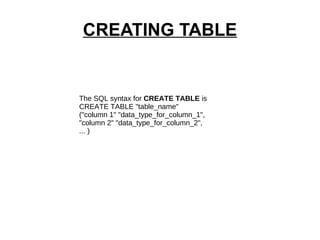
CREATING TABLE The SQL syntax for  CREATE TABLE  is CREATE TABLE "table_name" ("column 1" "data_type_for_column_1", "column 2" "data_type_for_column_2", ... )
This ALTER TABLE sql command is to make changes in the table. The synatx is: ALTER TABLE[ owner_name ] table_name [ADD column_name datatype attributes] [MODIFY{column_name datatype |  column_constraint}]  Example Query: ALTER TABLE STUDENT ADD(PERCENTAGE NUMBER(5,2));
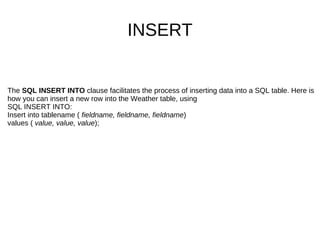
The  SQL INSERT INTO  clause facilitates the process of inserting data into a SQL table. Here is how you can insert a new row into the Weather table, using  SQL INSERT INTO: Insert into tablename (  fieldname, fieldname, fieldname )  values (  value, value, value ); INSERT
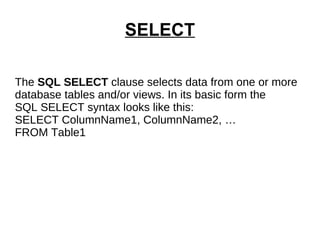
SELECT The  SQL SELECT  clause selects data from one or more database tables and/or views. In its basic form the  SQL SELECT syntax looks like this: SELECT ColumnName1, ColumnName2, … FROM Table1
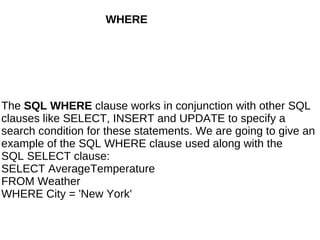
The  SQL WHERE  clause works in conjunction with other SQL clauses like SELECT, INSERT and UPDATE to specify a search condition for these statements. We are going to give an example of the SQL WHERE clause used along with the  SQL SELECT clause: SELECT AverageTemperature  FROM Weather WHERE City = 'New York' WHERE
The  SQL DISTINCT  clause works in conjunction with the SQL SELECT clause and selects only distinct (unique) data from a database table(s). Here is an example of SQL DISTINCT clause SELECT DISTINCT Column1 FROM Table1 The  SQL DISTINCT  clause works in conjunction with the SQL SELECT clause and selects only distinct (unique) data from a database table(s). Here is an example of SQL DISTINCT clause SELECT DISTINCT Column1 FROM Table1 DISTINCT
UPDATE The  SQL UPDATE clause serves to update data in database table. The SQL UPDATE clause basic syntax looks like this: UPDATE Table1 SET Column1 = Value1, Column2 = Value2, …
DELETE The SQL DELETE   clause is used to delete data from a database table. The simplest  SQL DELETE syntax looks like this: DELETE FROM Table1
TRUNCATE The SQL TRUNCATE TABLE clause deletes all rows from a database table. Here is the  SQL TRUNCATE TABLE syntax: TRUNCATE TABLE Weather
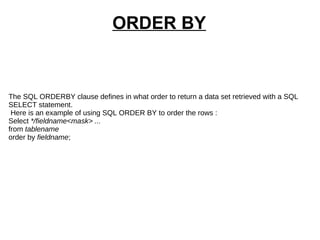
ORDER BY The SQL ORDERBY clause defines in what order to return a data set retrieved with a SQL SELECT statement. Here is an example of using SQL ORDER BY to order the rows : Select  */fieldname<mask> ...   from  tablename   order by  fieldname ;
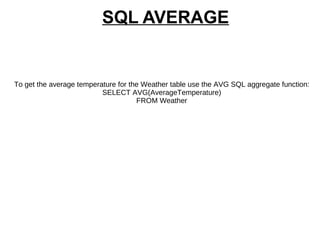
SQL AVERAGE To get the average temperature for the Weather table use the AVG SQL   aggregate function: SELECT AVG(AverageTemperature) FROM Weather
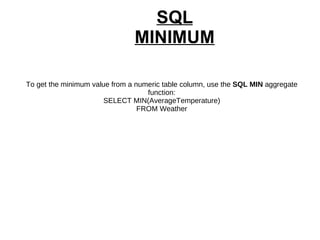
SQL MINIMUM To get the minimum value from a numeric table column, use the  SQL MIN  aggregate function: SELECT MIN(AverageTemperature) FROM Weather
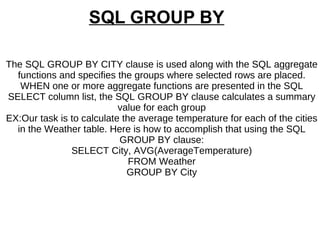
SQL GROUP BY The SQL GROUP BY CITY clause is used along with the SQL aggregate functions and specifies the groups where selected rows are placed. WHEN one or more aggregate functions are presented in the SQL SELECT column list, the SQL GROUP BY clause calculates a summary value for each group EX:Our task is to calculate the average temperature for each of the cities in the Weather table. Here is how to accomplish that using the SQL GROUP BY clause: SELECT City, AVG(AverageTemperature) FROM Weather GROUP BY City
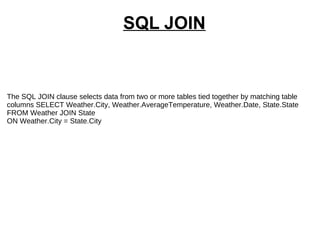
SQL JOIN The SQL JOIN clause selects data from two or more tables tied together by matching table columns SELECT Weather.City, Weather.AverageTemperature, Weather.Date, State.State FROM Weather JOIN State ON Weather.City = State.City
AND/OR The Syntax for  AND/OR SELECT &quot;column_name&quot; FROM &quot;table_name&quot; WHERE &quot;simple condition&quot; {[AND|OR] &quot;simple condition&quot;}+
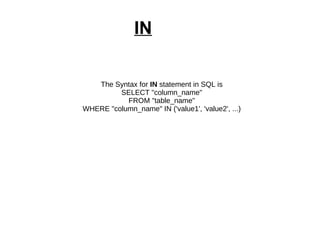
IN The Syntax for  IN  statement in SQL is SELECT &quot;column_name&quot; FROM &quot;table_name&quot; WHERE &quot;column_name&quot; IN ('value1', 'value2', ...)
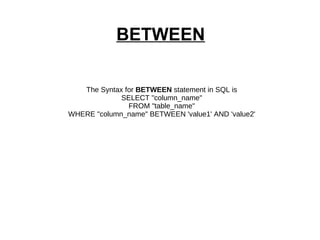
BETWEEN The Syntax for  BETWEEN  statement in SQL is SELECT &quot;column_name&quot; FROM &quot;table_name&quot; WHERE &quot;column_name&quot; BETWEEN 'value1' AND 'value2'
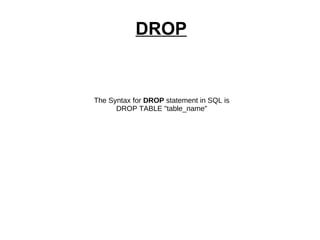
DROP   The Syntax for  DROP  statement in SQL is DROP TABLE &quot;table_name&quot;

Babitha2.mysql

  • 1.
  • 2.
    CREATING TABLE TheSQL syntax for CREATE TABLE is CREATE TABLE &quot;table_name&quot; (&quot;column 1&quot; &quot;data_type_for_column_1&quot;, &quot;column 2&quot; &quot;data_type_for_column_2&quot;, ... )
  • 3.
    This ALTER TABLEsql command is to make changes in the table. The synatx is: ALTER TABLE[ owner_name ] table_name [ADD column_name datatype attributes] [MODIFY{column_name datatype | column_constraint}] Example Query: ALTER TABLE STUDENT ADD(PERCENTAGE NUMBER(5,2));
  • 4.
    The SQLINSERT INTO clause facilitates the process of inserting data into a SQL table. Here is how you can insert a new row into the Weather table, using SQL INSERT INTO: Insert into tablename ( fieldname, fieldname, fieldname ) values ( value, value, value ); INSERT
  • 5.
    SELECT The SQL SELECT clause selects data from one or more database tables and/or views. In its basic form the SQL SELECT syntax looks like this: SELECT ColumnName1, ColumnName2, … FROM Table1
  • 6.
    The SQLWHERE clause works in conjunction with other SQL clauses like SELECT, INSERT and UPDATE to specify a search condition for these statements. We are going to give an example of the SQL WHERE clause used along with the SQL SELECT clause: SELECT AverageTemperature FROM Weather WHERE City = 'New York' WHERE
  • 7.
    The SQLDISTINCT clause works in conjunction with the SQL SELECT clause and selects only distinct (unique) data from a database table(s). Here is an example of SQL DISTINCT clause SELECT DISTINCT Column1 FROM Table1 The SQL DISTINCT clause works in conjunction with the SQL SELECT clause and selects only distinct (unique) data from a database table(s). Here is an example of SQL DISTINCT clause SELECT DISTINCT Column1 FROM Table1 DISTINCT
  • 8.
    UPDATE The SQL UPDATE clause serves to update data in database table. The SQL UPDATE clause basic syntax looks like this: UPDATE Table1 SET Column1 = Value1, Column2 = Value2, …
  • 9.
    DELETE The SQLDELETE clause is used to delete data from a database table. The simplest SQL DELETE syntax looks like this: DELETE FROM Table1
  • 10.
    TRUNCATE The SQLTRUNCATE TABLE clause deletes all rows from a database table. Here is the SQL TRUNCATE TABLE syntax: TRUNCATE TABLE Weather
  • 11.
    ORDER BY TheSQL ORDERBY clause defines in what order to return a data set retrieved with a SQL SELECT statement. Here is an example of using SQL ORDER BY to order the rows : Select */fieldname<mask> ... from tablename order by fieldname ;
  • 12.
    SQL AVERAGE Toget the average temperature for the Weather table use the AVG SQL aggregate function: SELECT AVG(AverageTemperature) FROM Weather
  • 13.
    SQL MINIMUM Toget the minimum value from a numeric table column, use the SQL MIN aggregate function: SELECT MIN(AverageTemperature) FROM Weather
  • 14.
    SQL GROUP BYThe SQL GROUP BY CITY clause is used along with the SQL aggregate functions and specifies the groups where selected rows are placed. WHEN one or more aggregate functions are presented in the SQL SELECT column list, the SQL GROUP BY clause calculates a summary value for each group EX:Our task is to calculate the average temperature for each of the cities in the Weather table. Here is how to accomplish that using the SQL GROUP BY clause: SELECT City, AVG(AverageTemperature) FROM Weather GROUP BY City
  • 15.
    SQL JOIN TheSQL JOIN clause selects data from two or more tables tied together by matching table columns SELECT Weather.City, Weather.AverageTemperature, Weather.Date, State.State FROM Weather JOIN State ON Weather.City = State.City
  • 16.
    AND/OR The Syntaxfor AND/OR SELECT &quot;column_name&quot; FROM &quot;table_name&quot; WHERE &quot;simple condition&quot; {[AND|OR] &quot;simple condition&quot;}+
  • 17.
    IN The Syntaxfor IN statement in SQL is SELECT &quot;column_name&quot; FROM &quot;table_name&quot; WHERE &quot;column_name&quot; IN ('value1', 'value2', ...)
  • 18.
    BETWEEN The Syntaxfor BETWEEN statement in SQL is SELECT &quot;column_name&quot; FROM &quot;table_name&quot; WHERE &quot;column_name&quot; BETWEEN 'value1' AND 'value2'
  • 19.
    DROP The Syntax for DROP statement in SQL is DROP TABLE &quot;table_name&quot;