β-Lactam Antibiotics
(Penicillins and Cephalosporins)
NasirAli
Lecturer Pharmaceutical Chemistry
Introduction to beta-lactams:
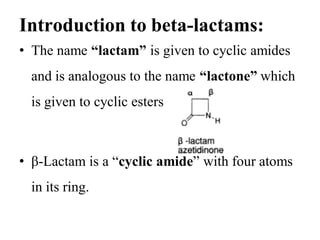
• The name “lactam” is given to cyclic amides
and is analogous to the name “lactone” which
is given to cyclic esters
• β-Lactam is a “cyclic amide” with four atoms
in its ring.
Introduction to beta-lactams:
• The “β-lactam” ring is the main part of
pharmacophore of these antibiotics.
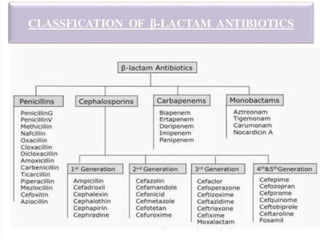
• β-Lactam antibiotics include two major,
widely used classes of antibiotics
1) Penicillins
2) Cephalosporins
Introduction to beta-lactams:
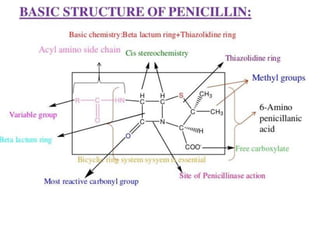
• The penicillins subclass of β-lactam antibiotics
is characterized by the presence of substituted
5-membered thiazolidine ring fused to the β-
lactam ring
• This fusion and chirality of the β-lactam ring
results in the molecule roughly possessing a
“V-Shape"
Introduction to beta-lactams:
• This drastically interferes with the planarity of
lactam bond and inhibits resonance of the
lactam nitrogen with its carbonyl group
• Consequently, the beta-lactam ring is more
reactive and more sensitive to nucleophilic
attack compared to normal planar amides
PENICILLINS
• Discovered by Alexander Fleming in 1928
• Was isolated from fungus Penicillium notatum
which is now known as Penicillium chrysogenum
• Florey and Chain isolated penicillin through freeze
drying and chromatography
• Penicillin was effective even when is was diluted
to 800 times
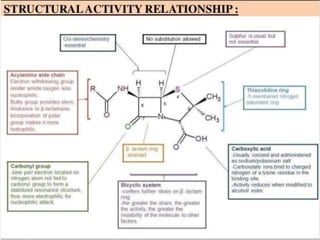
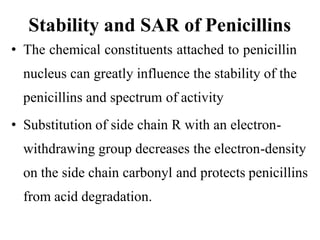
Stability and SAR of Penicillins
• The chemical constituents attached to penicillin
nucleus can greatly influence the stability of the
penicillins and spectrum of activity
• Substitution of side chain R with an electron-
withdrawing group decreases the electron-density
on the side chain carbonyl and protects penicillins
from acid degradation.
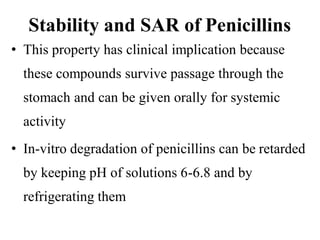
Stability and SAR of Penicillins
• This property has clinical implication because
these compounds survive passage through the
stomach and can be given orally for systemic
activity
• In-vitro degradation of penicillins can be retarded
by keeping pH of solutions 6-6.8 and by
refrigerating them
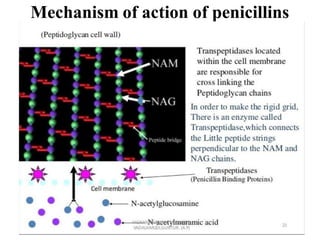
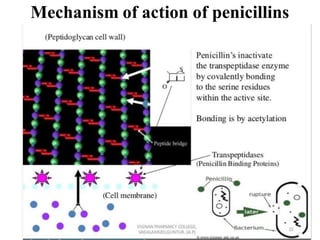
Mechanism of action of penicillins
Allergic reactions to Penicillins
• Allergy to penicillins is expressed as mild drug
rash or itching and is of delayed onset
• Occasionally the reaction is immediate and
profound
• It may include the cardiovascular collapse and
shock
• Topical wheal-and-flare test may be performed
Allergic reactions to Penicillins
• Erythromycin and clindamycin are useful
alternatives for therapy in many cases of penicillin
allergy
• Penicillins are prepared in facilities separate from
those used to prepare other drugs to prevent cross-
contamination and possible sensitization.
Allergic reactions to Penicillins
• The origin of allergy is hepatic reaction (formation of
antigenic penicilloyl proteins due to reaction of
nucleophilic group e.g. ε-Amino with β-lactam ring)
with host proteins and the responsible bond is in the
beta lactam ring
• Hence, this side effect is caused by the
pharmacophore and is unlikely to overcome with the
molecular manipulations.
Resistance to Penicillins
• The first mode of resistance is due to enzymatic
hydrolysis of the beta-lactam ring
• If the bacterium produces the enzymes beta-lactamase
or penicillinase, these enzymes will break open the
beta lactam ring rendering the antibiotic ineffective
• 2nd mode of beta-lactam resistance is due to possession
of altered penicillin-binding-proteins (PBPs)
Resistance to Penicillins
• Beta-lactams cannot bind effectively to these PBPs
as a result these antibiotics become less effective in
disrupting the cell wall
• Resistance to beta lactamase can be reduced by
carrying out some structural modifications in the
parent compound
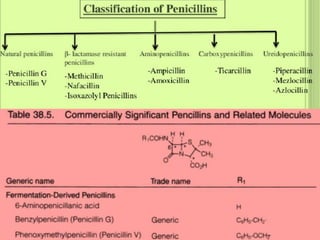
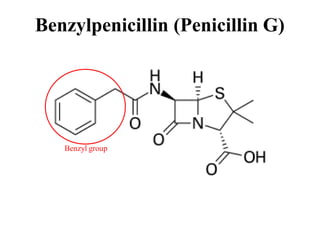
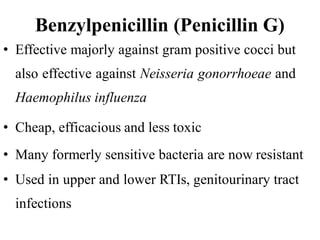
Benzylpenicillin (Penicillin G)
Benzyl group
Benzylpenicillin (Penicillin G)
• Effective majorly against gram positive cocci but
also effective against Neisseria gonorrhoeae and
Haemophilus influenza
• Cheap, efficacious and less toxic
• Many formerly sensitive bacteria are now resistant
• Used in upper and lower RTIs, genitourinary tract
infections
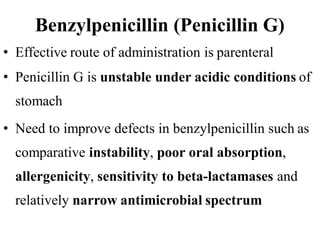
Benzylpenicillin (Penicillin G)
• Effective route of administration is parenteral
• Penicillin G is unstable under acidic conditions of
stomach
• Need to improve defects in benzylpenicillin such as
comparative instability, poor oral absorption,
allergenicity, sensitivity to beta-lactamases and
relatively narrow antimicrobial spectrum
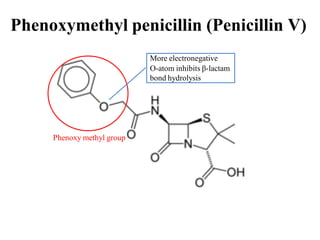
Phenoxymethyl penicillin (Penicillin V)
Phenoxy methyl group
More electronegative
O-atom inhibits β-lactam
bond hydrolysis
Phenoxymethyl penicillin (Penicillin V)
• Produced by bacteria in a medium rich in phenoxy
acetic acid
• Can also be prepared by semi-synthesis and is
comparatively more stable than penicillin G
• Stability is due to electronegative oxygen atom at
C-7 amide side chain inhibiting participation in
beta-lactam bond hydrolysis
Phenoxymethyl penicillin (Penicillin V)
• It was the first oral penicillin
• Antimicrobial spectrum is roughly same as that of
penicillin G
• Not used for acutely severe infections
• Same sensitivity to beta-lactamases as penicillin G
and almost same allergenicity
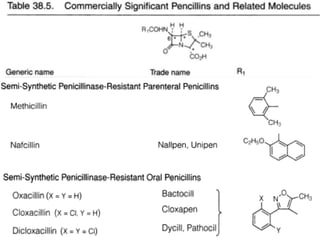
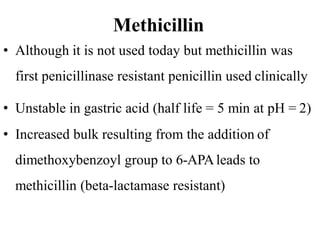
Methicillin
Dimethoxy benzoyl group
Methicillin
• Although it is not used today but methicillin was
first penicillinase resistant penicillin used clinically
• Unstable in gastric acid (half life = 5 min at pH = 2)
• Increased bulk resulting from the addition of
dimethoxybenzoyl group to 6-APAleads to
methicillin (beta-lactamase resistant)
Methicillin
• Methicillin has significantly narrower antimicrobial
spectrum so it was limited to use clinically only for
infections caused by beta-lactamase producing
Staphylococcus aureus and few other infections
• MRSA refers to methicillin resistant staphylococcus
aureus
• Resistance mechanism includes altered PBPs
Methicillin
• Methicillin is also an effective inducer of
penicillinases
• Methicillin has now been supplemented by a
number of agents
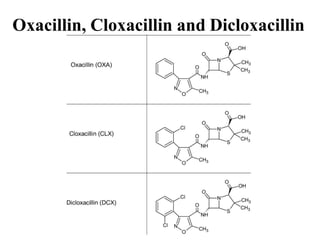
Oxacillin, Cloxacillin and Dicloxacillin
• They differ with reference to position of chlorine on
benzene ring
• They are somewhat more acid-stable with almost
same antimicrobial spectrum
• They do not cause production of beta-lactamase but
show activity against those bacteria who do produce
beta-lactamases
Oxacillin, Cloxacillin and Dicloxacillin
• Can be taken orally and are more potent
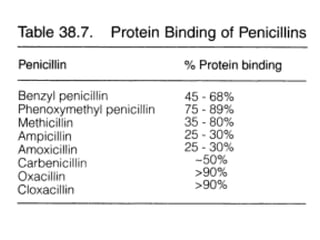
• Highly serum protein bound
• Not good choice for treatment of septicemia
• Microbes resistant to methicillin are also resistant to
isoxazolyl group of penicillins
• Used against Staphylococcus aureus
CEPHALOSPORINS
• These are beta lactam antibiotics isolated from
cephalosporium sp. and/or prepared synthetically
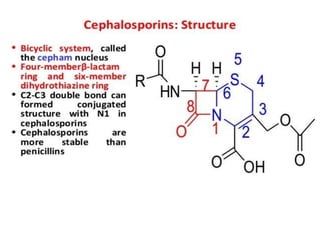
• These are in fact 7-cephalosporanic acid (7-ACA)
derivatives
• More acid-labile than corresponding 6-APAderivatives
• Mechanism of action is similar to penicillins i.e they
inhibit the cross-linking of peptidoglycan by inhibiting
the transpeptidase
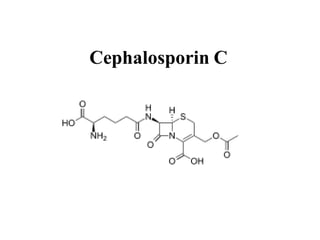
Cephalosporin C
CEPHALOSPORINS
• 7-ACA was derived from cephalosporin C and was
proved to be analogous to penicillin nucleus 6-APA
but was not sufficiently potent to be used clinically
• Modifications of 7-ACA produced useful antibiotic
agents
• First agent cephalothin was launched by Eli Lilly in
1954
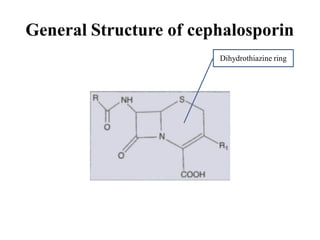
General Structure of cephalosporin
Dihydrothiazine ring
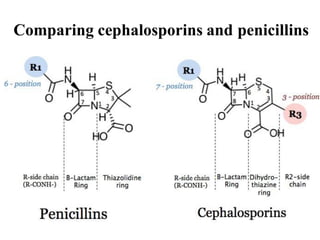
Comparing cephalosporins and penicillins
Degradation of cephalosporins
• Cephalosporins are more stable than penicillins
• Still undergo a variety of transformations
• The nature of reaction depends upon the side chain at
C-7 and substitution on C-3
• The presence of a good leaving group at C-3 facilitates
spontaneous expulsion of 3-subsituent either due to
hydrolysis of C-N bond of β-Lactam ring or by any
general nucleophile.
Degradation of cephalosporins
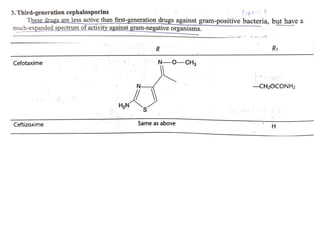
• Thus, desacetyl cefotaxime is more stable to hydrolysis than
cefotaxime
• absence of a good leaving group at C-3 makes them more
acid labile and makes them suitable for oral consumption
• Hence, cephalexin having methyl group at C-3 is much better
absorbed orally than cephaloglycin having acetoxymethyl
group at C-3 while both have same phenylglycyl side chains
at C-7
Degradation of cephalosporins
• The nature of substituent at C-7 determines the
facility with which the β-Lactam bond is
hydrolyzed or broken either by chemical or
enzymatic means of degradation of cephalosporin C
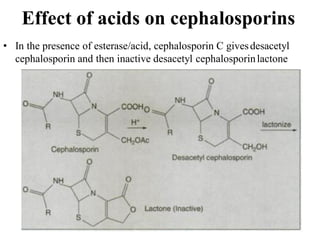
Effect of acids on cephalosporins
• In the presence of esterase/acid, cephalosporin C givesdesacetyl
cephalosporin and then inactive desacetyl cephalosporinlactone
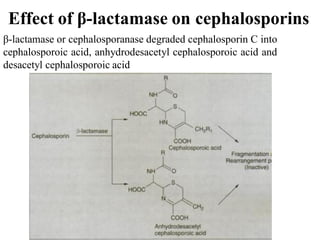
Effect of β-lactamase on cephalosporins
β-lactamase or cephalosporanase degraded cephalosporin C into
cephalosporoic acid, anhydrodesacetyl cephalosporoic acid and
desacetyl cephalosporoic acid
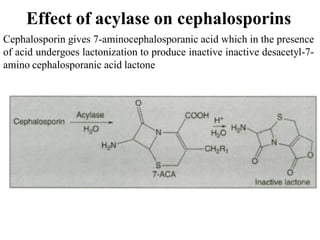
Effect of acylase on cephalosporins
Cephalosporin gives 7-aminocephalosporanic acid which in the presence
of acid undergoes lactonization to produce inactive inactive desacetyl-7-
amino cephalosporanic acid lactone
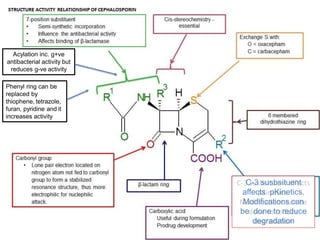
Acylation inc. g+ve
antibacterial activity but
reduces g-ve activity
Phenyl ring can be
replaced by
thiophene, tetrazole,
furan, pyridine and it
increases activity
C-3 susbsituent
affects pKinetics.
Modifications can
be done to reduce
degradation
Cefazolin
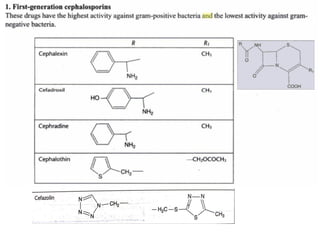
• Natural acetyl side chain is replaced by thio-linked
thiadiazole ring
• Although above group is good leaving group the drug is not
subjected to hydrolysis
• At C-7 is possesses tetrazoylmethylene unit
• Less irritant on injection and has longer half life
• It is comparatively unstable and should be protectedfrom
heat and light
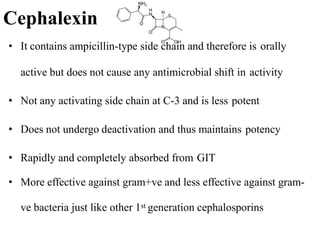
Cephalexin
• It contains ampicillin-type side chain and therefore is orally
active but does not cause any antimicrobial shift in activity
• Not any activating side chain at C-3 and is less potent
• Does not undergo deactivation and thus maintains potency
• Rapidly and completely absorbed from GIT
• More effective against gram+ve and less effective against gram-
ve bacteria just like other 1st generation cephalosporins
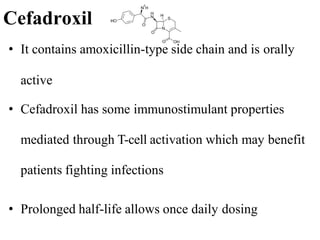
Cefadroxil
• It contains amoxicillin-type side chain and is orally
active
• Cefadroxil has some immunostimulant properties
mediated through T-cell activation which may benefit
patients fighting infections
• Prolonged half-life allows once daily dosing
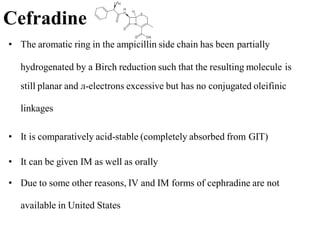
Cefradine
• The aromatic ring in the ampicillin side chain has been partially
hydrogenated by a Birch reduction such that the resulting molecule is
still planar and л-electrons excessive but has no conjugated oleifinic
linkages
• It is comparatively acid-stable (completely absorbed from GIT)
• It can be given IM as well as orally
• Due to some other reasons, IV and IM forms of cephradine are not
available in United States
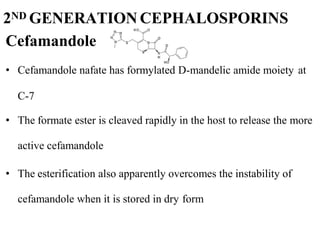
• Cefamandole nafate has formylated D-mandelic amide moiety at
C-7
• The formate ester is cleaved rapidly in the host to release the more
active cefamandole
• The esterification also apparently overcomes the instability of
cefamandole when it is stored in dry form
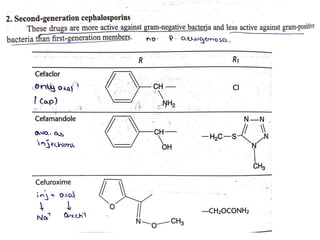
2ND GENERATION CEPHALOSPORINS
Cefamandole
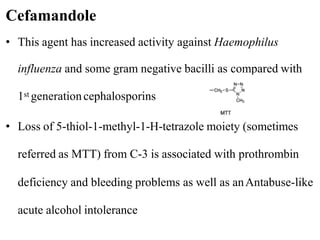
• This agent has increased activity against Haemophilus
influenza and some gram negative bacilli as compared with
1st generationcephalosporins
• Loss of 5-thiol-1-methyl-1-H-tetrazole moiety (sometimes
referred as MTT) from C-3 is associated with prothrombin
deficiency and bleeding problems as well as anAntabuse-like
acute alcohol intolerance
Cefamandole
• This group also enhances potency and prevents metabolism by
deacetylation
• Like other 2nd generation cephalosporins, cefamandole is more
active against gram negative bacteria
• Principle clinical use is for lower respiratory tract infections as
well as septicemia and UTIs, skin and skin structures, bone and
joint infections.
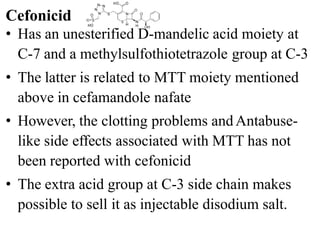
Cefamandole
• Has an unesterified D-mandelic acid moiety at
C-7 and a methylsulfothiotetrazole group at C-3
• The latter is related to MTT moiety mentioned
above in cefamandole nafate
• However, the clotting problems andAntabuse-
like side effects associated with MTT has not
been reported with cefonicid
• The extra acid group at C-3 side chain makes
possible to sell it as injectable disodium salt.
Cefonicid
• Pain and discomfort at injection site is experienced by
some of the patients
• Cefonicid has longer half-life than the other members
of this group
• The drug is somewhat unstable needs to be protected
from heat and sunlight and may yellow or darken
Cefonicid
• Kirby-Bauer disk testing may overestimate the
beta-lactamase producing bacteria to this agent, so
some extra precaution in interpretation of
laboratory results is required.
Cefonicid
An introductory chapter on antibiotics discuss beta lactam.

An introductory chapter on antibiotics discuss beta lactam.

  • 1.
    β-Lactam Antibiotics (Penicillins andCephalosporins) NasirAli Lecturer Pharmaceutical Chemistry
  • 2.
    Introduction to beta-lactams: •The name “lactam” is given to cyclic amides and is analogous to the name “lactone” which is given to cyclic esters • β-Lactam is a “cyclic amide” with four atoms in its ring.
  • 3.
    Introduction to beta-lactams: •The “β-lactam” ring is the main part of pharmacophore of these antibiotics. • β-Lactam antibiotics include two major, widely used classes of antibiotics 1) Penicillins 2) Cephalosporins
  • 4.
    Introduction to beta-lactams: •The penicillins subclass of β-lactam antibiotics is characterized by the presence of substituted 5-membered thiazolidine ring fused to the β- lactam ring • This fusion and chirality of the β-lactam ring results in the molecule roughly possessing a “V-Shape"
  • 5.
    Introduction to beta-lactams: •This drastically interferes with the planarity of lactam bond and inhibits resonance of the lactam nitrogen with its carbonyl group • Consequently, the beta-lactam ring is more reactive and more sensitive to nucleophilic attack compared to normal planar amides
  • 7.
    PENICILLINS • Discovered byAlexander Fleming in 1928 • Was isolated from fungus Penicillium notatum which is now known as Penicillium chrysogenum • Florey and Chain isolated penicillin through freeze drying and chromatography • Penicillin was effective even when is was diluted to 800 times
  • 14.
    Stability and SARof Penicillins • The chemical constituents attached to penicillin nucleus can greatly influence the stability of the penicillins and spectrum of activity • Substitution of side chain R with an electron- withdrawing group decreases the electron-density on the side chain carbonyl and protects penicillins from acid degradation.
  • 15.
    Stability and SARof Penicillins • This property has clinical implication because these compounds survive passage through the stomach and can be given orally for systemic activity • In-vitro degradation of penicillins can be retarded by keeping pH of solutions 6-6.8 and by refrigerating them
  • 17.
    Mechanism of actionof penicillins
  • 18.
    Mechanism of actionof penicillins
  • 19.
    Allergic reactions toPenicillins • Allergy to penicillins is expressed as mild drug rash or itching and is of delayed onset • Occasionally the reaction is immediate and profound • It may include the cardiovascular collapse and shock • Topical wheal-and-flare test may be performed
  • 20.
    Allergic reactions toPenicillins • Erythromycin and clindamycin are useful alternatives for therapy in many cases of penicillin allergy • Penicillins are prepared in facilities separate from those used to prepare other drugs to prevent cross- contamination and possible sensitization.
  • 21.
    Allergic reactions toPenicillins • The origin of allergy is hepatic reaction (formation of antigenic penicilloyl proteins due to reaction of nucleophilic group e.g. ε-Amino with β-lactam ring) with host proteins and the responsible bond is in the beta lactam ring • Hence, this side effect is caused by the pharmacophore and is unlikely to overcome with the molecular manipulations.
  • 22.
    Resistance to Penicillins •The first mode of resistance is due to enzymatic hydrolysis of the beta-lactam ring • If the bacterium produces the enzymes beta-lactamase or penicillinase, these enzymes will break open the beta lactam ring rendering the antibiotic ineffective • 2nd mode of beta-lactam resistance is due to possession of altered penicillin-binding-proteins (PBPs)
  • 23.
    Resistance to Penicillins •Beta-lactams cannot bind effectively to these PBPs as a result these antibiotics become less effective in disrupting the cell wall • Resistance to beta lactamase can be reduced by carrying out some structural modifications in the parent compound
  • 24.
  • 25.
    Benzylpenicillin (Penicillin G) •Effective majorly against gram positive cocci but also effective against Neisseria gonorrhoeae and Haemophilus influenza • Cheap, efficacious and less toxic • Many formerly sensitive bacteria are now resistant • Used in upper and lower RTIs, genitourinary tract infections
  • 26.
    Benzylpenicillin (Penicillin G) •Effective route of administration is parenteral • Penicillin G is unstable under acidic conditions of stomach • Need to improve defects in benzylpenicillin such as comparative instability, poor oral absorption, allergenicity, sensitivity to beta-lactamases and relatively narrow antimicrobial spectrum
  • 27.
    Phenoxymethyl penicillin (PenicillinV) Phenoxy methyl group More electronegative O-atom inhibits β-lactam bond hydrolysis
  • 28.
    Phenoxymethyl penicillin (PenicillinV) • Produced by bacteria in a medium rich in phenoxy acetic acid • Can also be prepared by semi-synthesis and is comparatively more stable than penicillin G • Stability is due to electronegative oxygen atom at C-7 amide side chain inhibiting participation in beta-lactam bond hydrolysis
  • 29.
    Phenoxymethyl penicillin (PenicillinV) • It was the first oral penicillin • Antimicrobial spectrum is roughly same as that of penicillin G • Not used for acutely severe infections • Same sensitivity to beta-lactamases as penicillin G and almost same allergenicity
  • 30.
  • 31.
    Methicillin • Although itis not used today but methicillin was first penicillinase resistant penicillin used clinically • Unstable in gastric acid (half life = 5 min at pH = 2) • Increased bulk resulting from the addition of dimethoxybenzoyl group to 6-APAleads to methicillin (beta-lactamase resistant)
  • 32.
    Methicillin • Methicillin hassignificantly narrower antimicrobial spectrum so it was limited to use clinically only for infections caused by beta-lactamase producing Staphylococcus aureus and few other infections • MRSA refers to methicillin resistant staphylococcus aureus • Resistance mechanism includes altered PBPs
  • 33.
    Methicillin • Methicillin isalso an effective inducer of penicillinases • Methicillin has now been supplemented by a number of agents
  • 34.
  • 35.
    Oxacillin, Cloxacillin andDicloxacillin • They differ with reference to position of chlorine on benzene ring • They are somewhat more acid-stable with almost same antimicrobial spectrum • They do not cause production of beta-lactamase but show activity against those bacteria who do produce beta-lactamases
  • 36.
    Oxacillin, Cloxacillin andDicloxacillin • Can be taken orally and are more potent • Highly serum protein bound • Not good choice for treatment of septicemia • Microbes resistant to methicillin are also resistant to isoxazolyl group of penicillins • Used against Staphylococcus aureus
  • 37.
    CEPHALOSPORINS • These arebeta lactam antibiotics isolated from cephalosporium sp. and/or prepared synthetically • These are in fact 7-cephalosporanic acid (7-ACA) derivatives • More acid-labile than corresponding 6-APAderivatives • Mechanism of action is similar to penicillins i.e they inhibit the cross-linking of peptidoglycan by inhibiting the transpeptidase
  • 38.
  • 39.
    CEPHALOSPORINS • 7-ACA wasderived from cephalosporin C and was proved to be analogous to penicillin nucleus 6-APA but was not sufficiently potent to be used clinically • Modifications of 7-ACA produced useful antibiotic agents • First agent cephalothin was launched by Eli Lilly in 1954
  • 42.
    General Structure ofcephalosporin Dihydrothiazine ring
  • 43.
  • 48.
    Degradation of cephalosporins •Cephalosporins are more stable than penicillins • Still undergo a variety of transformations • The nature of reaction depends upon the side chain at C-7 and substitution on C-3 • The presence of a good leaving group at C-3 facilitates spontaneous expulsion of 3-subsituent either due to hydrolysis of C-N bond of β-Lactam ring or by any general nucleophile.
  • 49.
    Degradation of cephalosporins •Thus, desacetyl cefotaxime is more stable to hydrolysis than cefotaxime • absence of a good leaving group at C-3 makes them more acid labile and makes them suitable for oral consumption • Hence, cephalexin having methyl group at C-3 is much better absorbed orally than cephaloglycin having acetoxymethyl group at C-3 while both have same phenylglycyl side chains at C-7
  • 50.
    Degradation of cephalosporins •The nature of substituent at C-7 determines the facility with which the β-Lactam bond is hydrolyzed or broken either by chemical or enzymatic means of degradation of cephalosporin C
  • 51.
    Effect of acidson cephalosporins • In the presence of esterase/acid, cephalosporin C givesdesacetyl cephalosporin and then inactive desacetyl cephalosporinlactone
  • 52.
    Effect of β-lactamaseon cephalosporins β-lactamase or cephalosporanase degraded cephalosporin C into cephalosporoic acid, anhydrodesacetyl cephalosporoic acid and desacetyl cephalosporoic acid
  • 53.
    Effect of acylaseon cephalosporins Cephalosporin gives 7-aminocephalosporanic acid which in the presence of acid undergoes lactonization to produce inactive inactive desacetyl-7- amino cephalosporanic acid lactone
  • 54.
    Acylation inc. g+ve antibacterialactivity but reduces g-ve activity Phenyl ring can be replaced by thiophene, tetrazole, furan, pyridine and it increases activity C-3 susbsituent affects pKinetics. Modifications can be done to reduce degradation
  • 55.
    Cefazolin • Natural acetylside chain is replaced by thio-linked thiadiazole ring • Although above group is good leaving group the drug is not subjected to hydrolysis • At C-7 is possesses tetrazoylmethylene unit • Less irritant on injection and has longer half life • It is comparatively unstable and should be protectedfrom heat and light
  • 56.
    Cephalexin • It containsampicillin-type side chain and therefore is orally active but does not cause any antimicrobial shift in activity • Not any activating side chain at C-3 and is less potent • Does not undergo deactivation and thus maintains potency • Rapidly and completely absorbed from GIT • More effective against gram+ve and less effective against gram- ve bacteria just like other 1st generation cephalosporins
  • 57.
    Cefadroxil • It containsamoxicillin-type side chain and is orally active • Cefadroxil has some immunostimulant properties mediated through T-cell activation which may benefit patients fighting infections • Prolonged half-life allows once daily dosing
  • 58.
    Cefradine • The aromaticring in the ampicillin side chain has been partially hydrogenated by a Birch reduction such that the resulting molecule is still planar and л-electrons excessive but has no conjugated oleifinic linkages • It is comparatively acid-stable (completely absorbed from GIT) • It can be given IM as well as orally • Due to some other reasons, IV and IM forms of cephradine are not available in United States
  • 59.
    • Cefamandole nafatehas formylated D-mandelic amide moiety at C-7 • The formate ester is cleaved rapidly in the host to release the more active cefamandole • The esterification also apparently overcomes the instability of cefamandole when it is stored in dry form 2ND GENERATION CEPHALOSPORINS Cefamandole
  • 60.
    • This agenthas increased activity against Haemophilus influenza and some gram negative bacilli as compared with 1st generationcephalosporins • Loss of 5-thiol-1-methyl-1-H-tetrazole moiety (sometimes referred as MTT) from C-3 is associated with prothrombin deficiency and bleeding problems as well as anAntabuse-like acute alcohol intolerance Cefamandole
  • 61.
    • This groupalso enhances potency and prevents metabolism by deacetylation • Like other 2nd generation cephalosporins, cefamandole is more active against gram negative bacteria • Principle clinical use is for lower respiratory tract infections as well as septicemia and UTIs, skin and skin structures, bone and joint infections. Cefamandole
  • 62.
    • Has anunesterified D-mandelic acid moiety at C-7 and a methylsulfothiotetrazole group at C-3 • The latter is related to MTT moiety mentioned above in cefamandole nafate • However, the clotting problems andAntabuse- like side effects associated with MTT has not been reported with cefonicid • The extra acid group at C-3 side chain makes possible to sell it as injectable disodium salt. Cefonicid
  • 63.
    • Pain anddiscomfort at injection site is experienced by some of the patients • Cefonicid has longer half-life than the other members of this group • The drug is somewhat unstable needs to be protected from heat and sunlight and may yellow or darken Cefonicid
  • 64.
    • Kirby-Bauer disktesting may overestimate the beta-lactamase producing bacteria to this agent, so some extra precaution in interpretation of laboratory results is required. Cefonicid